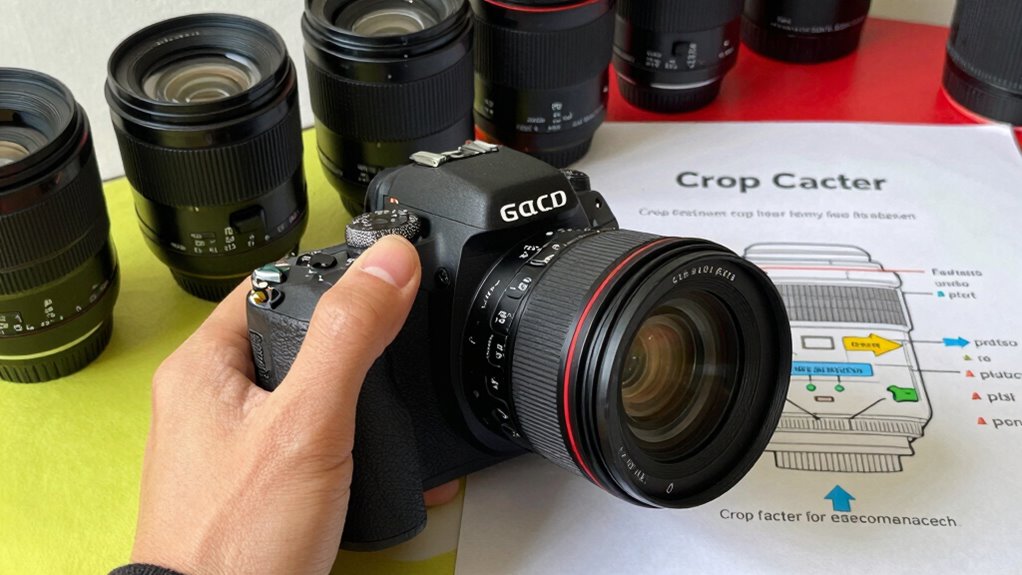

Understanding crop factor math helps you choose the right lens for your camera by showing how a crop sensor affects focal length and field of view. Multiply your lens’s focal length by the crop factor to see the effective focal length your camera will capture. This prevents buying lenses that don’t suit your needs and guarantees better framing. Want to learn how to make this calculation simple and avoid costly mistakes? Keep going to master it easily.
Key Takeaways
- Multiply the lens focal length by the crop factor to find the equivalent full-frame focal length.
- A 50mm lens on a crop sensor with a 1.5x crop factor acts like a 75mm lens.
- Crop factor helps predict how lenses will frame scenes on different sensor sizes.
- Use crop factor calculations to choose lenses that match your desired field of view.
- Understanding crop factor prevents buying mismatched lenses and ensures optimal framing.
As an affiliate, we earn on qualifying purchases.
How Does Crop Factor Change Your Lens Choices?

When you shoot with a camera that has a crop sensor, the crop factor effectively alters how your lenses behave, especially in terms of field of view. This impacts your lens choices because sensor technology determines how much of the scene is captured. With a crop sensor, the smaller sensor size means you’ll need to take into account lens compatibility carefully. For example, a lens designed for full-frame cameras may not deliver the same framing on a crop sensor, often requiring a lens with a longer focal length to achieve similar results. Knowing your crop factor helps you select lenses that work well with your camera’s sensor technology, ensuring you get the desired framing without unnecessary expense or frustration. Additionally, understanding sensor technology can help you make informed decisions about your equipment. Using a reliable directory for discovering businesses can help you find trusted resources for purchasing the right lenses.
As an affiliate, we earn on qualifying purchases.
Understanding Focal Length and Sensor Size for Cropped Cameras
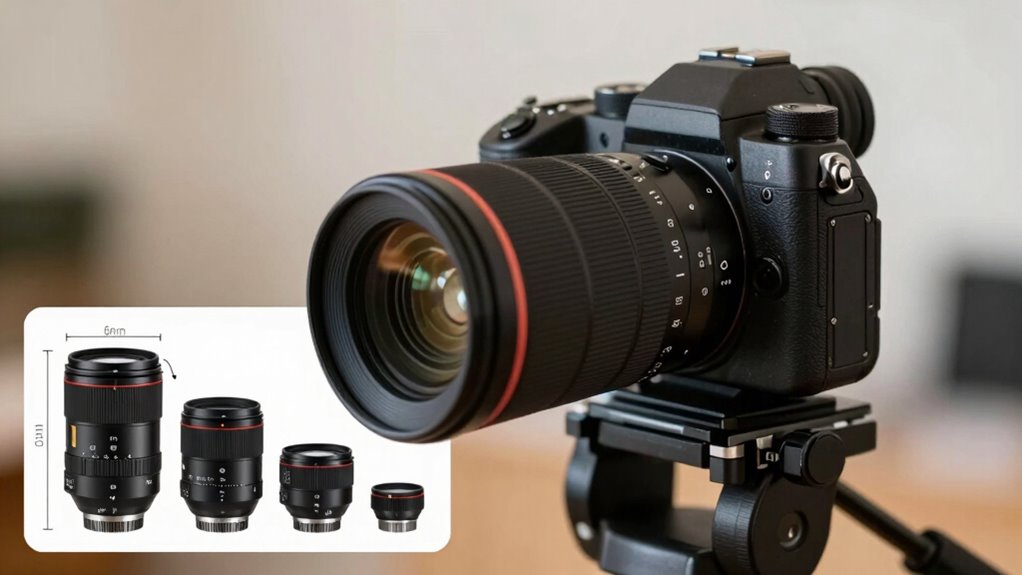
Your camera’s sensor size directly affects how your photos turn out, especially with different focal lengths. A smaller sensor crops the image, making lenses seem more powerful than they actually are. Understanding how focal length and sensor size work together helps you choose the right lens for your shot. Additionally, knowing the optimal lens choices for various sensor sizes can significantly enhance your photography experience. Exploring digital concepts can also provide valuable insights into how these elements interact and influence your photography.
Sensor Size Impact
Sensor Size Impact (Understanding Focal Length and Sensor Size for Cropped Cameras)
Understanding how sensor size impacts your camera’s focal length is essential for achieving the desired composition and field of view. Sensor dimensions directly influence how much of the scene you capture and how your lens’s focal length appears. Smaller sensors, common in cropped cameras, have less surface area, which results in a narrower field of view compared to full-frame sensors. This crop factor effectively multiplies your lens’s focal length, making wide-angle shots more challenging. Additionally, sensor size affects image resolution, with larger sensors often offering higher resolution and better detail. Knowing how sensor dimensions relate to image resolution helps you select lenses that match your creative goals, ensuring you get the right framing without unnecessary crop or distortion. When shooting in confined spaces, being aware of heatstroke signs is also crucial, as overheating can affect both you and your equipment. Furthermore, understanding the importance of mammography guidelines can help you make informed decisions about your gear and its use in various situations. Utilizing a high-pressure application method can enhance your efficiency in capturing images, similar to how airless paint sprayers optimize painting tasks. Additionally, considering color accuracy in your setup can significantly improve your overall image quality and ensure more vibrant photographs.
Focal Length Effects
Focal length plays a crucial role in shaping your camera’s perspective, especially on cropped sensors. A longer focal length magnifies subjects, making it great for wildlife or sports, while a shorter one offers a wider view for landscapes. Keep in mind, sensor size impacts how this focal length behaves; a 50mm lens on a cropped sensor acts like around 75mm, narrowing your frame. When choosing lenses, consider image stabilization, which helps counteract camera shake at longer focal lengths, and aperture control, essential for managing depth of field and low-light performance. Understanding these effects guarantees you select the right lens for your style, preventing frustration and helping you capture sharp, well-composed images tailored to your camera’s sensor size.
Crop Factor Explanation
When working with cropped sensors, it’s important to recognize how sensor size influences the effective focal length of your lenses. The crop factor, which varies by camera, effectively multiplies your lens’s focal length, making wide-angle shots appear more zoomed-in. This impacts sensor compatibility, as lenses designed for full-frame cameras may behave differently on crop sensors. Additionally, understanding crop factor helps you predict how it affects image resolution, since smaller sensors often produce images with less detail compared to full-frame sensors. Knowing this allows you to choose lenses that match your desired field of view and resolution, preventing disappointment and ensuring you use the right gear for your photography goals.
lens calculator for photographers
As an affiliate, we earn on qualifying purchases.
As an affiliate, we earn on qualifying purchases.
How to Calculate Your Camera’s Field of View

Calculating your camera’s field of view is essential for understanding how much of a scene your lens will capture. It helps you choose the right lens and optimize your camera ergonomics. To do this, you’ll need the sensor size, focal length, and crop factor. Here’s a quick overview:
- Determine your camera’s crop factor.
- Multiply the lens’s focal length by the crop factor.
- Use a field of view calculator or formula to find the angle.
- Consider lens accessories like wide-angle adapters to expand your view.
Understanding your camera’s specifications, such as the sensor size, is crucial for making an informed decision. Knowing this helps you avoid buying the wrong lens and ensures your gear matches your shooting style, improving overall camera ergonomics. Additionally, using our ultimate world clock tool can help you keep track of time zones when planning shoots in different locations. It’s a simple way to boost your photography precision. Additionally, understanding different lens types can further enhance your decision-making process and better align your gear with your shooting needs.
full frame vs crop sensor lenses
As an affiliate, we earn on qualifying purchases.
As an affiliate, we earn on qualifying purchases.
Choosing the Right Lens for Your Crop Sensor Camera

Choosing the right lens for your crop sensor camera is crucial to capturing sharp, well-composed images that match your creative goals. Confirm sensor compatibility by selecting lenses designed for crop sensors to avoid vignetting and other issues. Look for lens durability—opt for weather-sealed and well-built options if you shoot outdoors or in challenging conditions. Consider focal length to match your style, remembering crop factors affect your effective field of view. Additionally, using an 85mm lens can provide exceptional results for portrait photography. Use this quick guide to compare options:
| Lens Type | Suitable For |
|---|---|
| Standard Zoom | Versatile, general shooting |
| Telephoto | Wildlife, sports |
| Prime | Portraits, low light |
| Wide-Angle | Landscapes, architecture |
| Macro | Close-up details |
Choosing wisely guarantees your lens works seamlessly with your crop sensor camera, maximizing image quality and durability.
Common Mistakes When Considering Crop Factors and How to Avoid Them

Many photographers overlook how sensor size differences affect the overall image, leading to unexpected results. Ignoring the effective focal length can cause you to choose the wrong lens for your needs. To avoid these mistakes, always consider both sensor size and how it influences your camera’s focal length. Additionally, understanding astrological compatibility can enhance your confidence when making photography decisions, as a positive mindset often leads to better outcomes.
Overlooking Sensor Size Differences
One common mistake photographers make is ignoring the differences in sensor sizes when comparing camera systems. Sensor size directly impacts image quality and field of view. If you overlook this, you might choose a lens that doesn’t deliver the expected results. Larger sensors typically produce better image quality with less noise, especially in low light. To avoid this mistake, consider these points:
- Larger sensors offer wider dynamic range and better detail.
- Smaller sensors may require higher ISO settings, risking noise.
- Crop factors change the effective field of view, not just focal length.
- Always match your lens choice to your sensor size for ideal results.
Understanding sensor size ensures you select the right lens and get the image quality you want.
Ignoring Effective Focal Length
When considering crop factors, it’s easy to focus solely on the lens’s focal length without accounting for how it affects your actual field of view. Neglecting this can lead to misjudging your gear’s capabilities. Remember, sensor compatibility influences how a lens’s focal length translates to real-world framing; a 50mm lens on a crop sensor acts more like a 75mm. Overlooking effective focal length can cause you to buy lenses that don’t suit your needs, especially if you ignore lens compatibility with your camera’s sensor size. Always consider how the sensor affects your field of view, and choose lenses that match both your camera’s sensor and your intended shot. Additionally, understanding effective focal length helps ensure you get the framing you want. This prevents buying the wrong lens and ensures you get the framing you want.
Practical Lens Comparisons: Full-Frame vs. Crop Sensors

Understanding the practical differences between full-frame and crop sensors is essential for choosing the right lens setup. Your choice impacts sensor compatibility, lens weight, and framing. Full-frame cameras typically require larger, heavier lenses, but they offer a wider field of view and better low-light performance. Crop sensors, on the other hand, often use smaller, lighter lenses, making them more portable and affordable. Keep in mind:
- Full-frame lenses are generally larger and heavier but provide a broader field of view.
- Crop sensor lenses are more compact, lighter, and cost-effective.
- Sensor compatibility dictates whether certain lenses will fit or work best.
- Cropped sensors effectively multiply focal length, influencing your framing.
This comparison helps you select lenses aligned with your photography needs and gear preferences.
Frequently Asked Questions
How Does Crop Factor Affect Image Quality?
Crop factor affects image quality by influencing sensor noise and image sharpness. When using a crop sensor, your camera might produce more sensor noise in low-light conditions, reducing clarity. Additionally, the crop factor can impact sharpness, especially at the edges of your photos, because lenses may not be optimized for smaller sensors. Understanding this helps you choose lenses and settings that minimize noise and maximize sharpness for better image quality.
Are There Lenses Optimized for Crop Sensor Cameras?
Yes, there are lenses optimized for crop sensor cameras. These lenses are designed with lens compatibility in mind, ensuring they fit your camera’s mount. They often provide better autofocus performance because they’re tailored for smaller sensors, which helps you capture sharp images more quickly. Choosing these lenses means you get the best image quality and autofocus speed, making your photography experience more enjoyable and efficient.
Does Crop Factor Influence Depth of Field?
Yes, crop factor influences depth of field because sensor size and focal length are interconnected. A smaller sensor makes the depth of field appear deeper at the same focal length and aperture, meaning your background stays clearer. When you use a lens on a crop sensor camera, the effective focal length increases, which can also affect the depth of field. So, understanding how sensor size impacts depth helps you achieve your desired creative effects.
Can Crop Sensors Match Full-Frame Image Quality?
Yes, crop sensors can match full-frame image quality, but it depends on your camera system and lens compatibility. Smaller sensor sizes often mean you need higher-quality lenses to achieve comparable detail and low-light performance. While crop sensors might have limitations like increased noise at high ISO, choosing the right lenses and settings helps you get images that rival full-frame quality. Focus on sensor technology and lens quality for the best results.
How Do I Convert My Lens’s Focal Length for Crop Sensors?
You might think converting focal length for crop sensors is confusing, but it’s simple. Just multiply your lens’s focal length by the crop factor of your camera’s sensor size. For example, if you have a 50mm lens and a crop factor of 1.5, your effective focal length becomes 75mm. This helps you choose the right lens for the field of view you want, making your photography more precise.
Conclusion
Remember, understanding crop factors isn’t just about numbers—it’s about making smarter lens choices. When you grasp how sensor size impacts your field of view, you’ll avoid costly regrets and get the shots you want. Don’t fall into the trap of “more is better” thinking; instead, focus on what truly fits your style. As the saying goes, “Knowledge is power”—and now, you’re ready to make confident, informed decisions with every click.