
The Ray-Ban Meta Gen 2 Wayfarer is my best overall pick among the best intelligent smart glasses because it combines a recognizable frame, an established AI platform, and practical camera and audio features. The Ray-Ban Meta Gen 1 Wayfarer offers a more value-focused route into the same ecosystem, while the OHO Smart AI Glasses make more sense for beginners who mainly want audio and calling. The biggest choice is between polished software and ambitious feature lists, since many lesser-known models advertise translation, object recognition, or 4K recording without matching Meta’s platform maturity. Buyers must also weigh camera quality against privacy, open-ear audio against sound leakage, and photochromic convenience against frame weight. Continue reading for my full breakdown of which designs suit different budgets, faces, and AI priorities.

Get the latest gadgets delivered free with Prime
- Fast, free delivery on millions of items
- Prime Video, Amazon Music and more included
- Member-only deals all year
Complete the kit



Key Takeaways
- I rank the Ray-Ban Meta Gen 2 Wayfarer first because its combination of AI software, camera functions, and wearable styling is more balanced than the feature-heavy alternatives.
- The roundup separates into two groups: established Meta models with a clearer ecosystem and generic AI glasses that compete through translation, object recognition, and higher claimed video resolution.
- A 4K specification alone did not secure a top position; app quality, stabilization, storage, microphones, and export reliability can matter more than the resolution printed on a listing.
- The OHO audio-focused glasses are the simplest entry point for calls and music, but buyers seeking a camera, scene recognition, or visual AI should move higher in the ranking.
- Photochromic lenses appear throughout this lineup, yet lens versatility does not equal AI capability; I gave more weight to assistant access, phone dependence, controls, privacy feedback, and likely daily comfort.
| AI Smart Glasses with Language Translation, Photochromic Lenses, and AI Assistant |  | Best Overall for Translation | Languages Supported: 164 | Battery Capacity: 110mAh per battery | Battery Life: 8 hours music playback; 7 days standby | VIEW LATEST PRICE | See Our Full Breakdown |
| AI Smart Glasses Color-Change Lens with Translation, Music, and Hands-Free Calls – Black |  | Best Adjustable Tint | Tint Control: 4 brightness levels | Translation Languages: 164 | Battery Capacity: 110mAh | VIEW LATEST PRICE | See Our Full Breakdown |
| AI Smart Glasses with ChatGPT & Real-Time Translation, Bluetooth Audio, Photochromic Lenses, Metal Frame |  | Best Camera-Free Work Pair | Weight: 32g | Battery Life: Up to 6 hours | Bluetooth Version: 5.4 | VIEW LATEST PRICE | See Our Full Breakdown |
| AI Smart Glasses with Camera, 8MP HD, 1080P Video, Real-Time Translation, Voice Assistant, Object Recognition, Bluetooth Sunglasses for Men & Women |  | Best for AI Object Recognition | Camera Resolution: 8MP | Video Resolution: 1080p | Battery Capacity: 290mAh | VIEW LATEST PRICE | See Our Full Breakdown |
| AI Smart Glasses with Camera, 4K Video & Photo Capture, Real-Time Translation, Open-Ear Bluetooth Audio, Photochromic Lenses |  | Best for 4K Hands-Free Capture | Camera: 4K | Video Stabilization: EIS anti-shake | Audio: Open-ear Bluetooth with HD stereo sound | VIEW LATEST PRICE | See Our Full Breakdown |
| AI Smart Glasses with 8MP Camera and 4K Video |  | Best for Multilingual Travel | Camera resolution: 8MP | Video resolution: 4K | Video recording time: Up to 80 minutes | VIEW LATEST PRICE | See Our Full Breakdown |
| Ray-Ban Meta Gen 1 Wayfarer Smart AI Glasses |  | Best for Classic Style | Generation: Gen 1 | Frame style: Wayfarer | Frame finish: Matte Black | VIEW LATEST PRICE | See Our Full Breakdown |
| AI Smart Glasses with 4K Camera and IP65 Protection |  | Best for Wet-Weather Use | Camera resolution: 4K | Battery capacity: 290mAh | Protection rating: IP65 | VIEW LATEST PRICE | See Our Full Breakdown |
| Meta Fury Smart AI Glasses |  | Best for Clear Hands-Free Calls | Camera: 12MP | Video resolution: 3K HD | Battery life: More than 8 hours | VIEW LATEST PRICE | See Our Full Breakdown |
| Ray-Ban Meta Gen 2 Wayfarer Smart AI Glasses |  | Best Overall | Generation: Gen 2 | Frame: Wayfarer, Matte Black | Camera: 12MP ultra-wide | VIEW LATEST PRICE | See Our Full Breakdown |
| AI Smart Glasses with 8MP Camera and 4K Video | 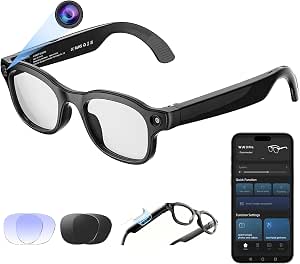 | Best for High-Resolution Capture | Camera: 8MP | Photo Output: Up to 32MP with anti-shake, HDR, and noise reduction | Video Resolution: 4K | VIEW LATEST PRICE | See Our Full Breakdown |
| 2026 AI Smart Glasses with Translation and Photochromic Lenses |  | Best Lightweight Translator | Translation Languages: 164 | Lens Type: Photochromic | Lens Protection: UV protection and blue-light filtering | VIEW LATEST PRICE | See Our Full Breakdown |
| OHO Smart AI Glasses with Bluetooth Audio |  | Best for All-Day Audio | Lens Thickness: 2.0mm | Lens Type: Photochromic | Lens Protection: Blue-light blocking | VIEW LATEST PRICE | See Our Full Breakdown |
| AI Smart Glasses with ChatGPT and Real-Time Translation |  | Best for Work and Meetings | AI Assistant: ChatGPT-powered voice assistant | Translation Coverage: More than 160 languages | Translation Modes: Real-time voice, video, and photo translation | VIEW LATEST PRICE | See Our Full Breakdown |
| Ray-Ban Meta Skyler Smart AI Glasses |  | Best Design and Social Capture | Camera: 12MP ultra-wide | Audio: Open-ear speakers | AI Assistant: Meta AI | VIEW LATEST PRICE | See Our Full Breakdown |
| intelligent smart glasse | Battery Life |
|---|---|
| AI Smart Glasses with Language | 8 hours music playback; 7 days standby |
| AI Smart Glasses Color-Change | 4–6 hours playback; 7 days standby |
| AI Smart Glasses with ChatGPT | Up to 6 hours |
| AI Smart Glasses with Camera | Up to 7 hours music playback; 7 days standby |
| AI Smart Glasses with Camera | — |
| AI Smart Glasses with 8MP Came | — |
| Ray-Ban Meta Gen 1 Wayfarer Sm | — |
| AI Smart Glasses with 4K Camer | — |
| Meta Fury Smart AI Glasses | More than 8 hours |
| Ray-Ban Meta Gen 2 Wayfarer Sm | Up to 8 hours |
| AI Smart Glasses with 8MP Came | — |
| 2026 AI Smart Glasses with Tra | 4–7 hours |
| OHO Smart AI Glasses with Blue | Up to 10 hours |
| AI Smart Glasses with ChatGPT | — |
| Ray-Ban Meta Skyler Smart AI G | — |
More Details on Our Top Picks
AI Smart Glasses with Language Translation, Photochromic Lenses, and AI Assistant
I rank AI Smart Glasses with Language Translation, Photochromic Lenses, and AI Assistant highest for multilingual buyers because its 164-language translation without a subscription is paired with IP67 protection and eight-hour music playback. That combination makes it more travel-ready than the AI Smart Glasses Color-Change Lens model, which lacks water resistance and lasts only four to six hours. Photochromic polarized lenses also reduce the need to swap between indoor glasses and sunglasses, while open-ear audio keeps nearby sounds audible. The tradeoff is specialization: there is no camera for recording or object recognition, unlike the 8MP HD Camera model. I would also check the fit carefully, since the adjustable frame is designed around Western facial structures and may sit poorly on some faces.
Pros:- Translates 164 languages without a subscription
- IP67 protection is stronger than the weather resistance offered by most alternatives in this batch
- Photochromic polarized lenses adapt to changing outdoor light
- Eight-hour music playback and fast magnetic charging support longer travel days
Cons:- No camera for photo capture, video, or visual recognition
- Full smart functionality depends on a Bluetooth-connected device
- Frame geometry may not fit every face shape comfortably
Best for: Frequent international travelers who prioritize broad, subscription-free translation, weather resistance, and longer audio playback over camera capture
Not ideal for: Buyers who need hands-free photos or object recognition, or whose facial proportions may not suit a Western-oriented frame
- Languages Supported:164
- Battery Capacity:110mAh per battery
- Battery Life:8 hours music playback; 7 days standby
- Charging Time:1.5 hours
- Water Resistance:IP67
- Connectivity:Bluetooth 5.4
- Lens Technology:Photochromic polarized
- Frame Material:TR90
- Frame Fit:Adjustable for Western facial structures
Our verdict“I recommend this model to translation-first travelers who want stronger weather protection and battery life without paying for camera hardware.”
AI Smart Glasses Color-Change Lens with Translation, Music, and Hands-Free Calls – Black
AI Smart Glasses Color-Change Lens with Translation, Music, and Hands-Free Calls earns its place through four selectable tint levels, giving commuters and mixed indoor-outdoor users more control than the automatic photochromic lenses on the Language Translation and AI Assistant model. Its 164-language coverage, voice control, and one-hour charging time create a practical everyday package for calls, audio, and short translation sessions. I rank it below that rival for travel, however, because playback falls to four to six hours and there is no water resistance; rain or strenuous outdoor use poses a real limitation. Translation also relies on a smartphone app, so this is not a self-contained interpreter. Buyers who value deliberate lens control may accept those compromises, while camera seekers should move to the 8MP HD Camera model.
Pros:- Four tint levels provide more direct light control than automatic-only lenses
- Translation covers 164 languages
- One-hour charging is the fastest stated charging time in this batch
- Supports voice control, music, and hands-free calls on iOS and Android
Cons:- No water resistance makes it a poor match for rain or wet outdoor settings
- Four-to-six-hour playback may not cover a full travel day
- Translation requires a smartphone app
Best for: Urban commuters and business travelers who move between changing light conditions and want manual tint control with multilingual assistance
Not ideal for: Hikers, cyclists, and all-day travelers who need rain protection, longer playback, or translation without a phone app
- Tint Control:4 brightness levels
- Translation Languages:164
- Battery Capacity:110mAh
- Battery Life:4–6 hours playback; 7 days standby
- Charging Time:1 hour
- Connectivity:Bluetooth
- Water Resistance:None
- Compatibility:iOS and Android
Our verdict“I would choose this pair for controllable tint and short daily trips, but not for wet conditions or phone-free travel.”
AI Smart Glasses with ChatGPT & Real-Time Translation, Bluetooth Audio, Photochromic Lenses, Metal Frame
I see AI Smart Glasses with ChatGPT & Real-Time Translation as the strongest camera-free choice for meetings, office tasks, and discreet voice assistance. The 32g metal-and-TR90 construction is lighter than the 40.8g AI Smart Glasses with Camera, 8MP HD, while ChatGPT support and translation across more than 160 languages keep the focus on communication rather than recording. That absence of a camera may also feel less intrusive around colleagues. Open-ear audio preserves awareness during calls, and photochromic lenses add outdoor flexibility. Still, the six-hour battery trails the eight-hour music rating of the Language Translation and AI Assistant model. The lenses also rely on UV exposure, so they generally will not darken inside a vehicle. I would skip this pair if visual documentation or object recognition is part of the job.
Pros:- ChatGPT voice and meeting assistance support work-focused use
- 32g construction is the lightest camera-free design in this batch
- Translation supports more than 160 languages
- Metal frame offers a more polished appearance than all-TR90 alternatives
Cons:- No camera for recording, photography, or object recognition
- Six-hour battery rating trails the leading audio-focused model
- Photochromic lenses usually remain light inside vehicles
Best for: Office workers and multilingual professionals who want lightweight AI voice support without wearing a camera around colleagues
Not ideal for: Drivers expecting lenses to darken behind a windshield and field workers who need visual documentation or object recognition
- Weight:32g
- Battery Life:Up to 6 hours
- Bluetooth Version:5.4
- Lens Type:Photochromic
- Lens Protection:UV and blue light protection
- Frame Material:Metal
- Temple Material:TR90
- Translation:More than 160 languages
Our verdict“I favor this model for camera-conscious professionals who want a light frame, broad translation, and voice-based AI assistance.”
AI Smart Glasses with Camera, 8MP HD, 1080P Video, Real-Time Translation, Voice Assistant, Object Recognition, Bluetooth Sunglasses for Men & Women
AI Smart Glasses with Camera, 8MP HD is my pick for buyers who want visual AI tools without moving to the highest-resolution camera. Its object recognition and real-time translation can help with travel, field tasks, and identifying unfamiliar items, while the 8MP sensor records stabilized 1080p footage. Compared with the 4K Camera and Photo Capture model, video detail is lower and the 40.8g frame is heavier, but this pair supplies clearer battery expectations: up to seven hours of music and seven days of standby. Bluetooth 5.4 plus Wi-Fi also gives it broader stated connectivity. IP65 protection suits dust and light rain, though it is weaker than the IP66 rating of the 4K model. Photochromic response may slow in winter or indoors, and intensive camera use can shorten runtime.
Pros:- 8MP camera records stabilized 1080p video
- Object recognition adds practical visual intelligence beyond audio-only models
- Bluetooth 5.4 and Wi-Fi provide flexible connectivity
- Seven-hour music rating offers a stated benchmark for daily use
Cons:- 1080p capture has less detail than the competing 4K model
- 40.8g weight is heavier than the 35g and 32g alternatives
- Photochromic darkening can be slow indoors, in vehicles, or during low-UV winter conditions
Best for: Travelers and field workers who need object recognition, translated interactions, and dependable 1080p hands-free documentation
Not ideal for: Video creators who prioritize 4K detail or buyers who want the lightest frame and stronger protection from water
- Camera Resolution:8MP
- Video Resolution:1080p
- Battery Capacity:290mAh
- Battery Life:Up to 7 hours music playback; 7 days standby
- Weight:40.8g
- Waterproof Rating:IP65
- Frame Material:TR90
- Lens Type:Photochromic
- Connectivity:Bluetooth 5.4 and Wi-Fi
Our verdict“I recommend this pair for practical visual assistance and 1080p documentation when object recognition matters more than maximum camera resolution.”
AI Smart Glasses with Camera, 4K Video & Photo Capture, Real-Time Translation, Open-Ear Bluetooth Audio, Photochromic Lenses
I place AI Smart Glasses with Camera, 4K Video & Photo Capture first for recording detail. Its 4K camera with electronic stabilization is better suited to sports clips, travel footage, and work documentation than the 1080p output of the 8MP HD Camera model. It is also lighter at 35g and carries stronger IP66 protection, which makes active outdoor use more convincing. ChatGPT voice support, translation in more than 139 languages, and open-ear stereo audio broaden its use beyond recording. The missing details matter, though: the listing gives a 290mAh capacity but no runtime, storage figure, or stated connectivity version. Translation coverage is also narrower than the 164-language audio-first options. I would choose it for capture quality, but buyers seeking predictable endurance or well-documented storage should favor a more transparent alternative.
Pros:- 4K capture provides more recording detail than the 1080p camera model
- Electronic image stabilization helps reduce motion in hands-free footage
- 35g frame is relatively light for camera-equipped glasses
- IP66 protection is the strongest rating among the camera models in this batch
Cons:- No stated battery-life figure makes daily endurance hard to predict
- Storage capacity and connectivity details are not supplied
- Translation covers fewer languages than the 164-language alternatives
Best for: Sports participants, travelers, and field professionals who value lightweight 4K hands-free recording with weather protection
Not ideal for: Buyers who need verified all-day battery life, stated storage capacity, or the broadest available translation coverage
- Camera:4K
- Video Stabilization:EIS anti-shake
- Audio:Open-ear Bluetooth with HD stereo sound
- Translation:Real-time in 139+ languages
- Assistant:ChatGPT voice assistant
- Lenses:Photochromic with UV protection
- Weight:35g
- Waterproof Rating:IP66
- Battery Capacity:290mAh
Our verdict“I would buy this model for lightweight 4K capture outdoors, provided uncertain runtime and storage specifications are acceptable.”
AI Smart Glasses with 8MP Camera and 4K Video
I rank these as the best option for multilingual travel because support for more than 165 languages pairs translation with object recognition and hands-free capture. The 8MP camera and stabilized 4K video also give travelers more recording detail than the weather-ready AI Smart Glasses B0GJ5LD7QL, whose listed camera specification does not identify a photo resolution. Open-ear audio keeps directions, calls, and music audible without fully blocking surrounding sound. The compromise is endurance: video recording stops at about 80 minutes, despite music playback reaching 10 hours. Ray-Ban Meta Gen 2 offers a stronger all-day package and a charging case, while these glasses require a paired phone for their full feature set. I place them below that model overall, but translation breadth makes them the sharper specialist pick.
Pros:- Stabilized 4K video and 8MP still-photo capture
- Translation support for more than 165 languages
- Object recognition and hands-free AI assistance
- Up to 10 hours of open-ear music playback
Cons:- Video recording lasts only about 80 minutes per charge
- Full functionality depends on a paired smartphone
- The advanced feature set may command a relatively high price
Best for: I recommend these to international travelers who want broad language support, stabilized hands-free video, and audible awareness outdoors.
Not ideal for: I would skip these for creators planning long recording sessions because video capture is limited to about 80 minutes per charge.
- Camera resolution:8MP
- Video resolution:4K
- Video recording time:Up to 80 minutes
- Music playback:Up to 10 hours
- Battery capacity:300mAh
- Languages supported:More than 165
- Bluetooth version:5.3
- Audio design:Open-ear
Our verdict“I would choose these for language-heavy trips, but not for day-long video capture without charging breaks.”
Ray-Ban Meta Gen 1 Wayfarer Smart AI Glasses
I give the Ray-Ban Meta Gen 1 Wayfarer the style-focused role because it wraps smart functions in a familiar frame with polarized Gradient Graphite lenses. Its 12MP ultra-wide camera offers higher still-image resolution than the 8MP travel model B0H7PYTP9X, while open-ear speakers support calls and music without earbuds. Live translation and AI assistance keep it relevant as intelligent eyewear rather than a camera accessory alone. Yet Ray-Ban Meta Gen 2 is the stronger performance buy: it specifies 3K video, up to eight hours of battery life, and another 48 hours from its case. Gen 1 battery duration is not supplied here, creating more uncertainty for long days. I would choose this version when iconic Wayfarer styling matters more than having the newest recording and power package.
Pros:- Recognizable Wayfarer design with a matte-black finish
- 12MP ultra-wide camera for hands-free capture
- Polarized Gradient Graphite lenses
- Live translation, AI assistance, calls, and open-ear audio
Cons:- Battery-life figures are not provided
- Full functionality requires smartphone pairing
- The built-in camera may create privacy concerns around other people
Best for: I recommend this pair to style-conscious commuters who want discreet AI, camera, call, and audio functions in a recognizable Wayfarer frame.
Not ideal for: I would skip it for buyers who need documented all-day endurance or the stronger 3K video package offered by Gen 2.
- Generation:Gen 1
- Frame style:Wayfarer
- Frame finish:Matte Black
- Camera:12MP ultra-wide
- Audio:Open-ear speakers
- Connectivity:Bluetooth
- Lenses:Polarized Gradient Graphite
- Smart features:Video recording, live translation, and AI assistance
Our verdict“I see this as the pick for classic Ray-Ban styling, while Gen 2 is the better choice for documented endurance and sharper video.”
AI Smart Glasses with 4K Camera and IP65 Protection
I select these as the best wet-weather option because their IP65 rating provides a stated level of water and dust protection missing from Meta Fury and the two Ray-Ban listings in this batch. That makes the glasses better suited to walks, travel, and outdoor calls when conditions are changeable. A 4K camera, real-time translation, object recognition, and an AI assistant give them broader utility than audio-only smart eyewear, while open-ear playback helps preserve environmental awareness. They do not lead the group overall, however. The 290mAh battery has no stated runtime, making trip planning harder than with Ray-Ban Meta Gen 2 and its published eight-hour figure. The camera and AI functions may also concern nearby people. I favor this model when IP65 protection outweighs battery certainty, not when proven all-day endurance is the priority.
Pros:- IP65 protection for outdoor use in varied conditions
- 4K hands-free photo and video capture
- Real-time translation and object recognition
- Open-ear audio for calls and music without sealed earbuds
Cons:- No battery-runtime figure is provided
- Camera and AI functions may raise privacy concerns
- A 290mAh battery may require careful power management during extended outings
Best for: I recommend these to walkers and frequent travelers who expect light rain or dusty conditions and still want camera-based AI features.
Not ideal for: I would skip these for buyers who need a verified runtime before committing to a full day away from power.
- Camera resolution:4K
- Battery capacity:290mAh
- Protection rating:IP65
- Connectivity:Bluetooth with smart-app support
- Translation:Real-time
- AI functions:ChatGPT assistant and object recognition
- Audio design:Open-ear music and calling
Our verdict“I would buy these for weather resistance and broad AI tools, provided the unspecified runtime is an acceptable risk.”
Meta Fury Smart AI Glasses
I assign the Meta Fury Smart AI Glasses the calling role because six microphones with noise reduction provide a more communication-focused setup than the other models listed here. The open-ear speakers keep calls, Spotify, Apple Music, and Audible accessible while leaving the ears uncovered. A 12MP camera, 3K HD recording, live translation, and more than eight hours of battery life also put Meta Fury close to Ray-Ban Meta Gen 2 on headline capability. Gen 2 remains my higher-ranked all-round choice because its case supplies up to 48 additional hours and its established Wayfarer identity is clearer. Meta Fury counters with six-microphone voice capture and customizable colors, but durability and water resistance are unspecified. Some functions may also require extra accounts or fees. I recommend it when calls and voice pickup carry more weight than weather readiness or charging-case endurance.
Pros:- Six microphones with noise reduction for voice pickup
- 12MP camera with 3K HD recording
- More than eight hours of stated battery life
- Direct compatibility with Spotify, Apple Music, and Audible
Cons:- No durability or water-resistance rating is stated
- Some features may require separate accounts or added fees
- The camera may be uncomfortable in privacy-sensitive settings
Best for: I recommend these to mobile professionals and heavy voice callers who want noise-reduced microphone pickup alongside music, translation, and 3K capture.
Not ideal for: I would skip these for hikers and wet-weather commuters because no durability or water-resistance rating is supplied.
- Camera:12MP
- Video resolution:3K HD
- Battery life:More than 8 hours
- Microphones:Six with noise reduction
- Audio:Open-ear speakers
- Media connectivity:Spotify, Apple Music, and Audible
- Translation:Live translation
- Fit:Designed for women and men
Our verdict“I would pick Meta Fury for frequent hands-free calls, while Ray-Ban Meta Gen 2 remains the more complete travel-and-charging package.”
Ray-Ban Meta Gen 2 Wayfarer Smart AI Glasses
I rank the Ray-Ban Meta Gen 2 Wayfarer first because it presents the most balanced combination of intelligent assistance, capture quality, battery disclosure, and familiar styling. Its 12MP ultra-wide camera records 3K Ultra HD video, matching Meta Fury’s listed resolution while adding a case rated for up to 48 hours. The glasses themselves run for up to eight hours, giving this pick a clearer power plan than the IP65 model B0GJ5LD7QL, whose runtime is unstated. Meta AI, real-time translation, messaging, calls, and open-ear speakers cover the main reasons to buy intelligent glasses rather than a basic camera frame. The tradeoffs are dependence on Bluetooth and internet access for full AI operation, plus the social friction of wearing a camera in public. Even so, I find its overall feature balance stronger than the more specialized alternatives.
Pros:- 12MP ultra-wide camera with 3K Ultra HD video
- Up to eight hours of use from the glasses
- Charging case supplies up to 48 additional hours
- Meta AI, translation, calls, messaging, and open-ear audio in a Wayfarer frame
Cons:- Full AI functionality depends on Bluetooth and internet access
- The integrated camera may create privacy concerns in shared spaces
- No price is supplied, limiting direct value comparison
Best for: I recommend these to everyday buyers who want polished styling, capable recording, intelligent assistance, and a charging system suited to regular travel.
Not ideal for: I would skip these for offline users or privacy-sensitive workplaces because full AI functions need internet access and the visible camera may be unwelcome.
- Generation:Gen 2
- Frame:Wayfarer, Matte Black
- Camera:12MP ultra-wide
- Video resolution:3K Ultra HD
- Battery life:Up to 8 hours
- Charging case:Up to 48 hours
- Audio:Open-ear speakers
- AI and connectivity:Meta AI and real-time translation via Bluetooth; internet required
Our verdict“I consider this the best all-round choice for buyers who accept connected-AI requirements and want fewer compromises across style, capture, and battery life.”
AI Smart Glasses with 8MP Camera and 4K Video
I rank the AI Smart Glasses with 8MP Camera and 4K Video as the capture-focused pick because they pair advertised 4K recording with processed 32MP photos, anti-shake, HDR, and noise reduction. The three replaceable lenses also give photographers more flexibility than the fixed green lenses on the Ray-Ban Meta Skyler. Beyond imaging, translation, object recognition, and voice assistance make these more intelligent than a basic recording frame. That versatility comes with compromises: the 290mAh battery may drain quickly during repeated 4K recording, and the frame is described as bulkier than ordinary eyewear. Ray-Ban Meta Skyler offers the more polished fashion profile and a native 12MP ultra-wide camera, while this model favors capture options and outdoor adaptability. I place it below established-brand choices because long-term software support is unclear.
Pros:- Advertised 4K video and processed 32MP photos with anti-shake, HDR, and noise reduction
- Object recognition, translation, and voice assistance cover more than simple recording
- Three replaceable lenses support different lighting and shooting situations
- IP65 protection and magnetic wireless charging suit regular outdoor use
Cons:- The 290mAh battery may require frequent charging during camera-heavy use
- Bulkier construction is less discreet than conventional glasses
- Long-term app and AI software support is not specified
Best for: Travelers and outdoor creators who prioritize hands-free 4K video, adaptable lenses, and object recognition
Not ideal for: All-day videographers who cannot recharge regularly, or style-focused buyers wanting a discreet conventional frame
- Camera:8MP
- Photo Output:Up to 32MP with anti-shake, HDR, and noise reduction
- Video Resolution:4K
- Battery Capacity:290mAh
- Water Resistance:IP65
- Weight:0.09 lb
- Lenses:3 replaceable lenses
- Connectivity and Charging:Bluetooth and magnetic wireless charging
Our verdict“I recommend this model to buyers who value flexible, high-resolution hands-free capture more than discreet styling or proven endurance.”
2026 AI Smart Glasses with Translation and Photochromic Lenses
I see the 2026 AI Smart Glasses as the strongest lightweight translation choice in this group. Their 164-language coverage matches the OHO Smart AI Glasses, but the documented 30g weight and IP65 rating make this pair especially appealing for travelers moving between offices, airports, and outdoor settings. Photochromic lenses with UV and blue-light filtering remove the need to swap between clear glasses and sunglasses, while open-ear audio keeps environmental sounds audible. The main drawback is endurance: the quoted four-to-seven-hour runtime falls short of OHO’s ten-hour ceiling and may not cover a full travel day. Translation also depends on a mobile app, limiting independence from a phone. I rank these for wearability and broad language support, not for camera functions or day-long battery life.
Pros:- Real-time translation supports 164 languages
- 30g frame is suited to extended wear
- Photochromic lenses add UV protection and blue-light filtering
- IP65 protection and open-ear audio work well for mobile use
Cons:- Translation requires a mobile app
- Four-to-seven-hour battery life trails longer-lasting models
- No integrated camera or object-recognition capability is listed
Best for: International travelers who want a light, weather-resistant translation headset that works indoors and outside
Not ideal for: Phone-free users or travelers who need translation and audio for more than seven hours between charges
- Translation Languages:164
- Lens Type:Photochromic
- Lens Protection:UV protection and blue-light filtering
- Battery Life:4–7 hours
- Bluetooth:Version 5.4
- Weight and Water Resistance:30g; IP65
Our verdict“I would choose this pair for light, adaptable travel eyewear, provided phone dependence and midrange battery life are acceptable.”
OHO Smart AI Glasses with Bluetooth Audio
The OHO Smart AI Glasses earn my all-day audio role by combining up to ten hours of use with photochromic, blue-light-blocking lenses. That ceiling is markedly longer than the four-to-seven-hour range of the 2026 AI Smart Glasses, making OHO the better match for extended calls, music, or translation sessions. The polycarbonate construction and 2.0mm lenses favor practical daily wear, while 164-language translation adds genuine travel value beyond standard Bluetooth glasses. Buyers should recognize what is missing: there is no listed camera, object recognition, or video capture, so this is less capable than the 8MP Camera and 4K Video model for visual AI tasks. Its splash-and-sweat resistance is also less reassuring than a documented IP65 rating. I favor OHO for battery-led simplicity, not maximum intelligence.
Pros:- Up to 10 hours of battery life supports longer listening sessions
- Photochromic lenses adapt between indoor and outdoor light
- Blue-light blocking adds value for screen-heavy workdays
- Translation supports 164 languages
Cons:- No camera, video capture, or object recognition is listed
- Splash-and-sweat resistance lacks a stated IP rating
- Bluetooth functions require a paired compatible device
Best for: Commuters and frequent callers who want long Bluetooth runtime, adaptive lenses, and occasional phone-assisted translation
Not ideal for: Creators needing hands-free photos or video, and outdoor users who require a certified IP water-resistance rating
- Lens Thickness:2.0mm
- Lens Type:Photochromic
- Lens Protection:Blue-light blocking
- Battery Life:Up to 10 hours
- Connectivity:Bluetooth
- Frame Material:Polycarbonate
- AI and Resistance:164-language real-time translation; splash and sweat resistant
Our verdict“I recommend OHO for buyers who place long audio runtime and lens comfort ahead of camera-based AI features.”
AI Smart Glasses with ChatGPT and Real-Time Translation
I give the AI Smart Glasses with ChatGPT the work-focused role because their feature set extends beyond calls and music to an AI voice assistant, multiple translation modes, and an AI meeting assistant. Compared with the OHO Smart AI Glasses, this pair offers broader productivity tools while retaining photochromic lenses and up to ten hours of music playback. Bluetooth 5.4 and eight-hour talk time also suit long calling days better than the 2026 AI Smart Glasses’ four-to-seven-hour range. The tradeoff is complexity: voice, video, photo, and meeting functions create a steeper setup and learning curve than OHO’s simpler audio-first design. Runtime can also change with usage, and the supplied data does not identify a built-in camera for visual translation. I rank it for AI-assisted communication, not straightforward operation or visual capture.
Pros:- ChatGPT-powered voice assistant expands hands-free productivity
- AI meeting assistant is more work-oriented than typical audio glasses
- Supports real-time voice, video, and photo translation across more than 160 languages
- Up to 10 hours of music playback and Bluetooth 5.4 suit extended work sessions
Cons:- Numerous AI modes may involve more setup and a steeper learning curve
- Battery duration varies by activity, with talk time limited to eight hours
- The product data does not clarify whether visual translation uses an integrated camera or a paired device
Best for: Multilingual professionals who want hands-free calls, meeting assistance, and several translation modes in one wearable
Not ideal for: Buyers seeking simple Bluetooth eyewear or a clearly documented built-in camera for independent photo and video capture
- AI Assistant:ChatGPT-powered voice assistant
- Translation Coverage:More than 160 languages
- Translation Modes:Real-time voice, video, and photo translation
- Work Feature:AI meeting assistant
- Music Battery Life:Up to 10 hours
- Talk Time:Up to 8 hours
- Bluetooth and Lenses:Bluetooth 5.4; photochromic with UV and blue-light protection
Our verdict“I would pick this model for translation-heavy work and meeting support, but not for buyers who want simple controls or documented onboard imaging.”
Ray-Ban Meta Skyler Smart AI Glasses
I rank the Ray-Ban Meta Skyler as the style-and-sharing pick because it combines a recognizable eyewear shape with a 12MP ultra-wide camera, open-ear speakers, live streaming, and Meta AI. Compared with the generic 8MP Camera and 4K Video glasses, Skyler offers the higher native sensor resolution and a more discreet fashion profile, though the supplied data does not state 4K recording. Built-in live streaming and privacy controls make it better suited to social capture than translation-first models such as the 2026 AI Smart Glasses. Those benefits carry two meaningful uncertainties: no battery specification is provided, and camera-equipped eyewear can make people nearby uncomfortable despite available privacy controls. Fixed green lenses are also less adaptable than photochromic options. I place Skyler high for polished everyday integration, but not for maximum lens versatility or clearly documented endurance.
Pros:- 12MP ultra-wide camera offers higher native resolution than the listed 8MP models
- Live streaming supports hands-free social content creation
- Open-ear speakers preserve awareness during calls and listening
- Meta AI, real-time translation, and privacy controls broaden everyday usefulness
Cons:- Battery life and durability details are not supplied
- Wearable recording may create privacy concerns for users and bystanders
- Fixed green lenses lack the indoor-outdoor flexibility of photochromic lenses
Best for: Style-conscious social creators who want discreet hands-free photos, streaming, calls, and AI assistance
Not ideal for: Battery-focused travelers, photochromic-lens buyers, or users uncomfortable managing the privacy implications of wearable recording
- Camera:12MP ultra-wide
- Audio:Open-ear speakers
- AI Assistant:Meta AI
- Lenses:Green
- Connectivity:Bluetooth
- Capture Features:Video recording and live streaming
- Communication Features:Hands-free calls, real-time translation, and privacy controls
Our verdict“I recommend Skyler to style-led creators who value social capture and discreet AI features more than stated battery figures or adaptive lenses.”

How We Picked
I ranked these glasses by how well they serve the promise of useful, wearable intelligence, rather than by counting advertised functions. My primary criteria were AI-assistant usefulness, translation workflow, camera capability, audio clarity, and control simplicity. I also weighed whether each model appears practical as eyewear, including frame design, lens options, battery demands, charging method, and compatibility with everyday prescription needs.
The highest positions went to products that present the best balance of software maturity and daily usability. I placed less-established models lower when their appeal depends heavily on ambitious claims such as 4K capture, object recognition, or broad language support without a clearly defined app experience. Price and versatility shaped the value rankings, while camera-free simplicity earned credit for buyers who want audio assistance without recording hardware. This logic favors dependable core functions over the longest feature list.
Factors to Consider When Choosing Best Intelligent Smart Glasses
I would choose intelligent glasses by starting with the job they need to perform most often: AI assistance, translation, camera capture, or open-ear audio. Trying to buy every function in one frame often leads to extra weight, shorter battery life, and software that feels unfinished. The sections below explain the tradeoffs hidden behind headline specifications and where paying more can make sense.
Choose the AI Platform Before the Frame
I treat the software platform as the defining part of intelligent glasses because the assistant, mobile app, updates, and account requirements shape nearly every interaction. A familiar chatbot name in a product title does not reveal whether access is built into the glasses, routed through a companion app, or opened through a phone shortcut. I would check which tasks work by voice, which require a screen, and whether a subscription is needed after purchase. Established ecosystems may offer smoother updates and clearer privacy controls, while lesser-known platforms may provide more experimental functions. Phone compatibility also matters because an unsupported operating-system version can reduce advanced glasses to a Bluetooth headset. Paying more is easier to justify when the platform has a clear update history and well-documented controls.
Treat Translation Claims With Care
Real-time translation can mean several different things, ranging from hearing translated speech through the speakers to reading text on a phone. Most glasses without a display cannot place translated captions directly in the wearer’s field of view. I would verify whether conversation mode supports two-way speech, how many languages work offline, and how much delay the app introduces. Cloud translation may perform better but depends on mobile data and sends audio beyond the device. Busy streets and group conversations can also expose weaknesses in microphone pickup that are absent from a language-count claim. For travel, I would prioritize a clear two-way workflow and offline language packs over an inflated list of supported languages. Buyers expecting subtitle-like visuals need display-equipped eyewear, which is a different class from most products here.
Judge the Camera as a Complete System
I would not choose between an 8MP, 12MP, or 4K model from resolution alone. Stabilization, field of view, microphone quality, storage, and export speed decide whether clips are pleasant to watch and easy to share. Camera placement also affects whether footage matches the wearer’s line of sight or feels slightly off-center. A higher recording resolution can consume storage and battery faster without producing a better result in dim rooms. I also look for a visible recording indicator, since discreet capture can make people nearby uncomfortable and may conflict with local rules. Buyers who mainly want calls, music, and voice assistance can save money and reduce privacy concerns by choosing camera-free glasses. For frequent hands-free capture, I would pay more for a better-supported camera workflow rather than a larger number on the box.
Balance Battery Life Against Weight
Battery estimates can be misleading because continuous video, translation, calls, and standby use drain glasses at very different rates. I would compare active-use estimates for the feature I plan to use, not just the longest advertised standby figure. A charging case is useful for travel, while wireless charging may be more convenient at a desk, but proprietary cables are easy to misplace. Larger batteries can make the temples thicker and create pressure behind the ears. That tradeoff matters more for all-day prescription wear than for occasional recording sessions. I favor quick, repeatable charging and replaceable accessories over a dramatic battery claim with few details. If the glasses will replace regular eyewear, comfort after several hours deserves more weight than maximum recording time.
Match the Lenses to Daily Use
Photochromic lenses can reduce the need to swap between indoor glasses and sunglasses, but they do not darken equally in every setting. Many react slowly inside cars because windshields block much of the ultraviolet light that activates them. Blue-light filtering may suit desk work, while polarized sun lenses are usually better for glare near roads or water. I would also confirm whether the frame can accept prescription lenses and whether replacement lenses affect the warranty. A fashionable frame that cannot be fitted correctly will spend more time in a drawer than a plainer, comfortable model. Buyers with strong prescriptions should ask an optician about lens thickness and frame curvature before ordering. In this category, fit and prescription compatibility often deliver more daily value than another AI shortcut.
Know When a Lower Price Is a False Economy
Budget intelligent glasses can be sensible when the goal is Bluetooth audio, calls, or occasional translation. The risk rises when a low-cost model promises a camera, object recognition, a broad AI assistant, waterproofing, and long battery life at once. I would inspect the return policy, app-store history, warranty contact, privacy policy, and availability of replacement charging parts. An abandoned companion app can remove much of the product’s intelligence even when the speakers still work. Paying more for Meta makes sense for buyers who value a recognizable support network and a more developed content-sharing workflow. A simpler OHO-style model may offer better value for buyers who do not want a camera or advanced visual AI. The best budget choice is the one with fewer dependable functions, not the one with the most unchecked claims.
Frequently Asked Questions
Are Ray-Ban Meta Gen 2 Glasses Worth Paying More For Than Generic AI Glasses?
I think the premium is easier to justify for buyers who want a mature app, regular software support, and streamlined camera sharing. Generic models may advertise translation, object recognition, photochromic lenses, or 4K video for less money, but the product titles rarely reveal how smoothly those features work together. Meta’s disadvantage is that buyers enter a more defined ecosystem and may not receive every specialized function advertised by smaller brands. Generic glasses can still make sense for experimentation or a narrow need such as translation. For frequent use, I would pay more for platform consistency rather than chase the longest specification list.
Do These Smart Glasses Show Translations in Front of My Eyes?
Most glasses in this roundup appear to be audio smart glasses without an in-lens display. Their translation features usually rely on microphones, open-ear speakers, and a phone app rather than placing subtitles over the wearer’s view. I would read the app description and manual before buying because the phrase “real-time translation” does not define the output method. Buyers who need visible captions, navigation arrows, or teleprompter text should search for display-equipped glasses instead. Those products are usually heavier, more expensive, and have different battery demands. For spoken travel assistance, audio translation may be enough, but it should not be mistaken for augmented reality.
Is a 4K Camera Better Than the 12MP Camera in Meta Glasses?
Those labels measure different parts of the camera system, so I would not treat 4K and 12MP as a direct quality contest. Video resolution describes the recorded frame, while megapixels are commonly used for still-image resolution. Lens quality, image processing, stabilization, orientation, and low-light performance can outweigh either number. Some products may also upscale footage or restrict the frame rate at their highest resolution. I would choose the model with the clearer sample footage and export workflow, especially if hands-free video is the main purpose.
Should I Buy Camera-Free Smart Glasses for Work?
Camera-free glasses can be the better workplace choice when the priorities are calls, music, voice access, and lower social friction. Offices, healthcare sites, schools, and client locations may restrict wearable cameras even when recording is disabled. Removing the camera can also reduce weight, simplify controls, and direct more of the budget toward audio. The drawback is losing point-of-view capture, visual search, and scene-based AI functions. I would choose an OHO-style audio model for routine communication, while a camera model better suits creators and buyers who need visual assistance.
Can Intelligent Smart Glasses Replace My Everyday Prescription Glasses?
They can, but only when the frame supports compatible prescription lenses and a comfortable professional fit. I would verify the prescription range, lens-provider policy, warranty terms, and whether photochromic or blue-light options can be added locally. Thick temples may interfere with hats, helmets, or over-ear headphones, while extra front weight can cause nose pressure. Battery aging also matters because the electronics may become outdated before a quality optical frame would. Buyers who depend on one pair all day should favor fit, repair access, and lens replacement over novelty features.
Conclusion
For the strongest mix of intelligence, wearability, and ecosystem support, I recommend the Ray-Ban Meta Gen 2 Wayfarer as the best overall choice. The Ray-Ban Meta Gen 1 Wayfarer is my value pick for buyers who want Meta’s established platform at a potentially lower cost. Beginners who mainly need calls and open-ear audio should start with the OHO Smart AI Glasses, which avoid the complexity and privacy concerns of a camera. For premium buyers, Gen 2 remains the strongest fit because its appeal rests on the complete platform rather than one headline specification. Buyers focused on maximum capture flexibility should compare the 8MP 4K model with wireless charging and three lenses, while translation-focused shoppers should prioritize a model with ChatGPT access, photochromic lenses, and a clearly documented companion app. My final choice would follow the primary daily task, since the best camera glasses, travel translator, and audio eyewear are not automatically the same product.
Halloween Picks
halloween
As an affiliate, we earn on qualifying purchases.