If you’re looking for the best color calibration tools, I recommend options like the Datacolor Spyder Checkr, SpyderX Elite, Calibrite Display Pro HL, and the Spyder Photo/Video Kit. These devices guarantee your monitor displays accurate, vibrant colors, perfect for photography, video editing, or digital design. They’re quick, user-friendly, and compatible with various screens, including HDR and OLED. Stay with me, and I’ll help you pick the perfect tool for your needs.
Key Takeaways
- Choose from professional-grade calibrators like Calibrite Display Pro HL or Spyder X2 Elite for high accuracy and HDR support.
- Consider compatibility with your operating system and display type, including OLED, mini-LED, or HDR screens.
- Look for calibration kits that include comprehensive tools such as validation, ambient light measurement, and multi-display profiling.
- Prioritize portable, user-friendly devices with quick setup, ideal for both professionals and enthusiasts.
- Balance features and budget, noting that advanced tools offer superior precision but at higher costs.

Datacolor Spyder Checkr – Color calibration tool for cameras. Ensure accurate, consistent color with varied cameras/light. Has 48 target colors + grey card for in-camera white balance
𝗦𝗜𝗠𝗣𝗟𝗜𝗙𝗬 𝗪𝗢𝗥𝗞𝗙𝗟𝗢𝗪: Software analyzes color results of your test shot to instantly create an HSL preset to use...
As an affiliate, we earn on qualifying purchases.
Datacolor Spyder Checkr Color Calibration Tool

If you’re a photographer or videographer looking for a reliable way to guarantee accurate color reproduction, the Datacolor Spyder Checkr is an excellent choice. I’ve used it to ensure consistent colors across different cameras and lighting setups. Its 48 spectrally engineered color patches cover sRGB, skin tones, and black tints, making calibration straightforward. The included grey card helps with in-camera white balance, while software analysis creates HSL presets for easy editing. Designed for durability and portability, it withstands outdoor shoots and studio work. The replaceable target cards keep calibration precise over time, and its rugged build makes it a dependable tool for professional workflows.
Best For: professional photographers and videographers seeking precise and consistent color calibration across various cameras and lighting conditions.
Pros:
- Includes 48 spectrally engineered color patches for comprehensive calibration
- Durable, portable design suitable for studio and outdoor use
- Software generates easy-to-apply HSL presets for streamlined editing
Cons:
- Requires manual setup and interpretation of test results
- Replacement target cards need periodic updates due to fading over time
- Initial investment may be higher compared to basic calibration tools

Datacolor SpyderExpress
QUICK & EASY COLOR CALIBRATOR: Whether you're editing photos, designing graphics, or producing content, SpyderExpress helps you view...
As an affiliate, we earn on qualifying purchases.
Datacolor SpyderExpress Monitor Calibration Tool
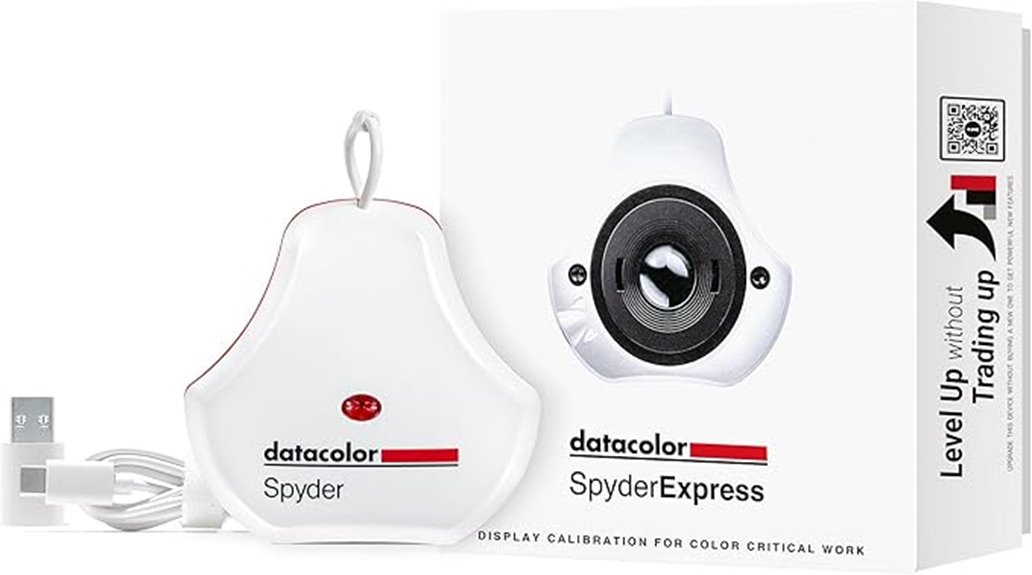
The Datacolor SpyderExpress Monitor Calibration Tool is an excellent choice for photographers, designers, and content creators seeking quick, accurate color calibration without the complexity or cost of high-end devices. It supports MacBook M4 mini-LED displays and standard monitors, calibrating up to three screens per setup. With a fast 90-second process, it’s perfect for busy workflows. The software guides you through simple steps, ensuring reliable results. Its upgradeable features include ambient light adjustment and multi-display profiling, making it future-proof. Compact and lightweight, it’s ideal for beginners and pros alike, helping you achieve consistent, true-to-life colors across all your digital projects.
Best For: photographers, designers, and content creators seeking quick, accurate, and user-friendly monitor calibration for multiple displays.
Pros:
- Fast 90-second calibration process ideal for busy workflows
- Supports multiple displays and upgradeable software for advanced features
- Compact, lightweight design suitable for both beginners and professionals
Cons:
- Limited to calibration up to three displays, which may not suffice for larger setups
- Basic features may require software upgrades for full functionality
- Does not include hardware options for advanced color management beyond basic calibration
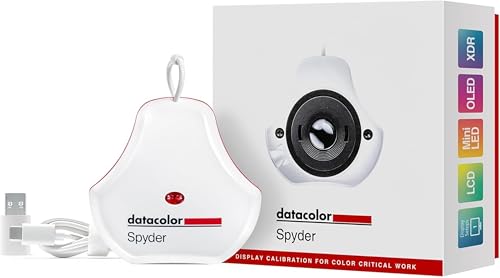
datacolor Spyder - Monitor Calibrator for Graphic Designers, Photographers, and Content Creators, Shows You True Colors, Works on OLED Monitors & LED Screens, Easy-to-Use Color Calibration Tool
Color “Surprises” Are a Thing of the Past: Datacolor’s exclusive DevicePreview TM Beta feature simulates what your photos...
As an affiliate, we earn on qualifying purchases.
Datacolor Spyder Monitor Calibration Tool

For photographers and digital artists seeking professional-quality color accuracy without complicated setups, the Datacolor Spyder Monitor Calibration Tool is an excellent choice. It calibrates a wide range of displays, including OLED, mini-LED, and Apple Liquid Retina XDR, in about 90 seconds. The device features an intuitive interface with pre-set options for beginners and customizable settings for pros. Its software includes DevicePreview Beta, simulating how images appear across devices, and an ambient light sensor that adjusts brightness automatically or manually. Users praise its speed, ease of use, and reliable results, making it ideal for ensuring consistent, accurate colors across multiple monitors.
Best For: photographers and digital artists seeking quick, accurate monitor calibration with easy-to-use tools suitable for both beginners and professionals.
Pros:
- Fast calibration process (~90 seconds) with reliable, professional-quality results
- User-friendly interface with pre-set options and customizable settings
- Supports multi-monitor calibration and adapts to ambient lighting conditions
Cons:
- Compatibility issues with certain monitors like OLED and wide-gamut LCDs
- Software crashes and connection problems, especially with USB-C ports
- Occasional difficulty in recognition, profile reversion, or registration processes

Calibrite Display Pro HL Monitor Calibration Colorimeter for LCD Mini LED and OLED Displays, Measure Up to 3000 Nits, PROFILER Software, USB C w/Adapter, Validation/Color Uniformity Tools
SPECIFICATIONS: HL high luminance sensor colorimeter measures up to 3000 nits, calibrates and profiles LCD mini LED OLED...
As an affiliate, we earn on qualifying purchases.
Calibrite Display Pro HL (CCDIS3HL)
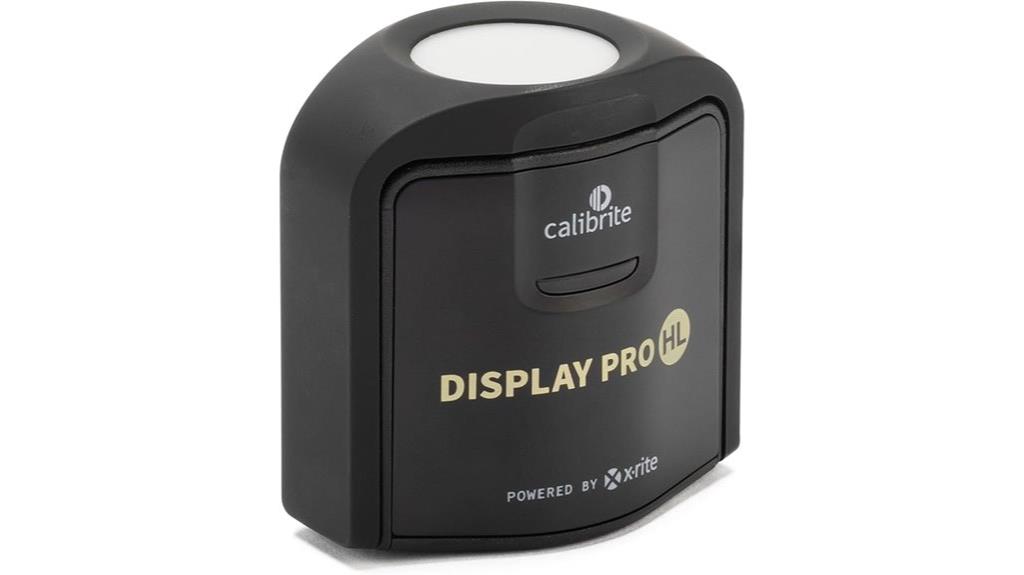
Looking for a monitor calibration tool that can handle the brightest displays with exceptional accuracy? The Calibrite Display Pro HL (CCDIS3HL) is built for that purpose. Equipped with an advanced HL sensor, it measures up to 3,000 nits, ensuring precise calibration for high-luminance screens like OLED, mini-LED, and Apple XDR panels. Its professional software offers customizable options for white point, gamma, and profile validation. Compatible with Mac and Windows, it’s perfect for high-end editing and design work. Compact, portable, and featuring a USB-C connection, the Display Pro HL replaces older models, guaranteeing superior color accuracy across current and future display technologies.
Best For: professionals requiring precise calibration of high-luminance displays like OLED, mini-LED, and Apple XDR panels for high-end photo editing and design work.
Pros:
- Capable of measuring up to 3,000 nits to handle bright displays with high accuracy
- Compatible with multiple display types including LCD, OLED, mini-LED, and Apple XDR panels
- Includes customizable software options for White Point, Gamma, Profile Validation, and Uniformity Check
Cons:
- May be more expensive than standard calibration tools due to advanced features
- Requires USB-C connection, which might necessitate adapters for some setups
- Primarily designed for professional use, potentially overkill for casual users
Calibrite Display 123 Colorimeter (CCDIS123)
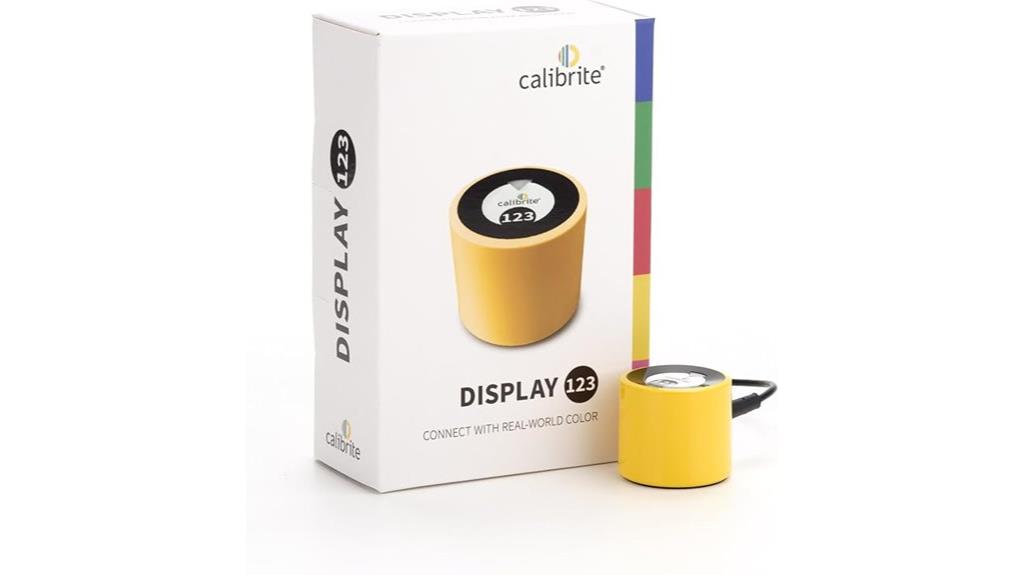
If you need a straightforward and portable color calibration tool, the Calibrite Display 123 Colorimeter (CCDIS123) is an excellent choice, especially for users with dual-monitor setups. It supports two displays, making calibration simple and efficient. Its compact design measures just 1.5 by 1.5 by 1.4 inches and weighs only 4.8 ounces, so it’s easy to carry around. The device offers native and photo brightness modes, ensuring accurate color correction and consistent results over time. Compatible with monitors needing precise calibration, it’s ideal for photographers, designers, gamers, and home users seeking reliable color accuracy in a user-friendly package.
Best For: users seeking a portable, easy-to-use color calibration device for dual-monitor setups, including photographers, designers, gamers, and home users.
Pros:
- Supports dual-display calibration for efficient setup
- Compact and lightweight design for portability
- Offers native and photo brightness modes for versatile color correction
Cons:
- Customer reviews average only 3.9 stars, indicating mixed satisfaction
- Limited to monitor calibration; does not support broader device calibration
- May require additional software or calibration tools for advanced adjustments
Datacolor Spyder X Pro Monitor Calibrator
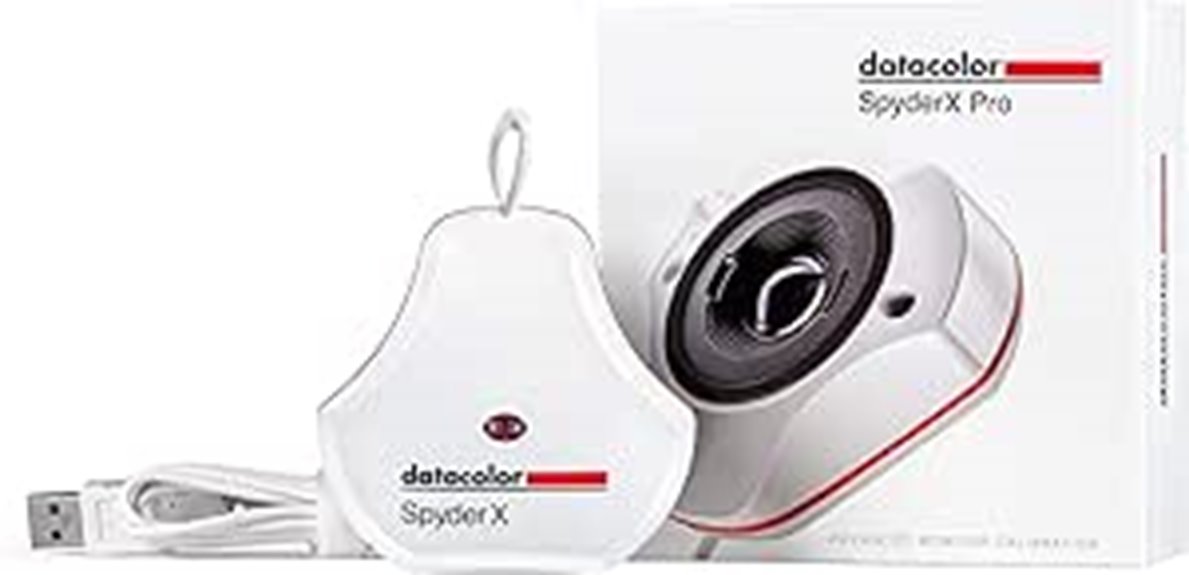
The Datacolor Spyder X Pro Monitor Calibrator stands out with its innovative lens-based color engine, making it an excellent choice for photographers and creative professionals who demand high precision and accurate color reproduction. It offers rapid calibration—usually in just one to two minutes—and supports multiple displays, including laptops and desktops. Its advanced features include room-light monitoring, automatic profile adjustments, and an intuitive interface with single-click calibration and preset targets. Designed for ease of use, even beginners can confidently achieve consistent, true-to-life colors, making it ideal for professional photo editing, printing, and creative workflows.
Best For: creative professionals, photographers, and designers seeking quick, accurate monitor calibration to ensure consistent color reproduction across multiple displays.
Pros:
- Rapid calibration process typically completed in just 1-2 minutes.
- Supports calibration of multiple monitors, including laptops and desktops.
- User-friendly interface with single-click calibration and preset targets, suitable for beginners and experts alike.
Cons:
- Requires four AA batteries, which may need frequent replacement.
- Slightly higher price point compared to basic calibration tools.
- Limited advanced customization options for highly specialized calibration needs.
Datacolor Spyder X2 Elite Monitor Color Calibrator
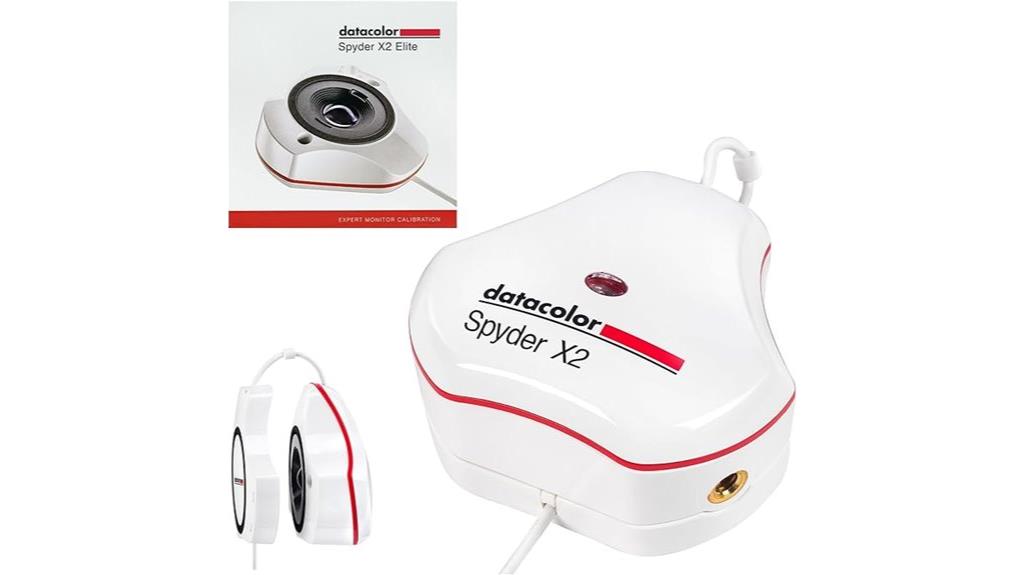
The Datacolor Spyder X2 Elite Monitor Color Calibrator is an excellent choice for professionals in photography, video production, and digital design who demand precise and consistent color accuracy across their displays. It offers advanced features like Video & Cinema Targets, soft proofing, and Studio Match for multiple monitor calibration, making it suitable for both beginners and experts. Its redesigned software provides an intuitive interface, simplifying the calibration process. With native USB-C connectivity and a USB-A adapter, setup is seamless. Overall, the X2 Elite combines professional-grade calibration with user-friendly design, ensuring your visuals are accurate, vibrant, and consistent every time.
Best For: professionals and serious enthusiasts in photography, video production, and digital design seeking precise, reliable monitor calibration.
Pros:
- Offers advanced calibration features including Video & Cinema Targets and soft proofing for accurate color fidelity.
- User-friendly, remastered software with an intuitive interface suitable for various skill levels.
- Seamless connectivity with native USB-C and included USB-A adapter for versatile device compatibility.
Cons:
- May be more expensive compared to basic calibrators, which could be a consideration for casual users.
- Requires some knowledge of calibration settings to fully utilize advanced features.
- The size and setup process might be cumbersome for very limited workspace or quick adjustments.
Calibrite Display Plus HL (CCDIS3PLHL)
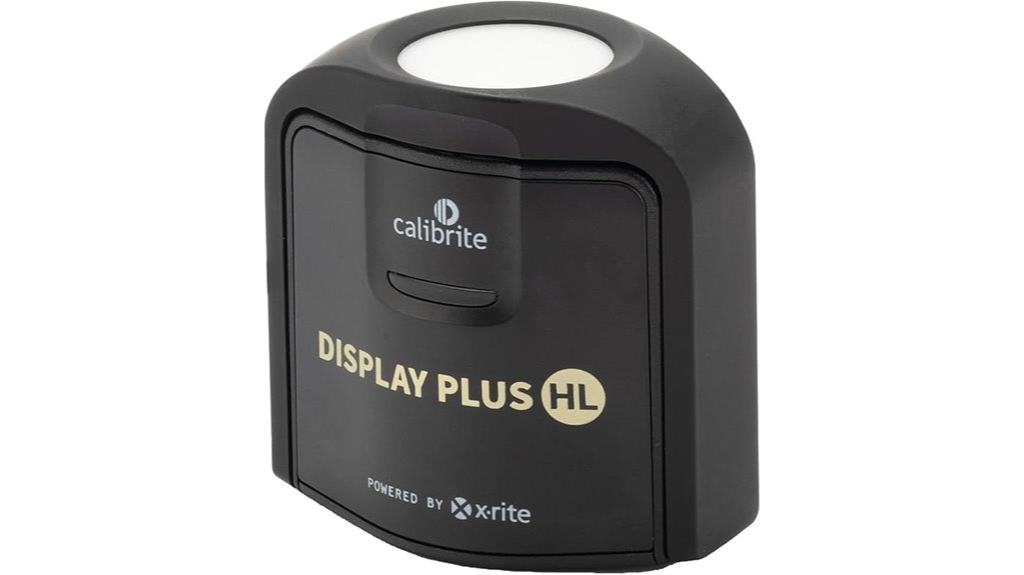
Calibrite Display Plus HL (CCDIS3PLHL) stands out as the ideal choice for professionals working with high-brightness displays, such as HDR monitors and OLED screens. Its advanced HL sensor measures luminance up to 10,000 nits, ensuring accurate calibration for bright displays. Compatible with Mac and Windows, it supports various screen types like LCD, mini-LED, OLED, and Apple XDR panels. The device pairs with Calibrite PROFILER software, offering customization for White Point, Gamma, and HDR modes. While effective for high-luminance calibration, users report some challenges with software consistency and device placement, making proper setup essential for peak results.
Best For: professionals and enthusiasts working with high-brightness displays such as HDR monitors, OLED screens, and Apple XDR panels who require precise luminance measurement and accurate color calibration.
Pros:
- Supports luminance measurement up to 10,000 nits, ideal for HDR and high-brightness displays
- Compatible with Mac and Windows, supporting a variety of screen types including OLED, mini-LED, and LCD
- Accurate color profiling with Calibrite PROFILER software and support for HDR calibration modes
Cons:
- Software can be inconsistent, requiring multiple adjustments for accurate settings like white point and color temperature
- Device placement can be tricky, especially on vertical monitors, which may affect calibration accuracy
- Some users find the device and setup process finicky, and software updates are needed for improved ease of use
Datacolor SpyderExpress Monitor Calibration Tool
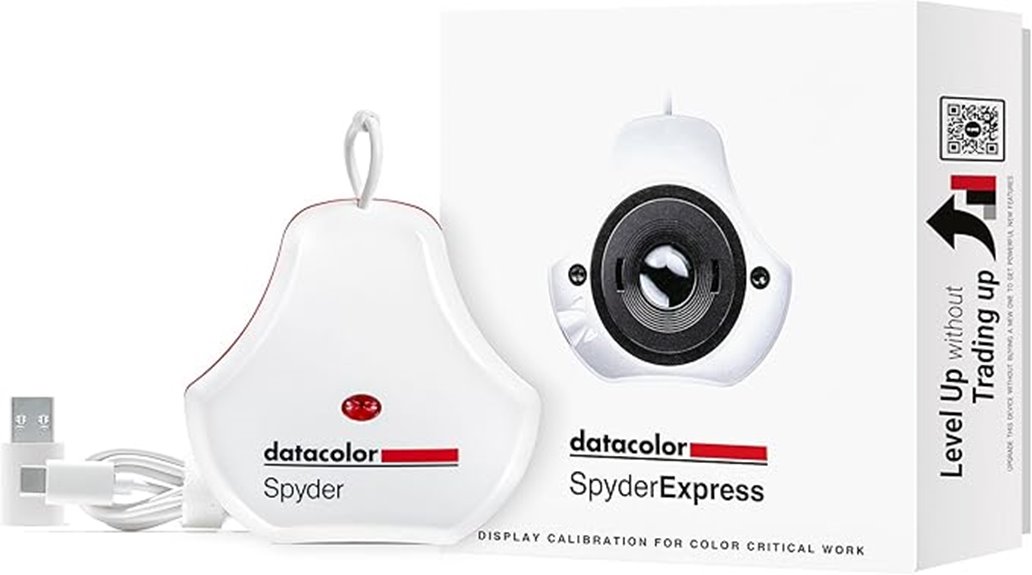
If you’re looking for an easy-to-use calibration tool that delivers professional-grade color accuracy, the Datacolor SpyderExpress is an excellent choice. It supports MacBook M4 mini-LED displays and standard monitors, calibrating up to three screens per workstation. The device is small, lightweight, and designed for simplicity, with a quick 90-second calibration process. Its software guides you through three simple steps, making it suitable for both beginners and pros. With upgradeable features like ambient light adjustment and multi-display profiling, it offers long-term value. Users praise its speed, reliability, and ability to produce accurate, consistent colors across all your digital creations.
Best For: creators and professionals seeking an easy, reliable, and cost-effective monitor calibration solution for multiple displays, including MacBook M4 mini-LED screens.
Pros:
- Quick 90-second calibration process suitable for busy workflows
- Supports up to three displays, ensuring consistent color accuracy across devices
- Upgradeable software with advanced features like ambient light adjustment and multi-display profiling
Cons:
- Limited advanced features in the basic version, requiring software upgrades for full functionality
- May not be suitable for high-end color-critical workflows without additional calibration tools
- Compatibility is primarily focused on digital displays; hardware calibration for printers is not included
Calibrite ColorChecker Studio (CCSTUDIO)

For professionals seeking precise color calibration across multiple devices, the Calibrite ColorChecker Studio (CCSTUDIO) stands out as an ideal choice. It replaces the X-Rite i1Studio, requiring a software download—ccStudio—for full features. The device supports monitor, projector, scanner, printer, and camera profiling, making it versatile for various workflows. Its Intelligent Iterative Profiling technology ensures maximum accuracy for each display. Additionally, it automatically measures ambient light to set the ideal luminance, helping ensure consistent color comparisons between prints and screens. Powered by trusted X-Rite technology, the CCSTUDIO delivers reliable, professional-grade calibration results for demanding creative professionals.
Best For: creative professionals and color enthusiasts seeking comprehensive, accurate calibration for multiple devices including monitors, printers, scanners, projectors, and cameras.
Pros:
- Versatile support for multiple device types including display, projector, scanner, printer, and camera profiling
- Advanced Intelligent Iterative Profiling technology ensures maximum color accuracy for each display
- Automatically measures ambient light to set optimal luminance, ensuring consistent color comparisons
Cons:
- Requires download of ccStudio software for full functionality, adding an extra step for setup
- May be more complex than simple calibration tools, potentially overwhelming casual users
- Higher price point compared to basic calibration devices, reflecting its professional-grade capabilities
Calibrite Video Photo Kit (CCPLHL-PPV2)
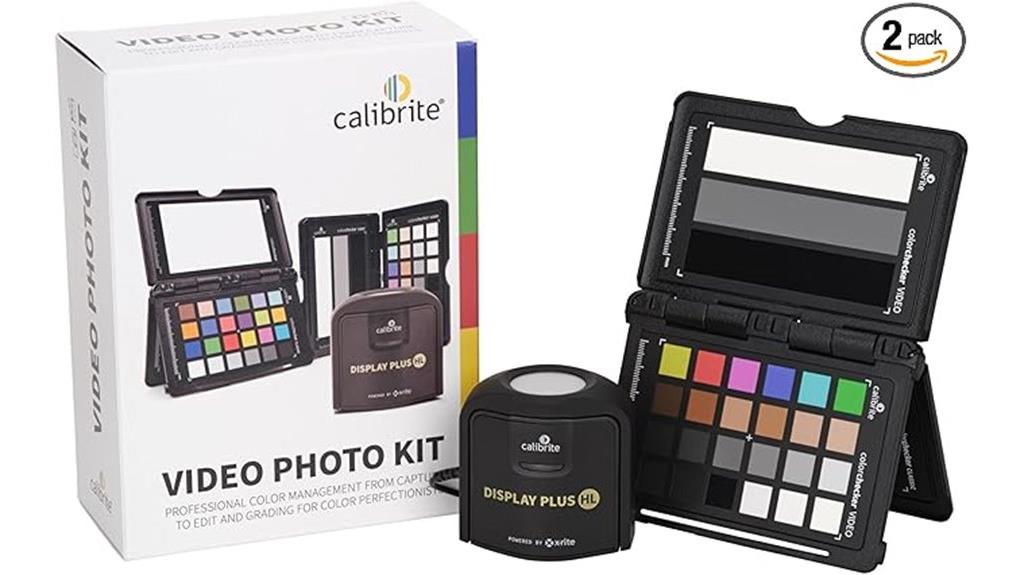
The Calibrite Video Photo Kit (CCPLHL-PPV2) is an excellent choice for content creators who work with multiple cameras and diverse lighting conditions. It’s designed for professional workflows, offering tools for both still images and videos, including video targets, custom white balance, and color profiling. Compatible with Mac and Windows, it supports advanced calibration on LCD, OLED, and Apple XDR displays, thanks to its high-quality colorimeter. The software, Calibrite Profiler, lets you fine-tune presets, white point, gamma, and camera profiles. Users praise its intuitive setup and accurate results, though some report packaging issues. Overall, it’s a versatile, reliable option to assure consistent, vibrant colors across your devices.
Best For: professional content creators and videographers working with multiple cameras and diverse lighting who need precise color calibration for both still images and moving videos.
Pros:
- Suitable for both Mac and Windows operating systems, offering versatile compatibility.
- Supports high-brightness displays up to 10,000 nits, including LCD, OLED, and Apple XDR.
- Includes comprehensive calibration tools and software for fine-tuning color profiles and white balance.
Cons:
- Some users have experienced packaging damage or missing components upon purchase.
- Calibration responses can vary, requiring occasional adjustments for optimal results.
- The initial setup and calibration process may be complex for beginners without prior experience.
Digital Calipers, Electronic LCD Display Measuring Tool
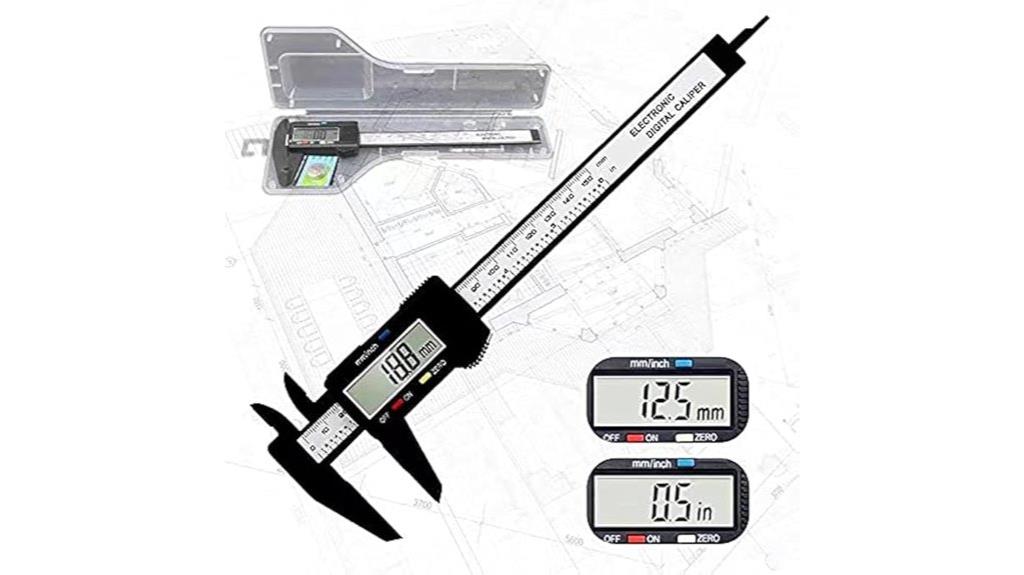
Digital calipers with electronic LCD displays offer an affordable and user-friendly solution for those needing quick, accurate measurements in everyday tasks. I find them perfect for jewelry, DIY projects, or 3D printing, thanks to their versatile measurement modes—external, internal, depth, and step. The LCD screen makes reading measurements straightforward, and features like auto on/off and unit conversion add convenience. While made mostly from plastic, which limits durability, these calipers are lightweight and compact, making them easy to handle. They provide reasonable accuracy within ±0.1mm, making them suitable for non-professional tasks. Overall, they’re a handy, budget-friendly tool for precise measurements around the home or workshop.
Best For: hobbyists, DIY enthusiasts, and home users seeking an affordable, easy-to-use digital caliper for precise measurements in everyday projects.
Pros:
- Offers versatile measurement modes including external, internal, depth, and step measurements.
- Features an easy-to-read LCD display with automatic on/off and unit conversion functions.
- Lightweight, compact, and includes accessories like spare batteries and a protective case.
Cons:
- Made primarily from plastic, which can limit durability with frequent or heavy use.
- Limited measurement precision, only displaying up to two decimal places for inches and one for millimeters.
- Lacks a locking mechanism, which may lead to inaccuracies if the caliper shifts during measurement.
Spyder Photo/Video Kit: Color Management Tools for Photo and Video
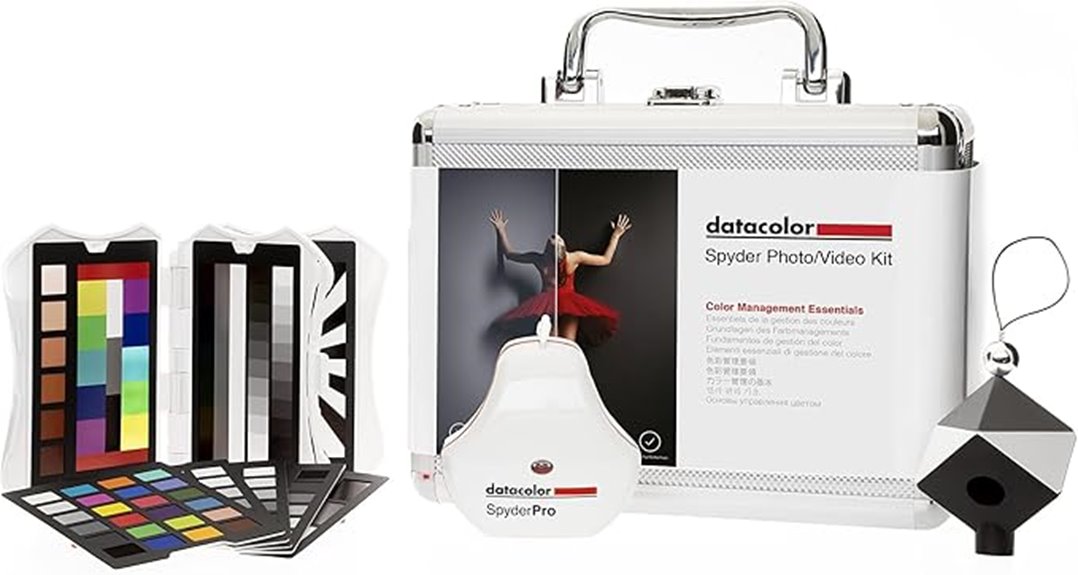
If you’re serious about achieving accurate and consistent colors across your photo and video projects, the Spyder Photo/Video Kit is an ideal choice. It offers a complete set of tools, including SpyderPro for monitor calibration, Spyder Checkr Video for detailed video color info, and Spyder Cube for superior white balance, exposure, and contrast correction. These tools work together to guarantee your displays and footage match true colors, streamlining your workflow. Compact and easy to use, the kit helps maintain color accuracy from capture to editing, saving you time and effort while delivering professional-quality results every time.
Best For: photographers and videographers seeking accurate, consistent color management from capture through editing to produce professional-quality results.
Pros:
- Comprehensive set of color calibration tools including monitor calibration, video color info, and white balance correction.
- Ensures true color matching across displays and footage, streamlining workflow and reducing editing time.
- Compact, user-friendly design suitable for both beginners and professionals.
Cons:
- Higher price point may be a barrier for casual or hobbyist users.
- Requires some technical knowledge to fully utilize all features effectively.
- Limited to specific tools; may need additional equipment for advanced workflows.
Datacolor Spyder Celebration Kit (Includes Spyder, Spyder Cube, Spyder Checkr 24)
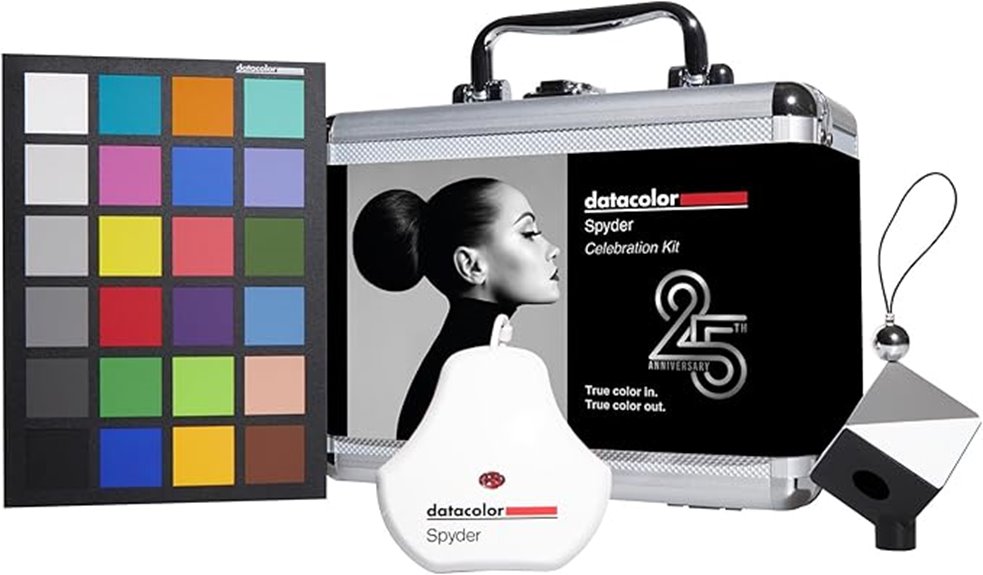
Photographers and creative professionals who need consistent, accurate color management will find the Datacolor Spyder Celebration Kit to be an essential tool. This all-in-one kit includes the Spyder monitor calibrator, Spyder Cube, and Spyder Checkr 24, covering everything from capture to display. The 2024 Spyder calibrator guarantees true-to-life colors across OLED, mini-LED, and XDR Retina screens. The Spyder Cube helps set white balance and neutral gray values, while the Checkr 24 provides spectrally engineered targets for precise color correction. With a 4.2-star rating and extensive features, this kit streamlines color accuracy for professional workflows.
Best For: professional photographers and creative professionals seeking comprehensive, reliable color management from capture to display.
Pros:
- Includes essential tools (Spyder, Cube, Checkr 24) for complete color calibration and correction
- Ensures accurate color fidelity across a variety of modern display technologies like OLED and mini-LED
- User-friendly with spectrally engineered targets and software for precise white balance and color correction
Cons:
- Might require recalibration for factory-calibrated monitors to achieve optimal accuracy
- Slightly higher price point due to comprehensive kit components
- Limited detailed user reviews available as of the latest release, potentially affecting initial confidence
Calibrite ColorChecker Display Pro (CCDIS3)
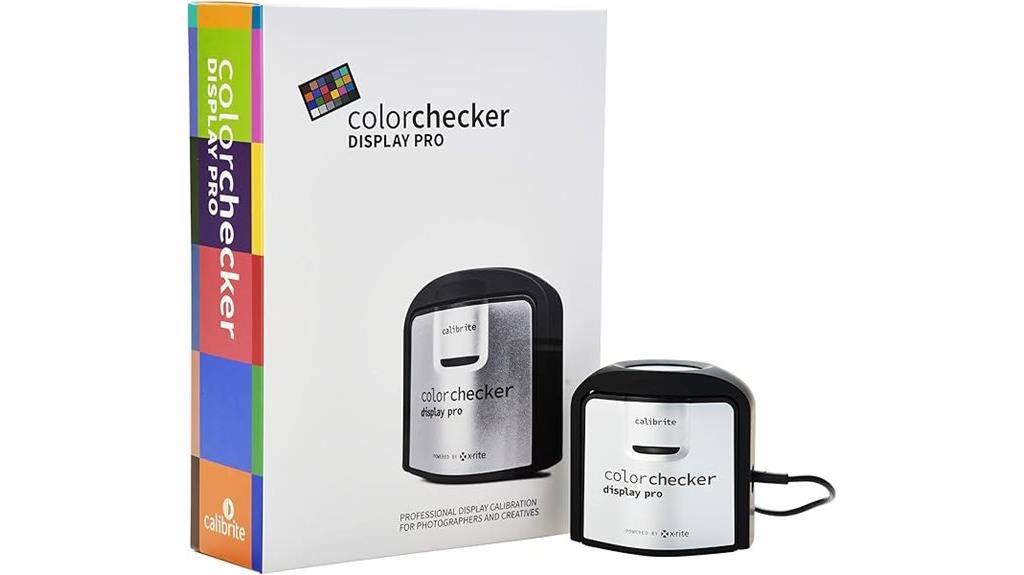
The Calibrite ColorChecker Display Pro (CCDIS3) stands out as an ideal choice for professionals and serious enthusiasts who need precise and consistent color calibration across various display types. Powered by X-Rite, this compact device measures just 1.5 inches on each side and weighs only 4.9 ounces, making it highly portable. It works seamlessly with ccProfiler or i1Profiler software, ensuring accurate color profiling. Its optical design guarantees high repeatability, whether calibrating monitors or projectors. The rotatable diffuser arm adds versatility, allowing ambient light measurement and projector profiling. Overall, CCDIS3 offers reliable performance, supporting multiple calibration scenarios for stunning, consistent visuals.
Best For: professionals and serious enthusiasts seeking precise, reliable, and versatile color calibration for monitors and projectors in various environments.
Pros:
- Compact and lightweight design for easy portability and use on the go
- High repeatability ensures consistent calibration across different displays and types
- Supports multiple calibration scenarios including ambient light measurement and projector profiling
Cons:
- Slightly higher price point may be a barrier for casual users
- Requires compatible software (ccProfiler or i1Profiler) for full functionality
- Limited to display and projector calibration, not suitable for other color management needs
Factors to Consider When Choosing a Color Calibration Tool for Monitors
When selecting a color calibration tool, I consider how well it works with my display and how easy it is to use. Accuracy and software features are also vital for consistent results, while durability guarantees it lasts over time. Understanding these factors helps me choose the right tool for my needs.
Compatibility With Displays
Choosing the right color calibration tool requires guaranteeing compatibility with your specific display technology, whether it’s OLED, mini-LED, LCD, or HDR screens. Not all calibration devices support every display type, so confirming compatibility ensures accurate color profiling. If you use multiple monitors, check whether the tool can calibrate them simultaneously, maintaining consistent colors across screens. It’s also essential to verify compatibility with your operating system—Windows or macOS—to guarantee smooth software integration. For high-brightness displays, especially HDR setups with luminance up to 10,000 nits, ensure the device’s software can handle those levels. Additionally, confirm that the calibration tool supports your monitor’s connection type, whether USB-C or USB-A, for an easy setup process. Proper compatibility is key to achieving precise, reliable calibration results.
Calibration Speed and Ease
Selecting a color calibration tool that offers quick setup and straightforward operation can substantially boost your workflow, especially if you’re pressed for time. Tools that calibrate in around 90 seconds to a few minutes help you stay productive without long interruptions. User-friendly software with guided instructions reduces the learning curve and minimizes errors, making calibration easier even for beginners. Devices that support multiple displays simultaneously or in quick succession enhance efficiency in multi-monitor setups. Automatic or semi-automatic features require minimal manual adjustments, saving time and ensuring consistency across calibrations. The ease of initiating and completing calibration, combined with clear instructions and simple interfaces, notably improves speed and overall user experience, allowing you to focus more on your work and less on technical hurdles.
Accuracy and Precision
Ensuring high accuracy and precision in color calibration is vital for achieving consistent, true-to-life colors on your monitor. Accurate calibration means on-screen colors closely match real-world hues, which is essential for professionals like photographers and designers. Advanced tools use sophisticated sensors and spectrally engineered color targets to measure and correct color discrepancies with minimal error. Calibrating for specific gamma, white point, and luminance levels guarantees reliable color reproduction across different displays. Precision is often measured by Delta E (ΔE), with professional devices aiming for values below 2, indicating excellent color matching. Regular recalibration with high-precision tools helps maintain accuracy over time, accounting for monitor aging and environmental changes. Prioritizing accuracy and precision guarantees your visuals stay consistent and true to life.
Software Features and Updates
When evaluating color calibration tools, software features and updates play a crucial role in maintaining peak performance and compatibility. Regular updates ensure the software stays current with new monitor technologies and operating systems, preventing obsolescence. Advanced features like ambient light measurement, multi-display profiling, and soft proofing enhance calibration accuracy and streamline workflows. Customizable settings for white point, gamma, and luminance allow me to tailor profiles to specific display conditions and ambient lighting. A user-friendly interface and guided calibration process reduce the learning curve, making the software accessible for both beginners and professionals. Additionally, extensive support resources, including tutorials and troubleshooting guides, help maximize the tool’s effectiveness and resolve calibration issues quickly. These features are indispensable for achieving consistent, high-quality visuals.
Device Durability and Design
The durability and design of a color calibration device directly impact its longevity and reliability in everyday use. I look for devices built with high-quality materials like sturdy plastics or metals that can withstand frequent handling and transport. Protective casings or covers are essential to guard against drops, dust, and moisture, guaranteeing the device remains functional over time. A compact, lightweight design makes it easier to carry and reduces the risk of damage during travel or on-location shoots. Features like replaceable parts or target cards help extend the device’s lifespan and maintain calibration accuracy. An ergonomic design with easy-to-handle features ensures a secure grip and precise positioning, minimizing user error and making calibration smoother and more reliable.
Price and Value
Choosing a color calibration tool for your monitor often comes down to balancing price and value. Basic models start around $50, suitable for casual use, while professional-grade devices can cost several hundred dollars, offering advanced features like high luminance support and multi-device calibration. Cheaper options may provide decent accuracy but often lack the precision and consistency needed for professional workflows. When evaluating value, consider the device’s features, accuracy, durability, software support, and compatibility relative to its price. Investing in a higher-quality tool can improve color accuracy, save time, and boost productivity, especially for photographers, designers, and videographers. Ultimately, a slightly higher upfront cost can deliver better long-term benefits, making it a smarter investment for those who require precise and reliable calibration.
Multi-Display Support
If you work with multiple monitors, ensuring consistent color accuracy across all screens becomes a key consideration. I look for calibration tools that can support my setup’s number of displays, whether it’s two, three, or more. The software should allow for multi-display profiling, so I can create individual or unified color profiles tailored to each monitor, which streamlines my workflow. I also prioritize tools that automatically detect and calibrate multiple screens at once, saving me time and effort. For professional environments, options like studio matching or advanced multi-monitor analysis are essential. Additionally, I verify that the calibration device supports my monitor types, such as OLED, mini-LED, or high-gamut screens, ensuring thorough coverage and consistent results across all displays.
Support and Warranty
When selecting a color calibration tool for monitors, prioritizing support and warranty options guarantees your investment remains protected over time. I look for a thorough warranty that covers hardware defects and software issues to avoid unexpected expenses. It’s also essential that the manufacturer offers accessible support channels, such as phone, email, or live chat, for prompt troubleshooting. I verify if the warranty includes software updates and ongoing support to guarantee compatibility with evolving operating systems and display tech. Clear warranty durations, typically from one to three years, provide peace of mind for long-term coverage. Additionally, I review user feedback on the manufacturer’s support responsiveness and effectiveness, as good post-purchase assistance can be invaluable if issues arise down the line.
Frequently Asked Questions
How Often Should I Recalibrate My Monitor for Optimal Visuals?
I recommend recalibrating your monitor at least once a month to keep colors accurate and visuals stunning. If you notice color shifts or your work demands precise color matching, consider recalibrating more frequently, like every two weeks. Environmental factors like lighting changes can also affect calibration, so regular adjustments help maintain consistent quality. Staying on top of calibration ensures your visuals stay vibrant and true-to-life.
What Is the Ideal Calibration Process for Gaming Monitors?
For gaming monitors, I recommend calibrating at least once a month to keep colors accurate and contrast sharp. Start by resetting your monitor settings, then use a calibration tool like a colorimeter or software to adjust brightness, contrast, and gamma. Make sure you’re in a well-lit environment, and save your settings. Regular calibration guarantees vibrant visuals and helps you spot details in dark or bright scenes.
Can Calibration Tools Improve Color Accuracy for Creative Professionals?
Yes, calibration tools can substantially improve color accuracy for creative professionals like me. I’ve found that using a good calibration device helps guarantee my monitor displays true-to-life colors, which is essential for photo editing, design, and printing. It’s a quick, effective way to eliminate color inconsistencies and maintain consistency across projects, so I can trust my monitor to deliver precise visuals every time.
Are Calibration Tools Compatible With All Monitor Types and Brands?
Yes, calibration tools are generally compatible with most monitor types and brands, but it’s crucial to check each device’s specifications first. I’ve found that many tools support a wide range of monitors, including LCD, LED, and OLED screens. However, some older or specialized monitors may have limited compatibility or require specific drivers. Always verify compatibility before purchasing to guarantee smooth calibration and ideal color accuracy.
What Are the Signs That My Monitor Needs Calibration Again?
Think of your monitor as a painter’s canvas—it needs regular touch-ups. If colors start looking off, images seem dull or overly vibrant, or if you notice inconsistent shading, it’s time to recalibrate. Also, if your screen appears too dark or too bright despite settings, that’s a sign. Regular calibration keeps your visuals sharp, accurate, and consistent, ensuring your display always paints the perfect picture.
Conclusion
Choosing the right color calibration tool can feel overwhelming, but remember, a picture is worth a thousand words. Just like a painter needs the perfect palette, you need the right tools to bring out your monitor’s true colors. With the options I’ve shared, you’re well on your way to stunning visuals. Trust me, investing in quality calibration tools is like planting seeds for a masterpiece—patience and care will reward you with breathtaking results.