For greenhouse growers, measuring daily light integral (DLI) is essential to ensure optimal plant development. The VBR-20 DLI Light Meter stands out as the best overall choice, offering reliable readings and user-friendly features. The DLI Sun Meter impresses with Bluetooth connectivity and data export, ideal for tech-savvy growers, while the Apogee Instruments DLI-500 provides highly accurate measurements for professional use. However, tradeoffs include cost and complexity—more feature-rich models often come at a higher price and require more calibration. Continue reading for a detailed breakdown of these options to find the best fit for your greenhouse needs.

Get the latest gadgets delivered free with Prime
- Fast, free delivery on millions of items
- Prime Video, Amazon Music and more included
- Member-only deals all year
Complete the kit


Key Takeaways
- The top-ranked VBR-20 offers a balanced mix of accuracy, ease of use, and affordability, making it suitable for most growers.
- Bluetooth-enabled models like the DLI Sun Meter facilitate data management but may have a steeper learning curve for beginners.
- Professional-grade options such as the Apogee DLI-500 prioritize precision, often at a higher cost and more complex operation.
- Multi-function meters with additional sensors (e.g., temperature, CO₂) are valuable for comprehensive environmental monitoring but tend to be more expensive.
- Choosing the right DLI meter depends heavily on the grower’s experience level, budget, and specific data needs.
| VBR-20 DLI Light Meter for Plants |  | Best Overall for Versatile Long-Term Light Tracking | Measurement: DLI (mol/m²/d) | Connectivity: Bluetooth | Battery: 1 AAA (up to 1 year) | VIEW ON AMAZON | See Our Full Breakdown |
| DLI Sun Meter for Plants – Measure Daily Light, PAR, and Sunlight Conditions with Bluetooth and CSV Export |  | Best for Data Export and Trend Analysis | Measurement: PAR in µmol/m²/s, DLI in mol/m²/day | Data Storage: 180 days | Connectivity: Bluetooth | VIEW ON AMAZON | See Our Full Breakdown |
| EVO-20 DLI Light Meter – Sunlight Classifier for Garden & Landscape |  | Best for Quick Sunlight Classification in Outdoor Settings | Measurement Type: Daily Light Integral (DLI) | Display: Digital | Memory: Stores 10 days of DLI | VIEW ON AMAZON | See Our Full Breakdown |
| Apogee Instruments DLI-500 PAR, Daily Light Integral, and Photoperiod Meter |  | Best for Professional Research and Precise Light Measurement | Measurement Range: 400-700 nm | Data Storage: Up to 99 days | Connectivity: USB-C | VIEW ON AMAZON | See Our Full Breakdown |
| AH-200 PAR Meter with CO₂, Temperature & Humidity Sensors for Plants |  | Best for All-in-One Environmental Monitoring in Greenhouses | Sensors: PAR, CO₂, temperature, humidity | Data Logging: Yes | Connectivity: USB | VIEW ON AMAZON | See Our Full Breakdown |
| DLI Light Meter 2 in 1 PAR & DLI Sunlight Measurement Tool for Plants, Lawn, Garden | 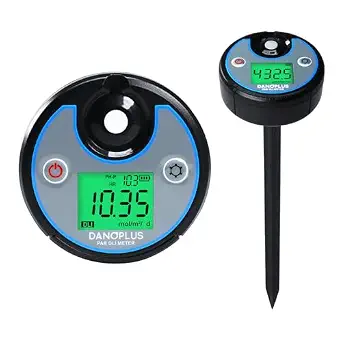 | Best for Long-Term Data Logging and Outdoor Use | Measurement Range (PPFD): 0-5000 μmol/m2/sec | Wavelength Range: 400-700nm | Data Storage: Up to 5 years | VIEW ON AMAZON | See Our Full Breakdown |
| AH-20 DLI Sunlight Calculator for Plants, Records MOL/(㎡d) Over 10 Days |  | Best for Automatic, Short-Term Daily Light Measurement | Measurement Unit: mol/m²/d | Measurement Duration: 10 days | Sensor: PAR Sensor from Japan | VIEW ON AMAZON | See Our Full Breakdown |
| dli meter for greenhouse | Connectivity | Data Storage |
|---|---|---|
| VBR-20 DLI Light Meter for Pla | Bluetooth | 180 days |
| DLI Sun Meter for Plants | Bluetooth | 180 days |
| EVO-20 DLI Light Meter | — | — |
| Apogee Instruments DLI-500 PAR | USB-C | Up to 99 days |
| AH-200 PAR Meter with CO₂ | USB | — |
| DLI Light Meter 2 in 1 PAR & D | — | Up to 5 years |
| AH-20 DLI Sunlight Calculator | — | — |
More Details on Our Top Picks
VBR-20 DLI Light Meter for Plants
This meter stands out for its ability to record daily light integral over an impressive 180 days, making it ideal for growers who want detailed, long-term light data. Unlike the EVO-20, which classifies sunlight exposure in broad categories, the VBR-20 provides precise DLI measurements via Bluetooth, enabling more accurate light management. However, its reliance on Bluetooth and AAA batteries means it may be less convenient for casual users or those seeking Wi-Fi connectivity. The device’s dual indoor and outdoor use broadens its applicability, and its long data storage supports seasonal adjustments. The primary tradeoff is that its specialized design and Bluetooth-only connection might be overkill for hobbyists with simple needs. Overall, this pick makes the most sense for serious growers who need reliable, long-term light data without network dependency.Pros:- Long-term data storage of 180 days for comprehensive analysis
- Bluetooth connection with no internet required, ensuring privacy and simplicity
- Suitable for both indoor and outdoor environments, increasing versatility
Cons:- Requires AAA battery replacement after about a year, adding ongoing maintenance
- Limited to Bluetooth connection, lacking Wi-Fi or cloud syncing for remote access
Best for: Professional growers and serious hobbyists who want detailed, long-term light tracking without internet dependence
Not ideal for: Casual gardeners or beginners who prefer simple, real-time readings without long-term data management
- Measurement:DLI (mol/m²/d)
- Connectivity:Bluetooth
- Battery:1 AAA (up to 1 year)
- Usage:Indoor and outdoor
- Data Storage:180 days
Our verdict“This is best suited for dedicated growers needing detailed long-term light data and who are comfortable with Bluetooth technology.”
DLI Sun Meter for Plants – Measure Daily Light, PAR, and Sunlight Conditions with Bluetooth and CSV Export
The DLI Sun Meter excels at tracking both PAR and DLI, with the added benefit of CSV export for detailed analysis, making it a strong choice for those who want to scrutinize seasonal or daily trends. Compared to the EVO-20, which classifies sunlight into broad categories, this meter provides numeric PAR and DLI readings, perfect for nuanced light optimization. Its Bluetooth connection and 1-year battery are comparable to other models, but it lacks a display, requiring users to connect via app for data review—less convenient for real-time needs. The CSV export capability makes it ideal for growers who want to deeply analyze light data post-collection. The main tradeoff is the absence of a real-time display, which can slow quick adjustments. Overall, this device suits data-driven growers who prefer digital records over instant readings.Pros:- Tracks both PAR and DLI for comprehensive light assessment
- Enables detailed analysis via CSV export, ideal for long-term trend tracking
- Bluetooth connectivity with no internet dependency
Cons:- No built-in display for instant readings, requiring app connection
- Battery life limited to about 1 year, similar to the VBR-20
Best for: Hobbyists and professionals who prioritize detailed data export and trend analysis over immediate feedback
Not ideal for: Growers seeking instant, on-the-spot light readings without needing to connect to a device or analyze CSV files
- Measurement:PAR in µmol/m²/s, DLI in mol/m²/day
- Data Storage:180 days
- Connectivity:Bluetooth
- Battery:1 AAA (up to 1 year)
- Export:CSV files
Our verdict“This meter is best for users who want to analyze light data in depth rather than rely on quick, real-time readings.”
EVO-20 DLI Light Meter – Sunlight Classifier for Garden & Landscape
The EVO-20 offers a simple, intuitive way to classify sunlight exposure into categories like full sun or shade, making it especially useful for landscapers and gardeners needing quick placement decisions. Its digital display shows DLI over 10 days, providing a straightforward way to compare exposure patterns without complex calculations. Compared to the more data-rich models, this device focuses on ease of use and portability, but it measures DLI over time rather than providing instant light levels, which limits its usefulness for immediate adjustments. Initial readings might be blank if the device hasn’t accumulated sufficient light exposure, which can be confusing for new users. This pick is ideal for outdoor environments where quick, broad classifications are enough to guide plant placement.Pros:- Classifies sunlight into categories like full sun or shade for easy decision-making
- Stores and reviews DLI over 10 days, aiding seasonal planning
- Portable, no setup required, with auto-start feature
Cons:- Measures DLI over time, not instant light levels, limiting real-time adjustments
- Initial readings may be blank until sufficient light exposure occurs
Best for: Landscape professionals and gardeners who need quick sunlight classification without detailed data analysis
Not ideal for: Growers seeking precise, real-time light measurements for indoor or controlled environment cultivation
- Measurement Type:Daily Light Integral (DLI)
- Display:Digital
- Memory:Stores 10 days of DLI
- Power:Long battery life
- Usage:Auto-start, no setup
Our verdict“This device is best for outdoor gardeners who need a quick, easy way to classify sunlight exposure without detailed data analysis.”
Apogee Instruments DLI-500 PAR, Daily Light Integral, and Photoperiod Meter
The DLI-500 provides laboratory-grade measurements, with a full-spectrum sensor covering 400-700 nm, making it ideal for research or professional growers who need exact data. Its IP65-rated durability and included accessories, like a soil stake and USB-C, set it apart from simpler models like the AH-200, which is more suited for hobbyist use. While it offers highly accurate and comprehensive data, the need for USB-C data transfer and its professional focus might be overkill for casual growers. The four-year warranty and robust design justify its higher price, but this device’s complexity and cost make it less suitable for those with basic needs. Overall, this tool makes the most sense for dedicated research or large-scale growers seeking precise, reliable data.Pros:- Provides precise, research-grade measurements including PAR, DLI, and photoperiod
- Durable IP65-rated design suitable for outdoor or harsh environments
- Includes comprehensive accessories and long warranty for reliability
Cons:- Requires USB-C connection, less convenient for field use without a computer
- Higher cost and complexity limit its suitability for casual users
Best for: Professional growers, researchers, or large-scale operations requiring high-accuracy light measurements
Not ideal for: Home gardeners or hobbyists looking for a simple, portable device without data management complexity
- Measurement Range:400-700 nm
- Data Storage:Up to 99 days
- Connectivity:USB-C
- Durability:IP65-rated
- Power Source:AAA batteries
- Warranty:4 years
Our verdict“This is best for professionals who need highly accurate, durable, and comprehensive light measurement in research or commercial settings.”
AH-200 PAR Meter with CO₂, Temperature & Humidity Sensors for Plants
The AH-200 combines PAR, DLI, VPD, and CO₂ measurements in a single device, making it the most comprehensive option for greenhouse environments. Its external sensors provide flexible placement, and the USB data logging allows for detailed trend analysis, similar to the data logging features of the DLI-500 but with added environmental parameters. Unlike the more straightforward meters, this device requires connection to a PC for data visualization, which may complicate quick decision-making. Its ability to measure multiple parameters makes it ideal for sophisticated growers managing complex environments, but casual growers might find it overly complex and expensive. The inclusion of external sensors enhances versatility but adds to the setup effort. Overall, this device is perfect for those needing in-depth environmental control in greenhouses or hydroponic systems.Pros:- Measures multiple key parameters including PAR, CO₂, temperature, and humidity
- Built-in data logging with USB export for comprehensive trend analysis
- External sensors offer flexible placement for accurate environmental monitoring
Cons:- Requires PC connection for data visualization, limiting portability
- More complex setup and higher cost compared to basic light meters
Best for: Greenhouse growers and researchers who need detailed environmental data alongside light measurements
Not ideal for: Casual hobbyists or growers seeking simple, standalone light meters without environmental sensors
- Sensors:PAR, CO₂, temperature, humidity
- Data Logging:Yes
- Connectivity:USB
- Display:Backlit LCD
- Included Sensors:3 external sensors
Our verdict“This all-in-one environmental meter suits professional and advanced growers needing detailed, multi-parameter monitoring in greenhouses.”
DLI Light Meter 2 in 1 PAR & DLI Sunlight Measurement Tool for Plants, Lawn, Garden
This light meter stands out for its ability to record data over up to 5 years, making it ideal for growers who track light trends over time. Unlike the AH-20 DLI Sunlight Calculator, which automatically logs daily data but only over 10 days, this model offers prolonged storage and detailed analysis. Its waterproof design and outdoor suitability make it a reliable choice for greenhouse and garden environments. The device measures both PPFD and DLI, giving a comprehensive view of light conditions, but it requires a PC connection to fully access stored data, which could be inconvenient for users seeking standalone functionality. Compared with other options, this model’s strength lies in its long-term data recording, though it sacrifices some portability since it relies on USB connection for data export.
Pros:- Extensive data storage capacity for up to 5 years of light tracking
- Waterproof IP65 rating suitable for outdoor conditions
- Dual measurement of PPFD and DLI for comprehensive light analysis
- Easy data export via USB to PC
Cons:- Requires connection to a PC for full data access, limiting portability
- Limited wavelength range (400-700nm) may miss some spectral details
- No standalone display for quick readings
Best for: Growers who need detailed, long-term light data for greenhouse management or research projects
Not ideal for: Gardeners who prefer a simple, portable device without the need for PC connectivity or long data storage
- Measurement Range (PPFD):0-5000 μmol/m2/sec
- Wavelength Range:400-700nm
- Data Storage:Up to 5 years
- Display:Real-time date and clock
- Waterproof Level:IP65
- Additional Features:Records DLI and photoperiod, connects via USB, includes soil rod
Our verdict“This meter is best suited for advanced users needing detailed, long-term light data, especially in outdoor or greenhouse settings.”
AH-20 DLI Sunlight Calculator for Plants, Records MOL/(㎡d) Over 10 Days
This device offers a straightforward way to measure daily mol of photons absorbed by plants, making it especially useful for growers focused on short-term daily light management. Unlike the DLI Light Meter 2 in 1, which emphasizes long-term data logging, the AH-20 automatically records over a 10-day period without manual input, simplifying ongoing monitoring. Its Japanese-calibrated PAR sensor ensures accuracy, but it’s limited to sunlight measurement and requires manual battery replacement when depleted. The device’s automatic recording feature means less hassle, but users must be comfortable with manual time zone adjustments via the instruction manual. Compared to more comprehensive meters, this model sacrifices extended data storage for ease of use over a specific period.
Pros:- Automatic data recording over 10 days without manual input
- Highly accurate with a Japanese-calibrated PAR sensor
- Suitable for both indoor and outdoor use with water spray resistance
- Battery operated for portable use
Cons:- Limited to sunlight measurement, lacking features like DLI or PAR spectrum analysis
- Battery replacement needed when power runs out, which could cause data gaps
- Requires manual setup for time zone adjustments, which can be confusing
Best for: Growers who want quick, accurate sunlight measurements over a short period with minimal setup
Not ideal for: Researchers or long-term growers needing extended data logging or detailed spectral analysis
- Measurement Unit:mol/m²/d
- Measurement Duration:10 days
- Sensor:PAR Sensor from Japan
- Calibration:Rigorously calibrated
- Water Resistance:Sprayable with water
- Power:Battery operated
Our verdict“This meter makes sense for growers seeking quick, reliable sunlight data over a short period without complex features.”
How We Picked
These products were selected based on their relevance to greenhouse growers seeking accurate, reliable, and user-friendly DLI measurement tools. We prioritized performance, build quality, ease of use, and value for money. Devices with features like Bluetooth connectivity, data export, and multi-sensor capabilities were favored for their practicality. Our ranking reflects a balance between affordability and professional-grade accuracy, ensuring options suitable for hobbyists, commercial growers, and advanced users alike. The final list aims to guide buyers toward tools that match their specific operational needs and technical skills.| dli meter for greenhouse | Connectivity |
|---|---|
| VBR-20 DLI Light Meter for Pla | Bluetooth |
| DLI Sun Meter for Plants | Bluetooth |
| EVO-20 DLI Light Meter | — |
| Apogee Instruments DLI-500 PAR | USB-C |
| AH-200 PAR Meter with CO₂ | USB |
| DLI Light Meter 2 in 1 PAR & D | — |
| AH-20 DLI Sunlight Calculator | — |
Factors to Consider When Choosing Dli Meter For Greenhouse
To choose the best DLI meter for your greenhouse, it’s important to consider several factors that influence usability, accuracy, and value. Not all meters are created equal, and understanding these aspects can help you avoid common pitfalls like overpaying for unnecessary features or choosing a device that’s too basic for your needs. A well-chosen meter can improve your crop yields and save time, making the investment worthwhile.Accuracy and Calibration
Accurate measurements are essential for effective light management. Look for meters that are well-calibrated and tested against industry standards. Devices with built-in calibration features or that come with calibration certificates tend to deliver more consistent results. Keep in mind that budget models may sacrifice precision, so if your operation depends on exact data, investing in a professional-grade meter can pay off in the long run.
Ease of Use and Interface
A simple, intuitive interface helps reduce errors and saves time. Consider whether the device has a clear display, straightforward controls, and whether it provides real-time readings or requires complex setup. Some meters include mobile apps or Bluetooth connectivity, which can streamline data collection and analysis. However, more advanced interfaces might require a learning curve, especially for beginners.
Connectivity and Data Management
Features like Bluetooth, Wi-Fi, or CSV export can greatly enhance data handling, especially for larger operations. These options allow for easy storage, comparison, and analysis of light data over time. If you prefer manual record-keeping, a basic model with a clear display might suffice, but for ongoing monitoring, connectivity features are invaluable. Be aware that added connectivity often increases the device’s cost and complexity.
Additional Sensors and Functions
Some meters include sensors for temperature, humidity, or CO₂, providing a more comprehensive environmental picture. This can be particularly useful when managing complex greenhouse conditions. However, multi-function meters tend to be more expensive and may require more maintenance. Determine whether these extra features are necessary for your operation or if a dedicated light meter will suffice.
Price and Value
Budget options can be suitable for hobbyists or small setups, but they might lack precision or durability. Conversely, premium meters offer high accuracy and durability but at a higher price point. It’s important to weigh your specific needs against the cost—sometimes investing in a quality device reduces errors and improves yields, justifying the initial expense. Consider long-term value over short-term savings to make the best investment.
Frequently Asked Questions
How often should I calibrate my DLI meter for greenhouse use?
Calibration frequency depends on the model and usage but generally should be done at least once a year or whenever you notice inconsistent readings. Some meters include calibration features or come with calibration kits, making this process easier. Regular calibration ensures your measurements remain accurate, which is vital for maintaining optimal light conditions for your plants. For high-value or professional units, more frequent calibration—every few months—is often recommended.
Can I use a general light meter instead of a dedicated DLI meter for my greenhouse?
While a general light meter can measure light intensity, it may not provide the integrated daily light data needed to optimize plant growth over time. DLI meters are specifically designed to measure the total amount of light received per day, which is more relevant for horticultural purposes. Using a dedicated DLI meter improves accuracy in monitoring daily light levels, helping you fine-tune your lighting schedules more effectively.
Are Bluetooth-enabled DLI meters worth the extra cost?
Bluetooth-enabled meters can significantly streamline data collection and analysis, especially if you manage multiple sensors or large areas. They allow you to export data directly to smartphones or computers, reducing manual recording errors. However, they tend to be pricier and may require additional setup or app management. For serious greenhouse operations or tech-savvy growers, the convenience often justifies the additional expense.
What is the typical lifespan of a good DLI meter for greenhouse use?
High-quality DLI meters can last between 3 to 5 years with proper care, including regular calibration and maintenance. Cheaper models may have shorter lifespans due to lower build quality or less durable sensors. Investing in a reputable brand and following the manufacturer’s maintenance instructions can extend your device’s usability and keep your measurements accurate over time.
Should I prioritize a multi-function meter or a dedicated DLI meter?
This depends on your specific needs. Multi-function meters offer additional environmental data like temperature, humidity, or CO₂ levels, which can be useful for comprehensive climate control. However, dedicated DLI meters usually provide more precise light measurements focused solely on light intensity and daily light integral. If your primary concern is light management, a specialized DLI meter is often more accurate and easier to use for that purpose.
Conclusion
For most hobbyist or small-scale greenhouse growers, the VBR-20 DLI Light Meter offers a reliable and affordable starting point. Commercial growers or those seeking the highest precision should consider the Apogee DLI-500 for its accuracy, despite its higher price. Beginners will benefit from models with simple interfaces and Bluetooth connectivity, while advanced users might prefer multi-sensor options with extensive data management features. Ultimately, selecting the right DLI meter hinges on your operational scale, budget, and how detailed your monitoring needs are.Fall Picks
fall essentials
As an affiliate, we earn on qualifying purchases.