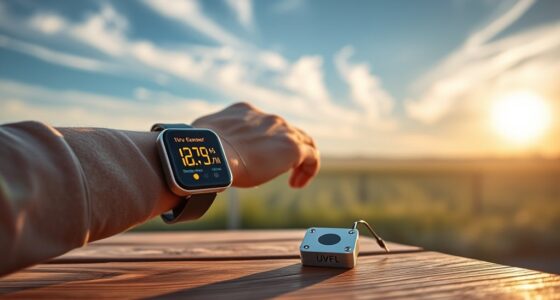
A handheld spectrometer offers portable spectral analysis for diverse applications, from scientific research to gemstone identification. The Mammoth M400 PAR Meter & Spectrometer stands out as the best overall choice, combining full-spectrum analysis with an intuitive touch display. For those prioritizing precision, the Sekonic C-7000 Spectrum Analyzer provides highly detailed color control, while budget-conscious buyers will appreciate the EISCO Economy Spectroscope Tube Set for classroom use. Each option presents tradeoffs between accuracy, ease of use, and price. Continue reading to explore these options in detail and find the best fit for your needs.

Get the latest gadgets delivered free with Prime
- Fast, free delivery on millions of items
- Prime Video, Amazon Music and more included
- Member-only deals all year
Complete the kit



Key Takeaways
- High-end models like the Mammoth M400 deliver comprehensive spectral data but come at a higher cost and complexity.
- Portability and ease of use are consistent priorities, with smaller, lightweight devices favored for fieldwork.
- Spectral range varies; some units cover broad wavelengths (340–1000 nm), while others focus on specific ranges for niche applications.
- Accuracy and resolution are vital for precise work, but they often mean higher price tags or more complex operation.
- Compatibility with mobile apps or PC software can enhance usability but may introduce additional setup or connectivity challenges.
| Mammoth M400 PAR Meter & Spectrometer with Full Spectrum Analyzer and Touch Display |  | Best Overall for Professional Light Analysis | Wavelength Range: 380–780 nm | Resolution: 0.2 nm | Accuracy: ±0.5 nm | VIEW ON AMAZON | See Our Full Breakdown |
| Sekonic C-7000 Spectrometer Spectrum Analyzer – Portable Handheld Tool for Precision Color Control & Interpretation |  | Best for Color Accuracy and Versatile Light Measurement | Product Dimensions: 2.76 x 1.18 x 7.87 inches | Item Weight: 3.52 ounces | Batteries: 2 AA batteries | VIEW ON AMAZON | See Our Full Breakdown |
| Eisco PH100QA Spectroscope, Optical Spectrometer, 400-700nm Range, Black |  | Best Educational & Basic Spectral Analysis Tool | Range: 400-700 nm | Accuracy: +/- 5 nm | Material: Metal | VIEW ON AMAZON | See Our Full Breakdown |
| Portable Handheld Spectrometer and Light Meter, 340–1000 nm, USB-C |  | Best Compact USB-C Spectrometer for Real-Time Light Analysis | Wavelength Range: 340–1000 nm | Measurements: CCT, CRI, PAR, PPFD | Dimensions: 47 × 28 × 25 mm | VIEW ON AMAZON | See Our Full Breakdown |
| Eisco Labs Premium Quantitative Spectroscope, Pack of 2, 400-700nm Range, +/-5nm Accuracy |  | Best for Educational and Basic Scientific Spectral Analysis | Range: 400-700 nm | Accuracy: +/- 5 nm | Diffraction Grating: 500 lines/mm | VIEW ON AMAZON | See Our Full Breakdown |
| EISCO Premium Quantitative Spectroscope – 400-700nm Range, 5nm Accuracy |  | Best for High-Resolution Scientific Analysis | Range: 400-700nm | Accuracy: ±5nm | Diffraction Grating: 500 lines/mm | VIEW ON AMAZON | See Our Full Breakdown |
| Handheld Diffraction Spectroscope, Pocket-Sized Gemological Spectrometer for Gemstone Identification |  | Best for On-the-Go Gemstone Identification | Material: Aircraft aluminum | Size: Pocket-sized | Application: Gemstone identification | VIEW ON AMAZON | See Our Full Breakdown |
| EISCO Economy Spectroscope Tube Set for Classroom Optics, Black, 6 Pack |  | Best for Group Classroom Learning | Quantity: 6 | Material: Cardboard | Length: 10.25 inches | VIEW ON AMAZON | See Our Full Breakdown |
| HPCS-330P Spectrometer PPFD Meter PAR Quantum Meter with Wireless Bluetooth |  | Best for Wireless Light Measurement | Wavelength Range: 350 to 800 nm | PPFD Measurement Range: 0 to 200,000 lx | Color Temperature Range: 1,000 to 100,000K | VIEW ON AMAZON | See Our Full Breakdown |
| Handheld 340–1000 nm Spectrometer with Android App and PC Software |  | Best for Broad Spectrum and Mobile Compatibility | Wavelength Range: 340–1000 nm | Measurements: Spectrum, CCT, CRI, lux, PPFD, PAR, blue light | Dimensions: 1.2 x 0.79 x 1.1 inches | VIEW ON AMAZON | See Our Full Breakdown |
More Details on Our Top Picks
Mammoth M400 PAR Meter & Spectrometer with Full Spectrum Analyzer and Touch Display
The Mammoth M400 stands out for its high-precision spectral measurements, with a 0.2 nm resolution and full spectrum coverage from 380–780 nm, making it ideal for research and professional lighting calibration. Its 4-inch touchscreen offers a user-friendly interface, simplifying complex data interpretation. Compared to the Sekonic C-7000, it provides more detailed spectral data, though at a higher price point. The device’s durable CNC aluminum housing adds portability and reliability, but its reliance on beta software for data export can cause frustration and limits seamless workflow. It’s best suited for indoor growers, lighting engineers, and researchers who demand accuracy and full spectrum analysis, but less so for casual hobbyists or those on a tight budget.
Pros:- High-precision spectral measurements with 0.2 nm resolution
- Full spectrum analysis covering 380–780 nm
- Intuitive 4-inch HD touchscreen interface
- Rugged CNC aluminum construction
Cons:- Requires beta software for data export, which may be unstable
- Higher price compared to basic light meters
- Limited to PC software for data download
Best for: Lighting professionals, researchers, and indoor growers requiring precise spectral data
Not ideal for: Casual users or hobbyists who need a simple, low-cost light meter without complex data handling
- Wavelength Range:380–780 nm
- Resolution:0.2 nm
- Accuracy:±0.5 nm
- Spectral Bandwidth:2 nm
- Display:4″ HD IPS touchscreen
- Battery Life:24 hours
- Material:CNC aluminum
- Weight:<2 lbs
Our verdict“This device is best for professionals needing detailed spectral data and robust build quality, accepting some software limitations.”
Sekonic C-7000 Spectrometer Spectrum Analyzer – Portable Handheld Tool for Precision Color Control & Interpretation
The Sekonic C-7000 excels in providing detailed color and light data in a portable form, measuring illuminance and spectrum with high precision, suitable for industrial design, photography, and engineering. Its compact size—just 2.76 x 1.18 x 7.87 inches—and only 3.52 ounces make it extremely convenient for fieldwork. While it offers comprehensive color interpretation modes like TM-30, and CRI, it doesn’t match the spectral resolution of the Mammoth M400, making it less ideal for detailed research. The device’s need for 2 AA batteries adds to its portability but may require frequent replacements. Its somewhat complex interface could challenge beginners, yet it remains a versatile choice for professionals needing quick, accurate color data in various environments.
Pros:- High-precision measurements of diverse light sources
- Compact, lightweight, and portable design
- Multiple color interpretation modes including CRI and TM-30
- Easy to carry in the field
Cons:- Requires frequent replacement of 2 AA batteries
- Complex interface may require learning curve
- Limited detailed spectral resolution compared to larger lab units
Best for: Designers, photographers, and engineers needing portable color and light measurement
Not ideal for: Hobbyists or educational users seeking simple, straightforward spectral analysis without complex features
- Product Dimensions:2.76 x 1.18 x 7.87 inches
- Item Weight:3.52 ounces
- Batteries:2 AA batteries
- Measurement Range:Illuminance 1-200,000 lx
- Measurement Modes:Single and continuous
- Color Interpretation:TM-30, TLCI/TLMF, SSI, CRI
Our verdict“Ideal for professionals needing accurate, portable color and light data, though not suited for detailed spectral research or casual use.”
Eisco PH100QA Spectroscope, Optical Spectrometer, 400-700nm Range, Black
The Eisco PH100QA provides reliable spectral measurements within 400–700 nm, with an accuracy of +/- 5 nm, making it suitable for classroom experiments, basic scientific investigations, and hobbyist projects. Its sturdy metal construction ensures durability for frequent handling, and its straightforward design makes it accessible for students and beginners. Compared with digital options like the Mammoth M400, it lacks advanced data logging and digital display features but offers a hands-on approach to learning about spectra. Its limited wavelength range and manual calibration mean it’s less suited for detailed professional research, but it remains a solid choice for foundational education and simple experiments.
Pros:- Reliable wavelength measurements with +/- 5 nm accuracy
- Durable metal construction for longevity
- Simple to use for educational purposes
- Versatile for flame tests, gas analysis, and astronomy
Cons:- Limited to 400–700 nm wavelength range
- Requires proper handling to maintain calibration
- Lacks digital data export or advanced features
Best for: Science students, educators, and hobbyists interested in basic spectral analysis
Not ideal for: Advanced researchers or professionals needing detailed spectral data or extended wavelength coverage
- Range:400-700 nm
- Accuracy:+/- 5 nm
- Material:Metal
- Intended Age Group:Grades 9-14, Ages 14-21
Our verdict“This spectroscope is perfect for educational use and basic spectroscopy, but not for detailed scientific research or extended wavelength analysis.”
Portable Handheld Spectrometer and Light Meter, 340–1000 nm, USB-C
This compact, lightweight spectrometer offers a broad measurement range from 340 to 1000 nm, covering UV to near-infrared. Its real-time analysis of CCT, CRI, PAR, and PPFD makes it highly versatile for indoor horticulture, photography, and basic scientific measurements. Its tiny size—just 47 × 28 × 25 mm—and weight of only 23 grams make it extremely portable, fitting comfortably in a pocket. However, its exclusive compatibility with Android devices and wired connection may limit flexibility for some users. The included PC software enables report generation in PDF format, adding value for documentation. Compared with bulkier, more feature-rich units like the Mammoth M400, this model trades advanced spectral resolution for extreme portability and ease of use in the field.
Pros:- Broad wavelength range from 340–1000 nm
- Extremely compact and lightweight design
- Real-time measurement and PDF report export
- Easy to carry for on-the-go analysis
Cons:- Not compatible with iOS devices
- Requires wired connection via USB-C
- Limited spectral resolution compared to larger lab units
Best for: Indoor growers, photographers, and field scientists who need quick, portable light measurements via Android devices
Not ideal for: iOS users or those needing wireless or high-resolution spectral data for detailed research
- Wavelength Range:340–1000 nm
- Measurements:CCT, CRI, PAR, PPFD
- Dimensions:47 × 28 × 25 mm
- Weight:23 g
- Mobile Compatibility:Android only
- Connection:USB Type-C
- Report Export:PDF
Our verdict“This device is ideal for quick, portable light measurements on Android, accepting limited spectral resolution and wired connectivity.”
Eisco Labs Premium Quantitative Spectroscope, Pack of 2, 400-700nm Range, +/-5nm Accuracy
The Eisco Labs Pack of 2 spectroscopes offers reliable measurements within 400–700 nm, with a +/- 5 nm accuracy that suits classroom demonstrations, basic experiments, and introductory research. Its robust 500 lines/mm diffraction grating ensures clear spectral separation, and the secure design guarantees legible readings even with frequent handling. Compared to digital spectrometers like the Mammoth M400, it lacks digital output and advanced features but excels in physical durability and ease of use for students. Its wavelength range is limited, making it unsuitable for applications needing UV or near-infrared data, yet it remains an excellent choice for foundational science education and simple spectroscopy tasks.
Pros:- High accuracy with +/- 5 nm wavelength measurement
- Durable design with clear, legible readings
- Includes two spectroscopes for classroom or group use
- Versatile for basic scientific experiments
Cons:- Limited to 400–700 nm range
- Requires careful handling to maintain calibration
- No digital data export capabilities
Best for: Science educators, students, and hobbyists interested in hands-on, reliable spectral analysis
Not ideal for: Researchers or professionals requiring detailed spectral data beyond 400–700 nm
- Range:400-700 nm
- Accuracy:+/- 5 nm
- Diffraction Grating:500 lines/mm
- Size:8″L x 4″W x 1″D
- Includes:2 spectroscopes
Our verdict“This pack is well-suited for education and basic spectroscopy, though it lacks digital features for advanced analysis.”
EISCO Premium Quantitative Spectroscope – 400-700nm Range, 5nm Accuracy
This spectroscope stands out for its ability to deliver detailed spectral measurements within the visible range, making it ideal for educational and research settings that require precision. Compared with the Eisco PH100QA, it offers a broader wavelength range and higher accuracy, though it’s limited to visible light and demands careful handling to maintain calibration. Its 500 lines/mm diffraction grating provides sharp, clear readings, perfect for studying light sources and spectra in detail. However, its focus on high-resolution visible light analysis means it isn’t suitable for broader or more specialized applications. This pick makes the most sense for scientists and students needing reliable, high-precision spectral data in the lab.Pros:- High-resolution spectral measurements with 500 lines/mm diffraction grating
- Accurate results with ±5nm precision
- Versatile for studying various light sources and spectra
- User-friendly design for clear and reliable readings
Cons:- Limited to visible light spectrum only
- Requires careful handling to maintain measurement accuracy
Best for: Researchers and advanced students who need accurate, high-resolution spectral data within visible light.
Not ideal for: Casual hobbyists or educators seeking a more versatile or durable instrument for general classroom use.
- Range:400-700nm
- Accuracy:±5nm
- Diffraction Grating:500 lines/mm
Our verdict“This spectroscope is perfect for scientific professionals and students who need high-precision measurements within the visible range, but it’s less suitable for broader or rugged use.”
Handheld Diffraction Spectroscope, Pocket-Sized Gemological Spectrometer for Gemstone Identification
This compact diffraction spectroscope is designed specifically for gemologists and jewelry pros who need quick, portable spectral analysis. Its durable aircraft aluminum construction and high-quality optics ensure reliable readings in the field, making it more robust than the cardboard-based EISCO Economy set. While it excels at identifying gemstones, it requires some spectral knowledge to interpret results accurately, and it’s not suited for general spectroscopic work. Compared with larger, more detailed spectrometers like the HPCS-330P, it emphasizes portability over extensive measurement features. This device is ideal for professionals who need to verify gemstones swiftly and accurately outside of a lab setting.Pros:- Compact and portable for easy travel use
- Durable construction with high-quality optics
- Enables quick and accurate gemstone analysis
- Made from aircraft aluminum for ruggedness
Cons:- Requires some spectral analysis knowledge for best results
- Limited to gemstone identification, not a general spectrometer
Best for: Gemologists and jewelry professionals who need a portable, durable tool for gemstone analysis on-site.
Not ideal for: Beginners or casual users lacking spectral analysis experience, as interpretation requires some training.
- Material:Aircraft aluminum
- Size:Pocket-sized
- Application:Gemstone identification
Our verdict“This spectroscope makes the most sense for gemologists needing a durable, portable tool for field gemstone identification, but it’s less suited for broader scientific applications.”
EISCO Economy Spectroscope Tube Set for Classroom Optics, Black, 6 Pack
This set of six cardboard spectroscope tubes offers an accessible way to introduce students to spectral analysis. Its adjustable slit cap allows for detailed light studies, and the multiple units support group activities or multiple students simultaneously. Compared to more durable metal models like the EISCO Premium, these are less sturdy but significantly more affordable and practical for educational use. Their lightweight, cardboard construction limits longevity, especially with frequent handling, but the set’s value lies in its affordability and quantity. This makes it a strong choice for classrooms needing multiple units for hands-on demonstrations, especially where budget is a concern.Pros:- Set of six units for multiple students or group work
- Adjustable slit cap for detailed spectral analysis
- Durable enough for classroom use at this price point
Cons:- Made of cardboard, less durable over time
- Limited to educational use, not suitable for professional research
Best for: Educators seeking a cost-effective, multiple-unit solution for classroom spectral demonstrations.
Not ideal for: Professional or research environments requiring durable, long-lasting equipment that withstands heavy use.
- Quantity:6
- Material:Cardboard
- Length:10.25 inches
Our verdict“This spectroscope set is perfect for educational settings needing multiple units for teaching, but it isn’t designed for serious or long-term scientific work.”
HPCS-330P Spectrometer PPFD Meter PAR Quantum Meter with Wireless Bluetooth
This device combines spectral measurement with light quantification, making it well-suited for horticultural and environmental monitoring. Its Bluetooth connectivity and ability to save and export reports streamline data collection, especially compared to the more manual operation of the Handheld 340–1000 nm spectrometer. While its wavelength accuracy of ±1 nm is impressive, it’s limited to Windows software for report generation, which could be restrictive for some users. Its detachable sensor adds flexibility, but the reliance on wireless connection and Windows software means it’s less versatile for those seeking simple, offline measurements. This pick makes the most sense for professionals monitoring plant growth environments or indoor lighting setups who prioritize data management.Pros:- Wireless Bluetooth connection for easy data transfer
- Detachable sensor for flexible measurements
- Compact and portable design
- Can save data and export reports via PC software
Cons:- Limited to Windows system for report printing
- Wavelength accuracy may vary slightly in different environments
Best for: Horticulturists and environmental professionals needing wireless, portable light measurements with report export capabilities.
Not ideal for: Users who prefer standalone or Android-based devices, or those needing spectral data in tabular format without software dependency.
- Wavelength Range:350 to 800 nm
- PPFD Measurement Range:0 to 200,000 lx
- Color Temperature Range:1,000 to 100,000K
- Wavelength Accuracy:±1 nm
- Connectivity:Wireless Bluetooth
Our verdict“This spectrometer is ideal for professionals needing wireless, portable light monitoring with detailed reporting, though it’s less suited for offline or Android-only workflows.”
Handheld 340–1000 nm Spectrometer with Android App and PC Software
This compact spectrometer covers a wide wavelength range from 340 to 1000 nm, making it suitable for diverse applications from plant lighting to color analysis. Its small size and lightweight design enhance portability, and it supports Android app and PC software for comprehensive data management, including report creation in PDF. Compared with the HPCS-330P, it offers a broader spectral range but lacks secondary development options and table-based spectral data export, which could limit advanced analysis. Its wired USB connection is a minor inconvenience but ensures stable data transfer. This device makes the most sense for users who need a versatile, portable instrument that works seamlessly with mobile and PC platforms for diverse measurement needs.Pros:- Broad 340–1000 nm wavelength coverage
- Lightweight and compact for portability
- Supports Android and PC software with PDF report export
- Measures multiple lighting and plant-growth metrics
Cons:- Does not export spectral data in table format
- No secondary development support
- Mobile connection limited to wired USB-C and Android
Best for: Researchers and hobbyists needing a lightweight, versatile spectrometer with broad wavelength coverage and report export options.
Not ideal for: Users requiring secondary development capabilities or detailed spectral data in tabular format for advanced analysis.
- Wavelength Range:340–1000 nm
- Measurements:Spectrum, CCT, CRI, lux, PPFD, PAR, blue light
- Dimensions:1.2 x 0.79 x 1.1 inches
- Weight:0.811 ounces
- Connectivity:USB Type-C
Our verdict“This spectrometer is well-suited for versatile, on-the-go measurements across a broad spectrum with convenient report features, though it lacks advanced data options for power users.”

How We Picked
In selecting these handheld spectrometers, I prioritized a combination of spectral performance, build quality, user interface, and value. Devices were evaluated based on their spectral range, accuracy, ease of operation, portability, and additional features like connectivity options. I also considered the target user—whether professionals, students, or hobbyists—and balanced these factors against price. The ranking reflects which models provide the best overall performance while remaining accessible and versatile for different types of users.Factors to Consider When Choosing Handheld Spectrometer
Choosing the right handheld spectrometer involves understanding your specific needs and balancing performance with convenience. Key factors include spectral range, measurement accuracy, user interface, and connectivity options. Considering these elements carefully can help avoid common pitfalls, like overspending on unnecessary features or selecting a device that lacks the precision needed for your application.Spectral Range and Resolution
The spectral range determines which wavelengths your device can measure, impacting its suitability for applications like gemstone analysis or plant spectroscopy. Resolution, often indicated in nanometers (nm), affects how precisely the device can distinguish between close spectral lines. Higher resolution generally means better detail but often comes with increased cost and complexity. Balancing these factors depends on your specific use case—more detailed work requires broader range and higher resolution, while basic applications can suffice with narrower ranges and lower resolutions.
Ease of Use and Display
A user-friendly interface can significantly reduce training time and improve measurement consistency. Touchscreens and intuitive menus streamline operation, especially for those new to spectral analysis. Conversely, some professional-grade units may have complex software that requires a learning curve. Think about your comfort level with technology and whether you need quick, on-the-fly readings or detailed analysis, which might justify a steeper learning curve.
Connectivity and Data Management
Many modern spectrometers include Bluetooth, USB, or Wi-Fi capabilities, facilitating data transfer to computers or mobile devices. This flexibility can speed up data analysis and reporting but might add to device cost and complexity. If you frequently need to share results or integrate measurements into larger workflows, prioritize models with reliable connectivity options. For occasional use, simpler data logging might be sufficient, reducing the need for advanced features.
Build Quality and Portability
Since handheld spectrometers are often used in the field, durability and size matter. Devices with robust casing and lightweight design improve portability and resilience against rough environments. Some units include protective features or carry cases, which can add to the initial investment. Weigh the importance of ruggedness versus compactness based on where and how often you’ll use the spectrometer.
Price and Value
Prices range from budget-friendly options to premium devices with advanced features. Evaluate whether the added cost corresponds to meaningful improvements in accuracy, spectral range, or usability. Cheaper models may lack precision or durability, so consider how critical spectral accuracy and build quality are for your tasks. Investing in a more capable device can pay off if it reduces errors or speeds up workflows, but for light or educational use, lower-cost options may suffice.
Frequently Asked Questions
Can handheld spectrometers replace lab-grade equipment?
Handheld spectrometers are designed for portability and convenience, but they generally cannot match the precision and detailed spectral analysis of lab-grade instruments. While they are suitable for field measurements, initial screening, or educational purposes, critical scientific or industrial applications often require more advanced, benchtop equipment. It’s important to match your expectations with the device’s capabilities to avoid overestimating its performance.
How accurate are handheld spectrometers for color measurement?
Accuracy varies widely among models, with professional devices offering resolutions of 1-2 nm and high-grade calibration. For precise color matching, look for spectrometers with high spectral resolution and good calibration routines. Cheaper units might provide approximate readings, which are still useful for general comparisons but less reliable for exact color matching in critical applications like manufacturing or quality control.
Are portable spectrometers suitable for gemstone identification?
Yes, many handheld spectrometers are used for gemstone analysis, especially those covering UV to near-infrared ranges with high spectral resolution. However, not all models are equally effective; some may lack the necessary sensitivity or spectral range. For gemstone identification, choose a device with broad wavelength coverage and proven accuracy to distinguish between similar stones or detect treatments.
What features should I prioritize if I am a beginner?
Beginners should look for models with straightforward operation, clear displays, and good customer support. Devices with pre-set calibration, simple data export, and minimal setup are ideal for learning and quick results. Avoid overly complex interfaces or high-cost units that require extensive training unless you anticipate needing advanced features as your skills grow.
Is connectivity necessary for most handheld spectrometers?
Connectivity can enhance data management and analysis, especially if you need to share results or integrate with software. However, not all applications require it; basic models without connectivity still perform well for simple measurements. Consider your workflow—if you frequently analyze data on a computer or mobile device, prioritize models with Bluetooth or USB options. For occasional use, standalone units may be sufficient.
Fall Picks
fall essentials
As an affiliate, we earn on qualifying purchases.