When searching for a peristaltic dosing pump set, it’s essential to consider factors like flow rate accuracy, ease of use, durability, and compatibility with your setup. The Gikfun DC 12V Adjustable Peristaltic Liquid Dosing Pump stands out as the best overall choice for its balance of precision and affordability. For specialized needs, the Kamoer DIP1500 offers high flow rates suitable for larger applications, while the Kamoer KXP100 excels in low flow accuracy for delicate dosing tasks. While some models prioritize high capacity, others focus on fine control or ease of integration — a key tradeoff buyers often face. Keep reading to see how each option stacks up for your specific requirements.

Get the latest gadgets delivered free with Prime
- Fast, free delivery on millions of items
- Prime Video, Amazon Music and more included
- Member-only deals all year
Complete the kit



Key Takeaways
- The top picks balance flow rate precision with ease of setup, catering to both hobbyist and professional needs.
- Higher flow capacity models tend to be more complex or less precise at low flows, making them better suited for industrial applications.
- Smart and programmable pumps offer automation but often come at a higher price point and increased complexity.
- Compatibility with control systems like Arduino or RS485 interfaces is a common feature in advanced models, ideal for custom automation.
- Durability and ease of maintenance vary significantly; investing in a well-built pump reduces long-term costs.





| peristaltic dosing pump set | Flow Rate | Voltage |
|---|---|---|
| Gikfun DC 12V Adjustable Peris | 8-70 ml/min | — |
| INTLLAB BT100 Peristaltic Pump | 0.06-360 mL/min | — |
| Gikfun 12V DC Dosing Pump Peri | 0-100 ml/min | DC 12V |
| 24V Peristaltic Pump Variable | 0-800 mL/min | 24V |
| Kamoer DIP 3 Rotors Stepper Mo | — | 24V |
| Gikfun 12V Adjustable Peristal | 8-70ml/min | — |
| Peristaltic Pump | — | 110-240V |
| Kamoer DIP1500 Peristaltic Pum | up to 1500ml/min | 24V DC |
| Kamoer DIPump KK300 4-Rotor Hi | 0-300ml/min | — |
| Kamoer KCP PRO2 High Flow Peri | 40-210ml/min | 12V |
| Kamoer M1-STP Intelligent Peri | — | 24V |
| INTLLAB 12V DC Peristaltic Liq | 2~100 mL/min | — |
| Kamoer NKP Low Flow Peristalti | ≥70 ml/min | 12V DC |
| Kamoer KXP100 0.01-110ml/min L | 0.01-110 ml/min | 24V |
More Details on Our Top Picks
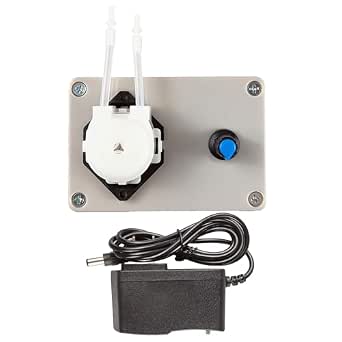
Gikfun DC 12V Adjustable Peristaltic Liquid Dosing Pump, 8-70 ml/min, with Adapter
This Gikfun pump offers straightforward flow control with a double knob design, making it a reliable choice for simple laboratory tasks. Compared to the more advanced INTLLAB BT100, it lacks automation features and viscosity handling, which limits its use in complex setups. Its adjustable flow rate from 8-70 ml/min makes it suitable for non-viscous liquids in water treatment or biochemical analysis, but it can’t handle viscous fluids or high-precision demands. The ease of disassembly and quiet operation are definite advantages, yet the absence of compatibility with viscous liquids restricts its versatility.
Pros:- Affordable with reliable basic functionality
- Adjustable flow rate for simple calibration
- Easy to disassemble for cleaning and maintenance
Cons:- Limited to non-viscous liquids, reducing versatility
- No automation or remote control options
Best for: Laboratory technicians or hobbyists needing an affordable, easy-to-maintain dosing pump for non-viscous liquids
Not ideal for: Industrial users or chemical processors requiring precise control over viscous or complex fluids
- Flow Rate:8-70 ml/min
- Tube Size:2mm ID x 4mm OD
- Output Voltage:DC 12V 2A
- Application:Laboratory, biochemical analysis, water treatment
Our verdict“This pump is ideal for budget-conscious users handling straightforward, non-viscous liquids in small-scale settings.”
INTLLAB BT100 Peristaltic Pump – High-Precision Dosing Pump with Variable Speed and RS485 Interface
The INTLLAB BT100 excels in delivering high-precision flow control, with a stepper motor maintaining accuracy at speeds from 0.1 to 100 RPM. Compared to the simpler Gikfun model, it offers automation capabilities via RS485, making it suitable for complex, repeatable dosing tasks. Its durable stainless steel construction and quick tubing changes support heavy-duty applications, but the setup process can be challenging for those without technical experience. While its flow range (0.06-360 mL/min) is broad, the lack of detailed viscosity handling info means it may struggle with highly viscous fluids.
Pros:- Exceptional accuracy and repeatability with stepper motor
- Automation-ready with RS485 interface and control options
- Robust, corrosion-resistant stainless steel build
Cons:- Complex initial setup requiring technical skills
- Price not specified, potentially high for hobbyists
Best for: Industrial, biotech, or chemical labs requiring automation and high-precision dosing for complex processes
Not ideal for: Hobbyists or small-scale users who need simple, manual operation without extensive setup
- Flow Rate:0.06-360 mL/min
- Speed:0.1-100 RPM
- Interface:RS485
- Tubing:2m 17# tubing
- Material:Corrosion-resistant stainless steel
- Power:Automatic Power-Off Memory
Our verdict“This pump is perfect for professionals needing reliable, automated dosing in demanding industrial environments.”
Gikfun 12V DC Dosing Pump Peristaltic Dosing Head with Connector for Arduino Aquarium Lab Analytic DIY AE1207
This compact Gikfun pump is designed for easy integration into DIY projects, with a flow rate up to 100 ml/min and a simple snap-in tube design. Unlike the more advanced Kamoer DIP 3, it offers limited control features and is not suitable for prolonged or high-viscosity applications. Its straightforward operation makes it ideal for hobbyists or quick setups, but the drive must be purchased separately, adding to the initial cost. Its ease of tube replacement and low size make it versatile for small-scale experiments and automation prototypes.
Pros:- Easy to remove and replace tubing for quick maintenance
- Compact design ideal for DIY projects
- Flexible for various applications like chemical transport or watering
Cons:- Limited durability for long-term or heavy use
- Drive not included, increasing setup complexity
Best for: DIY enthusiasts or educational users needing a straightforward, small-volume dosing solution
Not ideal for: Industrial or continuous high-volume applications where durability and automation are required
- Motor RPM:5000RPM
- Voltage:DC 12V
- Flow Rate:0-100 ml/min
- Tube Size:2mm ID x 4mm OD
- Relative Humidity:<80%
Our verdict“This pump suits hobbyists and educators seeking an accessible, small-scale dosing device for experiments and prototypes.”
24V Peristaltic Pump Variable Speed 0-800ml/min OLED Liquid Dosing Pump for Scientific and Industrial Use
This 24V pump offers a high flow capacity up to 800 mL/min, making it ideal for large-volume chemical transfer or biotech processes. Its OLED display and quick-release, chemical-resistant tubing provide intuitive control and easy maintenance, surpassing the simpler Kamoer DIP 3 in usability. However, the 24V power requirement means it’s less compatible with standard lab setups, and its advanced features may pose a learning curve for new users. Its hygienic, contamination-minimizing design ensures reliable operation in sensitive environments.
Pros:- High flow rate suitable for large-volume applications
- Chemical-resistant quick-release tubing simplifies maintenance
- Intuitive OLED interface with multiple dispensing modes
Cons:- Requires 24V power supply, limiting portability
- Complex features may require training for optimal use
Best for: Laboratories or industrial facilities needing high-volume, precise dosing with minimal contamination risk
Not ideal for: Small-scale or hobbyist applications where lower flow rates and simpler operation suffice
- Voltage:24V
- Flow Rate:0-800 mL/min
- Speed:0-430 rpm
- Display:OLED
- Application:Scientific, industrial, biotech
Our verdict“This pump is designed for professionals needing fast, high-volume dispensing with reliable control and minimal contamination risk.”
Kamoer DIP 3 Rotors Stepper Motor Peristaltic Pump 24V, Small Intelligent Variable Speed Lab Liquid Dosing Pump, 0-452 ml/min, BPT Tube 4.8 mm ID x 8 mm OD, White
The Kamoer DIP 3 combines compactness with advanced digital control, supporting up to 15 pumps via RS485. Compared to the more straightforward Gikfun model, it offers extensive control options and supports multiple simultaneous operations, making it a strong choice for complex laboratory automation. Its flow range (up to 452 ml/min) balances precision with capacity, yet the setup can be daunting for beginners due to multiple control options. The ability to operate multiple pumps simultaneously makes it suitable for multi-channel dosing tasks but may be overkill for simple applications.
Pros:- Supports up to 15 pumps for large automation setups
- Precise digital control with adjustable flow and speed
- Multiple control options including external signals and RS485 communication
Cons:- Complex to configure for beginners
- Limited maximum flow for very high-volume applications
Best for: Research labs and automation projects requiring precise, multi-channel liquid dosing with flexible control methods
Not ideal for: Users seeking a simple, plug-and-play pump for occasional use or small-scale tasks
- Voltage:24V
- Flow Range:1-452 ml/min
- Current:2A max
- Pump Tube:BPT, 4.8 mm ID x 8 mm OD
- Material:Plastic
- Control:RS485, external signals
Our verdict“This pump is best suited for advanced laboratory automation requiring multiple synchronized dosing channels.”
Gikfun 12V Adjustable Peristaltic Dosing Pump for Aquarium and Laboratory Use
This Gikfun pump stands out for its adjustable flow rate ranging from 8 to 70ml/min, making it ideal for delicate experiments or aquarium dosing where fine control is essential. Compared to the Kamoer DIP1500, it offers less maximum flow but excels in precision and ease of cleaning, thanks to its simple disassembly. However, its limited capacity and inability to handle viscous liquids restrict its use to lighter fluids. The easy-to-disassemble design makes maintenance straightforward, but the pump isn’t suited for long-term, continuous operation in demanding environments. This pick makes the most sense for hobbyists or small-scale laboratory setups needing flexible, cleanable dosing solutions.Pros:- Adjustable flow rate for versatile small-scale applications
- Easy to disassemble and clean, reducing maintenance time
- Suitable for scientific, aquarium, and water treatment use
Cons:- Not recommended for continuous long-term operation
- Cannot handle viscous or high-viscosity liquids
Best for: Aquarium hobbyists or small lab users needing adjustable, easy-to-maintain dosing for light fluids
Not ideal for: Industrial or large-volume water treatment, where higher flow and durability are required
- Flow Rate:8-70ml/min
- Tube Size:2mm ID x 4mm OD
- Power Supply:DC 12V
- Application:Aquarium, Laboratory, Water Treatment, Biochemical Analysis
Our verdict“This pump is best suited for users requiring precise, adjustable dosing in light-fluid applications with frequent cleaning needs.”
Peristaltic Pump, 50/60Hz US Plug 110-240V, Single Head, Adjustable Flow, Dosing Pump with Adapter for Aquarium, Lab, Analytical
This pump offers a reliable, compact design with a single head and adjustable flow, making it suitable for both laboratory and industrial environments where space-saving and consistent performance are priorities. Unlike the Kamoer DIP1500, which supports high volumes and automation, this model’s strength lies in its straightforward operation and maintenance, thanks to its disassemblable head. Its single head limits flow capacity, so it’s not ideal for high-volume needs, and it requires a compatible US power supply. It excels in environments where simplicity and reliability matter more than maximum flow, but its limited capacity makes it less suited to large-scale water or chemical dosing.Pros:- Adjustable flow control for precision dosing
- Compact design with easy disassembly for maintenance
- Reliable performance in demanding environments
Cons:- Limited to single head, reducing maximum flow capacity
- Requires US power plug, limiting global flexibility
Best for: Laboratories or small industrial setups needing dependable, adjustable dosing with minimal complexity
Not ideal for: High-volume industrial water treatment or chemical transfer projects
- Frequency:50/60Hz
- Voltage:110-240V
- Design:Single Head
- Flow Adjustment:Yes
Our verdict“This model is ideal for users who need a dependable, space-efficient pump for moderate-volume applications in lab or industrial settings.”
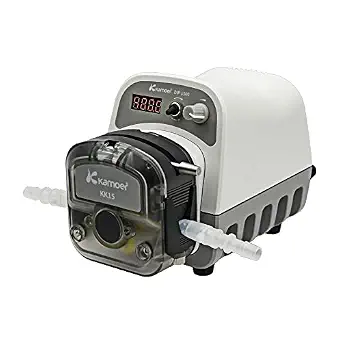
Kamoer DIP1500 Peristaltic Pump 24V 1500ml/min High Flow Liquid Dosing Pump
The DIP1500 from Kamoer stands out with its impressive flow capacity of up to 1500ml/min, making it well-suited for large-scale or automated processes. Its advanced digital control options, including a LED display and multiple communication modes like Modbus, surpass the simpler manual controls of the Kamoer KK300. While its high capacity is a clear advantage, the tube consumables have a limited lifespan of around 200 hours, which could lead to higher maintenance costs over time. Additionally, its noise level of up to 65dB might be disruptive in quiet environments. This pump is best for automation-heavy setups where high flow and precision control are needed, but less so for small, infrequent dosing tasks.Pros:- High flow rate up to 1500ml/min for efficient dosing
- Multiple control options including external analog and communication interfaces
- Supports automatic memory and versatile operation modes
Cons:- Tube life limited to around 200 hours, increasing maintenance
- Noise level may be noticeable in quiet settings
Best for: Automated laboratory or industrial processes requiring high-volume, programmable dosing
Not ideal for: Small-scale or hobbyist applications where low flow and simplicity are preferred
- Flow Rate:up to 1500ml/min
- Voltage:24V DC
- Power:<50W
- Control Methods:Rotary encoder, foot switch, external analog, 485 communication
Our verdict“This pump is best for automation-focused environments needing high flow rates and flexible control but involves ongoing consumable costs.”
Kamoer DIPump KK300 4-Rotor High Flow Peristaltic Pump, 0-300ml/min, 24V
The KK300 with its four rotors offers a versatile solution for laboratory and industrial tasks requiring steady, precise flow control up to 300ml/min. Its multiple control modes, including rotary encoder and analog inputs, provide flexibility for complex automation needs. Compared to the DIP1500, it supports smaller flow rates with higher precision, while its support for various tubing sizes boosts adaptability. The digital display simplifies operation, but the setup can be complex and may require some technical knowledge. Noise remains below 65dB, suitable for quiet environments. This model is well-suited for detailed research projects or multi-step chemical dosing where control and precision are paramount.Pros:- Supports multiple control modes for flexibility
- High precision with digital calibration and stepper motor
- Supports various tubing sizes for application versatility
Cons:- Setup can be complex and may require technical skills
- Noise level could be noticeable in sensitive environments
Best for: Laboratory researchers or industrial operators needing precise, multi-flow liquid transfer
Not ideal for: High-volume or continuous industrial water treatment applications
- Flow Rate:0-300ml/min
- Rotors:4
- Power Supply:24V
- Control Modes:Rotary encoder, foot switch, external analog, 485 communication
- Display:4-digit digital
Our verdict“This pump suits users needing detailed control and multiple operation modes for medium-volume laboratory or industrial dosing tasks.”
Kamoer KCP PRO2 High Flow Peristaltic Dosing Pump, 40-210ml/min, 12V DC
The KCP PRO2 offers a compact solution with a flow range of 40 to 210ml/min, making it suitable for precise chemical dosing in confined spaces. Its 12V operation and lightweight design simplify integration into small systems, while the adjustable flow ensures accuracy for sensitive applications. Compared to the high-capacity DIP1500, this pump is less suited for bulk water transfer but excels in small-scale chemical dosing or aquarium supplementation. The tool-free tubing change feature simplifies maintenance, but its limited maximum flow restricts use in high-volume scenarios. This pump is ideal for laboratory or industrial environments where space and precise control matter most.Pros:- Adjustable flow for fine control
- Compact and lightweight for easy setup
- Tool-free tubing changes simplify maintenance
Cons:- Limited maximum flow for high-volume needs
- Requires 12V DC power supply, which may need adapters
Best for: Laboratory or industrial users needing compact, accurate dosing of chemicals or additives
Not ideal for: Large-volume water transfer or continuous high-flow applications
- Voltage:12V
- Flow rate:40-210ml/min
- Weight:765g
- Size:110 x 76 x 140mm
Our verdict“This pump is best for small-scale, precise dosing tasks where space and accuracy are key, but not for bulk or high-volume applications.”
Kamoer M1-STP Intelligent Peristaltic Pump 24V 0-88ml/min Low Flow
The Kamoer M1-STP stands out as the most versatile choice in this lineup, thanks to its support for multiple dosing modes and built-in flow calibration, making it ideal for laboratory and industrial environments where accuracy is paramount. Its compact size and lightweight design facilitate seamless integration into various setups, while the multiple control options including RS485 and foot-switch support diverse operational preferences. Compared with the Kamoer KXP100, it offers more programming flexibility but is limited to lower flow rates, which may not suit high-volume needs. The need for compatible tubing and its temperature range could restrict use in more extreme conditions. This pick is best suited for users needing precise, programmable dosing in controlled environments. It’s less suitable for high-flow industrial applications or environments with temperatures outside 0-60°C.Pros:- Supports multiple dosing modes with adjustable parameters
- Built-in flow calibration for high accuracy
- Compact and lightweight for easy workspace integration
Cons:- Limited to low flow applications up to 88 ml/min
- Requires compatible tubing and may need calibration adjustments for different liquids
Best for: Laboratory technicians and industrial users requiring accurate, programmable low-flow dosing
Not ideal for: High-volume industrial processes or environments with temperature extremes above 60°C
- Flow Range:0-88 ml/min
- Voltage:24V
- Weight:510 g
- Temperature Range:0-60 °C
- Control Options:RS485, foot-switch
- Relative Humidity:below 80%
Our verdict“This pump excels for precise, programmable dosing in lab or small-scale industrial settings where flow accuracy is critical.”
INTLLAB 12V DC Peristaltic Liquid Pump for Aquarium and Laboratory Use
The INTLLAB 12V DC pump offers a flexible solution for aquarium and laboratory dosing, with easy disassembly for cleaning and adjustable flow direction, making it well-suited for Viscous or non-viscous liquids. Its flow rate varies significantly with tube size and liquid viscosity, which means users must fine-tune setup for accurate dosing—more manual effort than the Kamoer M1-STP. Compared to the Kamoer NKP, it supports a broader range of liquids but lacks the high-precision programmable features. Its adaptability makes it appealing for DIY and experimental applications, yet it demands careful calibration for precise control. This model suits hobbyists and researchers needing flexible, easy-to-maintain pumps for mixed liquids. It’s less ideal for applications where consistent, high-precision flow is mandatory.Pros:- Easy to disassemble and clean
- Supports adjustable flow direction
- Suitable for viscous and non-viscous liquids
Cons:- Flow rate varies with tube size and viscosity
- Requires setup and calibration for accurate flow control
Best for: DIY enthusiasts, aquarium hobbyists, and researchers working with various liquids
Not ideal for: High-precision laboratory settings or high-volume industrial dosing
- Flow Rate:2~100 mL/min
- Tube Size:1mm ID x 3mm OD, 2mm ID x 4mm OD, 3mm ID x 5mm OD
- Power Supply:12V DC
- Application:Aquarium, laboratory, chemical
- Viscosity Compatibility:Supports viscous and non-viscous liquids
Our verdict“This pump offers flexible, easy maintenance for hobbyists and researchers needing adaptable liquid dosing solutions.”
Kamoer NKP Low Flow Peristaltic Pump 12V DC Small Dosing Pump for Aquarium Lab Analysis
The Kamoer NKP offers a steady flow rate of at least 70ml/min, making it suitable for precise low-volume dosing in aquariums and lab analysis. Its lightweight, easy-to-maintain design supports quick head removal, simplifying cleaning and replacements. While it’s less flexible than the Kamoer KXP100 in terms of programmability, it delivers reliable, consistent flow for routine lab or aquarium tasks. Compared to the Kamoer M1-STP, it lacks advanced digital controls but compensates with simplicity and durability. Its flow rate may be limiting for larger-volume applications, and it’s restricted to a 12V power source, which could limit portability. This pump is best for users prioritizing ease of use and consistent low-volume dosing over advanced programmability.Pros:- Easy to remove and clean pump head
- Supports changing flow direction
- Low power consumption and lightweight
Cons:- Flow rate may not suit high-volume applications
- Limited to 12V power source and flow rate ≥70ml/min
Best for: Aquarium keepers and laboratory staff needing dependable low-flow dosing with minimal fuss
Not ideal for: High-volume industrial or chemical dosing where flow needs exceed 70ml/min
- Flow Rate:≥70 ml/min
- Tube Size:3mm ID x 5mm OD
- Voltage:12V DC
- Humidity:<80%
- Ambient Temp:<80°C
Our verdict“Ideal for users who need a compact, reliable low-flow pump for routine aquarium or lab dosing tasks.”
Kamoer KXP100 0.01-110ml/min Low Flow Intelligent Programmable Peristaltic Pump
The Kamoer KXP100 combines high-precision flow control with WiFi remote operation, making it suitable for advanced laboratory, aquarium, and industrial uses where settings need to be adjusted remotely. Its LCD display and memory function enable easy setup and retention of parameters, outperforming simpler pumps like the Kamoer NKP in programmability. Despite its low-flow range, it’s ideal for applications demanding meticulous dosing and remote management, though it’s limited to low flow rates and requires an external power supply. Compared with the Kamoer M1-STP, it offers more connectivity options at the expense of flow capacity. This pick is best for users who value remote access and high accuracy over high-volume throughput. It may not suit high-flow needs or environments lacking WiFi connectivity.Pros:- High-precision flow control with adjustable settings
- WiFi remote control compatible with iOS and Android
- Memory function retains settings after power off
Cons:- Limited to low-flow applications
- Requires external power supply and no included tubing
Best for: Research labs and tech-savvy aquarium hobbyists requiring remote-controlled, precise dosing
Not ideal for: High-volume or industrial dosing where flow exceeds 110ml/min, or setups without WiFi
- Flow Rate:0.01-110 ml/min
- Voltage:24V
- Pump Size:93x100x108mm
- Pump Tube:imported BPT, 3.2×6.4mm
- Weight:534g
Our verdict“This pump is ideal for users seeking remote, precise control in low-flow dosing scenarios where connectivity matters.”

How We Picked
These products were selected based on multiple criteria including flow rate accuracy, reliability, build quality, ease of installation, and versatility. We prioritized pumps that serve both small-scale laboratory or aquarium setups and larger industrial applications, ensuring a range of options for different user needs. Price-to-performance ratios and user feedback also played key roles in ranking. Pumps with advanced features such as digital interfaces or programmability were favored for users seeking automation. Ultimately, the list aims to highlight models that offer the best balance of precision, durability, and value for various dosing applications.Factors to Consider When Choosing Peristaltic Dosing Pump Set
Choosing the right peristaltic dosing pump set involves understanding several key factors that impact performance and usability. Beyond just flow rate, consider how the pump’s control options, durability, and compatibility fit your specific needs. Making an informed decision requires balancing your budget with the complexity of features you require. This guide will explore the main considerations to help you avoid common pitfalls and select a pump that truly matches your application.Flow Rate Range and Precision
Matching the pump’s flow rate to your application’s requirements is fundamental. A pump with too high a maximum capacity may lack accuracy at lower flows, while a low-capacity pump could struggle with larger volumes. Precision is especially critical in laboratory or medical settings, where small deviations can impact results. Be sure to verify whether the pump maintains accuracy across its entire range, and consider models with programmable or adjustable flow rates for flexibility.
Ease of Installation and Integration
Some pumps are designed for plug-and-play operation, suitable for quick setup, while others offer extensive integration options like RS485, Wi-Fi, or compatibility with microcontrollers like Arduino. If you plan to automate or include the pump within a larger system, choose a model with compatible interfaces. Conversely, simpler models may be better for basic tasks, reducing setup complexity and minimizing the risk of configuration errors.
Build Quality and Durability
Peristaltic pumps operate by compressing tubing, making the quality of the tubing and pump head vital for longevity. Cheaper plastics or poorly sealed components can lead to leaks or early wear. Investing in pumps with sturdy construction and easy-to-replace tubing can lower maintenance costs and downtime. Consider the environment you’ll be using the pump in, whether it’s a laboratory, aquarium, or industrial setting, and ensure the materials are compatible with your liquids.
Control and Automation Features
Advanced models with programmable dosing schedules, remote control, or feedback systems can save time and improve accuracy. However, these features come with increased complexity and cost. For users unfamiliar with automation, simple manual controls may suffice, but for those needing precise, repeatable dosing, a pump with digital interfaces or preset programs can be invaluable. Think about whether your setup will benefit from automation or if manual operation is enough.
Cost and Long-Term Value
While budget models are tempting, they may require more frequent maintenance or offer less precise control. Conversely, higher-priced pumps often deliver better durability, accuracy, and feature sets, which can justify their cost over time. Consider the total cost of ownership, including replacement tubing, power consumption, and potential downtime. For critical applications, investing in a more robust, feature-rich model can be more economical in the long run.
Frequently Asked Questions
Can I use these pumps for chemical dosing?
Many peristaltic dosing pumps are suitable for chemical applications due to their gentle pumping action and the ability to use chemically resistant tubing. However, it’s crucial to check the chemical compatibility of the pump materials with your specific liquids. Pumps designed for laboratory or industrial use typically have better material choices, reducing risks of corrosion or degradation. Always verify the pump’s specifications and consult with manufacturers if in doubt about chemical compatibility.
How accurate are these pumps at low flow rates?
Accuracy at low flows varies among models. Pumps with finer control and digital interfaces tend to perform better at small volumes, often within a few percent of the target. Cheaper or mechanical pumps may have significant variability when dosing very small quantities. If your application requires precise low-volume dosing, choose a model explicitly rated for high accuracy at low flows and consider programmable features that allow calibration and fine adjustments.
Are these pumps easy to clean and maintain?
Most peristaltic pumps are relatively straightforward to clean because the tubing is replaceable and separate from the motor assembly. Regular maintenance involves replacing worn tubing and cleaning the pump head, which is usually simple. Pumps with accessible, modular components tend to be easier to service, reducing downtime and prolonging lifespan. For critical or frequent use, look for models that emphasize ease of maintenance and have readily available spare parts.
What control options should I consider for automation?
If automation is a priority, look for pumps with digital interfaces like RS485, USB, or Wi-Fi, which allow remote operation and integration into control systems. Programmable pumps with preset dosing schedules or feedback loops provide consistent results over time. Simpler models may lack these features but are easier to set up and operate manually. Think about your technical skills and whether your system benefits from advanced control or basic operation.
How do I choose between a small and large capacity pump?
The decision depends on your application’s volume needs. Small-capacity pumps excel in precision dosing of small quantities, ideal for laboratory experiments or delicate chemical addition. Larger capacity pumps are better suited for industrial processes or water treatment, where high flow rates and volume are required. Consider not only current needs but also potential future expansion to ensure your choice remains effective as your requirements grow.
Conclusion
For users seeking a reliable, all-around performer, the Gikfun DC 12V Adjustable Peristaltic Liquid Dosing Pump delivers a strong balance of accuracy and affordability, making it the best overall pick. Those with larger volume needs or industrial applications might prefer the Kamoer DIP1500 for its high flow capacity, while hobbyists and small-scale labs will find the Kamoer KXP100 ideal for low-volume, precise dosing. Beginners or casual users should opt for models with straightforward controls, whereas automation enthusiasts will benefit from pumps with digital and programmable features. Tailor your choice to your specific application, budget, and technical comfort level for best results.
As an affiliate, we earn on qualifying purchases.Halloween Picks
halloween