
A wireless lavalier microphone kit can make phone videos, interviews, and presentations easier to hear without keeping a microphone in your hand. My best overall pick is the DJI Mic Mini for its compact kit and charging case, while the RØDE Wireless PRO suits creators who need a more advanced recording setup. Four-microphone bundles may fit group shoots, while UHF headset systems make more sense for live speaking than casual phone recording. The main tradeoffs are device compatibility, number of speakers, recording controls, and how much gear you want to manage. Read on for the full comparison and help matching a kit to your setup.

Get the latest gadgets delivered free with Prime
- Fast, free delivery on millions of items
- Prime Video, Amazon Music and more included
- Member-only deals all year
Complete the kit

Key Takeaways
Kit design separates the leading compact picks: the DJI Mic Mini and NEEWER CM28 include charging cases, while simpler phone-focused bundles may require more attention to charging and storage.
More transmitters help only when you record groups: four-microphone kits can suit roundtable videos, but a two-person kit is easier to manage for interviews and solo content.
Connector compatibility is a buying gate: phone-first kits and camera-oriented systems are not interchangeable by default, so check included adapters and device support before choosing.
UHF bodypack systems serve a different job: the Pyle, Phenyx Pro, and HOTEC kits pair headset or lavalier options with a receiver setup suited to presentations and live speaking.
Advanced controls add complexity as well as capability: the RØDE Wireless PRO is the premium pick for demanding workflows, while beginner kits favor simpler phone connections.
| Mini Mic Pro Wireless Lavalier Microphone for iPhone and Android |  | Best Compact Pick | Microphone type: Wireless lavalier | Compatibility: iPhone, Android, tablets, and laptops | Included adapters: USB-C and Lightning | VIEW ON AMAZON | See Our Full Breakdown |
| 2-Pack Wireless Lavalier Microphone for iPhone, iPad, and Android |  | Best Value for Two-Person Recording | Connectivity: 2.4GHz wireless | Microphones: 2 | Connector: USB Type-C | VIEW ON AMAZON | See Our Full Breakdown |
| DJI Mic Mini Wireless Lavalier Microphone Kit with Charging Case and Accessories |  | Best Premium Creator Kit | Transmitter weight: 10 g | Transmitters: 2 | Receiver: 1 | VIEW ON AMAZON | See Our Full Breakdown |
| Mini Wireless Lavalier Microphone, Dual Channel with AI Noise Cancellation for iPhone, Android, Camera |  | Best Long-Range Dual-Mic Pick | Channels: 2 microphones | Wireless range: 328 ft | Battery life: 36 hours with charging case | VIEW ON AMAZON | See Our Full Breakdown |
| 4-Pack Wireless Mini Lavalier Microphones for iPhone, Android, and iPad |  | Best for Group Recording | Microphones: 4 | Receiver: USB-C and Lightning dual-port | Compatibility: iPhone, iPad, and Android smartphones | VIEW ON AMAZON | See Our Full Breakdown |
| NEEWER CM26 MAX AI Wireless Lavalier Microphone |  | Best for Adjustable Noise Control | Connection: USB-C receiver; no Bluetooth pairing required | Noise cancellation: Two AI modes: indoor up to -15 dB; outdoor up to -40 dB | Audio sampling: 48 kHz/24-bit | VIEW ON AMAZON | See Our Full Breakdown |
| PQRQP 3-in-1 Professional Wireless Lavalier Microphone for iPhone/Android/Camera – Elegant Black |  | Best for Cross-Device Simplicity | Receiver: 3-in-1 universal: USB-C, Lightning, and 3.5 mm | Microphone setup: Dual wireless microphones | Compatibility: Android phones, iPhone including iPhone 15, laptops, and cameras | VIEW ON AMAZON | See Our Full Breakdown |
| NEEWER CM28 Wireless Lavalier Microphone Kit with Charging Case |  | Best for Backup Recording | Kit contents: 2 transmitters, 1 receiver, charging case | Recording format: 48 kHz WAV, 16-bit | Transmitter storage: 4GB each; up to 9 hours | VIEW ON AMAZON | See Our Full Breakdown |
| Pyle PDWMU211 Dual UHF Wireless Microphone System with Headset, Lavalier, Beltpack Transmitter & Receiver |  | Best for Classrooms and Presentations | System type: Dual UHF narrow-band wireless microphone system | Selectable channels: 8 | Operating range: Up to 160+ ft | VIEW ON AMAZON | See Our Full Breakdown |
| Phenyx Pro PDP-1-1B Single Digital Wireless Headset/Lavalier Microphone System |  | Best for a Single Presenter | Frequency range: 902–928 MHz UHF | Tunable frequencies: 15 | Audio quality: 48 kHz/24-bit | VIEW ON AMAZON | See Our Full Breakdown |
| MAYBESTA Wireless Mini Lavalier Microphone 2-Pack for iPhone, iPad & Android |  | Best for Simple Phone Recording | Microphones: 2 wireless lavalier microphones | Compatibility: USB-C iPhone models, iPad, Android, laptops, and tablets | Pickup pattern: Omnidirectional | VIEW ON AMAZON | See Our Full Breakdown |
| HOTEC UHF Wireless Headset/Lavalier Microphone System with Bodypack Transmitter and Rechargeable Receiver | 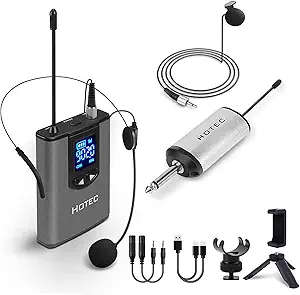 | Best for Presentations and PA Systems | Wireless type: UHF | Microphones: Headset microphone and lavalier microphone | Selectable frequencies: 32 | VIEW ON AMAZON | See Our Full Breakdown |
| Wireless Lavalier Microphone 4-Pack for iPhone, Android, and Cameras |  | Best for Four-Person Recording | Transmitters: 4 | Receiver: 1 3-in-1 receiver | Wireless technology: 2.4GHz | VIEW ON AMAZON | See Our Full Breakdown |
| RØDE Wireless PRO Wireless Microphone System (2 Transmitters, 1 Receiver, Charging Case) |  | Best for Professional Production | Transmitters: 2 | Receivers: 1 | Recording format: 32-bit float onboard recording | VIEW ON AMAZON | See Our Full Breakdown |
| ZealSound Mini Wireless Lavalier Microphone for iPhone, iPad, and Android – Dual Channel with Noise Cancellation |  | Best Compact Kit with Charging Case | Microphones: 2 transmitters | Weight: 5 g / 0.18 oz per microphone | Audio quality: 48kHz/24-bit | VIEW ON AMAZON | See Our Full Breakdown |
More Details on Our Top Picks
Mini Mic Pro Wireless Lavalier Microphone for iPhone and Android
For a solo creator who wants a small, simple kit, the Mini Mic Pro is easier to pack than the two-transmitter DJI Mic Mini bundle. Its included USB-C and Lightning adapters cover many phones and tablets, and plug-and-play setup avoids app or Bluetooth pairing. Foam and dead-cat covers give it more practical outdoor protection than a bare clip-on mic, while the under-one-ounce weight keeps it unobtrusive on clothing. You can also charge your phone while recording, which helps on longer shoots. The tradeoff is up to six hours per charge, shorter than the DJI bundle’s stated 48-hour kit runtime. It is a one-mic choice, too, so interviewers who need two voices should look at the two-mic DJI kit or the four-mic set instead.
Pros:- Under-one-ounce microphone is easy to wear and carry
- USB-C and Lightning adapters support a broad range of compatible devices
- Foam and dead-cat covers help reduce wind noise outdoors
- Phone can be charged while recording
Cons:- Up to six hours per charge is limiting for long recording days
- Single-microphone setup is not suited to recording two speakers at once
Best for: Solo mobile creators who want a lightweight, adapter-ready mic for phone video and occasional outdoor recording
Not ideal for: Interviewers recording two or more people, or creators who need a long multi-day runtime without recharging
- Microphone type:Wireless lavalier
- Compatibility:iPhone, Android, tablets, and laptops
- Included adapters:USB-C and Lightning
- Wind protection:High-density foam and dead-cat cover
- Weight:Under 1 ounce
- Battery life:Up to 6 hours per charge
- Charging while recording:Device can be charged simultaneously
Our verdict“Choose the Mini Mic Pro for a compact, straightforward solo setup; pick a multi-mic kit if you record interviews or need longer runtime.”
2-Pack Wireless Lavalier Microphone for iPhone, iPad, and Android
Two microphones in one plug-and-play set make this a practical fit for interviews, co-hosted clips, and paired presentations. Its 2.4GHz connection and stated 66-foot unobstructed range give speakers room to move, while built-in noise reduction and windproof foam address common recording distractions. Compared with the Mini Mic Pro, this kit is better equipped for two voices, but its microphones run for only up to four hours per charge. The receiver can charge a phone during use, though that does not extend the microphone runtime. Phone and tablet setup is the simplest path; Windows and Mac computers require adapters. Buyers wanting a case-based kit with longer stated runtime and more recording controls should compare it with the DJI Mic Mini.
Pros:- Two microphones support simultaneous two-person recording
- Plug-and-play operation requires no app or Bluetooth pairing
- 66-foot stated range allows some movement away from the receiver
- Receiver can charge the phone during recording
Cons:- Up to four hours of working time is short for extended sessions
- Windows and Mac computer use requires adapters
- Stated range applies to unobstructed conditions
Best for: Two-person interviewers and co-hosts recording on compatible iPhones, iPads, or Android phones
Not ideal for: Creators who need a full-day recording session, or computer users who want direct setup without sourcing adapters
- Connectivity:2.4GHz wireless
- Microphones:2
- Connector:USB Type-C
- Compatible devices:iPhone, iPad, Android smartphones, Windows/Mac computers
- Pickup pattern:Omnidirectional
- Charging time:1.5 hours
- Working time:Up to 4 hours
- Wireless range:66 feet, unobstructed
- Special features:Clip-on, noise reduction, windproof foam
Our verdict“Pick this set for straightforward two-person phone recording, but consider the DJI Mic Mini if longer runtime and recording controls matter more.”
DJI Mic Mini Wireless Lavalier Microphone Kit with Charging Case and Accessories
The most control-focused kit in this group, the DJI Mic Mini combines two transmitters with a receiver and charging case, giving creators a flexible setup for solo work or two-person recording. Its two noise-cancellation levels, five gain settings, automatic limiting, and mono or stereo modes offer more ways to adapt a recording than the simpler Mini Mic Pro. The 10 g transmitters and magnetic or clip-on wearing options also suit creators who want a discreet mic. The product states up to 48 hours of battery life, but that is a kit-level claim; the supplied data does not give a per-charge transmitter runtime. The broad accessory bundle adds utility, though it also means more pieces to pack and track. Some features, including safety track, require the DJI Mimo app.
Pros:- Two transmitters support solo or two-person recording
- Five gain levels and two noise-cancellation settings allow audio adjustment
- Mono and stereo modes suit different recording workflows
- Charging case and hard EVA case help store and transport the kit
Cons:- Safety track and some other features require the DJI Mimo app
- Large accessory bundle adds pieces to organize
- The supplied data does not specify per-charge transmitter runtime
Best for: Creators recording interviews or varied video formats who want adjustable audio settings, two transmitters, and a storage case
Not ideal for: Buyers who want the fewest components or app-free access to every feature
- Transmitter weight:10 g
- Transmitters:2
- Receiver:1
- Battery life:Up to 48 hours, as stated in the title
- Audio pickup:Omnidirectional
- Noise cancellation:Two levels
- Gain adjustment:5 levels
- Recording modes:Mono and stereo
- Included accessories:Charging case, camera audio cable, USB-C phone adapter, USB-C charging cable, windscreens, clip magnets, carrying pouch, 2 Deco Gear lapel microphones, 5-inch hard EVA case
Our verdict“Choose the DJI Mic Mini for a flexible creator kit with recording controls and two transmitters, provided you are comfortable managing its accessories and app-dependent features.”
Mini Wireless Lavalier Microphone, Dual Channel with AI Noise Cancellation for iPhone, Android, Camera
Its defining advantage is the stated 328-foot range, paired with two microphones for recording separate voices. That makes this kit more suited to presenters who move around a space than the 2-Pack Wireless Lavalier Microphone’s stated 66-foot range. The USB-C receiver ships with Lightning and USB-A adapters, and the charging case is claimed to provide up to 36 hours of battery life. Compact mics and furry wind muffs help with on-camera use and outdoor shoots, while AI noise reduction targets distracting background sound. The compatibility caveats need close attention: the listing excludes GoPro, Insta360, Akaso, and OnePlus devices. Its range claim is also best treated as a stated maximum, since real environments can affect wireless performance.
Pros:- Two channels capture two speakers simultaneously
- Stated 328-foot range exceeds the 66-foot claim of the 2-Pack Wireless Lavalier Microphone
- Charging case provides up to 36 hours of stated battery life
- USB-C, Lightning, and USB-A adapters broaden device connection options
Cons:- Not compatible with GoPro, Insta360, Akaso, or OnePlus devices
- Compatibility and port type need checking before purchase
- The stated maximum range may not reflect performance in obstructed spaces
Best for: Two-person creators recording with compatible phones, cameras, or computers who need room to move between mic and receiver
Not ideal for: GoPro, Insta360, Akaso, or OnePlus owners, and buyers unwilling to verify device and port compatibility
- Channels:2 microphones
- Wireless range:328 ft
- Battery life:36 hours with charging case
- Connectors:USB-C, Lightning, USB-A
- Noise cancellation:AI noise reduction
- Microphone dimensions:Under 3 cm long and under 1.5 cm wide
- Compatibility:iPhone, Android, cameras, laptops/PCs; not compatible with GoPro, Insta360, Akaso, or OnePlus
- Included outdoor accessory:Furry wind muffs
Our verdict“Choose this dual-mic kit for compatible gear and long-distance movement, after checking the device exclusions and connector fit.”
4-Pack Wireless Mini Lavalier Microphones for iPhone, Android, and iPad
Four microphones make this the group-recording choice in a lineup otherwise centered on solo or two-person kits. Automatic pairing keeps setup simple, while DSP noise reduction and omnidirectional pickup support a range of voices around a conversation. Its USB-C and Lightning dual-port receiver covers many phones and tablets, and the receiver can charge a phone during recording. Each microphone is listed for up to eight hours, so the stated 32-hour combined runtime should not be read as the run time of one mic. Compared with the DJI Mic Mini, this set can capture more people at once but has fewer listed audio controls such as adjustable gain and mono or stereo modes. Android users may need to enable OTG, and the supplied compatibility list does not include computers or cameras.
Pros:- Four microphones allow simultaneous recording of up to four people
- USB-C and Lightning receiver supports compatible Android and Apple phones and tablets
- Automatic pairing simplifies setup
- Battery display and phone charging during recording help manage mobile sessions
Cons:- Android users may need to enable OTG
- Eight hours is the stated runtime per microphone; 32 hours is combined across four
- Compatibility information does not list cameras or computers
Best for: Small teams, group interviews, and family creators who need up to four speakers on compatible phones or tablets
Not ideal for: Camera or computer users, and Android owners whose devices do not support the required OTG setting
- Microphones:4
- Receiver:USB-C and Lightning dual-port
- Compatibility:iPhone, iPad, and Android smartphones
- Microphone battery life:Up to 8 hours per microphone
- Charging time:2 hours per microphone
- Transmission range:Up to 20 m (65 ft)
- Audio processing:DSP noise reduction
- Pickup pattern:360° omnidirectional
- Other features:Real-time battery display and phone charging during recording
Our verdict“Pick this set when recording four people on compatible phones or tablets; choose the DJI Mic Mini for a smaller setup with more stated audio controls.”
NEEWER CM26 MAX AI Wireless Lavalier Microphone
The CM26 MAX stands out for creators who want to adapt noise handling to the setting: its two AI modes are specified for up to 15 dB of indoor and 40 dB of outdoor noise reduction. Compared with the NEEWER CM28, it lacks the listed standalone transmitter recording, but it offers 48 kHz/24-bit audio, a low-cut filter with two frequency choices, and a 3.5 mm monitoring port for checking audio while recording. The USB-C receiver skips Bluetooth pairing, and the charging case brings total runtime to up to 50 hours. That flexibility suits regular phone and camera use, though setup may require OTG activation on some Android devices. Its 394-foot range is a best-case open-area figure, so it is less meaningful in obstructed locations.
Pros:- Two AI noise cancellation modes for indoor and outdoor recording
- USB-C plug-and-play receiver avoids Bluetooth pairing
- Charging case supports up to 50 hours total runtime
- 3.5 mm monitoring port and adjustable low-cut modes
Cons:- Some Android devices require OTG activation
- Maximum stated range depends on an open, unobstructed path
Best for: Phone, tablet, or camera creators who record in changing indoor and outdoor conditions and want adjustable noise reduction and monitoring.
Not ideal for: Android users who want a guaranteed no-settings setup, or anyone who needs standalone transmitter recording.
- Connection:USB-C receiver; no Bluetooth pairing required
- Noise cancellation:Two AI modes: indoor up to -15 dB; outdoor up to -40 dB
- Audio sampling:48 kHz/24-bit
- Frequency response:20 Hz–20 kHz
- Low-cut modes:75 Hz, 150 Hz, or off
- Monitoring:3.5 mm TRS port
- Battery runtime:Up to 50 hours total with charging case
- Wireless range:Up to 394 ft (120 m) forward in open areas
Our verdict“Choose the CM26 MAX if adaptable noise control and long case-supported runtime matter more than the CM28’s standalone recording.”
PQRQP 3-in-1 Professional Wireless Lavalier Microphone for iPhone/Android/Camera – Elegant Black
The PQRQP’s main advantage is its 3-in-1 receiver, with USB-C, Lightning, and 3.5 mm connections for moving between supported phones, laptops, and cameras. Automatic plug-and-play pairing keeps setup simple, while the dual-microphone design suits interviews or two-person clips. Compared with the NEEWER CM26 MAX, it offers a more varied set of receiver connectors, but its stated battery life is 7 hours and it does not list selectable noise-control modes or audio monitoring. Active noise reduction may help focus voices, though the provided specifications do not quantify its effect. Pass-through charging lets the receiver charge while in use, which can help on longer shoots; the 65-foot range is shorter than the longer open-area claims of some alternatives. Some Android devices also need OTG enabled.
Pros:- 3-in-1 receiver supports USB-C, Lightning, and 3.5 mm connections
- Dual microphones suit interviews and two-person recordings
- Automatic plug-and-play connection without apps or Bluetooth
- Receiver supports pass-through charging during use
Cons:- 7-hour battery life is shorter than the CM26 MAX’s case-supported runtime
- Some Android devices require manual OTG activation
- 3.5 mm connector is not suitable for laptop audio input
Best for: Creators who switch between Lightning and USB-C phones, or connect to a camera, and want a straightforward dual-mic kit.
Not ideal for: Long-session shooters who need extended battery life, detailed audio controls, or a stated monitoring output.
- Receiver:3-in-1 universal: USB-C, Lightning, and 3.5 mm
- Microphone setup:Dual wireless microphones
- Compatibility:Android phones, iPhone including iPhone 15, laptops, and cameras
- Wireless range:65 ft
- Battery life:Up to 7 hours
- Noise reduction:Built-in active noise reduction chip
- Connectivity:Automatic plug-and-play; no Bluetooth or apps required
Our verdict“Pick the PQRQP for connector flexibility and simple two-person recording when a 7-hour battery window is enough.”
NEEWER CM28 Wireless Lavalier Microphone Kit with Charging Case
The CM28 earns a distinct place for its standalone transmitter recording: each transmitter has 4GB of storage for up to 9 hours of uncompressed WAV audio, giving two-person shoots a local recording option alongside wireless capture. That can help when a connection drops, a capability the CM26 MAX specifications do not list. The CM28 also includes two transmitters, a receiver, adapters, and cables, making it a more complete kit for mixed-device setups. Its tradeoffs are practical: storage and transmitter runtime are each capped at up to 9 hours, and receiver runtime is up to 8 hours. The claimed 200-meter wireless range applies to unobstructed areas. With two channels and a one-button noise cancellation feature, it is better suited to interviews than solo creators who do not need separate local recordings.
Pros:- Two transmitters support two-person recording
- Each transmitter records standalone 48 kHz WAV audio to 4GB storage
- One-button noise cancellation
- Adapters and cables support several device types
Cons:- Standalone storage holds up to 9 hours per transmitter
- The 200-meter range claim is for unobstructed areas and varies by location
- Receiver battery life is up to 8 hours
Best for: Interviewers and two-person video teams who want local WAV backups in each transmitter as well as wireless recording.
Not ideal for: Solo creators seeking a compact, simple phone kit or anyone who needs more than 9 hours of transmitter storage or battery runtime.
- Kit contents:2 transmitters, 1 receiver, charging case
- Recording format:48 kHz WAV, 16-bit
- Transmitter storage:4GB each; up to 9 hours
- Transmitter battery life:Up to 9 hours
- Receiver battery life:Up to 8 hours
- Wireless range:Up to 200 m in unobstructed areas
- Connectivity:USB and 3.5 mm jack
- Channels:2
Our verdict“Choose the CM28 when transmitter-side WAV backups are a priority and you can work within its 9-hour storage and battery limits.”
Pyle PDWMU211 Dual UHF Wireless Microphone System with Headset, Lavalier, Beltpack Transmitter & Receiver
The PDWMU211 is built around a plug-in receiver with 1/4-inch and balanced XLR outputs, making it a better match for mixers, powered speakers, and presentation systems than the phone-first PQRQP. Its beltpack can use either the included lavalier or headset microphone, so a speaker can choose a discreet clip-on mic or a more fixed position near the mouth. Eight selectable UHF channels and independent volume controls give operators some setup flexibility, and the stated range reaches 160 feet or more. The tradeoff is a less portable workflow: this is a receiver base and bodypack setup, not a compact USB-C kit, and the transmitter needs replaceable batteries. Its eight channels may also limit choices in crowded RF environments.
Pros:- Receiver provides both 1/4-inch and balanced XLR outputs
- Includes headset and lavalier microphones for different speaking setups
- Independent channel volume controls and LCD displays
- Stated operating range of up to 160+ ft
Cons:- Beltpack transmitter requires battery replacements
- Eight selectable channels may restrict options in RF-crowded environments
- Receiver base is less suited to compact phone recording than the PQRQP
Best for: Teachers, presenters, and event operators connecting a bodypack microphone system to a mixer or PA with XLR or 1/4-inch inputs.
Not ideal for: Mobile video creators who need a receiver that plugs directly into a phone, or users who want rechargeable bodypack batteries.
- System type:Dual UHF narrow-band wireless microphone system
- Selectable channels:8
- Operating range:Up to 160+ ft
- Output jacks:1/4 in (6.3 mm) and XLR balanced
- Microphones included:Headset and lavalier
- Audio output level:0–300 mV
- Receiver dimensions:6.8 × 5.3 × 1.7 in
- Power supply:110/220 V, 12–15 V adapter
Our verdict“Choose the PDWMU211 for a classroom or PA setup that needs headset and lavalier options with XLR or 1/4-inch output.”
Phenyx Pro PDP-1-1B Single Digital Wireless Headset/Lavalier Microphone System
The PDP-1-1B is the more focused choice for a single speaker using a mixer, powered speaker, or karaoke system. Its bodypack accepts either the included headset or lapel microphone, while the receiver sends audio over a 1/4-inch output. Compared with the dual-microphone Pyle PDWMU211, this is a single-channel system, but it adds encrypted 48 kHz/24-bit digital transmission, USB-C rechargeable batteries, and 15 tunable frequencies within the stated UHF band. Those details make it a more modern fit for one presenter who wants rechargeable hardware and frequency selection. Its line-of-sight range is 160–200 feet; obstacles can reduce that reach. The 1/4-inch connection also makes it less convenient for phone-first recording without suitable adapters or mic-level input.
Pros:- Includes both headset and lapel microphones
- Encrypted 48 kHz/24-bit digital transmission
- USB-C rechargeable receiver and transmitter
- 15 tunable frequencies and a mute function
Cons:- Single channel does not support two simultaneous microphone users
- Range is reduced by obstacles and requires line of sight for the stated reach
- 1/4-inch output is less convenient for phones without suitable adapters or input
Best for: A solo presenter or instructor who needs a rechargeable headset-or-lavalier system for a mixer, powered speaker, or karaoke machine.
Not ideal for: Two-person interview crews or phone creators who need a direct digital receiver and do not have a compatible audio input.
- Frequency range:902–928 MHz UHF
- Tunable frequencies:15
- Audio quality:48 kHz/24-bit
- Operating range:160–200 ft, line of sight
- Receiver battery:1500 mAh
- Transmitter battery:550 mAh
- Charging:USB Type-C
- Output connector:1/4 in TS; includes 6.35 mm to 3.5 mm adapter
Our verdict“Choose the PDP-1-1B for one presenter who values rechargeable UHF gear and has a 1/4-inch audio input.”
MAYBESTA Wireless Mini Lavalier Microphone 2-Pack for iPhone, iPad & Android
The MAYBESTA makes the most sense for creators who want two clip-on mics and a quick route to recording on a phone or tablet. Its automatic plug-and-play connection avoids app setup, while the longer receiver is designed to fit with most phone cases still on. That convenience gives it an edge over the more involved HOTEC UHF system, which adds headset use and a longer stated range but relies on a bodypack and adapters. MAYBESTA also includes a windscreen and noise reduction chip, though neither replaces careful mic placement in a loud setting. The tradeoff is limited published detail: battery life and wireless range aren’t specified, and buyers need the receiver suited to their device port. It is a straightforward choice for casual interviews and social video, rather than a kit for demanding production.
Pros:- Automatic plug-and-play connection avoids app setup
- Two transmitters support two-person recording
- Compatible with iPhone, iPad, Android, laptops, and tablets
- Includes a windscreen and a noise reduction chip
Cons:- Battery life and wireless range are not specified
- The receiver must match the device’s port
Best for: Phone-first vloggers and two-person interviewers who want a quick, app-free setup across compatible phones and tablets
Not ideal for: Filmmakers who need a stated wireless range or battery runtime before planning longer shoots
- Microphones:2 wireless lavalier microphones
- Compatibility:USB-C iPhone models, iPad, Android, laptops, and tablets
- Pickup pattern:Omnidirectional
- Noise reduction:Noise reduction chip
- Connection:Automatic plug-and-play; no app required
- Power:Rechargeable battery
- Included accessory:Windscreen
Our verdict“Choose the MAYBESTA for uncomplicated two-person phone recording when broad compatibility matters more than published range and runtime figures.”
HOTEC UHF Wireless Headset/Lavalier Microphone System with Bodypack Transmitter and Rechargeable Receiver
The HOTEC suits speakers who need to move around a room and connect to a mixer or PA speaker. Its UHF link offers 32 selectable frequencies and a stated line-of-sight range of up to 240 feet, giving it a different job from the phone-focused MAYBESTA. The included headset and lavalier let a presenter choose between a mic near the mouth and a clipped option, while adapters extend use to phones, cameras, and laptops. That flexibility comes with more setup: its 1/4-inch output and bodypack are less direct for modern phone-only recording than the RØDE Wireless PRO’s production-oriented receiver. The product description also notes occasional connection drops, so the stated range should not be treated as a guarantee in every venue. I’d favor it for talks, teaching, or karaoke where PA compatibility matters more than pocket-sized simplicity.
Pros:- Includes both a headset mic and a lavalier mic
- 32 selectable UHF frequencies help manage interference
- Stated line-of-sight range reaches up to 240 feet
- Adapters support use with phones, laptops, and DSLR cameras
Cons:- Occasional receiver-to-microphone connection drops are reported
- The 1/4-inch output can require adapters for modern devices
- Bodypack setup is bulkier than compact phone-oriented kits
Best for: Teachers, presenters, and performers who need a wearable mic system that can feed a PA, mixer, or compatible recording device
Not ideal for: Mobile creators seeking a tiny receiver and direct phone-first setup with minimal cables and adapters
- Wireless type:UHF
- Microphones:Headset microphone and lavalier microphone
- Selectable frequencies:32
- Operating range:Up to 240 feet line of sight
- Output:1/4-inch plug
- Power:Rechargeable transmitter and receiver
- Included accessories:Phone and camera adapters, dual charging cable, hot shoe mount, and phone holder
Our verdict“Pick the HOTEC when wearable mic choice and PA connectivity matter more than a compact, phone-first workflow.”
Wireless Lavalier Microphone 4-Pack for iPhone, Android, and Cameras
When a conversation has four speakers, this kit’s four simultaneous transmitters solve a problem that two-mic sets such as the ZealSound cannot: each person can have a dedicated mic. The included 3-in-1 receiver, windscreens, wired headphones, and storage case make it a fuller group-recording package, and pass-through charging can keep a session going while recording. Its stated 65-foot unobstructed range is more modest than the HOTEC’s 240-foot line-of-sight figure, so it fits seated interviews and compact shoots better than presenters moving across a large venue. Device support also has caveats: some phones require OTG enabled, and the listing excludes specific Samsung and Motorola models. I’d choose it for panels and family videos where channel count matters most, while solo creators may find the extra transmitters unnecessary.
Pros:- Four transmitters support four simultaneous speakers
- Up to six hours of battery life per transmitter
- Supports charging while recording
- Includes a 3-in-1 receiver, windscreens, headphones, and storage case
Cons:- 65-foot range is specified for unobstructed conditions
- Some devices require OTG, and certain Samsung and Motorola models are incompatible
- Must be charged before first use
Best for: Small-panel hosts and interviewers recording up to four people at once on compatible phones or computers
Not ideal for: Solo creators or buyers whose phone is one of the listed incompatible models, or who need long-range coverage
- Transmitters:4
- Receiver:1 3-in-1 receiver
- Wireless technology:2.4GHz
- Wireless range:65 feet unobstructed
- Pickup pattern:360° omnidirectional
- Battery life:Up to 6 hours per transmitter
- Charging:Rechargeable; supports charging while recording
- Included accessories:Windscreens, charging cables, wired headphones, and storage case
Our verdict“Choose this four-mic kit for group interviews and panels where recording every speaker matters more than extended range.”
RØDE Wireless PRO Wireless Microphone System (2 Transmitters, 1 Receiver, Charging Case)
The RØDE Wireless PRO is the production-focused pick for crews who need ways to protect and sync recorded audio. Its 32-bit float onboard recording can recover audio that would otherwise clip, while built-in timecode helps align sound across cameras. That makes it a stronger fit for multi-camera shoots than the ZealSound, whose appeal is compact phone recording and a charging case. The RØDE also includes two lavalier microphones, windshields, cables, and a charging case, so it arrives ready for a more complete recording setup. A stated 260-meter line-of-sight range suits interviews with more distance between talent and camera, though real conditions can affect coverage. The tradeoff is that these production features may be unnecessary for a single-speaker social video workflow, and two transmitters add little value if only one person is ever mic’d.
Pros:- 32-bit float onboard recording can recover clipped audio
- Built-in timecode supports synchronization across cameras
- Includes two lavalier microphones, cables, and windshields
- Stated 260-meter line-of-sight range
Cons:- Production features can add complexity for casual phone recording
- Two transmitters may be unnecessary for single-speaker use
Best for: Video crews and interviewers who need onboard recording safeguards and timecode for multi-camera production
Not ideal for: Casual solo creators who mainly record short phone videos and have no use for timecode or two transmitters
- Transmitters:2
- Receivers:1
- Recording format:32-bit float onboard recording
- Timecode:Built in
- Range:260 meters line of sight
- Compatibility:Cameras, USB-C phones, and computers
- Included accessories:2 lavalier microphones, charging case, cables, and windshields
Our verdict“Choose the RØDE Wireless PRO when timecode and recoverable onboard audio matter more than a simple phone-first kit.”
ZealSound Mini Wireless Lavalier Microphone for iPhone, iPad, and Android – Dual Channel with Noise Cancellation
For creators who want a two-person kit they can keep in a pocket, the ZealSound pairs 5-gram transmitters with a charging case and a USB-C receiver with Lightning adapter. Its stated 33 hours of total use with the case makes it more convenient between shoots than the MAYBESTA, which doesn’t list a battery runtime. On-mic mute, volume, and echo/reverb controls also put quick adjustments within reach, while 48kHz/24-bit audio provides a clear published recording specification. The claimed 328-foot range is a line-of-sight figure, so it shouldn’t be read as a promise through walls or crowds. Each mic runs up to six hours per charge, which can interrupt a long session if the case isn’t nearby. I’d pick it for compact mobile interviews, while the RØDE Wireless PRO better suits crews needing timecode and onboard recovery.
Pros:- Lightweight 5-gram microphones suit discreet wear
- Charging case provides up to 33 hours of total use
- Plug-and-play USB-C receiver includes a Lightning adapter
- On-mic controls include mute, volume, and echo/reverb
Cons:- Each microphone lasts up to six hours per charge
- 328-foot range depends on open line-of-sight conditions
Best for: Mobile vloggers and interviewers who want a discreet two-person kit with a charging case and on-mic controls
Not ideal for: Production crews recording long sessions without charging breaks or needing timecode and 32-bit float onboard recording
- Microphones:2 transmitters
- Weight:5 g / 0.18 oz per microphone
- Audio quality:48kHz/24-bit
- Wireless range:328 feet / 100 meters
- Battery life:Up to 6 hours per charge; up to 33 hours with charging case
- Connectivity:2.4GHz wireless; USB-C receiver with Lightning adapter
- Compatibility:iPhone, Android, iPad, tablets, MacBook, and USB-C laptops
- Included accessories:Charging case and foam windscreens
Our verdict“Choose the ZealSound for compact two-person mobile recording with convenient recharging and accessible mic controls.”

How We Picked
I compared each kit as a wireless lavalier microphone system, focusing on what affects recording success: supported devices, transmitter count, receiver and adapter setup, charging provisions, and options for wearable or headset microphones. A kit that is easy to connect to a phone may be a better fit for everyday clips than a more involved camera or UHF system, even if the latter offers more control for a dedicated setup.
The ranking favors versatility and practical usability first, then considers specialization. Kits with charging cases and broad device compatibility rise for mobile creators; multi-transmitter bundles earn their place for group recording but are less convenient for one-person use. Dedicated UHF systems and the RØDE Wireless PRO rank for their particular live or advanced workflows, while simpler mini kits suit buyers who value a quick phone setup. Each has a tradeoff, so the right choice depends on where and how many people you record.
Factors to Consider When Choosing Wireless Lavalier Microphone Kit
Before choosing a kit, start with the recording setup you already own and the situations you expect to record. These broader checks can prevent a mismatch between a microphone that looks versatile on the box and the receiver, connectors, or controls your workflow actually needs.
Match the Receiver to Your Recording Device
Write down the exact phone, tablet, or camera model you plan to use before comparing microphone features. A USB-C or Lightning plug can make a phone kit simple, but it does not automatically cover a camera with a 3.5 mm input. Some systems include different receiver connections or adapters, while others are aimed at one device type. A common mistake is buying around the word “3-in-1” without checking which cables are included in the specific package. If you switch between a phone and a camera, favor a kit whose connection options are clearly stated and budget time to check its setup instructions. For a single phone, a direct connection can mean less gear to carry and fewer parts to misplace.
Choose the Number of Transmitters for the People You Record
Count simultaneous speakers, not the number of people who might appear across separate videos. A two-transmitter kit often handles interviews and co-hosted clips without adding much setup work. Four-transmitter kits can make sense for panel or family recordings, but they bring more devices to charge, assign, and position. Check whether the receiver can handle all transmitters at once and how each voice is recorded or mixed. If you usually film alone, extra transmitters can sit unused while taking up space in the kit. For changing group sizes, weigh the convenience of spare transmitters against the need to keep every unit ready.
Decide Whether You Need a Lav, Headset, or Both
A clip-on lavalier keeps the microphone close to the speaker while leaving their hands free, which suits interviews and social videos. A headset microphone can stay in a more fixed position during a presentation, class, or live demonstration. Some UHF bodypack kits support both styles, but the transmitter and receiver format can be more involved than a small phone kit. Think about clothing, movement, and whether a visible microphone is acceptable in the shot. For a speaker who moves a lot, stable placement may matter more than a tiny transmitter. Don’t assume a kit includes both microphone styles just because the product family offers them; verify the contents of the package.
Treat Charging and Storage as Part of the Setup
A charging case can keep a receiver and transmitters together and make it easier to top them up between recordings. It also adds bulk compared with a pair of small components carried loose in a bag. Check which parts the case charges and whether the kit includes the cables or accessories you need for your routine. If you record away from a desk, plan how you will recharge the system before a long day rather than relying on a single battery claim. Keep track of adapters and clips too; a microphone that is charged but missing its receiver connection is still unusable. Frequent travelers may prefer a compact case, while a fixed presentation setup can prioritize a receiver that stays connected to the venue’s audio gear.
Pay for Recording Controls You Will Actually Use
Noise cancellation, onboard recording, separate channels, and adjustable gain can solve different problems, so identify the one your recordings have. Noise processing may reduce steady background sound, but it cannot replace a quiet location or careful microphone placement. Separate channels can give an editor more room to balance two speakers; a mixed output may be simpler for quick publishing. Advanced recording features are useful when you plan to edit or need a backup, but they add settings and workflow steps. Beginners who publish short clips may get more from a straightforward connection than a long control list. Choose extra controls when they address a specific recording risk or save time in your actual editing process.
Frequently Asked Questions
Can one wireless lavalier kit work with both my phone and camera?
Some kits support both, but the receiver connection and included adapters determine whether they work with your particular devices. Check the exact phone connector and camera audio input, then confirm the kit includes a suitable cable for each. A USB-C phone connection does not by itself provide a camera connection. If you move between devices often, choose a kit with clearly documented receiver options and keep the adapters with the system. For occasional camera use, a separate cable may be enough if the receiver supports it.
Is a four-transmitter kit a better choice than a two-transmitter kit?
It is better only when you regularly need to capture more than two people at once. More transmitters can reduce the need to pass one microphone around, but they also mean more charging, placement, and connection steps. Check that the receiver supports the full transmitter count simultaneously, since a bundle’s quantity alone does not describe how it records. For solo videos or ordinary interviews, a two-person system is usually simpler to keep ready. Choose four only when group recording is a recurring part of your work.
Should I choose a phone mini-mic kit or a UHF headset system?
A phone mini-mic kit is generally the more direct route for mobile video, while a UHF headset system suits presentations or live speaking where a bodypack and receiver can be part of the setup. Consider where the receiver will connect and whether you need to route audio into a camera, PA system, or phone. Headset placement can remain consistent as a speaker moves, while a lavalier is often less conspicuous on camera. UHF systems involve more separate components to position and manage. Select the format around the venue and recording device, not just microphone size.
Does AI noise cancellation mean I can record anywhere?
No. Noise cancellation may help with some steady background sounds, but it cannot make every environment quiet or restore speech that is masked by loud competing audio. Microphone distance and placement still affect voice clarity. For important recordings, choose a quieter location when possible and make a short sample to check the sound before filming the full session. Compare processed and unprocessed options if your kit offers them, since aggressive processing can change how a voice sounds. Treat noise control as one tool in the setup, not a substitute for recording conditions.
When is a premium wireless system worth choosing over a simpler kit?
A premium system makes sense when its recording controls, backup options, or workflow features solve a regular need in your production. If you edit multiple speakers, work with camera audio, or need more control over recordings, those features may save effort later. For short phone clips that need little editing, a simpler kit may be faster to connect and operate. Compare the full setup, including receiver, adapters, storage, and charging, rather than judging by the feature list alone. Pay for capability you expect to use consistently.
Conclusion
For a flexible mobile setup, I’d start with the DJI Mic Mini as the best overall choice, while the compact two-person phone kits make better value picks when straightforward recording matters most. Beginners should favor a phone-first kit with a direct connection and a clear transmitter count. For a premium, more advanced workflow, the RØDE Wireless PRO is the specialized choice. If you record larger groups, look at the four-transmitter bundles; for live presentations with headset or lavalier options, compare the Pyle, Phenyx Pro, and HOTEC UHF systems. Match the kit to your device and typical number of speakers, and the shortlist becomes much easier to narrow.