TL;DR

Get the latest gadgets delivered free with Prime
- Fast, free delivery on millions of items
- Prime Video, Amazon Music and more included
- Member-only deals all year
Prune Nourry and Google Arts & Culture have produced a 10-minute documentary using generative AI to recreate the studios of women sculptors who worked in Paris. The film accompanies Nourry’s “Visionaries” exhibition at the Petit Palais, running from October 20, 2026, to January 30, 2027.
Artist Prune Nourry and Google Arts & Culture have created a 10-minute documentary that uses generative AI to reconstruct the studios of women sculptors who worked in Paris in the late 19th and early 20th centuries. The film accompanies Nourry’s exhibition “Visionaries” at the Petit Palais, which opened October 20 and is scheduled to run through January 30, 2027, bringing attention to artists whose working lives are often missing from the historical record.
The documentary was made with film director Vincent Lorca after a year of research by three art historians. The researchers gathered letters, journals and photographic portraits related to women sculptors who lived and worked in Paris. Google says that few historical photographs of the artists’ actual workspaces survive, leaving gaps in the visual record the film seeks to address.
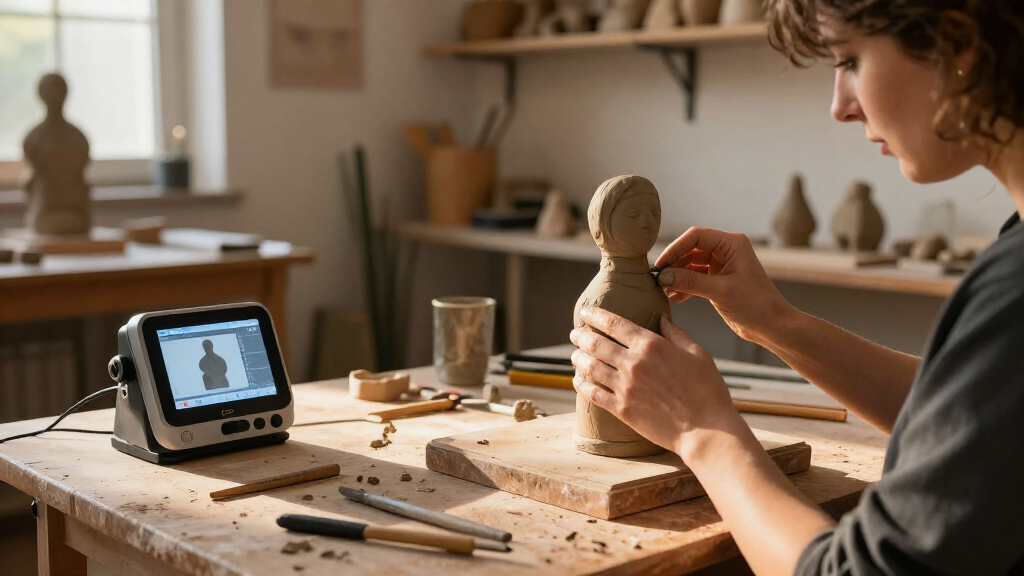
Lynn Cherny, creative technologist-in-residence at the Google Arts & Culture Lab, used Google generative AI and image-editing models to create studio scenes for sculptors including Nancy Elizabeth Prophet, Jane Poupelet and Camille Claudel. The team also used a custom tool built with Google Gemini to make 3D models from archival photographs and animate camera paths, giving viewers a virtual route through the reconstructed spaces.
A separate sequence, conceived by Nourry and Lorca, edits an archival photograph of Antoine Bourdelle’s studio so that female students gradually fade from view, leaving the men in the image. Google describes the sequence as a visual representation of how women artists were erased from accounts of art history. The exhibition presents monumental plaster portraits of 18 historical female sculptors; the film installation is in the museum galleries, and a behind-the-scenes trailer is available online through Google Arts & Culture.
Making Missing Studios Visible
The project addresses a practical problem for historians and museum visitors: when photographs of an artist’s studio do not exist, it is difficult to show where and how that person worked. AI-generated reconstructions can offer a visual interpretation of the limited evidence, helping audiences connect archival documents and portraits with the spaces in which artists made work.
That approach also carries a responsibility to distinguish reconstruction from documentary evidence. The scenes are not surviving photographs or verified, complete records of the studios. Their value lies in making research accessible, while the documentary’s methods and the underlying historical sources remain important to understanding what is known and what has been imagined.
The exhibition and film focus on women who worked in a predominantly male art world and were often remembered as models or muses rather than artists. Bringing their names and working lives into a public museum setting can broaden how visitors encounter the history of sculpture, without treating a visual reconstruction as proof of details that the archive does not preserve.
art history books on women sculptors
As an affiliate, we earn on qualifying purchases.
As an affiliate, we earn on qualifying purchases.
Research Behind the Reconstructions
Google’s report says the collaboration grew from a year of research into women sculptors in Paris. The art historians assembled letters, journals and photographic portraits, but the scarcity of studio photographs meant the project could not simply present images of the original rooms. Instead, the production used generative tools to build scenes and camera movement from archival material.
The museum exhibition is titled “Visionaries” and centers on Nourry’s plaster portraits of 18 historical sculptors. It opened October 20, 2026, alongside Art Basel Paris, and is scheduled to remain at the Petit Palais until January 30, 2027. The documentary is part of the exhibition presentation, rather than a stand-alone historical archive of studio interiors.
““Because few historical photos of their actual workspaces exist,” the team used generative AI and image-editing models to bring the studios to life.”
— Google Arts & Culture report
As an affiliate, we earn on qualifying purchases.
Where Evidence Ends and Reconstruction Begins
The report does not identify which archival sources support each individual studio scene, or explain how the team decided on specific room details that are not visible in surviving materials. It also does not describe a process for historians to review or verify each generated element. The reconstructions should therefore be understood as AI-assisted interpretations, not authenticated images of the studios.
Google’s account does not provide technical details about the models, the amount of human editing, or how the underlying research will be made available to visitors. It is also not clear from the announcement whether the documentary will be released in full online beyond its installation at the museum.
As an affiliate, we earn on qualifying purchases.
Exhibition Runs Through January
“Visionaries” is scheduled to remain at the Petit Palais through January 30, 2027, with the documentary installation presented in the museum galleries. Google Arts & Culture has also posted a behind-the-scenes trailer online. The announcement does not give a separate schedule for the film’s wider release or say whether the reconstructed studio models will be made available for independent viewing.
Visitors and researchers can look to the exhibition and accompanying film for the project’s presentation of the sculptors and its use of archival material. Further information about the evidence behind particular scenes, or any later online access to the full documentary, has not been announced in the source material.
As an affiliate, we earn on qualifying purchases.
Key Questions
What is the Prune Nourry documentary about?
It is a 10-minute film about women sculptors who worked in Paris in the late 19th and early 20th centuries. Using archival material and generative AI, it presents reconstructed versions of studios for artists including Nancy Elizabeth Prophet, Jane Poupelet and Camille Claudel.
Are the studio scenes historical photographs?
No. Google says few photographs of the artists’ actual workspaces survive. The scenes are AI-assisted reconstructions created from archival photos and other research, not original photographs of the studios.
Where can visitors see the film and exhibition?
The film installation accompanies the “Visionaries” exhibition at the Petit Palais in Paris. The exhibition opened October 20, 2026, and is scheduled to run through January 30, 2027. A behind-the-scenes trailer is available online through Google Arts & Culture.
How many sculptors are featured in “Visionaries”?
The exhibition presents monumental plaster portraits of 18 historical female sculptors. The documentary’s reported studio reconstructions include Nancy Elizabeth Prophet, Jane Poupelet and Camille Claudel.
Source: rss
Halloween Picks
halloween
As an affiliate, we earn on qualifying purchases.