
TL;DR

Get the latest gadgets delivered free with Prime
- Fast, free delivery on millions of items
- Prime Video, Amazon Music and more included
- Member-only deals all year
Neufangled Robotics describes Stringman as an open-source, cable-driven robot priced at $795 that moves a gripper through a room from four ceiling-corner anchors. The company lists an average payload of 1.9 kg in a specified 7-by-7-by-3-meter room, but the performance figures and comparisons come from its own materials; independent testing is not provided in the source.
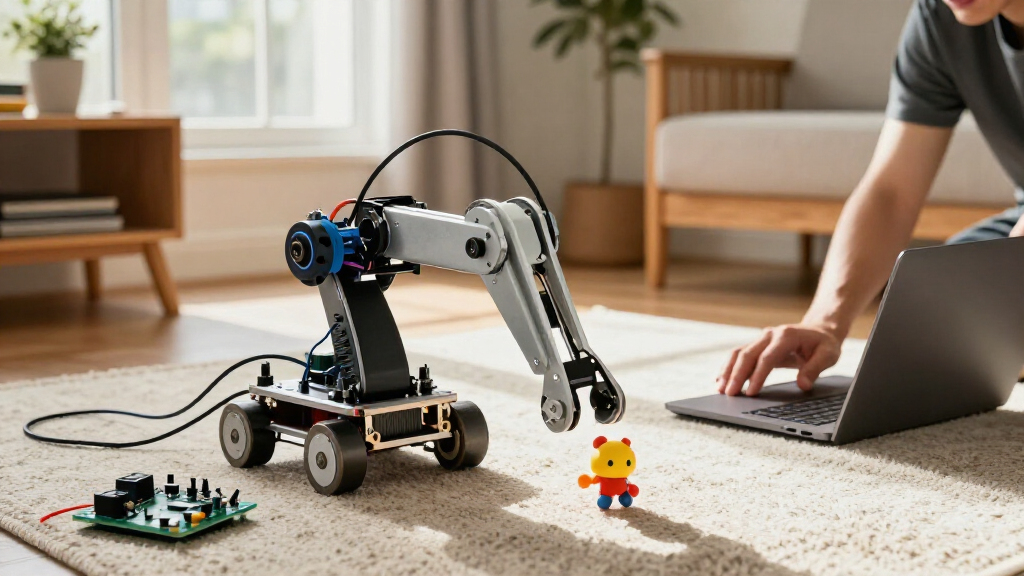
Neufangled Robotics is presenting Stringman, a $795 open-source robot that uses four motors and cables mounted near a room’s ceiling corners to move a gripper through the space. The company says it can carry an average 1.9 kilograms in a specified 7-by-7-by-3-meter room, offering a different approach to household and lab automation than wheeled robots or fixed-base arms.
Stringman’s cables converge on a gripper that can move objects within the area formed by the anchors. Neufangled lists support for rooms with an XY diagonal between 3 and 10 meters and heights between 2.3 and 4 meters. It gives a maximum payload of up to 2.2 kilograms near the floor and an average of 1.9 kilograms for the specified 7-by-7-by-3-meter example. Those figures are stated at a 28-newton line-tension limit and are net of the gripper and marker weight.
The company lists a traverse speed of about 0.4 meters per second. The system uses two anchor cameras and a camera on the gripper; a computer running the controller is external to the robot. Raspberry Pi boards handle the gripper and anchors, and the product information describes 3D-printed parts and 5 GHz Wi-Fi connectivity, with the gripper using 2.4 GHz Wi-Fi.
Neufangled says the mechanical CAD, circuit-board designs, software, bill of materials and build guide are published, and describes Stringman as OSHWA certified. Its listed price is $795. The company says installation requires secure mounting to wall studs or structural columns, connecting the lines and running a calibration process it describes as taking about five minutes.
A Robot That Uses Ceiling Space
Stringman’s main distinction is its use of overhead cables rather than a mobile base. By suspending the gripper from several points, the system is designed to reach across a room without driving over floor clutter. That could be useful in a home lab where objects need to move between workstations, or in spaces where floor-based robots have limited access.
The approach also changes the installation trade-off. A conventional arm occupies a workbench or floor area; Stringman requires permanent ceiling-height lines and structural mounting points. The company says the lines sit near the ceiling when parked, but they remain in the room while installed. This may suit a dedicated workspace better than a room used for many other purposes.
Neufangled compares Stringman’s stated work volume and payload with a seven-actuator, 0.75-meter arm, and says Stringman offers roughly 500 times the work-area volume per dollar in that comparison. That is a company-provided calculation, not an independent benchmark, and it compares different robot architectures. The published figures give prospective builders a starting point, but do not establish how the system performs across varied rooms or tasks.
Products Worth Considering

Apple MacBook Air 13-inch with M5 chip, 16GB memory, 512GB SSD, and 12MP Center Stage camera

Samsung Galaxy Tab S10 Lite – 6 GB RAM, 128 GB storage, up to 2 TB microSD, 10.9‑inch LCD, Gray

Amazon Kindle Paperwhite Signature Edition, 32GB (2024), Metallic Black
As an affiliate, we earn on qualifying purchases.
How the Cable System Works
The four anchors define a work area, with the gripper’s position controlled by adjusting cable lengths. Neufangled describes the design as distributing lifting force across the motors; in its example, the payload varies by location, with the strongest capacity near the floor and an average of 1.9 kilograms over the stated room volume. The gripper itself weighs 638 grams, which the company says is deducted from its payload figures.
The product is aimed in part at home-lab workflows. Neufangled says a Python API and an MCP server are available for connecting the robot to software agents, and it describes tools for collecting training data and running several robot-learning models. The source also says the system can operate on a local Wi-Fi network, with its interface served locally and AI models run on the owner’s hardware. These are vendor descriptions; the supplied material does not include independent validation of privacy or model performance.
Installation has practical constraints. The company says anchors can be fastened to wall studs or secured to structural columns, and that rooms with low-hanging objects at the center may not be suitable. It reports about 1,000 hours of accumulated testing in real homes, but provides no test protocol or breakdown of failures in the supplied information.
“Tension is all you need”
— Neufangled Robotics
Independent Performance Evidence
The supplied product information does not include independent tests of payload, speed, positioning accuracy, reliability or safety. Neufangled’s performance figures are tied to a particular room size and a 28-newton line-tension limit; results in other room layouts may differ. The company’s comparison with a conventional arm is also based on its stated assumptions, including actuator ratings and the arm’s dimensions.
Further details are not provided about the conditions behind the reported 1,000 testing hours, long-term wear, maintenance requirements or the robot’s behavior after a cable or power failure. Neufangled says the motors relax when line tension reaches 28 newtons, allowing lines to be pulled loose, but the source does not describe independent safety evaluation. The product page also does not specify shipping availability, warranty terms or whether the listed price covers all parts needed for installation.
Builds and Field Testing Ahead
The next evidence will come from independent builds and real-world use of the published plans. Prospective users will need to confirm that their mounting points, room dimensions and ceiling fixtures fit the installation requirements, then assess the robot’s performance in their own workspace. Neufangled provides a build guide, parts list and calibration instructions, but the source does not announce a release schedule or a forthcoming independent evaluation.
Further reporting could clarify the complete cost of a working installation, availability of components, support and warranty arrangements, and performance across room sizes. Until those details are independently documented, Stringman’s headline payload and work-volume claims should be treated as manufacturer specifications, not verified results.
Key Questions
What is Stringman?
Stringman is a cable-driven room-scale robot from Neufangled Robotics. Four ceiling-height anchors control a suspended gripper that can move objects within the defined work area.
How much can it carry?
Neufangled lists an average payload of 1.9 kilograms in a 7-by-7-by-3-meter room and up to 2.2 kilograms near the floor. These are company figures at a 28-newton line-tension limit, net of the gripper and marker.
Is Stringman open source?
The company says it has published the mechanical CAD, circuit-board designs and control software, along with a bill of materials and build guide. It also describes the project as OSHWA certified.
What does installation require?
Neufangled says users need a room with suitable structural mounting points, such as wall studs or columns, as well as a computer for the controller. The lines remain in the room while the system is installed, though the company says they can be parked near the ceiling.
Have the performance claims been independently verified?
Not in the supplied source material. The payload, speed, testing-hour and comparison figures are presented by Neufangled, with no independent testing results or detailed test protocol included.
Source: neufangled.com