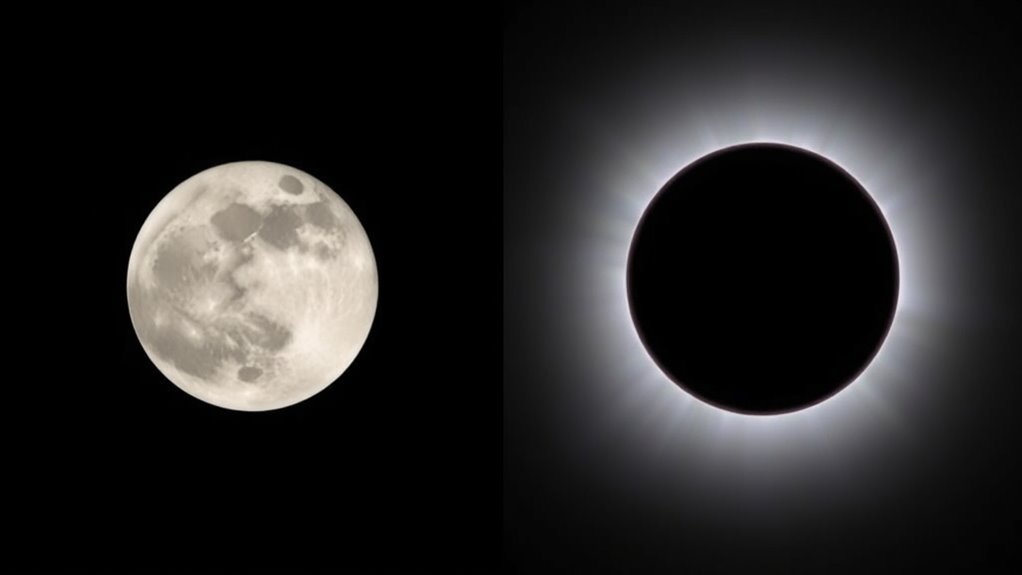
Penumbral and umbral lunar eclipses differ mainly in how the Moon passes through Earth’s shadow. In a penumbral eclipse, the Moon moves through the outer, lighter part of Earth’s shadow, causing a subtle dimming that’s often hard to notice. During an umbral eclipse, the Moon enters Earth’s darker, inner shadow, resulting in a more dramatic darkening or reddish hue. To truly spot the differences and understand these events better, keep exploring what makes each eclipse unique.
Key Takeaways
- Penumbral eclipses involve the Moon passing through Earth’s lighter, diffuse penumbra, causing subtle shading; umbral eclipses occur when it enters the darker, well-defined umbra.
- Penumbral eclipses produce slight dimming often hard to notice; umbral eclipses cause significant darkening and sometimes a reddish hue.
- Penumbral shadows are diffuse and less sharply defined, while umbral shadows are clear and sharply outlined.
- Penumbral eclipses are less visually striking and harder to observe; umbral eclipses are more dramatic and easier to identify.
- The interaction with Earth’s shadow zones determines the eclipse type and visibility, with umbral eclipses producing more noticeable effects.

Lunar eclipses occur when the Earth moves between the Sun and the Moon, blocking sunlight and casting a shadow. This shadow creates different regions on the Moon’s surface, which determine whether you witness a penumbral or umbral eclipse. Understanding these shadow regions is key to knowing what kind of eclipse you’ll see and how visible it will be from your location. The Earth’s shadow consists of two main parts: the penumbra, the lighter outer shadow, and the umbra, the darker, central shadow. During an eclipse, the Moon passes through these shadow regions, leading to distinct visual effects. The visibility of an eclipse depends on your geographic location and the Moon’s position relative to these shadow zones. If you’re in a region where the Moon passes through the penumbra, you’ll experience a penumbral eclipse, which can be subtle and often requires careful observation. Conversely, if the Moon enters the umbra, you’ll see a more dramatic, noticeable darkening called a umbral eclipse.
Lunar eclipses happen when Earth blocks sunlight, creating penumbral or umbral shadows on the Moon.
In a penumbral eclipse, the Moon only passes through the Earth’s penumbra. This causes a slight dimming of the lunar surface, which can be hard to notice with the naked eye. The shadow region involved in this eclipse is diffuse, and the change in brightness is very subtle—often described as a shadowy shading rather than a dramatic darkening. Because the penumbra is less distinct, eclipse visibility can be limited, and many people might not recognize the eclipse unless they are specifically looking for it. This type of eclipse tends to be more perceptible in regions with dark skies and minimal light pollution, but even then, the difference is often understated.
In contrast, during a umbral eclipse, the Moon passes fully into the Earth’s umbra. This results in a much more striking visual change: the Moon appears darker, sometimes taking on a reddish hue during totality. Since the umbra is sharply defined, the shadow regions create a clear boundary on the Moon’s surface. This makes the eclipse easier to observe and more spectacular to witness. The visibility of umbral eclipses is generally better across broader areas, especially if the eclipse occurs during nighttime hours. Whether total or partial, umbral eclipses tend to draw more attention because of their pronounced shadow regions and the dramatic change they bring to the lunar surface.
Ultimately, recognizing the difference between penumbral and umbral lunar eclipses hinges on understanding how the Earth’s shadow regions interact with the Moon. Knowing where the Moon passes through these shadow zones helps you anticipate the eclipse’s appearance and how well it will be visible from your vantage point. While penumbral eclipses can be subtle and easy to miss, umbral eclipses offer a more vivid and unmistakable spectacle, making them a favorite among skywatchers.

Solar Eclipse Glasses AAS Approved 2024 – ISO 12312-2:2015(E) & CE Certified,6 Pack Durable Plastic Eclipse Glasses for Direct Sun Viewing
2024 Total Solar Eclipse: The solar eclipse starting on April 8, 2024. This is an essential accessory for…
As an affiliate, we earn on qualifying purchases.
As an affiliate, we earn on qualifying purchases.
Frequently Asked Questions
Can Lunar Eclipses Be Visible From Anywhere on Earth?
Lunar eclipse visibility depends on your geographic location, so it’s not visible from everywhere on Earth. When an eclipse happens, only regions experiencing night can see it, meaning there are geographic restrictions. If you’re in the right part of the world during the eclipse, you’ll witness the event clearly. Otherwise, you might miss it entirely. Check local timings and moon phases to know if you’ll get a chance to observe it.
How Often Do Penumbral and Umbral Lunar Eclipses Occur Annually?
Imagine the night sky as a grand stage where lunar eclipses subtly appear. You’ll notice that the frequency variations and seasonal patterns influence how often penumbral and umbral lunar eclipses occur each year. Typically, you might see about 4 to 7 lunar eclipses annually, with some years hosting more penumbral or umbral events. These celestial phenomena dance in a predictable rhythm, offering you spectacular sights when the timing aligns.
Are Lunar Eclipses Safe to Observe With Naked Eyes?
Lunar eclipses are safe to observe with your naked eyes since they don’t harm your vision. You don’t need special viewing techniques, but it’s best to avoid looking directly at the Sun. Just watch the eclipse comfortably in a dark area, and enjoy the view. Remember, unlike solar eclipses, lunar ones pose no risk to your visual safety, making them easy and safe to observe without equipment.
What Is the Duration Difference Between Penumbral and Umbral Eclipses?
The eclipse duration varies markedly between penumbral and umbral lunar eclipses. You’ll notice the penumbral eclipse has a longer visibility window, often lasting several hours, but the actual darkening is subtle and may go unnoticed. In contrast, umbral eclipses have a shorter eclipse duration, typically a few hours, with a more distinct darkening. Understanding this helps you appreciate the eclipse’s visibility window and what to expect during each event.
How Do Lunar Eclipses Affect Ocean Tides?
Did you know lunar eclipses can subtly influence ocean tides? During an eclipse, the Moon’s gravitational influence causes tidal variations, although minor compared to regular lunar phases. The alignment amplifies the gravitational pull, leading to slightly higher high tides and lower low tides. While these effects are subtle, they remind you of the Moon’s powerful role in shaping Earth’s oceanic patterns, especially during full and new moons, when tidal forces are strongest.
NASA Lunar Telescope for Kids – 90x Magnification, Includes Two Eyepieces, Tabletop Tripod, and Finder Scope- Kids Telescope for Astronomy Beginners, Space Toys, NASA Gifts (Amazon Exclusive)
INSPIRE CURIOSITY – The NASA Lunar Telescope allows your child to see the moon in incredible detail; the…
As an affiliate, we earn on qualifying purchases.
As an affiliate, we earn on qualifying purchases.
Conclusion
So, now you know the key difference between penumbral and umbral lunar eclipses. Penumbral eclipses are subtler, with only about 60% of viewers noticing them, while umbral eclipses are more striking and easily observed. notably, umbral eclipses occur roughly twice as often as penumbral ones each year. Next time you look up, you’ll be able to spot the eclipse type and appreciate the celestial dance happening above you. Keep watching the skies—there’s always something amazing to see!

Celestron – Cometron 7×50 Astronomy Binoculars – Entry-Level for Stargazing and Comet Watching – Large 50mm Objective Lenses – Wide 6.6° Field of View – Multi-Coated Optics
EASY-TO-USE ASTRONOMY BINOCULARS FOR BEGINNERS: Cometron 7×50 binoculars are an easy, affordable way to learn the night sky…
As an affiliate, we earn on qualifying purchases.
As an affiliate, we earn on qualifying purchases.
ORSAIEIX Lunar Calendar 2026 Poster Moon Phases Wall-Art Astronomy Celestial Eclipses Chart for Stargazing Gardening Planning Home Office Decor(Unframed,12X18inch(30X45cm))
We have reserved a 0.6in (1.5cm) white margin for you, which is convenient for you to frame with…
As an affiliate, we earn on qualifying purchases.
As an affiliate, we earn on qualifying purchases.