
Exoplanet detection mainly relies on two indirect methods: transit and radial velocity. The transit method watches for tiny dips in star brightness caused by planets crossing in front of their stars, revealing size and orbit details. Radial velocity measures the star’s wobble due to gravitational pulls from planets, indicating their mass and orbit. Both techniques face challenges like faint signals and stellar noise, but advancements are improving detection capabilities—if you continue exploring, you’ll discover how scientists overcome these hurdles.
Key Takeaways
- Transit method detects exoplanets by observing dips in star brightness caused by planetary transits.
- Radial velocity method measures star wobble through spectral line shifts due to gravitational pull from orbiting planets.
- Transit provides planet size and orbital period, while radial velocity estimates planet mass and orbit shape.
- Both techniques face challenges like stellar activity, noise, and faint atmospheric signals, requiring precise instruments.
- Combining transit and radial velocity data improves detection accuracy and helps analyze exoplanet atmospheres.
Detecting exoplanets, or planets outside our solar system, requires specialized techniques because these distant worlds are too faint and small to be observed directly with most telescopes. Instead, astronomers rely on indirect methods, such as the transit and radial velocity techniques, to identify and study these planets. These methods have their own detection challenges, especially when it comes to analyzing planetary atmospheres, which can reveal clues about a planet’s composition and potential habitability.
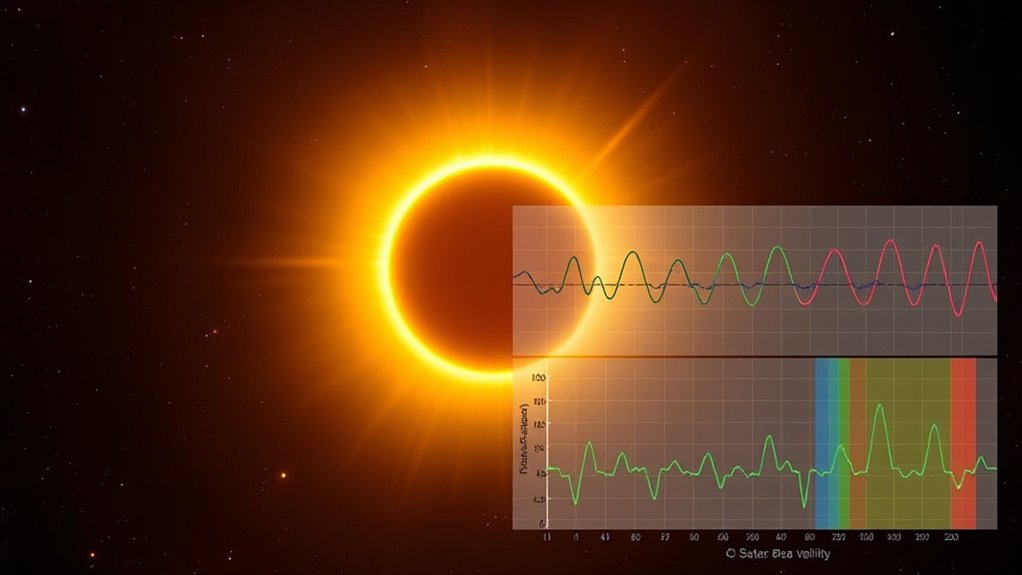
The transit method involves monitoring a star’s brightness over time. When a planet crosses in front of its host star, it causes a slight dip in the star’s light — a transit. This dip can be detected with sensitive photometers, and from it, you can infer the planet’s size and orbital period. However, the detection challenges here lie in distinguishing true planetary transits from other phenomena that also cause brightness variations, like stellar activity or binary star interactions. Additionally, analyzing the planetary atmospheres during transits requires capturing the star’s light filtering through the planet’s thin atmosphere, which is a tiny signal. This makes it difficult to study atmospheric composition, especially for smaller or more distant exoplanets.
The radial velocity method measures the star’s wobble caused by gravitational tugs from an orbiting planet. As the planet orbits, it pulls its star slightly toward and away from us, shifting the star’s spectral lines due to the Doppler effect. By tracking these shifts, you can determine the planet’s mass and orbit. But the detection challenges here involve the star’s intrinsic variability, which can mimic or obscure these signals. Plus, measuring small radial velocity changes demands extremely precise instruments, especially for detecting smaller planets with weaker gravitational effects.
When it comes to planetary atmospheres, both methods face hurdles. With transits, the atmosphere’s spectral signatures are faint and require high-precision spectroscopy to detect. And because atmospheres can be thick, thin, or even contain clouds and haze, interpreting the data becomes complicated. For radial velocity, atmospheric signals are indirect but can influence the observed stellar activity, complicating the detection process. Overall, these detection challenges mean that studying exoplanetary atmospheres demands advanced technology and careful data analysis, but the insights gained are invaluable for understanding these distant worlds and their potential to support life. Furthermore, ongoing advancements in detection sensitivity continue to improve our ability to analyze these atmospheres in greater detail.
Frequently Asked Questions
How Do Astronomers Differentiate Between Exoplanets and Stellar Activity?
You can differentiate exoplanets from stellar activity by analyzing stellar noise patterns and applying data filtering techniques. When you observe periodic signals that stay consistent over time, it’s likely an exoplanet. In contrast, stellar activity often causes irregular, short-term fluctuations. By carefully filtering out stellar noise, you enhance the clarity of potential planetary signals, making it easier to confirm the presence of exoplanets and avoid false positives.
What Are the Limitations of Current Exoplanet Detection Methods?
Sure, the biggest limitation of current detection methods is that they’re almost as noisy as a crowded coffee shop. Instrumental noise can mask or mimic signals, making planets harder to find. Observational bias means we favor certain star types or planetary sizes, leaving many worlds undiscovered. So, while we’ve made great strides, finding every exoplanet still feels a bit like searching for a needle in a cosmic haystack.
Can These Methods Detect Planets in Binary Star Systems?
You can detect planets in binary star systems, but binary star challenges make it tricky. The combined light from two stars can obscure or mimic planetary signals, complicating detection. To overcome this, astronomers use combined detection strategies, such as combining transit and radial velocity data, to confirm exoplanets. These methods work better together, helping you distinguish genuine planets from false positives caused by the complex dynamics of binary systems.
How Does Planetary Atmosphere Affect Detection Accuracy?
Imagine trying to spot a tiny boat on choppy waters; atmospheric interference acts like those waves, making it harder to detect a planet’s atmosphere accurately. When your instruments observe a planet’s atmosphere, clouds, storms, or haze can distort signals, reducing detection accuracy. This can obscure key details, much like fog blurs a distant lighthouse, challenging your ability to learn about the planet’s true nature.
Are There Upcoming Technologies Improving Detection Sensitivity?
You’ll be pleased to know that upcoming technologies are markedly improving detection sensitivity. Advanced imaging techniques, such as coronagraphs and starshades, allow you to better isolate exoplanets from their stars. Additionally, machine learning algorithms enhance data analysis, making it easier to identify faint signals. These innovations help you detect smaller, more distant planets with greater accuracy, pushing the boundaries of what’s possible in exoplanet discovery.
Conclusion
You now understand how transit and radial velocity methods help us find exoplanets. Did you know over 5,000 exoplanets have been confirmed so far? That’s like discovering a new planet every few days! These methods open a window to worlds beyond our solar system, fueling curiosity and inspiring future exploration. With each discovery, we get closer to answering whether life exists elsewhere. The universe is vast, and your curiosity can help unseal its secrets.