
Solar and lunar eclipses happen when the Sun, Moon, and Earth align perfectly due to celestial mechanics and gravity. During a solar eclipse, the Moon blocks sunlight, creating total or partial shadows, while lunar eclipses occur when Earth casts its shadow on the Moon. These events reveal the Sun’s corona and Earth’s shadow, offering stunning views and scientific opportunities. To explore the fascinating details behind these cosmic phenomena, keep exploring—you’ll uncover how these events connect to the universe’s grand design.
Key Takeaways
- Solar eclipses occur when the Moon blocks the Sun, visible along the path of totality; lunar eclipses happen when Earth casts a shadow on the Moon.
- Eclipses are caused by precise alignments of the Sun, Moon, and Earth, governed by celestial geometry and gravity.
- Total solar eclipses reveal the solar corona, providing scientific insights into solar activity and magnetic fields.
- Lunar eclipses are visible from anywhere on Earth’s night side and last several hours, making them more accessible for observation.
- Eclipses demonstrate celestial mechanics, highlighting the dynamic interactions of cosmic forces and enhancing our understanding of the universe.
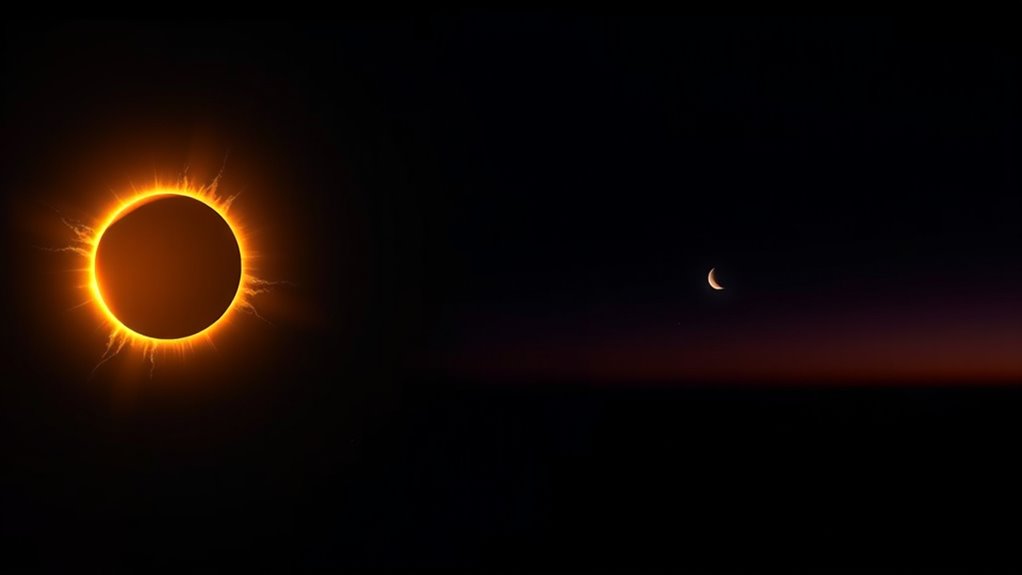
Have you ever wondered why solar and lunar eclipses happen? These awe-inspiring events occur because of the precise alignments between the Sun, Moon, and Earth. When such alignments happen, the Moon’s shadow falls across Earth’s surface during a solar eclipse, or Earth’s shadow covers the Moon during a lunar eclipse. During a solar eclipse, the Moon passes directly between the Sun and Earth, blocking the Sun’s light. As this shadow moves across the planet, observers in the right location witness a breathtaking sight. The Moon’s shadow consists of two parts: the umbra, where the Sun is completely blocked, creating totality, and the penumbra, where the Sun is only partially obscured, resulting in a partial eclipse. If you’re in the path of totality, you get the rare chance to see the solar corona— a stunning, wispy halo of plasma extending millions of miles into space. The solar corona shines brightly during totality because the Sun’s bright surface is blocked by the Moon, revealing this faint, beautiful crown of hot ionized gases.
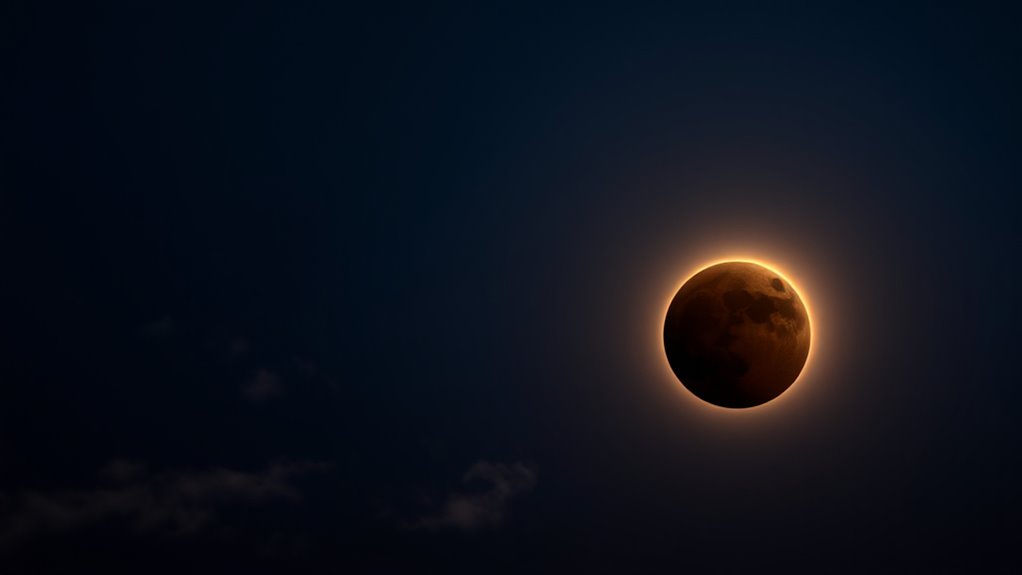
On the other hand, lunar eclipses happen when Earth gets precisely between the Sun and the Moon, casting its shadow onto the lunar surface. Unlike solar eclipses, lunar eclipses are visible from anywhere on the night side of Earth, making them more accessible for skywatchers. As Earth’s shadow slowly covers the Moon, the lunar surface takes on a reddish hue—often called a “blood moon.” This occurs because Earth’s atmosphere filters sunlight, scattering blue light and allowing the red hues to dominate. The shadow of Earth progressively darkens the Moon, providing a mesmerizing view for those observing with the naked eye or through binoculars.
Understanding these phenomena reveals the intricate dance of celestial bodies governed by gravity and geometry. The Moon’s shadow during a solar eclipse travels across Earth’s surface at high speeds, making precise timing essential for viewing. Meanwhile, the Earth’s shadow during a lunar eclipse slowly creeps across the Moon’s face, sometimes lasting several hours. Both events not only showcase the beauty of our universe but also offer valuable scientific opportunities. Astronomers study the solar corona during total solar eclipses because it’s normally hidden by the Sun’s brightness. By observing this outer atmosphere, they learn about solar wind and magnetic fields. So, whether it’s witnessing the Moon’s shadow darken the Sun or the Earth’s shadow turn the Moon red, these eclipses connect us to cosmic forces at play, reminding us of the universe’s grandeur and our place within it.

Sky-Watcher EQ6-R – Fully Computerized GoTo German Equatorial Telescope Mount – Belt-driven, Motorized, Computerized Hand Controller with 42,900+ Celestial Object Database
PRECISE ACCURATE GOTO: Computerized, motorized GoTo German equatorial telescope mount capable of accurately tracking astronomical objects for both...
As an affiliate, we earn on qualifying purchases.
Frequently Asked Questions
How Do Eclipses Affect Earth’s Climate Temporarily?
Eclipses can cause temporary climate variability by blocking sunlight and leading to brief atmospheric changes. You might notice a slight drop in temperature during a solar eclipse as less solar energy reaches Earth’s surface. These effects are usually short-lived, and the climate quickly returns to normal once the eclipse ends. While fascinating, eclipses don’t have a long-term impact on Earth’s climate but do temporarily influence atmospheric conditions.
Are There Cultural Beliefs Associated With Solar and Lunar Eclipses?
You might find yourself fascinated by the mythological significance and cultural rituals linked to solar and lunar eclipses. Across cultures, these celestial events have inspired stories, superstitions, and ceremonies that honor the sky’s power. From ancient Chinese dragons swallowing the sun to Indian rituals seeking protection, these beliefs create a sense of unity and reverence, reminding you how humanity connects with the cosmos through shared symbols and traditions.
Can Eclipses Be Safely Observed With Everyday Household Items?
You shouldn’t attempt eclipse safety with household viewing items like sunglasses or cameras, as they don’t provide proper protection. Instead, use eclipse glasses certified for solar viewing or a pinhole projector to watch safely. Never look directly at the eclipse without proper eye protection, even if it’s just with household items. Always prioritize safety to enjoy the event without risking eye damage.
How Do Astronomers Predict the Exact Timing of Eclipses?
You might be surprised to learn that astronomers predict eclipses with up to a 99.9% accuracy. They do this through precise orbital calculations, analyzing the orbits of the Earth, Moon, and Sun. By studying eclipse cycles like the Saros cycle, which repeats approximately every 18 years, they determine the timing and location of future eclipses. This meticulous work allows you to plan safe and spectacular viewing experiences.
Do Eclipses Have Any Impact on Wildlife Behavior?
Eclipses can influence wildlife behavior, causing animals to act unusually during the event. You might notice birds stopping their songs or nocturnal creatures becoming active earlier or later than usual. This eclipse influence affects their natural rhythms because they interpret the sudden darkness or light changes as a signal for dusk or dawn. These behaviors are temporary, but they show how sensitive wildlife is to environmental cues like eclipses.

Celestron - NexStar 127SLT Computerized Telescope - Compact and Portable - Maksutov-Cassegrain Optical Design - SkyAlign Technology - Computerized Hand Control - 127mm Aperture
COMPUTERIZED STAR LOCATING TELESCOPE: The Celestron NexStar 127SLT offers a database of more than 40,000 stars, galaxies, nebulae,...
As an affiliate, we earn on qualifying purchases.
Conclusion
Now that you know how solar and lunar eclipses happen, you’re like a cosmic explorer ready to witness these breathtaking events. With just a little planning, you can catch the sky’s spectacular light shows—like nature’s own fireworks. Remember, each eclipse is a once-in-a-lifetime chance to see the universe’s secrets unfold before your eyes. So keep your eyes on the sky and enjoy the celestial dance that’s out of this world!

Sky-Watcher Star Adventurer 2i Pro Pack – Motorized DSLR Night Sky Tracker Equatorial Mount for Portable Nightscapes, Time-Lapse and Panoramas – Wi-Fi App Camera Control – Long Exposure (S20512)
Portable nightscape tracking platform: Motorized portable tracking platform perfect for capturing incredible detail of the Milky Way, eclipses...
As an affiliate, we earn on qualifying purchases.

iEXOS-100-2 PMC-Eight Equatorial Tracker System Tripod and Mount for Astrophotography with WiFi and Bluetooth Compatible
Integrated Explore Scientific PMC-Eight system that transcends the industry standard single processor by utilizing eight CPUs that operate...
As an affiliate, we earn on qualifying purchases.