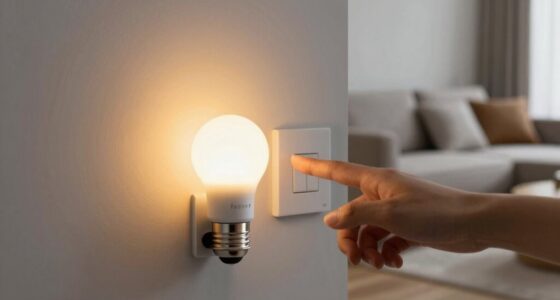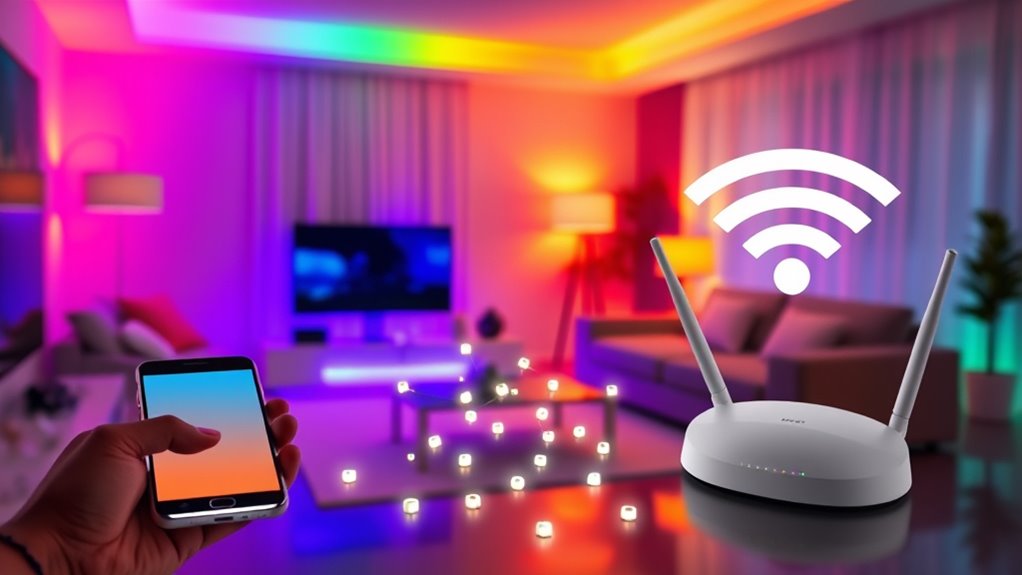

If you’re choosing between Bluetooth Mesh and Wi-Fi for smart lighting, consider your priorities. Bluetooth Mesh offers low-power operation, strong security, and a reliable, self-healing network, making it ideal for interconnected, energy-efficient systems. Wi-Fi provides broader connectivity, internet access, and easy remote control but consumes more power and depends on a central router. To find out how each option fits your needs and the best way to optimize your setup, explore the details further.
Key Takeaways
- Bluetooth Mesh offers low-power, energy-efficient connectivity ideal for interconnected smart lighting, reducing battery replacements.
- Wi-Fi provides higher data transfer rates and internet access, suitable for remote control and complex lighting systems.
- Bluetooth Mesh creates a decentralized network, enhancing reliability and coverage without relying heavily on Wi-Fi routers.
- Wi-Fi security depends on proper network configuration, while Bluetooth Mesh uses end-to-end encryption for device-to-device security.
- The choice hinges on balancing energy efficiency and connectivity needs, with Bluetooth Mesh favoring low power and Wi-Fi favoring broader access.
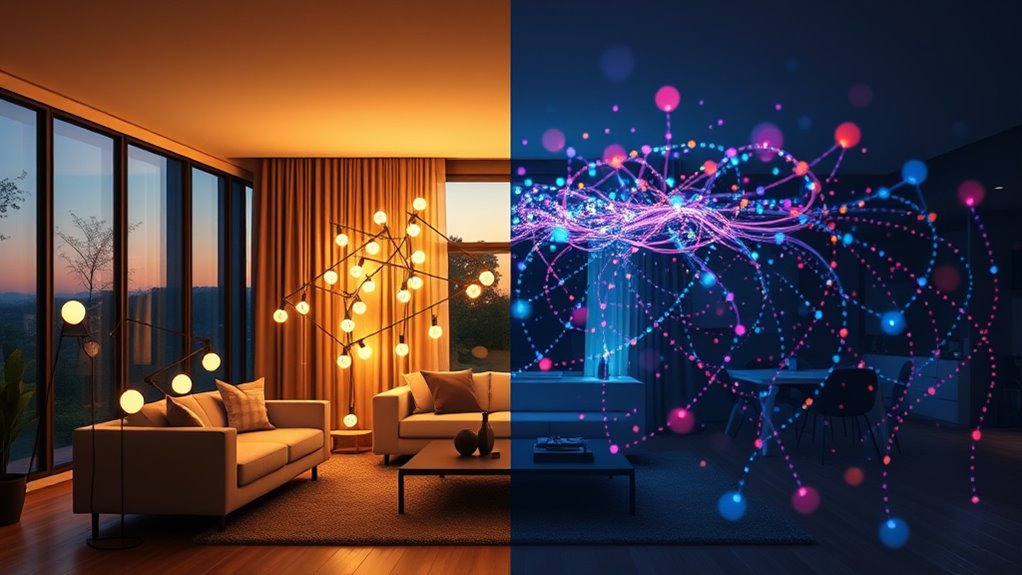
When choosing the right wireless technology for your smart lighting system, understanding the differences between Bluetooth Mesh and Wi-Fi is essential. Both options offer unique advantages, but your decision should hinge on factors like energy efficiency and security protocols. Bluetooth Mesh is designed to create a robust, low-power network that’s ideal for interconnected lighting systems. Its energy efficiency stems from its ability to operate with minimal power consumption, making it suitable for devices that need to run for long periods without frequent battery replacements or constant power draws. This protocol allows your lights to communicate directly with each other in a mesh network, reducing the need for constant Wi-Fi connectivity and lowering overall energy use.
Security is a paramount concern in smart lighting setups, especially as more devices connect to your home network. Bluetooth Mesh employs strong security protocols, including end-to-end encryption and device authentication, to safeguard communication between devices. These security features ensure that malicious actors can’t easily hijack your lighting system or access sensitive information. In contrast, Wi-Fi networks typically rely on WPA3 or WPA2 security protocols, which are effective but can be more vulnerable if not properly configured. Wi-Fi’s security depends on your router’s settings and the strength of your password, whereas Bluetooth Mesh’s built-in security measures are designed specifically for device-to-device communication. Additionally, Bluetooth Mesh’s power-efficient operation makes it a practical choice for smart lighting systems that benefit from long-term reliability without excessive energy costs.

EVEO Screen Cleaner Spray - Large Screen Cleaner Bottle - TV Screen Cleaner, Computer Screen Cleaner, for Laptop, Phone, Ipad - Computer Cleaning kit Electronic Cleaner (1 Pack)
- Versatile Screen Cleaner: Cleans TVs, computers, and phones
- Gentle on All Screens: Safe for LCD, LED, and OLED
- Includes Microfiber Cloth: Soft cloth for streak-free cleaning
As an affiliate, we earn on qualifying purchases.
Frequently Asked Questions
Which Protocol Offers Better Energy Efficiency for Smart Lighting?
Bluetooth Mesh generally offers better energy efficiency for smart lighting because it has lower power consumption, which helps prolong battery life. You’ll notice devices using Bluetooth Mesh consume less energy during communication, making it ideal for battery-powered sensors and switches. In contrast, Wi‑Fi tends to use more power, reducing battery life over time. So, if you want to optimize for longer battery life, Bluetooth Mesh is your better choice.
How Does Each Technology Handle Large-Scale Lighting Networks?
You’ll find that Bluetooth Mesh handles large-scale lighting networks better by addressing scalability challenges with multi-hop communication, allowing devices to relay messages efficiently. It simplifies network management through low power consumption and robust mesh architecture. Wi‑Fi, on the other hand, struggles with scalability due to bandwidth limitations and increased network congestion as more devices connect, making it less ideal for extensive lighting setups where managing numerous nodes is essential.
What Are the Security Differences Between Bluetooth Mesh and Wi-Fi?
You’ll find that Bluetooth Mesh uses AES-CCM encryption, ensuring secure communication, but its limited range can lead to network vulnerabilities if not properly managed. Wi-Fi, on the other hand, employs WPA3 encryption, offering stronger protection against attacks. While Wi-Fi’s broader network exposure can increase vulnerabilities, its advanced encryption standards generally provide a higher security level, making it safer for large-scale smart lighting networks.
Can Both Protocols Support Real-Time Lighting Control and Automation?
Both Bluetooth Mesh and Wi-Fi can support real-time lighting control and automation, but you might face latency issues with Bluetooth Mesh due to its network design, especially over larger setups. Compatibility challenges could also arise, as some smart lighting devices may work better with one protocol over the other. Wi-Fi generally offers lower latency and broader device compatibility, making it more reliable for seamless, real-time automation.
Which Technology Provides Easier Integration With Existing Smart Home Systems?
You’ll find Wi-Fi offers easier integration with existing smart home systems because it boasts broad vendor compatibility and seamless wireless interoperability. Many smart home platforms already support Wi-Fi devices, making setup straightforward. Bluetooth Mesh, while reliable for local control, may require additional hubs or bridges for compatibility with your current ecosystem. So, if you want smooth integration, Wi-Fi is generally the better choice for connecting your smart lighting.

iO CLEAN Screen Cleaner Spray (16oz - 473ml) – Best Large Cleaning Kit
- Comprehensive cleaning kit: Includes spray and microfiber cloth
- Gentle on delicate screens: Safe for all electronic devices
- Advanced cleaning formula: Removes dust, stains, and fingerprints
As an affiliate, we earn on qualifying purchases.
Conclusion
Ultimately, choosing between Bluetooth Mesh and Wi-Fi boils down to your specific needs. Bluetooth Mesh is great for low-power, widespread lighting networks, while Wi-Fi offers faster, higher-bandwidth control. Think of it like choosing a reliable friend versus a swift messenger; each has its strengths. Remember, “A chain is only as strong as its weakest link,” so pick the technology that best supports your smart lighting goals for a seamless experience.

Screen Cleaner Spray 16oz (4oz x 4 Pack) - TV & Computer Screen Cleaner with 2 Microfiber Cloths for Multiple Devices
- Quality Screen Care Kit: Includes 4 bottles and 2 cloths
- Best Cleaner for TV Screen: Removes dust and fingerprints easily
- Gentle Microfiber Cloths: Cleans without scratching surfaces
As an affiliate, we earn on qualifying purchases.