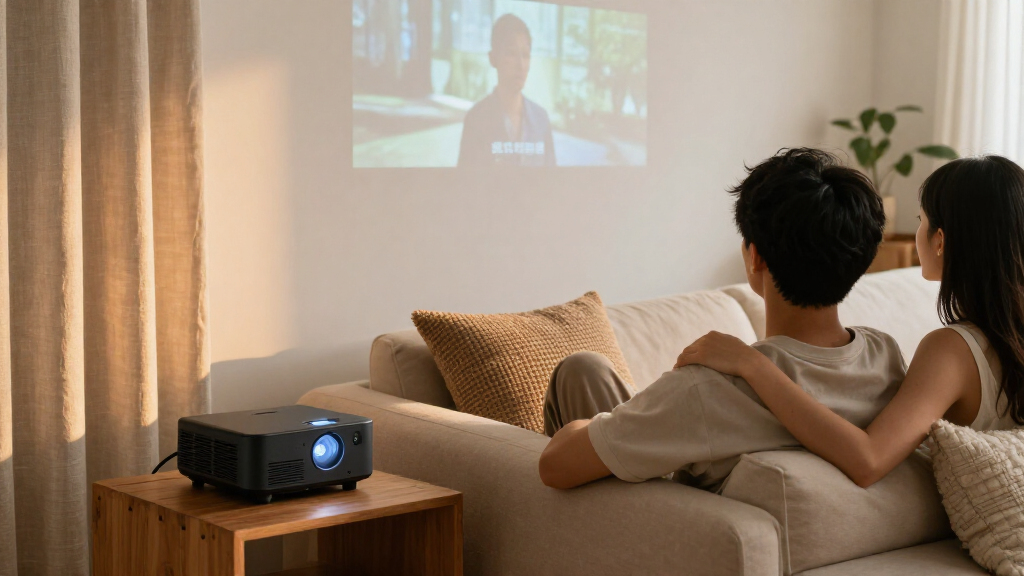
Among these portable projectors for home theaters, I’d put the JMGO N1S 4K Triple Laser in the best-overall position for viewers who prioritize 4K detail, strong light output, and Google TV. The XGIMI Elfin Flip 4K is a compelling alternative for a more flexible setup, while the Aurzen BOOM mini pairs Google TV with 20W Dolby Audio for buyers who want fewer separate components. The main tradeoffs are image performance versus portability, and built-in streaming convenience versus the freedom to add an external streaming device. Lower-cost and mini models can suit casual viewing, but they may ask you to compromise more on brightness, setup flexibility, or sound. Read on for how all 15 options compare and which one best fits your room and viewing habits.

Get the latest gadgets delivered free with Prime
- Fast, free delivery on millions of items
- Prime Video, Amazon Music and more included
- Member-only deals all year
Complete the kit



Key Takeaways
- The JMGO N1S 4K Triple Laser is the performance-led pick: its 4K laser approach and 1700 ISO lumens set it apart from the many native-1080p models in this roundup.
- Google TV and Roku are meaningful convenience differences: the JMGO, XGIMI, Boldever, and Aurzen BOOM mini use Google TV, while the HAPPRUN Roku Mini and Aurzen D1R bring Roku-based smart viewing.
- Native resolution matters more than a 4K input label: several models support 4K signals but display at native 1080p, so buyers should distinguish decoding compatibility from 4K image output.
- Placement flexibility comes in different forms: the XGIMI Elfin Flip emphasizes adaptable positioning, while the Magcubic’s 180-degree rotation suits unusual aiming needs; neither feature replaces checking throw distance and image geometry.
- Built-in extras solve specific problems, not every theater need: the Dxyiitoo’s DVD player, Aurzen BOOM mini’s 20W audio, and the TMY’s included 80-inch screen can simplify a setup, but buyers should still weigh image quality, room conditions, and sound preferences.
| HAPPRUN Portable 1080p Projector with 4K Decoding, Wi-Fi 6, Bluetooth 5.2, and Auto Focus |  | Best Overall for Flexible 1080p Home Theater Setups | Native resolution: 1920 × 1080 | Display type: LCD | Brightness: 2000 ANSI lumens | VIEW LATEST PRICE | See Our Full Breakdown |
| HAPPRUN Roku Smart Mini Projector with Wi-Fi and Bluetooth |  | Best for Simple Built-In Streaming | Display type: LCD | Maximum display resolution: HD | Maximum image size: 120 inches | VIEW LATEST PRICE | See Our Full Breakdown |
| JMGO N1S 4K Triple Laser Portable Projector, 1700 ISO Lumens, Google TV |  | Best Premium 4K Home Theater Picture | Native resolution: 3840 × 2160 | Display type: DLP | Brightness: 1700 ISO lumens | VIEW LATEST PRICE | See Our Full Breakdown |
| XGIMI Elfin Flip 4K Portable Projector with Google TV |  | Best for Gaming and Optical Zoom | Native resolution: 3840 × 2160 | Display type: DLP | Light source: RGB triple laser | VIEW LATEST PRICE | See Our Full Breakdown |
| Magcubic Portable Mini Projector with Wi-Fi 6, Bluetooth 5.4, and 180° Rotation |  | Best Compact Pick for Casual Viewing | Native resolution: 1280 × 720 | Maximum supported input resolution: 4096 × 2160 | Display type: LCD | VIEW LATEST PRICE | See Our Full Breakdown |
| TMY Native 1080P Mini Portable Projector with Two-Way Bluetooth and 80-Inch Screen |  | Best Starter Bundle | Native resolution: 1920 × 1080 | 4K input: Supported | Brightness: Up to 300 ANSI lumens | VIEW LATEST PRICE | See Our Full Breakdown |
| Boldever H1 Portable Google TV Projector, Native 1080p with 4K Support |  | Best All-in-One Setup | Native resolution: 1080p | 4K support: 4K decoding; displayed at native 1080p | Brightness: 2000 ANSI lumens | VIEW LATEST PRICE | See Our Full Breakdown |
| Thunrlge HY300 Pro Portable Smart Projector with Android 11 |  | Best for Flexible Placement | Native resolution: 1280 × 720 | Display type: TFT LCD | Operating system: Android 11 | VIEW LATEST PRICE | See Our Full Breakdown |
| HP MC425 Portable Full HD Projector with Wi-Fi and Bluetooth |  | Best Compact Short-Throw Pick | Native resolution: 1920 × 1080 | 4K support: Yes | Brightness: 200 ISO lumens | VIEW LATEST PRICE | See Our Full Breakdown |
| Dxyiitoo Portable 1080p Projector with Built-In DVD Player |  | Best for DVD Collections | Native resolution: 1920 × 1080 | Display type: LCD LED | Image size: 30–250 inches | VIEW LATEST PRICE | See Our Full Breakdown |
| YGSKK Mini Projector with Wi-Fi 6, Bluetooth 5.3, Built-In Apps, and Native 1080p |  | Best for Flexible Placement | Native resolution: 1080p; compatible with 4K input | Brightness: 300 ANSI lumens | Streaming apps: Prime Video, YouTube, Hulu | VIEW LATEST PRICE | See Our Full Breakdown |
| HOMPOW Native 1080p Portable Bluetooth Projector |  | Best for Flexible Source Connections | Native resolution: 1920 × 1080 | Display type: LCD | Listed brightness: 9500 lm and 9500 ANSI lumens (as listed) | VIEW LATEST PRICE | See Our Full Breakdown |
| HAPPRUN H1 Native 1080p Portable Projector with Bluetooth 5.3 |  | Best for Mounting Flexibility | Native resolution: 1920 × 1080 | Display type: LCD | Brightness: 300 ANSI lumens | VIEW LATEST PRICE | See Our Full Breakdown |
| Aurzen Roku TV D1R Portable Smart Projector |  | Best for Roku Households | Native resolution: 1920 × 1080 | Display type: LCD | Image size: 40–200 inches | VIEW LATEST PRICE | See Our Full Breakdown |
| Aurzen BOOM mini Google TV Outdoor Smart Projector with 20W Dolby Audio |  | Best for Built-In Audio and Google TV | Native resolution: 1920 × 1080 | Brightness: 500 ISO/ANSI lumens | Contrast ratio: 1000:1 | VIEW LATEST PRICE | See Our Full Breakdown |
| portable projectors for home theater | Native resolution | Display type | Brightness | Image size |
|---|---|---|---|---|
| HAPPRUN Portable 1080p Project | 1920 × 1080 | LCD | 2000 ANSI lumens | 50–300 inches |
| HAPPRUN Roku Smart Mini Projec | — | LCD | — | — |
| JMGO N1S 4K Triple Laser Porta | 3840 × 2160 | DLP | 1700 ISO lumens | 40–200 inches |
| XGIMI Elfin Flip 4K Portable P | 3840 × 2160 | DLP | 1600 ISO lumens | 40–200 inches |
| Magcubic Portable Mini Project | 1280 × 720 | LCD | 200 ANSI lumens | 80–130 inches |
| TMY Native 1080P Mini Portable | 1920 × 1080 | — | Up to 300 ANSI lumens | — |
| Boldever H1 Portable Google TV | 1080p | — | 2000 ANSI lumens | — |
| Thunrlge HY300 Pro Portable Sm | 1280 × 720 | TFT LCD | — | 40–130 inches |
| HP MC425 Portable Full HD Proj | 1920 × 1080 | — | 200 ISO lumens | — |
| Dxyiitoo Portable 1080p Projec | 1920 × 1080 | LCD LED | — | 30–250 inches |
| YGSKK Mini Projector with Wi-F | 1080p; compatible with 4K input | — | 300 ANSI lumens | — |
| HOMPOW Native 1080p Portable B | 1920 × 1080 | LCD | — | — |
| HAPPRUN H1 Native 1080p Portab | 1920 × 1080 | LCD | 300 ANSI lumens | 40–200 inches |
| Aurzen Roku TV D1R Portable Sm | 1920 × 1080 | LCD | — | 40–200 inches |
| Aurzen BOOM mini Google TV Out | 1920 × 1080 | — | 500 ISO/ANSI lumens | 40–200 inches |
More Details on Our Top Picks
HAPPRUN Portable 1080p Projector with 4K Decoding, Wi-Fi 6, Bluetooth 5.2, and Auto Focus
The HAPPRUN earns my overall pick for a portable home theater because it pairs native 1080p resolution with a listed 2000 ANSI lumens, giving it a stronger starting point for a large movie image than the HD Roku model or Magcubic’s 720p projector. Its autofocus, screen alignment, obstacle avoidance, and keystone correction reduce setup work when moving between rooms, while two HDMI ports make it easier to keep a streamer and game console connected. The tradeoff is that its smart features are not a complete replacement for a streaming box: some major services require an external device. Picture results are also better in a dark room, and autofocus may struggle if the projector is angled more than 15 degrees. I’d choose it for versatile, mostly stationary home viewing rather than frequent angled projection.
Pros:- Native 1920 × 1080 resolution avoids the detail limitation of the HD Roku and 720p Magcubic options.
- Listed 2000 ANSI lumens and a 50–300-inch image range suit flexible room layouts, especially with lights dimmed.
- Autofocus, 6D keystone correction, obstacle avoidance, and screen alignment simplify repositioning.
- Two HDMI ports plus USB, AV, and headphone connections accommodate a range of home theater devices.
Cons:- Some streaming services require an external streaming device.
- Autofocus may fail when the projector is angled more than 15 degrees.
- The image performs better in a dark environment than in a bright room.
Best for: Movie watchers who want a native 1080p image, flexible wired connections, and automatic setup adjustments for a darkened living room or bedroom.
Not ideal for: Buyers who want every streaming service built in, need reliable focus at steep projection angles, or plan to watch with substantial room light.
- Native resolution:1920 × 1080
- Display type:LCD
- Brightness:2000 ANSI lumens
- Contrast ratio:20000:1
- Image size:50–300 inches
- Wireless connectivity:Wi-Fi 6, Bluetooth 5.2
- Ports:2 HDMI, 2 USB, AV, 3.5 mm headphone jack
- Audio:Built-in 8W speaker
Our verdict“Choose the HAPPRUN if you want a flexible native-1080p home theater projector and are comfortable adding a streamer for services it does not support directly.”
HAPPRUN Roku Smart Mini Projector with Wi-Fi and Bluetooth
If I were choosing mainly for straightforward streaming, this HAPPRUN’s built-in Roku platform is its clearest advantage: popular apps are available without making a separate streaming stick the center of the setup. AirPlay and iOS casting add convenient ways to share video, while dual stereo speakers and Dolby Audio keep basic viewing self-contained. For a dedicated home theater, though, the listed HD maximum resolution is a real compromise beside the native-1080p HAPPRUN B0DDT9FQCQ or the 4K JMGO N1S. Its image also tops out at 120 inches, so it is better matched to a modest bedroom or small living room than a wall-filling theater screen. I’d favor it when ease of streaming matters more than fine image detail, and skip it if resolution is the priority.
Pros:- Built-in Roku gives direct access to popular streaming apps without a separate streaming player.
- Apple AirPlay and iOS casting offer convenient wireless playback options.
- Dual stereo speakers with Dolby Audio provide an integrated audio option for casual viewing.
- Digital keystone correction and multiple mounting positions support flexible placement.
Cons:- Maximum listed resolution is HD, below the native 1080p HAPPRUN and 4K JMGO alternatives.
- Maximum image size is 120 inches, limiting its appeal for a large dedicated theater screen.
- HDMI, USB, and 3.5 mm connections may call for external devices for some uses.
Best for: Viewers who want Roku apps, AirPlay, and built-in stereo sound in a compact projector for a smaller bedroom or living-room screen.
Not ideal for: Home theater buyers seeking native 1080p or 4K detail, a screen larger than 120 inches, or a high-resolution centerpiece for movie nights.
- Display type:LCD
- Maximum display resolution:HD
- Maximum image size:120 inches
- Contrast ratio:1800:1
- Streaming and wireless:Roku, dual-band Wi-Fi, Bluetooth 5.2, Apple AirPlay, iOS casting
- Audio:Dual stereo speakers with Dolby Audio
- Connections:HDMI with ARC, USB 2.0, 3.5 mm audio jack
- Throw distance:3.28–17.43 feet
Our verdict“Pick this HAPPRUN when built-in Roku convenience matters more than sharpness or a very large screen.”
JMGO N1S 4K Triple Laser Portable Projector, 1700 ISO Lumens, Google TV
The JMGO N1S is the premium pick for buyers who value image detail and color more than the simplest setup or lowest carrying weight. Its native 4K resolution, HDR10, and RGB triple-laser system give it a more ambitious picture specification than the 1080p HAPPRUN, while Google TV with licensed Netflix reduces the need for a separate streamer. A rotating gimbal, autofocus, and automatic keystone correction help aim the image without relying on the more limited angle tolerance noted for the HAPPRUN. The tradeoffs are its tabletop-only mounting listing and 4.4-pound weight, which make it less versatile for fixed ceiling placement or ultralight travel. Its minimum image size is 40 inches, so it also cannot project as small as some compact setups may require.
Pros:- Native 4K UHD resolution and HDR10 offer more detail potential than the 1080p HAPPRUN.
- RGB triple-laser color is specified for 110% BT.2020 coverage.
- Google TV includes licensed Netflix access and Google Cast.
- A 127-degree gimbal, autofocus, and auto keystone correction support flexible tabletop aiming.
Cons:- Tabletop is the listed mounting type, limiting installation choices compared with the HAPPRUN.
- At 4.4 pounds, it is heavier than an ultralight portable option such as the Magcubic.
- Its minimum listed image size is 40 inches, which may be too large for very small rooms.
Best for: Home theater viewers who want native 4K, wide-gamut laser color, Google TV, and easier aiming in a portable tabletop unit.
Not ideal for: Buyers who need ceiling mounting, an image smaller than 40 inches, or a lighter projector for frequent travel.
- Native resolution:3840 × 2160
- Display type:DLP
- Brightness:1700 ISO lumens
- Color technology:MALC 3.0 RGB triple laser
- Color coverage:110% BT.2020; 151% DCI-P3
- Image size:40–200 inches
- Smart platform:Google TV
- Audio:Dual 10W Dolby Audio speakers
- Weight and mounting:4.4 lbs; tabletop
Our verdict“Choose the JMGO N1S if native 4K, laser color, and integrated Google TV matter more than light weight or ceiling-mount flexibility.”
XGIMI Elfin Flip 4K Portable Projector with Google TV
The XGIMI Elfin Flip stands apart from the JMGO N1S through its optical zoom and gaming-focused feature set. Zoom lets buyers adjust image size without relying on digital resizing, which can help when a projector has to stay on a fixed shelf or table. Its native 4K resolution, RGB triple-laser source, and built-in Google TV also make it a strong living-room entertainment choice, while VRR and ALLM target players who want responsive gameplay. The listed 1 ms latency is a standout claim, though the product data does not specify a battery for portable operation. That makes “portable” more about moving and repositioning it than watching untethered. I’d compare it with the JMGO if picture-first features lead; the XGIMI is the more specialized choice when zoom and gaming modes carry extra weight.
Pros:- Native 4K resolution and RGB triple-laser light source target detailed home viewing.
- Optical zoom adjusts image size without digital image resizing.
- Google TV and dual Harman Kardon speakers provide integrated streaming and audio.
- VRR, ALLM, and listed 1 ms latency make it more gaming-focused than the JMGO N1S.
Cons:- No battery operation is specified, so portable use still depends on a power connection.
- The listed 240-volt input may limit compatibility in some regions.
- Its minimum image size is 40 inches, which can be restrictive in a small room.
Best for: Console gamers and home theater owners who need 4K, Google TV, and optical zoom to fit a large image into a particular room layout.
Not ideal for: Travelers who need battery-powered viewing or buyers whose local power supply may not match the listed 240-volt input.
- Native resolution:3840 × 2160
- Display type:DLP
- Light source:RGB triple laser
- Brightness:1600 ISO lumens
- Optical zoom:0.98–1.3:1
- Image size:40–200 inches
- Smart platform:Google TV
- Audio:Dual Harman Kardon built-in speakers
- Gaming features:1 ms latency, VRR, ALLM
Our verdict“Choose the XGIMI if optical zoom and gaming features are priorities, but check power compatibility and plan to use it near an outlet.”
Magcubic Portable Mini Projector with Wi-Fi 6, Bluetooth 5.4, and 180° Rotation
At just 0.88 lb, the Magcubic is the easiest option here to carry between rooms, and its 180-degree rotation can point an image toward a wall or ceiling without a conventional stand adjustment. Built-in apps, Wi-Fi 6, and an Air Mouse remote make it convenient for casual viewing, but its native 720p resolution and 200 ANSI lumens place it well below the HAPPRUN’s 1080p and 2000 ANSI-lumen specifications for a home theater. The projector accepts 4K input, but that does not make its displayed image native 4K. Its listed minimum image size is 80 inches, which may also frustrate viewers trying to make a small picture in a tight room. I’d treat it as a lightweight secondary screen for dark settings, not the main projector for detailed movie nights.
Pros:- At 0.88 lb, it is much easier to carry than the 4.4-pound JMGO N1S.
- The 180-degree rotating body supports flexible aiming from tabletop, tripod, or ceiling positions.
- Built-in apps and an Air Mouse remote with voice control reduce dependence on extra controls.
- Wi-Fi 6, Bluetooth 5.4, HDMI, and USB provide multiple connection options.
Cons:- Native 720p resolution provides less detail than the native-1080p HAPPRUN or 4K models.
- Brightness is 200 ANSI lumens, limiting its suitability for rooms with ambient light.
- The minimum listed image size is 80 inches, reducing placement flexibility in small spaces.
Best for: Travelers and casual viewers who want a very light projector for occasional, dark-room viewing and flexible ceiling or tabletop placement.
Not ideal for: Home theater buyers who prioritize crisp 1080p-or-better detail, watch with room lights on, or need a small projected image.
- Native resolution:1280 × 720
- Maximum supported input resolution:4096 × 2160
- Display type:LCD
- Brightness:200 ANSI lumens
- Weight:0.88 lb
- Image size:80–130 inches
- Rotation:180°
- Connectivity:Wi-Fi 6, Bluetooth 5.4, HDMI, USB
- Speaker:5W SoundBase
Our verdict“Pick the Magcubic for lightweight, occasional viewing in a dark room, not as a substitute for a sharper, brighter home theater projector.”
TMY Native 1080P Mini Portable Projector with Two-Way Bluetooth and 80-Inch Screen
The TMY is the easiest pick here for buyers who want an image and a screen in one package: its included 80-inch foldable screen removes one shopping decision, while native 1080p resolution gives movies more detail than the Thunrlge HY300 Pro’s 720p image. It also offers two-way Bluetooth, so it can send sound to an audio device or play audio from a phone. The tradeoff is its up to 300 ANSI lumens, which suits a darkened room far better than daytime viewing; the Boldever H1 is a stronger option if you want a brighter, more self-contained setup with Google TV. Phone adapters are not included, and some streaming services require an external streaming device rather than screen mirroring. I’d choose the TMY for occasional home movie nights, not as a bright-room centerpiece.
Pros:- Includes an 80-inch foldable screen, so a first-time buyer can start without sourcing one separately.
- Native 1080p resolution provides more image detail than the Thunrlge HY300 Pro’s 720p resolution.
- Two-way Bluetooth can connect external audio or play audio from a phone.
- HDMI and USB ports accommodate a range of connected media devices.
Cons:- Up to 300 ANSI lumens makes it a better fit for dark rooms than ambient-light viewing.
- A phone-to-projector adapter is required and must be purchased separately.
- Some streaming apps restrict screen mirroring, so an external streaming device or HDMI connection may be needed.
Best for: First-time projector buyers who want native 1080p and an included screen for occasional movie nights in a dark room.
Not ideal for: Viewers who watch with room lights on or expect direct phone mirroring to work with every streaming app.
- Native resolution:1920 × 1080
- 4K input:Supported
- Brightness:Up to 300 ANSI lumens
- Included screen:80-inch foldable screen
- Projection size:32–220 inches
- Projection distance:1.5–6 m
- Connectivity:Bluetooth, HDMI, USB
- Phone connection:HDMI adapter required; not included
Our verdict“Choose the TMY if you want an accessible 1080p movie-night setup with a screen included and can control the room lighting.”
Boldever H1 Portable Google TV Projector, Native 1080p with 4K Support
The Boldever H1 earns this spot by combining Google TV, a voice remote, and 30W stereo speakers in a portable 4-pound unit. That means fewer boxes and cables than the TMY, which relies more on connected devices, and a simpler route from setup to streaming. Its 2000 ANSI lumens also give it a brightness advantage over the low-light-focused HP MC425, though image results still depend on room conditions and screen size. Autofocus and auto keystone correction help when the projector is moved between rooms, while Wi-Fi 6 and Bluetooth 5.4 broaden connection options. The main resolution limit is straightforward: 4K content is decoded but displayed at native 1080p. Some apps also restrict mirroring, so I’d use Google TV directly for supported services rather than rely on casting.
Pros:- Built-in Google TV and a voice remote provide a direct streaming setup without requiring a separate player.
- 30W stereo speakers offer a more capable onboard audio option than the HP MC425’s 3W speaker.
- Auto focus and auto keystone correction reduce manual setup work when moving the projector.
- Wi-Fi 6, Bluetooth 5.4, AirPlay, and Miracast provide several ways to connect.
Cons:- 4K content displays at the projector’s native 1080p resolution rather than true 4K.
- Some apps restrict screen mirroring because of copyright protections.
Best for: Movie watchers who want built-in Google TV, strong onboard speakers, and automatic setup adjustments in one portable projector.
Not ideal for: Buyers who need native 4K projection or depend on casting protected content from a phone.
- Native resolution:1080p
- 4K support:4K decoding; displayed at native 1080p
- Brightness:2000 ANSI lumens
- HDR:HDR10
- Built-in operating system:Google TV
- Audio:30W stereo speakers
- Screen size:40–200 inches
- Setup and wireless:Autofocus, auto keystone, Wi-Fi 6, Bluetooth 5.4
- Weight:4.0 lbs
Our verdict“Pick the Boldever H1 if you want a portable home-theater setup with built-in streaming and audio, rather than native 4K.”
Thunrlge HY300 Pro Portable Smart Projector with Android 11
The HY300 Pro’s distinguishing feature is not image sharpness but where it can point: its 180° rotation makes ceiling projection and awkward placements easier, and automatic keystone correction helps square the image when the unit is angled. Built-in Android 11 and Netflix also give it a direct streaming path, unlike the TMY, which may need an external device for some services. That convenience comes with a meaningful picture compromise: the Thunrlge’s native resolution is 1280 × 720, below the TMY’s 1080p and the HP MC425’s Full HD. Its image tops out at 130 inches and its maximum throw distance is 3 meters, so it is better suited to casual viewing than a large, detail-focused theater setup. I’d pick it for a flexible bedroom or ceiling-viewing arrangement, not for maximum movie detail.
Pros:- 180° rotation supports unusual placements, including projection toward a ceiling.
- Automatic keystone correction helps adjust the image when the projector is angled.
- Android 11 and a built-in Netflix app offer direct streaming access.
- Wi-Fi 6, Bluetooth, HDMI, and USB support wired and wireless connections.
Cons:- Native 1280 × 720 resolution is less detailed than the TMY and HP MC425’s native 1080p.
- A maximum throw distance of 3 meters limits placement in larger rooms.
- Maximum image size is 130 inches, smaller than the largest image claims among these options.
Best for: Casual viewers who want built-in Netflix and the freedom to aim a compact projector at a wall or ceiling.
Not ideal for: Home-theater buyers prioritizing Full HD detail or needing to fill a large screen from farther than 3 meters.
- Native resolution:1280 × 720
- Display type:TFT LCD
- Operating system:Android 11
- Image size:40–130 inches
- Throw distance:0.5–3 m
- Rotation:180°
- Keystone correction:Automatic
- Connectivity:Wi-Fi 6, Bluetooth 5.0, HDMI, USB
- Contrast ratio:1500:1
Our verdict“Choose the Thunrlge for flexible ceiling or wall placement and built-in streaming, not for a high-detail, large-screen theater image.”
HP MC425 Portable Full HD Projector with Wi-Fi and Bluetooth
At 800 g, the HP MC425 is the most clearly travel-minded choice in this group, and its 0.8 throw ratio helps it make an 80-inch image from just 1.4 m away. That suits a small room where the projector cannot sit far behind the viewers; the TMY, by comparison, lists a projection distance starting at 1.5 m and extending to 6 m. Autofocus, vertical keystone correction, and 90° rotation make repositioning less fiddly, while USB-C PD power gives it flexible power options. The limitation is its 200 ISO lumens: this is a dark-room projector, not a pick for daytime viewing. It has no built-in battery, and its 3W speaker is modest beside the Boldever H1’s 30W system, so plan on a power source and external audio for a more theater-like setup.
Pros:- Short-throw lens makes an 80-inch image from 1.4 m, a useful fit for compact rooms.
- At 800 g, it is lighter and easier to carry than the 4-pound Boldever H1.
- Autofocus, vertical keystone correction, and 90° rotation support flexible placement.
- USB-C PD input, Bluetooth audio output, HDMI, and USB offer practical connection options.
Cons:- 200 ISO lumens is suited to dim rooms and limits use with substantial ambient light.
- No built-in battery means portable use still requires a compatible power source.
- The 3W built-in speaker is modest compared with the Boldever H1’s 30W stereo speakers.
Best for: Apartment dwellers and frequent movers who need Full HD projection at short range and can use a compatible USB-C power source.
Not ideal for: Viewers who need battery-powered playback, bright-room performance, or powerful built-in sound.
- Native resolution:1920 × 1080
- 4K support:Yes
- Brightness:200 ISO lumens
- Throw ratio:0.8
- 80-inch projection distance:1.4 m
- Image adjustments:Autofocus, auto vertical keystone, 90° rotation
- Wireless:Dual-band Wi-Fi, Bluetooth 5.4 audio output
- Power:USB-C PD 3.0, 65 W; no built-in battery
- Weight:800 g
Our verdict“Choose the HP MC425 for lightweight, short-throw Full HD viewing in a dark, compact room where external power and audio are available.”
Dxyiitoo Portable 1080p Projector with Built-In DVD Player
The Dxyiitoo is the niche choice for households that still watch discs: its built-in DVD player handles DVD, CD, VCD, and SVCD, so movie playback does not require a separate player. That makes it a different kind of all-in-one setup from the Boldever H1, which favors built-in streaming through Google TV. The Dxyiitoo also offers native 1080p resolution, HDMI, Wi-Fi, Bluetooth, and mounting options for a table, tripod, wall, or ceiling. Its stated maximum image size reaches 250 inches, but that figure alone does not establish how bright or detailed the image will look at that scale. It does not play Blu-ray, and its built-in stereo speakers may not satisfy viewers seeking substantial theater sound. I’d shortlist it for disc libraries and flexible mounting, not for buyers who want a modern streaming-first projector.
Pros:- Built-in player handles DVD, CD, VCD, and SVCD without a separate disc player.
- Native 1080p resolution supports Full HD source material.
- Wi-Fi, AirPlay, DLNA, Miracast, Bluetooth, HDMI, and USB provide varied connection options.
- Ceiling, tripod, table, and wall mounting options allow different room setups.
Cons:- Does not support Blu-ray discs.
- Built-in stereo speakers may fall short for viewers seeking more powerful home-theater sound.
- Maximum 250-inch image size does not by itself indicate suitable brightness or detail at that scale.
Best for: Households with DVD and CD collections that want disc playback and Full HD projection in one portable unit.
Not ideal for: Blu-ray owners or streaming-first viewers who want built-in smart TV software and stronger onboard audio.
- Native resolution:1920 × 1080
- Display type:LCD LED
- Image size:30–250 inches
- Throw distance:0.95–5 m
- Contrast ratio:8000:1
- Connectivity:Wi-Fi, Bluetooth 5, HDMI, USB, VGA, 3.5 mm jack
- Wireless features:AirPlay, DLNA, Miracast, screen mirroring
- Supported disc formats:CD, DVD, CD-R/RW, DVD-R/+R, DVD+RW/-RW, VCD, SVCD; no Blu-ray
- Mounting options:Ceiling, tripod, table, wall
Our verdict“Choose the Dxyiitoo if DVD playback is central to your movie setup and you are comfortable adding external audio for a fuller theater experience.”
YGSKK Mini Projector with Wi-Fi 6, Bluetooth 5.3, Built-In Apps, and Native 1080p
The YGSKK combines native 1080p with built-in Prime Video, YouTube, and Hulu, so a streaming stick is not needed for those services. Its 210° rotating base also makes it easier to aim at a wall or ceiling than the more conventional HOMPOW, though it doesn’t solve the need for a darkened room: 300 ANSI lumens is best suited to controlled, dim viewing. Electric focus and Wi-Fi 6 add convenience for a portable setup, while Bluetooth 5.3 can send audio to compatible speakers or headphones. One limitation is that Bluetooth does not connect to smartphones, and Android phone mirroring requires an app. I’d choose this over the HAPPRUN H1 for built-in streaming and flexible aiming, but skip it if bright-room viewing is a priority.
Pros:- Native 1080p resolution for Full HD movie playback.
- Built-in Prime Video, YouTube, and Hulu reduce reliance on a separate streaming device.
- 210° rotating base and remote-controlled electric focus support flexible placement.
- Wi-Fi 6 and Bluetooth 5.3 provide wireless networking and compatible audio options.
Cons:- 300 ANSI lumens limits practical viewing to dim rooms.
- Bluetooth does not support smartphone connections, and Android mirroring requires an app.
- Some streaming services or content may still call for an external device.
Best for: Viewers who want a compact 1080p setup with built-in streaming apps and the option to project onto a ceiling.
Not ideal for: People who watch with room lights on or want uncomplicated Bluetooth phone connections.
- Native resolution:1080p; compatible with 4K input
- Brightness:300 ANSI lumens
- Streaming apps:Prime Video, YouTube, Hulu
- Wireless connectivity:Wi-Fi 6; 2.4 GHz and 5 GHz; Bluetooth 5.3
- Ports:HDMI, USB, 3.5 mm audio
- Projection size:50–200 inches
- Focus and base:Electric focus; 210° rotation
- Audio:Built-in stereo speakers
- Warranty:3 years
Our verdict“Choose the YGSKK if built-in streaming and ceiling-friendly placement matter more than brightness for a home theater.”
HOMPOW Native 1080p Portable Bluetooth Projector
The HOMPOW suits a home theater built around several wired sources: HDMI, USB, AV, and a 3.5 mm jack give it broader legacy-device flexibility than the app-focused YGSKK. Native 1080p, electronic focus, and 50–100% zoom help adapt the image to a room without relying solely on moving the projector. Its listing gives conflicting brightness figures, and the product description recommends low-light use, so I would not choose it on the strength of the published lumen claims. Compared with the HAPPRUN H1, HOMPOW adds zoom and AV input, but the H1 lists clearer desktop, tripod, and ceiling-mount options. The included HDMI cable is useful for setup; phone connections may still require a separately purchased adapter.
Pros:- Native 1920 × 1080 resolution.
- HDMI, USB, AV, and 3.5 mm audio support a range of source devices.
- Electronic focus and 50–100% zoom provide useful image adjustment.
- Includes an HDMI cable, remote control, power cord, and lens wipe.
Cons:- The description recommends low-light viewing, limiting its fit for rooms with ambient light.
- Published brightness figures are inconsistent, making performance harder to judge from the specifications.
- A phone adapter is not included.
Best for: Home viewers switching between HDMI devices and older AV equipment who can watch in a darkened room.
Not ideal for: Buyers who need dependable bright-room performance or want to connect a phone without sourcing an adapter.
- Native resolution:1920 × 1080
- Display type:LCD
- Listed brightness:9500 lm and 9500 ANSI lumens (as listed)
- Contrast ratio:10000:1
- Projection size:40–200 inches
- Zoom:50–100%
- Connectivity:HDMI, USB, AV, Bluetooth 5.1, IR, 3.5 mm jack
- Audio:Built-in HiFi stereo speakers
- Lamp life:50,000 hours
Our verdict“Pick the HOMPOW for its mix of modern and legacy connections, provided your theater room can be darkened.”
HAPPRUN H1 Native 1080p Portable Projector with Bluetooth 5.3
The HAPPRUN H1 is a straightforward choice for buyers who want native 1080p and freedom to place the projector on a desk, tripod, or ceiling mount. That installation range sets it apart from the HOMPOW, whose listed mounting type is tabletop, and can make a permanent-looking home theater easier to arrange. The H1 also offers Bluetooth 5.3 audio output and a 40–200-inch image range, but its 300 ANSI lumens point to dim-room viewing rather than a bright family room. It does not include built-in streaming apps, so a TV stick or other HDMI source is needed for streaming; the YGSKK is more convenient if you want apps onboard. Phone and tablet connections may also call for a separate HDMI adapter.
Pros:- Native 1920 × 1080 resolution.
- Desktop, tripod, and ceiling-mount installation options suit varied room layouts.
- Bluetooth 5.3 audio output supports compatible external speakers or headphones.
- Projects images from 40 to 200 inches.
Cons:- 300 ANSI lumens makes dim-room use the more suitable setting.
- Streaming stick is sold separately; no built-in apps are specified.
- Phone and tablet connections may require a separately sold HDMI adapter.
Best for: Movie watchers planning a ceiling, tripod, or desktop installation who already have an HDMI streaming device.
Not ideal for: Buyers seeking an all-in-one smart projector or a model for viewing with significant ambient light.
- Native resolution:1920 × 1080
- Display type:LCD
- Brightness:300 ANSI lumens
- Contrast ratio:10000:1
- Image size:40–200 inches
- Throw distance:1.2–7 meters
- Connectivity:HDMI, USB, Bluetooth 5.3, IR, 3.5 mm audio
- Installation:Desktop, tripod, or ceiling mount
- Light source operating life:100,000 hours
Our verdict“Choose the HAPPRUN H1 if mounting options matter more to you than built-in apps or higher brightness.”
Aurzen Roku TV D1R Portable Smart Projector
The Aurzen Roku TV D1R is the most natural fit here for viewers who want a familiar streaming interface built into a native 1080p projector. Roku, AirPlay, and dual-band Wi-Fi give it more ready-to-use streaming options than the HAPPRUN H1, which depends on an external streaming stick. Setup is also less hands-on: autofocus and auto keystone correction help square and sharpen the image when moving between rooms. Its dual 5W speakers and Dolby Audio offer onboard sound, though a separate audio system may suit movie-focused rooms better. Roku activation requires an account and internet connection, and the fan produces steady noise. The required clearance around the body also makes it less convenient to tuck into a tight shelf than a more freely placed compact projector.
Pros:- Built-in Roku streaming and AirPlay support reduce dependence on external streaming hardware.
- Autofocus and auto keystone correction simplify setup after repositioning.
- Native 1920 × 1080 resolution and image sizes from 40 to 200 inches.
- Dual 5W speakers with Dolby Audio, plus Bluetooth 5.2.
Cons:- Activation requires a Roku account and an internet connection.
- Cooling fan produces steady noise during use.
- Needs at least 20 cm of clearance on both sides and at the rear.
Best for: Roku users who want an easy-to-set-up 1080p projector for a flexible living room or dedicated dim theater.
Not ideal for: Viewers who avoid account-based smart platforms, need silent operation, or have very limited clearance around the projector.
- Native resolution:1920 × 1080
- Display type:LCD
- Image size:40–200 inches
- Throw distance:3.71–18.58 feet
- Streaming and wireless:Roku, Wi-Fi, Bluetooth 5.2, AirPlay
- Ports:HDMI, USB, audio
- Speakers:Dual 5W with Dolby Audio
- Weight:2.1 kg
- Mounting:Tabletop, foldable stand, floor stand, or ceiling mount
Our verdict“Choose the D1R if Roku convenience and automatic setup outweigh its fan noise and clearance requirements.”
Aurzen BOOM mini Google TV Outdoor Smart Projector with 20W Dolby Audio
The Aurzen BOOM mini brings together Google TV, autofocus, automatic keystone correction, and a tilting stand, making it a capable all-in-one option for a den or an outdoor movie night after sunset. Its 500 ISO/ANSI lumens give it a brightness advantage over the 300-lumen YGSKK and HAPPRUN H1, but it is still best treated as a dim-room projector, not a daylight screen. The 20W Dolby Audio speakers are a stronger starting point for movie sound than the Aurzen Roku D1R’s dual 5W speakers, while Google Cast and two-way Bluetooth add connection flexibility. Tradeoffs include regular filter cleaning, no included HDMI cable, and a 1000:1 contrast ratio. It makes the most sense when built-in sound and Google TV matter more than dark-scene contrast.
Pros:- Google TV includes voice search and Google Cast.
- 500 ISO/ANSI lumens exceed the listed brightness of the YGSKK and HAPPRUN H1.
- 20W Dolby Audio speakers provide a more substantial onboard audio setup than the Roku D1R’s dual 5W speakers.
- Autofocus, automatic keystone correction, and a tilting stand help with flexible placement.
Cons:- Best suited to dim conditions rather than strong daylight.
- 1000:1 contrast ratio may be less appealing for viewers focused on dark-scene detail.
- HDMI cable is not included, and regular filter cleaning is needed to help prevent dust spots.
Best for: Households wanting Google TV, stronger onboard audio, and a portable projector for dim indoor viewing or outdoor movies after sunset.
Not ideal for: Buyers who need daytime visibility, prioritize deep contrast, or want a projector that needs little routine maintenance.
- Native resolution:1920 × 1080
- Brightness:500 ISO/ANSI lumens
- Contrast ratio:1000:1
- Image size:40–200 inches
- Maximum throw distance:19.75 feet
- Smart platform:Google TV with Google Cast
- Connectivity:Wi-Fi, Bluetooth, HDMI, USB, 3.5 mm jack
- Audio:20W speakers with Dolby Audio
- Light source operating life:30,000 hours
Our verdict“Choose the BOOM mini for Google TV and stronger built-in sound in dim settings, but look elsewhere for bright-room viewing.”
How We Picked
I ranked these projectors around the needs of a home theater buyer: image capability, native resolution, stated brightness, smart-TV access, placement flexibility, audio options, and practical setup. I treated native 4K output differently from 4K decoding or support, since accepting a 4K source does not mean a projector displays it at 4K. I also considered whether built-in features address a real setup need, such as streaming without an extra device or a DVD player for disc collections.
The ranking favors products that combine stronger theater-oriented picture specifications with useful everyday operation, rather than models that offer a long feature list without a clear home-viewing advantage. The JMGO N1S leads for its stated 4K triple-laser design and brightness; the XGIMI Elfin Flip and Aurzen BOOM mini stand out for different combinations of placement, smart TV, and audio. Compact and entry-oriented models remain relevant for casual rooms and tighter setups, but their position reflects the greater need to verify brightness, native resolution, and connection limits before choosing them as a primary theater projector.
Factors to Consider When Choosing Portable Projectors For Home Theaters
For a home theater, portability is only useful if the projector can make a satisfying image in the room where you plan to watch. I’d start by matching the projector to your viewing environment, then check resolution, placement, streaming, and audio as a complete system. These broader tradeoffs can prevent a convenient mini projector from becoming a frustrating main-screen replacement.
Match Brightness to Your Room
Brightness claims are easiest to interpret when you first decide how much light you can control. A darkened room lets more projectors produce a watchable image, while daylight or lamps can wash out contrast and color. For regular movie nights, curtains or blackout shades may improve the experience more than moving up one feature tier. Compare brightness figures only when they use a clearly stated measurement standard; different labels are not always directly comparable. A compact model aimed at occasional evening viewing may be a poor fit for a bright living room, even if its feature list looks extensive. If you cannot darken the room, prioritize a projector with stronger documented light output and temper expectations about cinematic blacks.
Read Resolution Claims Carefully
Check the projector’s native resolution before treating 4K support as a reason to buy. A model that decodes or accepts a 4K source may still display the image at native 1080p. Native 1080p can look sharp at common viewing sizes, especially when the source is good and the room is dark, but it is not the same detail level as native 4K. Screen size and viewing distance also affect how much extra resolution you can see. If you sit far from a modest screen, native 4K may matter less than brightness, focus, or a clean signal path. For a large image viewed up close, native resolution deserves more weight.
Plan Placement Before Choosing a Screen
Measure the distance from the likely projector position to the screen, then check the image size the model can produce at that distance. A portable design does not guarantee that it will fit neatly on a shelf or table, and a rotating body does not automatically correct a poorly aligned image. Keystone correction can help with setup, but heavy correction may affect the usable picture, so physical alignment remains preferable. Also account for power outlets, cable paths, and whether people or furniture will block the beam. A tripod-compatible or flexible-position model can help when the room changes between uses. Treat the screen and projector as a matched pair instead of buying a screen size first and hoping the projector can fill it.
Choose Streaming Around Your Existing Devices
Built-in Google TV or Roku can reduce setup steps and keep a living-room system tidy, but app availability and software support can change over time. Check whether the services you use are available directly and whether the projector’s interface suits everyone who will operate it. An external streaming stick can be a practical alternative if you already own one or want to replace it independently. Wireless casting is convenient for quick clips, but it may behave differently from streaming through a dedicated app, particularly with protected video. Think about network coverage at the projector location as well as the advertised Wi-Fi generation. The best choice is the one that fits your actual viewing routine, not simply the one with the longest smart-feature list.
Treat Sound as Part of the Theater Setup
Built-in speakers can make a portable projector ready for casual viewing, but their presence does not guarantee room-filling movie sound. A higher-output built-in system, such as the Aurzen BOOM mini’s stated 20W Dolby Audio, may reduce the need for a separate speaker in a small room. For a larger space or a more immersive setup, check available audio connections and how easily the projector can work with your speaker or soundbar. Bluetooth can be convenient, though wireless audio may introduce delay depending on the devices and content. If dialogue clarity matters, test the planned seating arrangement rather than judging sound by wattage alone. Budget and plan for external audio if the projector will serve as the centerpiece of a dedicated theater.
Pay for Features That Solve Your Specific Problem
Higher-end picture hardware makes sense when you watch often, want a large image, or value fine detail, but it may be wasted in a rarely used guest room. A built-in DVD player can simplify disc playback for a household with an existing collection, while an included screen may help a first-time setup get started. Neither accessory automatically means the projector is the strongest image choice. Mini models can be easier to move and store, but portability should not outrank focus, brightness, and connection needs for a permanent home theater. List the devices and sources you already own before paying for duplicate features. Spend more where it changes your regular viewing experience, and keep convenience extras in their proper place.
Frequently Asked Questions
Does a projector that supports 4K show movies in native 4K?
Not necessarily. “4K support” or “4K decoding” can mean the projector accepts a 4K source and processes it, while the displayed image remains at the projector’s native resolution. Check the native resolution specification separately before comparing models. In this roundup, the JMGO N1S is identified as a 4K projector, while several other options are described as native 1080p with 4K support. If fine detail on a large screen is your priority, native output is the spec to verify.
Can I use a portable projector as my main home theater display?
Yes, provided its brightness, placement, and connections suit the room and your viewing routine. A portable projector can work well as a primary display in a room where you can control ambient light and set up the image consistently. If you expect to watch with lights on, move the projector frequently, or need strong built-in sound, compare those needs directly against the model’s specifications. Also account for where you will store it and how often you will reconnect sources. Portability is most useful when it solves a real room or storage problem rather than simply sounding convenient.
Should I choose Google TV or Roku built into a projector?
Choose based on the streaming interface and apps you already use, rather than assuming one platform produces a better projected picture. Google TV appears on several options here, including the JMGO N1S, XGIMI Elfin Flip, Boldever H1, and Aurzen BOOM mini; Roku is built into the HAPPRUN Roku Mini and Aurzen D1R. Check that your preferred services are available and that the projector can connect reliably to your home network. If you already own a streaming device, built-in software may be less important than picture performance or placement. An external device can also give you more flexibility if the projector’s smart interface does not meet your needs.
Is built-in projector audio enough for movie nights?
It can be enough for casual viewing in a small room, but a projector’s built-in speaker may not deliver the scale or separation many people want for a home theater. The Aurzen BOOM mini’s stated 20W Dolby Audio gives it a stronger on-projector audio proposition than models whose standout features focus on connectivity or compactness. Still, speaker placement, room size, and listening distance affect the result. If you already own a soundbar or external speakers, check the projector’s audio output and connection options before buying. For a dedicated theater, plan the sound system as part of the purchase rather than treating it as an afterthought.
What should I check before buying a portable projector for a small room?
Measure the available throw distance and confirm the image size the projector can create from that position. Then check whether the lens can be aligned with your screen without placing the unit where people will cross the beam. Small rooms can make short throw distance, flexible placement, and manageable fan noise more useful than a very large maximum image claim. Confirm access to power and streaming connections, too, since a crowded setup can turn portability into extra cable management. Finally, choose a screen size that fits your actual seating distance instead of aiming for the biggest image the projector advertises.
Conclusion
For the strongest all-around theater-focused feature set in this group, I’d start with the JMGO N1S 4K Triple Laser, especially if 4K output and its stated brightness are priorities. The best premium-minded alternative is the XGIMI Elfin Flip 4K for buyers who want 4K capability alongside flexible placement, while the Aurzen BOOM mini suits viewers who value Google TV and more substantial built-in audio. For best value and casual viewing, compare the native-1080p options such as the HAPPRUN H1, HOMPOW, and TMY against your room and connection needs rather than paying for features you will not use. The best beginner route is a model with an interface or included accessory that simplifies your actual setup, such as a Roku or Google TV option, or the TMY with its included screen. For specific needs, choose the Dxyiitoo if its built-in DVD player fits your disc collection, the Magcubic if rotation helps your placement, or an Aurzen Roku model if you prefer Roku access. I’d make the final choice by matching native resolution, room brightness, throw distance, and sound to how you watch most often.