Your observing conditions depend mainly on atmospheric turbulence and light pollution. High turbulence causes the air to bend starlight unpredictably, making objects shimmer and details blurry. Light pollution from city lights washes out faint objects, reducing contrast and visibility. Stable air and dark skies improve your chances of seeing fine details on planets and stars. By understanding these factors, you can plan better and enjoy clearer views. Keep exploring to discover how to optimize your sky-watching experiences even further.
Key Takeaways
- Atmospheric turbulence causes light distortion, reducing image clarity and affecting astronomical seeing quality.
- Stable atmospheric conditions, often post-sunset, enhance observing clarity and detail.
- Light pollution from urban areas diminishes sky contrast, limiting visibility of faint celestial objects.
- Weather forecasts and real-time data help predict turbulence levels and optimal observing times.
- Choosing remote, dark-sky locations minimizes artificial light interference, improving observation conditions.
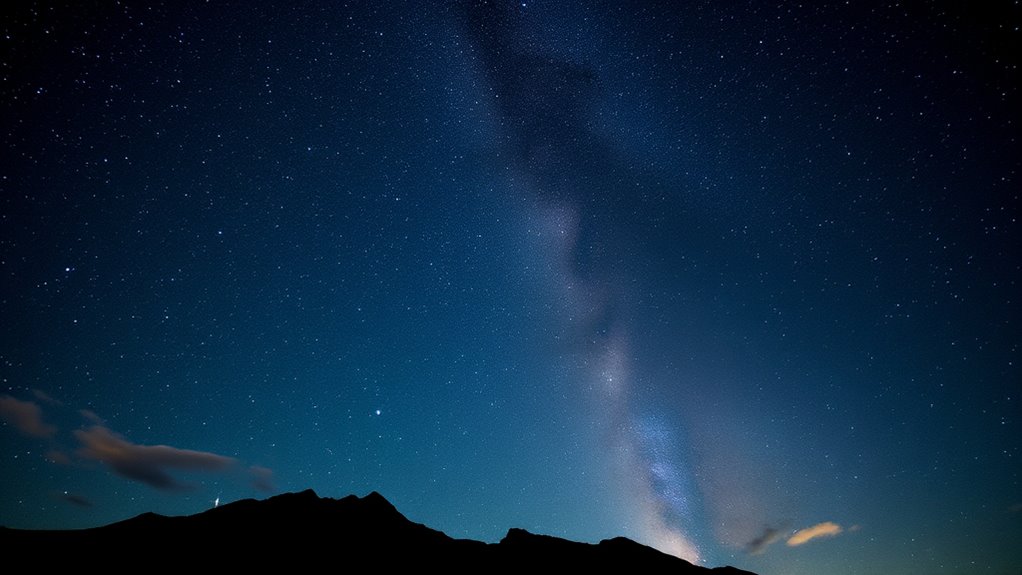
Have you ever looked up at the sky and wondered what the cloud patterns or colors reveal about the weather? When it comes to astronomical observing, the clarity of the sky is just as important as the weather itself. One of the biggest factors that can hinder your view is atmospheric turbulence. This phenomenon occurs when layers of air with different temperatures and densities mix, causing the light from stars and planets to bend and twinkle unpredictably. The more turbulence there is, the more your view gets distorted, making it difficult to see fine details or faint objects clearly. If you’ve noticed stars shimmering intensely, that’s a clear sign of high atmospheric turbulence, which reduces the quality of astronomical seeing. To improve your observing experience, it’s best to choose nights when the atmosphere is stable, often after sunset when the air has cooled and is less disturbed. Natural language processing advancements can help analyze atmospheric data to predict turbulence levels more accurately, further aiding planning for optimal observation conditions.
Light pollution also plays a consequential role in sky conditions. It’s the artificial brightness from urban areas, streetlights, and buildings that washes out the night sky, reducing contrast and hiding dim celestial objects. Even if the weather is perfect, excessive light pollution can make it nearly impossible to see stars beyond the brightest ones, such as Sirius or planets like Jupiter and Saturn. Bright skyglow from nearby cities creates a hazy backdrop that competes with the natural darkness needed for detailed astronomical observations. To get the best views, you should seek out dark-sky locations far from city lights. Using light pollution filters can help, but they’re no substitute for a genuinely dark environment. When the sky is free from artificial illumination, your eyes can adapt better, revealing more stars, nebulae, and other faint objects.
Both atmospheric turbulence and light pollution are unpredictable but manageable factors that influence your sky conditions. When planning a night of stargazing or astrophotography, check weather forecasts for atmospheric stability and try to pick nights with minimal turbulence. Simultaneously, research nearby light pollution levels and aim for remote locations or designated dark-sky parks. The combination of stable air and darkness enhances astronomical seeing, allowing you to observe the universe in its true detail. By understanding and minimizing these influences, you’ll markedly improve your ability to explore the night sky and enjoy the wonders it offers, unhindered by the distortions and glare that obscure your view.
Frequently Asked Questions
How Do Atmospheric Pollutants Affect Astronomical Seeing?
Atmospheric pollutants, like air pollution and aerosol particles, degrade astronomical seeing by causing turbulence in the Earth’s atmosphere. These particles scatter and absorb light from celestial objects, reducing clarity and sharpness. When air pollution levels are high, they increase the amount of aerosol particles, which heightens atmospheric instability. As a result, you’ll notice less stable viewing conditions, making it harder to observe fine details in stars, planets, and other celestial bodies.
What Is the Impact of Humidity on Sky Clarity?
High humidity effects can markedly reduce sky clarity, making it harder for you to see faint celestial objects. Moisture in the air causes water vapor to scatter light, leading to haziness and decreased contrast. When humidity levels are high, the atmosphere becomes more turbulent, which can blur images and diminish your viewing experience. To get the best views, aim for nights with lower humidity, ensuring clearer skies and sharper observations.
Can Lunar Phases Influence Sky Darkness and Observing Conditions?
Yes, lunar phases markedly influence sky darkness and observing conditions. When the moon is full or near full, lunar illumination causes intense moonlight interference, brightening the sky and reducing your ability to see faint objects. During new moon phases, the sky is darker, offering ideal conditions for deep-sky observations. You’ll find it easier to observe dim stars, galaxies, and nebulae when moonlight interference is minimal.
How Does Local Weather Forecasting Improve Observation Planning?
You can substantially improve your observation planning by leveraging local weather forecasting. Predictive models give you a sneak peek into upcoming conditions, so you know when clear skies will arrive. Real-time updates keep you informed right up to the moment, helping you avoid surprises. By staying ahead with accurate forecasts, you maximize your chances for perfect viewing, turning uncertainty into an advantage and making every night under the stars truly unforgettable.
What Techniques Are Used to Compensate for Atmospheric Turbulence?
You can compensate for atmospheric turbulence using techniques like adaptive optics and image stacking. Adaptive optics adjusts the telescope’s optics in real-time to counteract turbulence, providing clearer images. Meanwhile, image stacking combines multiple exposures to reduce the effects of atmospheric distortion. These methods help you obtain sharper, more accurate observations despite atmospheric disturbances, ensuring you get the best possible data during your astronomical sessions.
Conclusion
Understanding sky conditions helps you make the most of your astronomical observations. Did you know that clear, dark skies can improve your viewing quality by up to 50% compared to cloudy nights? By checking local weather and seeing forecasts, you can substantially enhance your stargazing experience. Remember, patience and preparation are key. Next time, plan your session under ideal conditions to enjoy the universe’s wonders at their brightest and clearest.