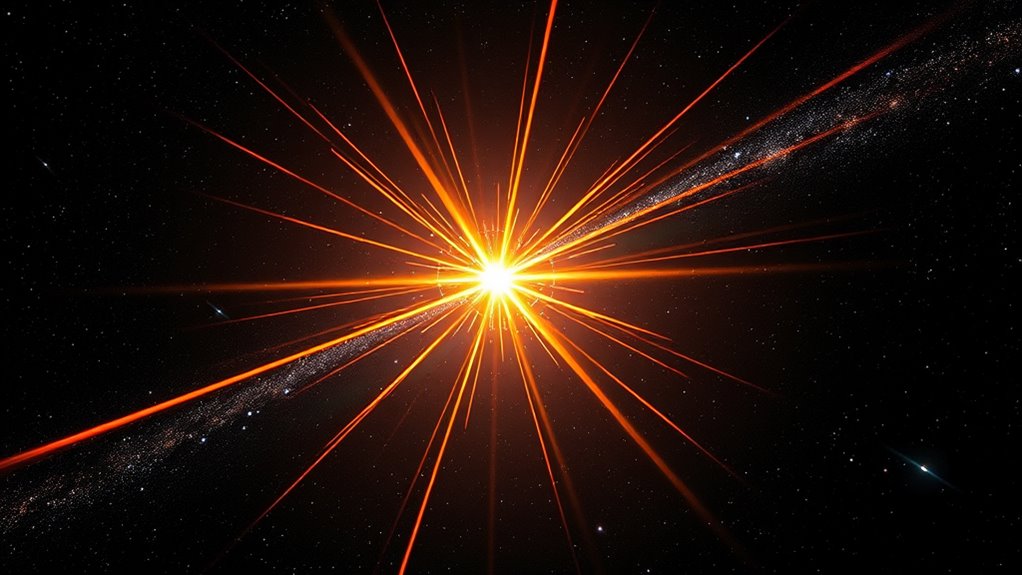

Gamma-ray bursts are some of the universe’s most spectacular cosmic fireworks, releasing more energy in seconds than the Sun does in its entire life. You see an initial flash followed by an afterglow across X-ray, optical, and radio wavelengths, revealing details about the burst’s environment and origins. The afterglow helps scientists understand the explosion, whether from collapsing massive stars or merging neutron stars. Keep exploring to discover how these explosive events shape our understanding of the cosmos.
Key Takeaways
- Gamma-ray bursts are among the universe’s most energetic explosions, releasing immense energy in seconds.
- The afterglow, observed across X-ray, optical, and radio wavelengths, reveals details about the burst’s environment.
- Analyzing afterglows helps determine the burst’s energy, surrounding material density, and magnetic fields.
- Long-duration bursts are linked to massive star collapse, while short bursts result from neutron star mergers.
- Studying afterglows confirms progenitor models and enhances understanding of cosmic explosive phenomena.

Have you ever wondered what causes some of the most energetic explosions in the universe? These powerful phenomena are known as gamma-ray bursts, and they release more energy in a few seconds than our Sun will emit over its entire lifetime. When a gamma-ray burst occurs, it sends a burst of gamma rays hurtling through space, which can be detected by specialized telescopes. But the true story begins after the initial flash, in what scientists call the afterglow phase. By analyzing this afterglow, you can gather essential information about the burst’s origins and the environment surrounding it.
When studying gamma-ray bursts, researchers rely heavily on afterglow analysis to understand the event better. The afterglow is produced as the high-energy jets from the explosion interact with the surrounding interstellar medium, creating a spectrum of electromagnetic radiation that gradually fades over time. Observing this fading glow across multiple wavelengths—X-ray, optical, radio—allows you to piece together details about the burst’s energy, the density of nearby material, and the magnetic fields involved. These insights help refine models of the explosion itself, offering clues about the nature of the progenitor that caused the burst.
Progenitor models are key to understanding what triggers gamma-ray bursts. You might think of them as the cosmic ancestors of these explosions. The two main types are long-duration bursts, believed to originate from massive stars collapsing into black holes or neutron stars, and short-duration bursts, which likely result from the merger of compact objects like neutron stars. By studying the afterglow, you can match observational data with these models, helping confirm which progenitor scenario fits each burst. For example, a long burst with an associated supernova supports the massive star collapse model, while a short burst’s location in a galaxy’s outskirts might point to a neutron star merger.
Progenitor models reveal whether long bursts come from collapsing stars or neutron star mergers.
Understanding the progenitors and analyzing the afterglow are interconnected steps. They allow you to test hypotheses about the origins of gamma-ray bursts and better grasp their role in the universe. These bursts aren’t just random explosions; they’re cosmic laboratories that reveal extreme physics, star death processes, and the formation of black holes. As you analyze the afterglow, you become part of a scientific quest to decode these spectacular events. Each observation adds a piece to the puzzle, bringing you closer to understanding the profound cosmic fireworks that light up the universe in brief, brilliant flashes.

What Are Gamma-Ray Bursts? (Princeton Frontiers in Physics)
New
As an affiliate, we earn on qualifying purchases.
As an affiliate, we earn on qualifying purchases.
Frequently Asked Questions
Can Gamma-Ray Bursts Affect Earth’s Atmosphere or Life?
Gamma-ray bursts can affect Earth’s atmosphere and life if they occur close enough. Their intense energy can cause atmospheric impacts, like ozone depletion, leading to increased UV exposure. This, in turn, can trigger biological effects, harming ecosystems and human health. However, such events are extremely rare, and Earth’s atmosphere usually shields us from most of the harmful radiation, minimizing potential damage to life on our planet.
How Do Scientists Predict Upcoming Gamma-Ray Bursts?
Predicting gamma-ray bursts is like trying to forecast a lightning strike—you can’t be exact, but you can spot warning signs. Scientists use predictive models that analyze data from space telescopes and observe potential progenitors, like massive stars or neutron star mergers. These models provide early warning signals, helping researchers monitor the skies for possible bursts. Your awareness of these signs can be vital in understanding and preparing for these cosmic fireworks.
Are Gamma-Ray Bursts Visible With Regular Telescopes?
You can’t see gamma-ray bursts with regular telescopes because they emit gamma rays, which are invisible to standard optical instruments. Instead, scientists use specialized gamma-ray detection instruments on space telescopes to observe these powerful events. While visible telescopes can’t detect gamma-ray bursts directly, they can sometimes capture afterglows that follow the initial burst, but the actual gamma-ray emission requires dedicated detection equipment beyond regular telescopes.
What Is the Longest Duration a Gamma-Ray Burst Has Lasted?
Imagine a cosmic symphony that lingers longer than expected. You’d find that the longest gamma-ray burst recorded lasted about 20 minutes—a rare celestial event stretching the limits of observational challenges. This extended burst duration defies typical short, fiery flashes, pushing astronomers to refine their detection techniques. Such rare, prolonged bursts reveal secrets about the universe’s most energetic phenomena, reminding you that even in space, some fireworks refuse to fade quickly.
Could Gamma-Ray Bursts Be Used for Interstellar Communication?
Gamma-ray bursts aren’t practical for interstellar communication. Their unpredictable nature, brief duration, and intense energy make them unreliable signals, unlike alien signals specifically designed for communication potential. You wouldn’t want to rely on these cosmic fireworks to send messages, as their primary role is in stellar phenomena, not conveying information across space. Instead, targeted, consistent signals are much more effective for interstellar communication, ensuring your message reaches its destination clearly.
astronomy afterglow analysis kit
As an affiliate, we earn on qualifying purchases.
As an affiliate, we earn on qualifying purchases.
Conclusion
Imagine witnessing the universe’s grandest fireworks show, where a single gamma-ray burst can outshine entire galaxies in seconds. Just last year, scientists captured a burst so intense, it released more energy in a few seconds than our Sun will in its entire lifetime. These cosmic explosions remind you that the universe is full of surprises—powerful and unpredictable. As you marvel at the cosmos, remember, these bursts are nature’s ultimate fireworks, illuminating the universe’s most extreme events.

RMYRHQ Cosmic Black Hole Explosion Wooden Jigsaw Puzzles for Adults 500 Pieces Vibrant Nebula&Planet Art Ideal for Sci-Fi Fans&Astronomy Enthusiasts Space Themed Parties&Family Game Nights Gifts
Entertainment interaction:Our puzzle creates a delightful family activity that bridges from adults and teens to seniors,Explore the fun…
As an affiliate, we earn on qualifying purchases.
As an affiliate, we earn on qualifying purchases.

Understanding the Enrichment of Heavy Elements by the Chemodynamical Evolution Models of Dwarf Galaxies (Springer Theses)
As an affiliate, we earn on qualifying purchases.
As an affiliate, we earn on qualifying purchases.