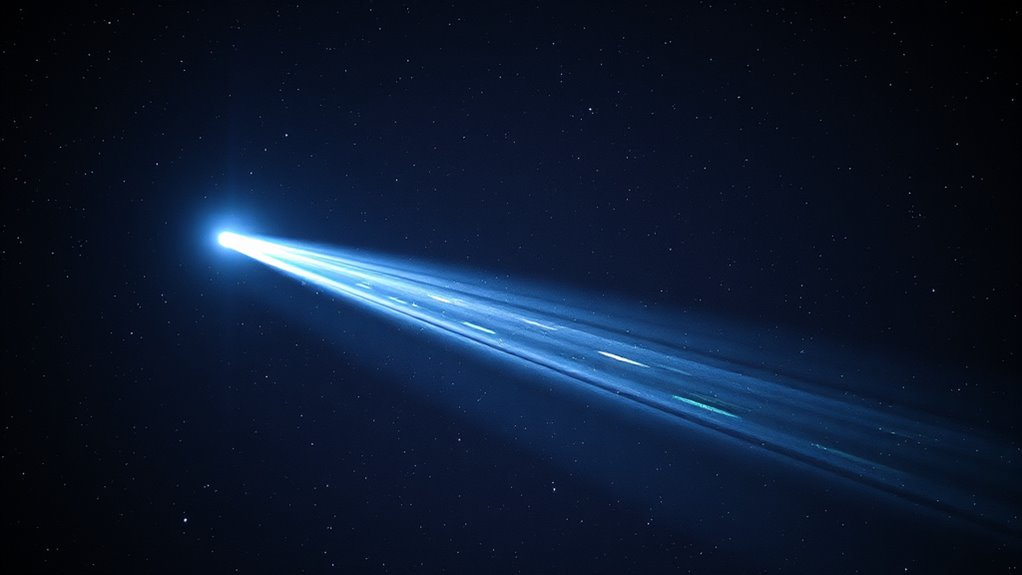

When you observe comets, you notice their spectral signatures reveal their composition, including water vapor, CO₂, and organic molecules. The tail always points away from the Sun and consists of gas and dust pushed by solar radiation and wind. Spectral analysis shows emission lines from ionized molecules, helping you understand the interactions between the comet and the solar environment. Exploring these features offers fascinating insights into the comet’s origins and the forces shaping its appearance. Keep exploring to uncover more secrets behind these celestial visitors.
Key Takeaways
- Spectral signatures reveal a comet’s composition by identifying absorption and emission lines from gases and dust.
- Emission lines in the tail indicate ionized molecules like CO, CO₂, and CN, showing interactions with solar radiation.
- The tail always points away from the Sun due to solar radiation pressure and solar wind effects on sublimated material.
- Analyzing spectral variations over time provides insights into solar activity and environmental influences on the comet.
- Spectral and tail observations help understand the comet’s origin, chemical makeup, and its interactions within the solar system.
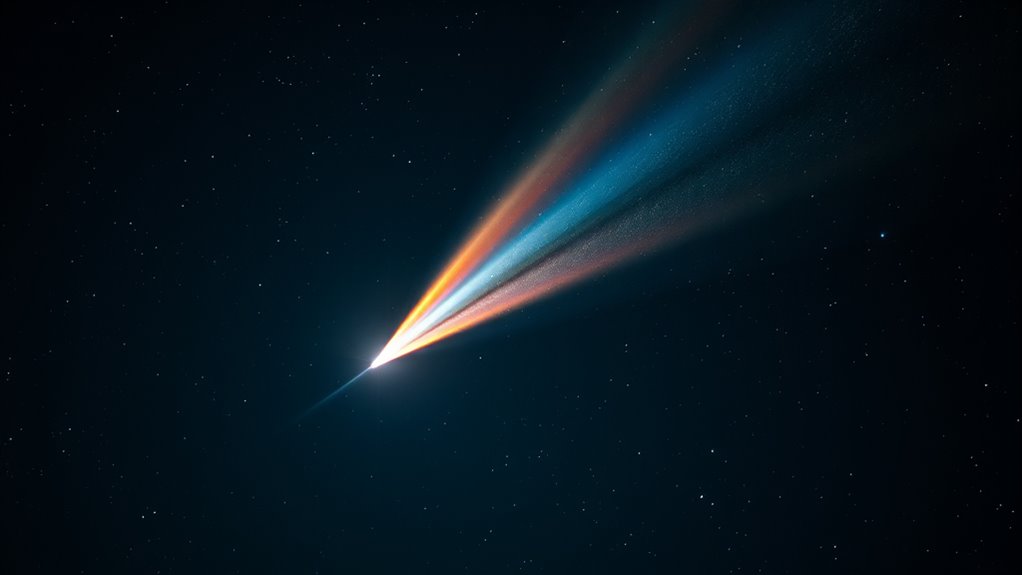
Comets are enthralling celestial objects that reveal their secrets through distinctive spectral signatures and striking tails. As you observe a comet, you can learn a great deal about its composition and behavior by examining its spectrum. Spectral analysis involves studying the light emitted or absorbed by the comet’s gases and dust, which helps identify the specific molecules present. When sunlight hits the comet’s coma—the cloud of gas and dust surrounding its nucleus—the gases absorb certain wavelengths, creating dark absorption lines in the spectrum. Conversely, as the gases fluoresce under solar radiation, they emit characteristic lines of their own. By analyzing these spectral signatures, you can determine the presence of water vapor, carbon dioxide, methane, and other molecules, offering clues about the comet’s origin and the early solar system. The spectral signatures are also influenced by the composition of gases, which can vary between comets, revealing different origins and histories.
The tail of a comet is perhaps its most striking feature, and understanding its composition can deepen your appreciation of these celestial visitors. The tail forms as the Sun’s heat causes sublimation of the comet’s ices, releasing gas and dust into space. This material is then pushed away from the comet’s nucleus by solar radiation pressure and solar wind, creating the iconic tail that always points away from the Sun. The tail is composed mainly of ionized gases and dust particles. Spectral analysis of the tail’s light reveals emission lines from ionized molecules like carbon monoxide, carbon dioxide, and various ions such as CN and C2. These spectral signatures help you identify the specific materials within the tail and understand how they interact with solar radiation. Observing the tail’s composition and changes over time can reveal how the comet responds to solar activity, such as solar flares or variations in solar wind intensity.
As you watch a comet streak across the sky, remember that each component—the spectral signatures and tail composition—tells a story about its origins, journey, and interaction with the Sun. By analyzing the spectral data collected through telescopes, you can uncover the chemical makeup of the comet’s gases and dust, gaining insights into the primordial materials that formed our solar system. The tail’s composition, shaped by external forces, offers a real-time view of the dynamic processes at play. Whether you’re an amateur astronomer or a seasoned researcher, paying attention to these details enriches your understanding of these ancient, icy travelers and their role in the cosmic tapestry.
Frequently Asked Questions
How Do Comets Originate in the Solar System?
You can understand that comets originated from the early solar system during comet formation, which took place over 4.6 billion years ago. During solar system origins, icy bodies and dust particles clumped together in the outer regions, forming cometary nuclei. These nuclei remained dormant until gravitational disturbances nudged them toward the Sun, where they develop tails and become visible as comets. This process links directly to the solar system’s initial formation and evolution.
Can Comets Be Visible With the Naked Eye From Earth?
Yes, you can see comets with the naked eye from Earth, especially when they’re bright enough. Their visibility depends on brightness variation, which varies as they approach the Sun and develop their tails. Bright comets can appear as fuzzy, glowing objects in the night sky, sometimes even during twilight. Keep an eye out during predicted appearances, and use binoculars or a telescope for even better viewing if they’re faint.
What Is the Difference Between a Comet’s Coma and Tail?
Imagine a comet’s glow as a celestial dance. The coma forms when sunlight warms the icy core, creating a glowing cloud of gas and dust. The tail, however, is a graceful streamer composed of ionized gases and dust particles pushed away by solar wind. While the coma surrounds the nucleus, the tail extends outward, always pointing away from the Sun, revealing the comet’s dynamic interaction with solar forces.
How Do Scientists Predict a Comet’s Future Trajectory?
You can predict a comet’s future trajectory by performing orbital calculations that analyze its current position and velocity. Scientists use gravitational modeling to account for influences from planets, the Sun, and other celestial bodies. By updating these calculations with new observations, they refine the comet’s path, helping forecast its future movement. This process allows for accurate predictions of when and where the comet will appear in the sky.
Are There Any Known Artificial Influences on Comet Appearances?
Did you know that less than 1% of comet appearances show signs of artificial influence? While extraterrestrial interference remains unconfirmed, artificial light pollution from Earth can affect how we observe comets, making them appear brighter or altering their tails. These influences don’t change the comet’s true nature but can mislead observations. So, when you see a bright, unusual tail, it’s likely natural, not human-made interference.
Conclusion
By studying a comet’s spectral signatures and tails, you reveal the secrets of our solar system’s icy travelers. These celestial visitors reveal their composition and behavior, offering clues about their origins. When you observe them closely, you see the bigger picture come into focus. Remember, appreciating comets is like hitting two birds with one stone—you gain knowledge and awe simultaneously. Keep exploring, and you’ll find the universe’s mysteries are just waiting to be uncovered.