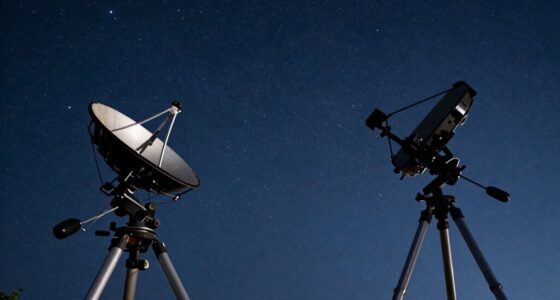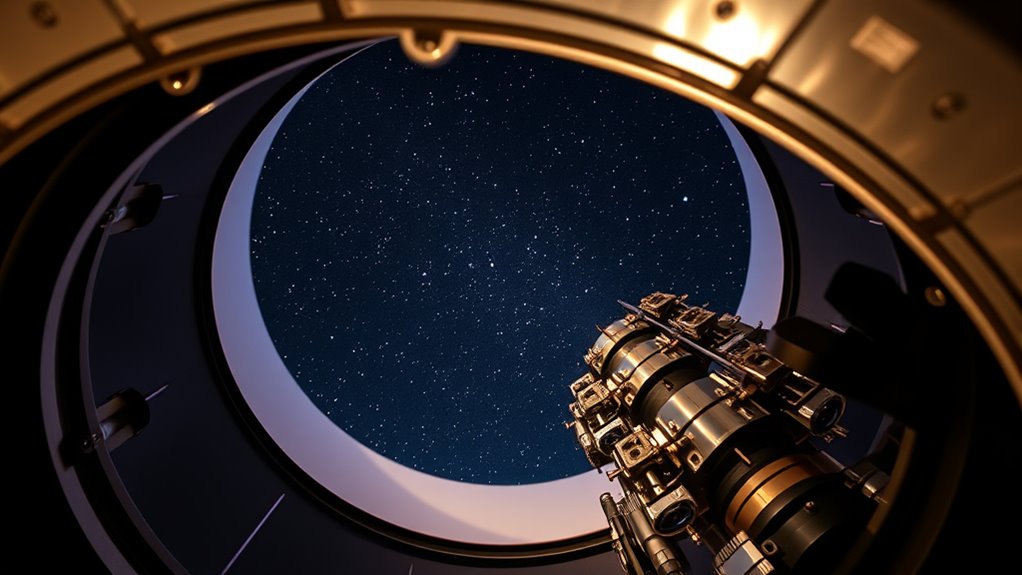

Adaptive optics in modern telescopes allow you to see celestial objects with clarity similar to space telescopes. They work by measuring distortions caused by Earth’s atmosphere using wavefront sensors and correcting them in real time with deformable mirrors. This technology sharpens images that would otherwise be blurry, expanding your ability to observe distant galaxies, stars, and exoplanets. If you keep exploring, you’ll discover how these advancements continue to push the boundaries of ground-based astronomy.

Get the latest gadgets delivered free with Prime
- Fast, free delivery on millions of items
- Prime Video, Amazon Music and more included
- Member-only deals all year
Key Takeaways
- Adaptive optics uses real-time wavefront correction to counteract atmospheric turbulence, enhancing image clarity in ground-based telescopes.
- It employs sensors and deformable mirrors to detect and correct wavefront distortions caused by Earth’s atmosphere.
- The technology enables telescopes to achieve space-like resolution, revealing detailed celestial phenomena from the ground.
- Advances in sensors and processing speed improve correction accuracy, expanding observational capabilities of ground-based observatories.
- Adaptive optics allows cost-effective, high-resolution astronomical observations, reducing reliance on space telescopes.
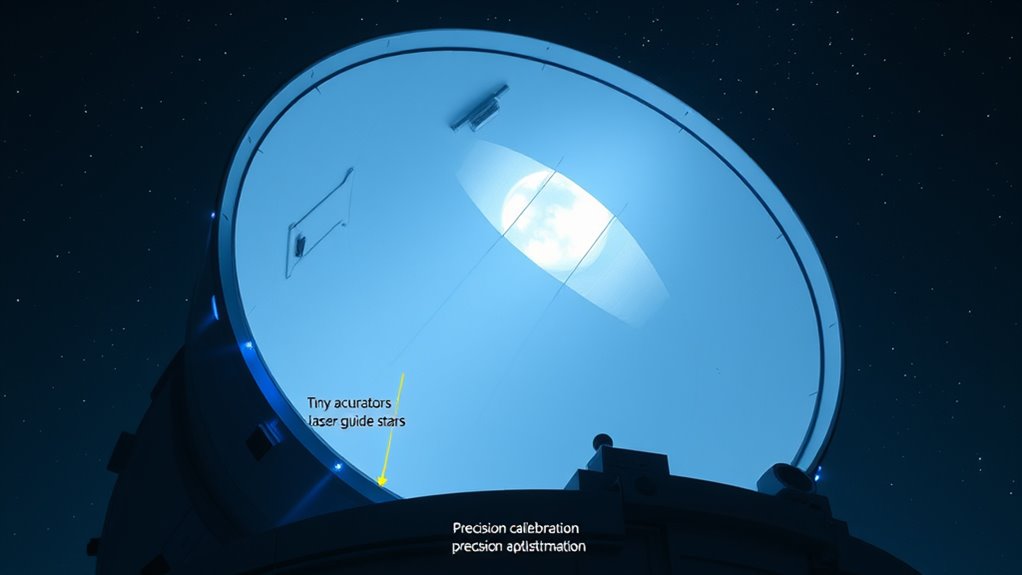
Adaptive optics has revolutionized modern telescopes by allowing astronomers to see celestial objects with unprecedented clarity. This technology primarily relies on ground-based correction techniques that counteract the distortion caused by Earth’s atmosphere. Instead of letting atmospheric turbulence blur your view, adaptive optics uses real-time adjustments to sharpen the images you observe. At the core of this correction system are wavefront sensors, which continuously monitor how incoming light waves are distorted as they travel through the atmosphere. These sensors detect minute aberrations in the wavefronts, providing critical information that guides the correction process.
Once the wavefront sensors measure the distortions, the data is sent to a deformable mirror. This mirror can change shape rapidly, often hundreds or thousands of times per second, to compensate for the detected aberrations. As a result, the light waves are corrected before they reach the telescope’s detector, delivering images with clarity comparable to space-based telescopes. This ground-based correction method is essential because it allows astronomers to observe celestial phenomena with remarkable detail from Earth, saving costs and expanding observational capabilities without the need for costly space missions.
The process begins with the wavefront sensor capturing incoming light and analyzing how it deviates from an ideal wavefront. Typically, a guide star—either natural or artificial—serves as a reference point for the sensor. When the guide star’s light passes through the atmosphere, it becomes distorted, but the wavefront sensor detects these distortions in real time. The sensor’s data is then processed by a computer that calculates the necessary adjustments for the deformable mirror. These adjustments happen almost instantaneously, allowing the telescope to correct for atmospheric turbulence dynamically.
Additionally, advancements in sensor technology continue to improve the speed and accuracy of wavefront measurements, further enhancing the capabilities of adaptive optics systems. This continuous feedback loop markedly enhances image resolution, making it possible to observe details that would otherwise be lost. For example, astronomers can study distant galaxies, star formation regions, and even exoplanets with much greater precision. Ground-based correction with wavefront sensors effectively turns a terrestrial telescope into a tool that rivals space telescopes in clarity, all while operating within Earth’s atmosphere. As technology advances, these systems become faster and more accurate, pushing the boundaries of what we can observe and understand about our universe.
As an affiliate, we earn on qualifying purchases.
Frequently Asked Questions
How Does Adaptive Optics Compare to Other Image Correction Methods?
You’ll find adaptive optics superior to other image correction methods because it uses wavefront correction with real-time adaptation, allowing it to instantly adjust for atmospheric distortions. Unlike static or less dynamic techniques, adaptive optics continuously refines the image, providing sharper, clearer views of celestial objects. This real-time process makes it highly effective for high-resolution astronomy, outperforming traditional methods that lack quick, automatic adjustments.
What Are the Main Challenges in Implementing Adaptive Optics Systems?
Imagine trying to keep a delicate mirror steady amidst a raging storm—that’s what implementing adaptive optics feels like. You face calibration complexity, fine-tuning the system to match atmospheric turbulence precisely. Real-time processing adds urgency, demanding lightning-fast computations to correct distortions instantly. Balancing these challenges is tough, but when you succeed, you discover crystal-clear images of the cosmos, revealing wonders hidden by Earth’s turbulent atmosphere.
How Does Atmospheric Turbulence Affect Telescope Imaging?
Atmospheric turbulence distorts your telescope images by causing wavefront distortion, which blurs the light coming from celestial objects. This turbulence creates rapid changes in air temperature and density, leading to atmospheric scattering that further degrades image quality. As a result, stars appear twinkling and images become less sharp. Adaptive optics systems help counteract these effects by adjusting the telescope’s optics in real-time, sharpening your view of the universe despite atmospheric disturbances.
Can Adaptive Optics Be Used in Space-Based Telescopes?
You can’t use adaptive optics in space-based telescopes the same way as ground-based ones. Space environments lack atmospheric turbulence, so space-based correction isn’t necessary. However, you can still integrate AO systems to correct for optical distortions within the telescope itself, improving image quality. This AO system integration helps achieve sharper images, but it mainly addresses internal hardware issues rather than atmospheric effects.
What Future Advancements Are Expected in Adaptive Optics Technology?
Future advancements in adaptive optics will enhance wavefront correction through improved algorithms and faster real-time sensing, allowing you to achieve sharper images with less delay. Expect better precision in compensating for atmospheric distortions, making observations more accurate. Innovations may also involve integrating adaptive optics with AI for predictive adjustments, enabling you to explore distant celestial objects with unprecedented clarity and detail, pushing the boundaries of astronomical research and discovery.
As an affiliate, we earn on qualifying purchases.
Conclusion
You now see how adaptive optics transform modern telescopes, giving you crystal-clear views of the universe. Did you know that these systems can correct atmospheric distortions up to 1,000 times per second? This rapid correction allows astronomers to observe celestial objects with unprecedented clarity, revealing details previously hidden. As technology advances, adaptive optics will continue to unseal cosmic secrets, making the universe more accessible and fascinating for you to explore.
As an affiliate, we earn on qualifying purchases.
high-resolution astronomical telescope
As an affiliate, we earn on qualifying purchases.
As an affiliate, we earn on qualifying purchases.
Halloween Picks
halloween
As an affiliate, we earn on qualifying purchases.