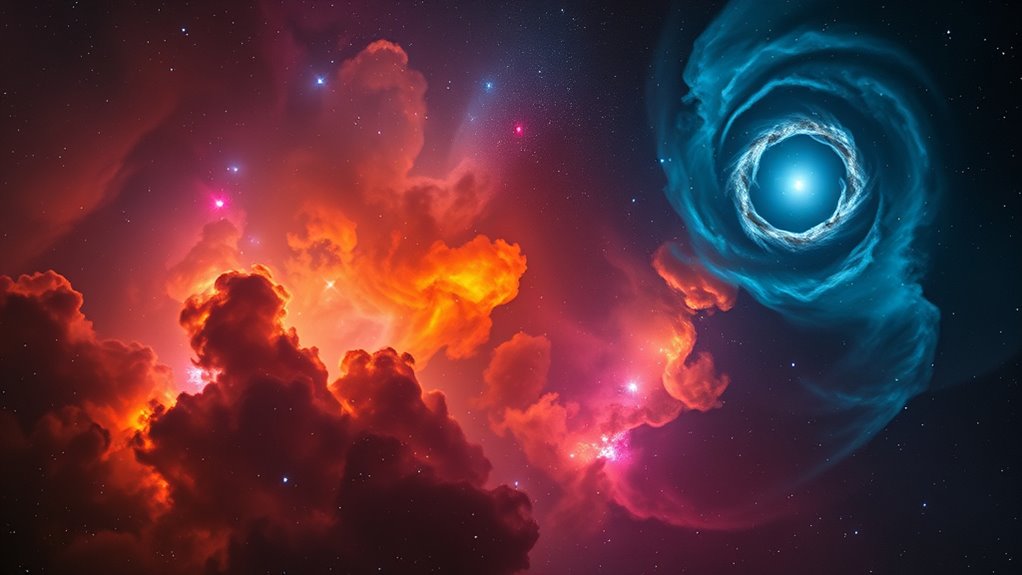
When observing nebulae, you’ll notice that emission nebulae glow brightly with reds and greens due to ionized gases, while reflection nebulae appear bluish as they scatter starlight. Planetary nebulae often show symmetrical shapes with vibrant colors and intricate structures. Using specialized imaging techniques like narrowband filters and spectroscopic analysis helps you identify elements and understand their compositions. If you explore further, you’ll uncover even more fascinating details about these cosmic clouds and their mysteries.

Get the latest gadgets delivered free — and shop member deals
- Fast, free delivery on millions of items
- Access to Prime Big Deal Days deals on October 6–7
- Prime Video, Amazon Music and more included
Key Takeaways
- Emission nebulae glow brightly in specific colors due to ionized gases emitting characteristic spectral lines.
- Reflection nebulae scatter nearby starlight, appearing bluish and revealing dust properties through imaging.
- Planetary nebulae are glowing shells around dying stars with symmetrical shapes, often captured with detailed imaging.
- Spectroscopic analysis helps identify elemental composition and physical conditions of different nebula types.
- Imaging techniques, including narrowband filters, emphasize specific emission features and nebular structures.
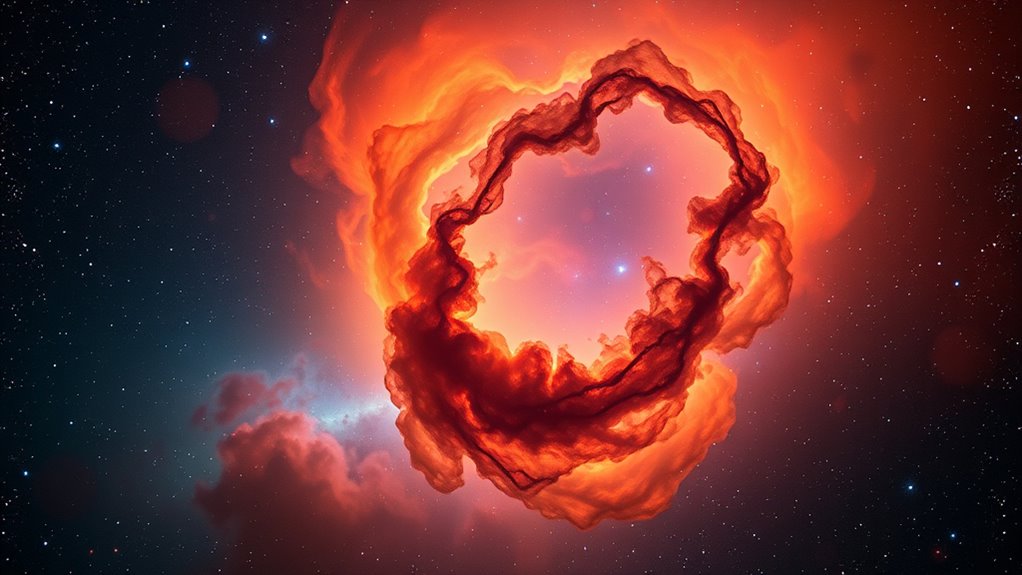
Have you ever looked up at the night sky and wondered what those faint, colorful patches are? Those glowing clouds are nebulae, and they come in various types—emission, reflection, and planetary. To truly understand what you’re seeing, astronomers rely on advanced methods like spectroscopic analysis and imaging techniques. These tools help reveal the composition, structure, and physical conditions within each nebula.
When observing an emission nebula, you’re witnessing clouds of ionized gas that glow brightly in specific colors, often reds and greens. This glow results from high-energy ultraviolet radiation from nearby hot stars ionizing the gas, causing it to emit light at characteristic wavelengths. Spectroscopic analysis plays a crucial role here. By splitting the light from the nebula into its component wavelengths, you can identify the elements present—such as hydrogen, oxygen, and nitrogen—and determine their relative abundances. Imaging techniques, especially narrowband imaging, allow you to capture detailed images that highlight these specific emission lines, revealing intricate filaments and shapes within the nebula. These images not only enhance your understanding but also provide a vivid visual representation of the nebula’s complex structure.
Spectroscopic and imaging techniques reveal the colorful, intricate structures of emission nebulae.
Reflection nebulae, on the other hand, don’t emit their own light. Instead, they scatter the light from nearby stars. When observing these, you notice a soft, bluish hue because blue light scatters more efficiently than other wavelengths, much like Earth’s sky. To analyze reflection nebulae, imaging techniques become vital. High-resolution images help you see the subtle variations in brightness and color, giving clues about the dust particles that scatter the star’s light. Spectroscopic analysis can also assist by studying the scattered light’s spectrum, which helps identify the properties of the dust grains and the illuminating stars. Together, these methods paint a picture of the dust composition and the star’s influence on its surroundings.
Planetary nebulae are the remnants of dying stars, often showing symmetrical shapes and vibrant colors. Observing them involves combining imaging techniques to capture their detailed structure with spectroscopic analysis to understand their chemical makeup. These nebulae appear as glowing shells around a central star, and through spectroscopy, you can measure the velocities and densities of the gases. Imaging helps you see the intricate shapes—rings, lobes, and filaments—that make planetary nebulae fascinating to study.
narrowband filters for astrophotography
As an affiliate, we earn on qualifying purchases.
As an affiliate, we earn on qualifying purchases.
Frequently Asked Questions
How Do Nebulae Form in the Galaxy?
You see nebulae form in your galaxy when massive stars create stellar nurseries, where gas and dust clump together under gravity. Supernova remnants also contribute by dispersing material that can later condense into new nebulae. These processes enrich the interstellar medium, providing the raw materials necessary for future star formation. So, nebulae are born from the cycle of stellar birth and death, continually shaping your galaxy’s evolution.
What Are the Differences Between Nebulae Types in Detail?
You can tell nebulae types apart by their spectral characteristics and physical structures. Emission nebulae glow brightly due to ionized gases emitting specific wavelengths, giving them a reddish hue. Reflection nebulae don’t emit their own light but reflect nearby stars’ light, appearing blue. Planetary nebulae are compact shells of gas expelled by dying stars, with smooth, rounded shapes. Recognizing these features helps you identify each nebula type in the night sky.
Can Nebulae Be Observed With the Naked Eye?
You can sometimes see nebulae with the naked eye, but it’s rare and depends on conditions. Under dark skies, objects like the Orion Nebula reveal themselves through visual observation as faint, glowing patches. Most nebulae require binoculars or telescopes to truly appreciate their beauty. Keep your eyes open and your patience ready—these celestial wonders might surprise you with their subtle glow, waiting to be uncovered in the night sky.
What Equipment Is Best for Astrophotography of Nebulae?
For astrophotography of nebulae, you should use a sturdy camera mount to keep your camera stable during long exposures. Pair it with a telescope lens or a dedicated astrophotography telescope to capture detailed images. This setup allows you to gather more light and reduce vibrations, resulting in clearer, more vibrant photos of nebulae. Make sure to use a tracking mount to follow the nebula’s movement across the sky.
How Long Does It Take for a Nebula to Evolve?
The lifecycle duration of a nebula varies widely, spanning from a few thousand to several million years depending on its type. You’ll find that evolutionary timescales are influenced by factors like stellar winds and supernovae, which can accelerate or slow the process. For example, emission nebulae may last a few million years before dispersing, while planetary nebulae typically evolve over tens of thousands of years.
spectroscopy equipment for astronomy
As an affiliate, we earn on qualifying purchases.
As an affiliate, we earn on qualifying purchases.
Conclusion
Now that you’ve explored emission, reflection, and planetary nebulae, you see how each type offers a unique glimpse into the universe. You observe their vibrant colors, their intricate shapes, and their fascinating origins. You marvel at their beauty, their complexity, and their stories. By understanding these nebulae, you deepen your connection to the cosmos, appreciating the wonder, the diversity, and the mystery that make the universe so mesmerizing. Keep observing, keep exploring, and let the stars inspire you.
high-resolution telescope for nebula observation
As an affiliate, we earn on qualifying purchases.
As an affiliate, we earn on qualifying purchases.
astrophotography imaging software
As an affiliate, we earn on qualifying purchases.
As an affiliate, we earn on qualifying purchases.
Halloween Picks
halloween
As an affiliate, we earn on qualifying purchases.