
Additive color mixing involves combining light wavelengths, like on screens, to create brighter colors and white, using primaries such as red, green, and blue. Subtractive mixing, used with paints and pigments, absorbs certain wavelengths, resulting in darker or muted hues, with primaries like cyan, magenta, and yellow. Understanding how these systems work helps you control colors in digital and physical media. Keep exploring to find out how these principles shape the visuals you see every day.
Key Takeaways
- Additive color mixing combines light wavelengths, creating brighter colors and white when all primaries are mixed.
- Subtractive color mixing involves pigments absorbing specific wavelengths, often resulting in darker, muted hues.
- Primary colors for additive mixing are red, green, and blue, while subtractive primaries are cyan, magenta, and yellow.
- Additive mixing is used in digital screens and lighting, whereas subtractive mixing applies to paints, printing, and physical media.
- The mechanisms differ: additive mixes light to produce new colors; subtractive mixes pigments, absorbing wavelengths to alter reflected colors.
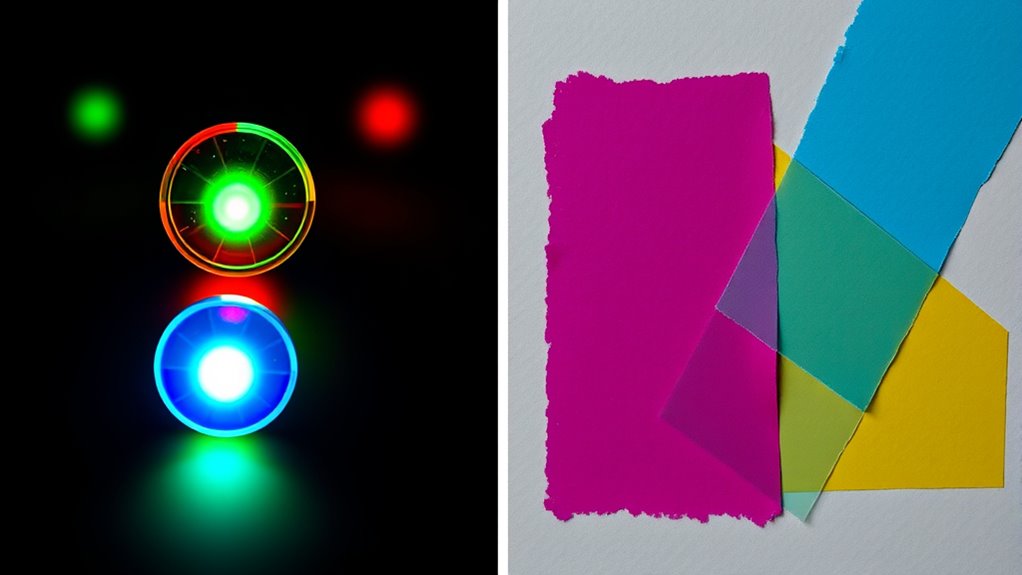
Color mixing is fundamental to how we perceive and create visual effects, but it works differently depending on whether you’re combining light or pigments. When dealing with light, you’re engaging in additive color mixing, which involves combining different wavelengths to produce new colors. This process is governed by color theory, which explains how different colors of light interact to create the spectrum we see. In additive mixing, primary colors are red, green, and blue. By blending these, you can create virtually any color, including white when all three are combined at full intensity. Your perception of color results from the way light interacts with your eyes, with each wavelength stimulating specific receptors in your retina.
In contrast, subtractive color mixing involves pigments, dyes, or inks that absorb (subtract) certain wavelengths of light while reflecting others. When you mix pigments, you’re often working with primary colors like cyan, magenta, and yellow. These are the building blocks of subtractive color mixing because they absorb specific parts of the spectrum and reflect the remaining wavelengths back to your eyes. The key to understanding pigment interaction here is recognizing that mixing these colors doesn’t produce a straightforward average; instead, it involves complex chemical interactions that determine which wavelengths are absorbed or reflected. As you combine more colors, the reflected light diminishes, and the resulting hue becomes darker or more muted. This is why mixing paints often results in muddy tones if not done carefully.
Your grasp of color theory helps you understand these differences, especially how primary colors relate to each system. In additive mixing, red, green, and blue are primary, and mixing them yields secondary colors like cyan, magenta, and yellow. In subtractive mixing, cyan, magenta, and yellow serve as primaries, producing a range of hues through pigment interaction. It’s essential to remember that, while both systems involve combining colors, the mechanisms are distinct: additive mixing builds brightness through light, whereas subtractive mixing darkens and enriches color through pigment interaction.
Additionally, understanding the spectral properties of different colors helps you make more accurate predictions about the outcomes of mixing in either system. Mastering these principles allows you to control color outcomes more precisely in various creative projects. Whether you’re working with digital screens or painting with physical media, knowing how light and pigments behave helps you predict and manipulate colors effectively. Recognizing these fundamental differences in how colors combine enables you to achieve the desired visual effects, whether you’re designing graphics, mixing paints, or working with lighting. Mastering the concepts of additive and subtractive color mixing ultimately enhances your ability to communicate visually and create compelling imagery.

KSIPZE 100ft Led Strip Lights RGB Music Sync Color Changing Led Lights with Smart App Control Remote Led Lights for Bedroom Room Lighting Flexible Home Décor
APP and IR Remote Contorl: With a stable connection,control your LED lights,freely change in 16 million colors,adjust brightness,customize…
As an affiliate, we earn on qualifying purchases.
As an affiliate, we earn on qualifying purchases.
Frequently Asked Questions
How Does Ambient Lighting Affect Color Mixing Results?
Ambient lighting substantially impacts your color mixing results. Different lighting conditions, especially variations in color temperature, can alter how colors appear and blend. Under warm light, colors may seem more vibrant or yellowish, while cool lighting can make them appear bluish or muted. You need to take into account these factors because they influence perception, making it essential to view your work under consistent lighting conditions to achieve accurate color mixing.
Can Digital Screens Accurately Replicate Subtractive Color Mixing?
Ever wonder if your digital screen can truly mimic subtractive color mixing? It can, but only if you pay attention to color calibration and the screen’s color gamut. Most screens are designed to display a wide range of colors, but they might not perfectly replicate the depth and nuance of subtractive mixing, especially with printed colors. Proper calibration helps make sure your display shows colors as accurately as possible.
What Are Common Mistakes When Blending Colors in Painting?
When blending colors in painting, you often make mistakes like overmixing, which can muddy your hues. To improve, follow basic Color Theory principles, understanding complementary and analogous colors. Use proper Brush Technique to layer and blend smoothly, avoiding harsh edges. Keep your colors fresh and work quickly before they dry. Practice patience and observe how colors interact naturally, helping you create seamless progressions and vibrant, harmonious blends in your artwork.
How Do Color Blind Individuals Perceive Additive and Subtractive Mixing?
Your world of color perception is like a dimly lit room where vision adapts silently. For color blind individuals, additive and subtractive mixing aren’t just technical processes but a different palette of perception. Their visual adaptation filters the vibrant spectrum, making certain shades blend into each other or appear muted. While they perceive the colors differently, their experience still tells a story—one of resilience and unique beauty, beyond the spectrum’s surface.
Are There Applications Where Both Methods Are Used Simultaneously?
Yes, there are applications where both methods are used simultaneously. You might encounter hybrid color systems or combined color techniques in digital displays and printing, where additive and subtractive processes work together to produce accurate colors. For example, in modern screens, LEDs (additive) are combined with color filters (subtractive) to create a wide spectrum. This integration enhances visual quality, making color reproduction more vibrant and precise across various devices.

Amsterdam Standard Series acrylic paint primary set | 5 x 120 ml (17791905)
Amsterdam Standard Series acrylic paint primary set | 5 x 120 ml (17791905)
As an affiliate, we earn on qualifying purchases.
As an affiliate, we earn on qualifying purchases.
Conclusion
Now that you see the dance between additive and subtractive color mixing, imagine yourself as a painter or a light artist, wielding vibrant colors like a magician’s brush. Additive mixing paints the sky with glowing hues, while subtractive blending shades a garden in lush tones. Both are like different melodies in a symphony of color. By understanding their rhythm, you discover a world where colors come alive, transforming your creations into vivid, mesmerizing masterpieces.

1,500 Color Mixing Recipes for Oil, Acrylic & Watercolor: Achieve precise color when painting landscapes, portraits, still lifes, and more
As an affiliate, we earn on qualifying purchases.
As an affiliate, we earn on qualifying purchases.
![MixPad Free Multitrack Recording Studio and Music Mixing Software [Download]](https://m.media-amazon.com/images/I/71ltIxIuz1L._SL500_.jpg)
MixPad Free Multitrack Recording Studio and Music Mixing Software [Download]
Create a mix using audio, music and voice tracks and recordings.
As an affiliate, we earn on qualifying purchases.
As an affiliate, we earn on qualifying purchases.