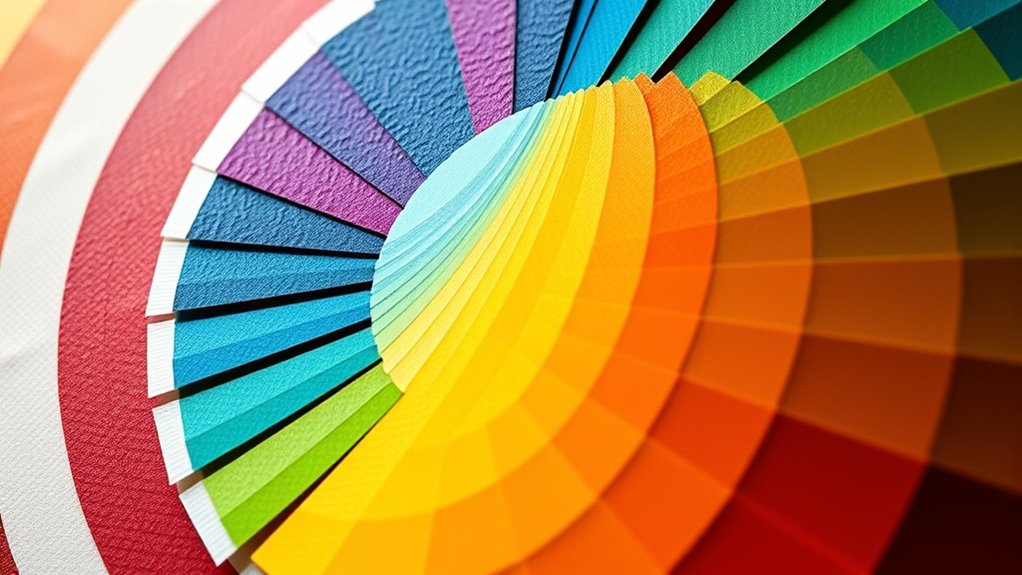

The history of color theory begins with Goethe’s exploration of how colors interact and influence perception, highlighting their emotional and natural effects. It moves through Newton’s scientific study of light and spectrum, which laid a foundation for understanding color relationships. Artists and scientists then collaborated to develop models like Munsell’s system, categorizing hue, value, and chroma. Continuing this evolution, color theory now combines scientific insights and artistic expression, revealing a rich story you’re encouraged to explore further.
Key Takeaways
- Goethe’s experiments explored subjective color interactions, emphasizing perception and psychological effects over scientific explanation.
- Newton’s spectrum demonstrated white light’s composition of multiple colors, influencing color mixing and relationships.
- 19th-century collaborations merged physics, art, and psychology, leading to color wheels and systematic theories.
- Munsell developed a structured color system based on hue, value, and chroma, formalizing color perception models.
- The evolution of color theory reflects a continuous integration of scientific understanding and artistic exploration from Goethe to Munsell.
Have you ever wondered how artists and scientists have come to understand the way colors interact and influence us? The journey begins with exploring how humans perceive color, a complex process rooted in our biology and environment. Early on, people noticed that colors could evoke emotions, convey messages, and even reveal truths about the natural world. This awareness sparked curiosity about how colors work and how they could be systematically studied. Over time, the evolution of palettes used in art reflects this growing understanding. Early artists relied on natural pigments derived from minerals, plants, and animals, which limited their choices but also emphasized the importance of understanding color relationships. As techniques and materials advanced, so did the variety of hues available, pushing artists to think more about how colors interacted and affected viewers.
The study of color perception played a crucial role in shaping early theories. Philosophers like Aristotle and later thinkers observed that colors are not just inherent qualities but are also perceived differently depending on context, lighting, and individual differences. These insights laid the groundwork for a more scientific approach. During the 18th century, scientists began experimenting with the physics of light and color, leading to a better understanding of how human eyes perceive different wavelengths. This period marked a shift from purely aesthetic considerations to a more analytical view, where the evolution of palettes was driven by both artistic needs and scientific discoveries.
As the 19th century unfolded, artists and scientists collaborated more closely, culminating in groundbreaking theories that combined physics, psychology, and art. The development of color wheels and charts, such as those by Isaac Newton and later by others, illustrated how colors relate to one another and how they could be systematically organized. Newton’s work with the spectrum of visible light revealed that white light is composed of a range of colors, inspiring artists to experiment with mixing and juxtaposing hues for desired effects. This era also saw the rise of impressionism and other movements that emphasized vibrant, expressive palettes, reflecting an evolving understanding of how colors influence mood and perception.
Moving into the 20th century, theorists like Albert Munsell introduced systematic approaches to color organization through models that considered hue, value, and chroma. Munsell’s color system, in particular, revolutionized the way artists, designers, and scientists think about color, providing a practical framework that captures the nuances of color perception. His work, along with others, helped formalize the science behind color interaction and perception. Today, the history of color theory from Goethe’s explorations of color phenomena to Munsell’s structured systems shows a continuous quest to understand how we see, interpret, and utilize color. This ongoing journey reflects our fascination with the vibrant world around us and our desire to harness its full expressive potential.

Color Theory for Artists: Everything you need to know about working with colour
As an affiliate, we earn on qualifying purchases.
As an affiliate, we earn on qualifying purchases.
Frequently Asked Questions
How Did Cultural Differences Influence Early Color Theories?
You see that cultural differences deeply shaped early color theories through cultural symbolism and artistic interpretations. Different societies assigned unique meanings to colors, influencing how they understood and categorized them. For example, some cultures linked red with luck or danger, while others associated it with power. These perspectives affected how artists and theorists perceived color relationships, creating diverse approaches rooted in cultural symbolism and artistic interpretations, shaping early color theories profoundly.
What Role Did Technology Play in Advancing Color Science?
Technology greatly advanced color science by enabling precise measurements through spectrophotometry and improving digital imaging. You can now analyze color properties accurately, leading to better color reproduction in displays and printing. These tools help scientists and designers understand color differences more objectively, driving innovations. As a result, technology bridges the gap between perception and scientific understanding, making color applications more consistent and reliable across various industries.
How Are Ancient Color Theories Relevant Today?
Ancient color theories still subtly influence your perceptions today, shaping cultural symbolism and artistic interpretations. They offer a poetic lens through which you can explore color’s emotional and cultural resonance, enriching your creative expression. By understanding these timeless ideas, you gain deeper insight into how colors evoke feelings and meanings across different societies, helping you craft more meaningful art and design that resonates on a universal level.
Who Were the Key Figures in Modern Color Theory Development?
You should know that key figures like Albert Munsell, Johannes Itten, and Josef Albers advanced modern color theory by exploring perception psychology and color symbolism. They developed systems to understand how we perceive colors, their emotional impact, and cultural meanings. Their work influences design, art, and science today, helping you create visually compelling and psychologically effective work. Their insights bridge scientific understanding with the symbolism that colors hold across cultures.
How Does Color Perception Vary Across Different Species?
Did you know some insects see in ultraviolet? Color perception varies greatly across species due to differences in spectral sensitivity and visual cognition. While humans typically see three color channels, birds and insects often see more, including ultraviolet light. This variation helps each species interpret their environment uniquely, influencing behaviors like finding food or mates. Your perception is just one way to experience a world that’s vastly different for other creatures.
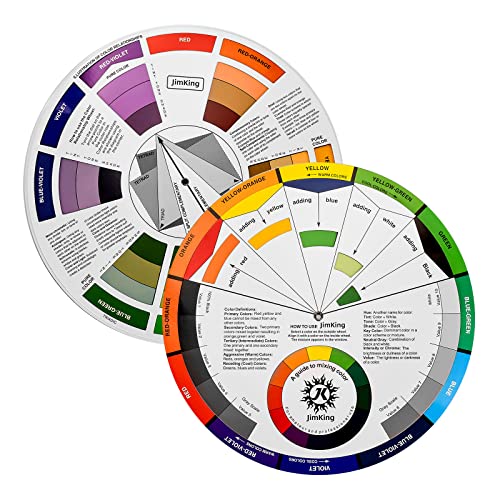
JimKing Creative Color Wheel, Paint Mixing Learning Guide, Art Class Teaching Tool for Makeup Painting Tattoo,Blending Board Chart Color Mixed Guide Hardboard(9.25inch)
Helps organise colours to make choices and combinations easier;Defines common terms and helps the artist to understand colour…
As an affiliate, we earn on qualifying purchases.
As an affiliate, we earn on qualifying purchases.
Conclusion
As you journey through the history of color theory, think of it as traversing a vibrant landscape, where Goethe’s passionate brushstrokes meet Munsell’s precise palette. Each thinker is a guiding star, illuminating the path toward understanding. Just as colors blend and shift in the sky at sunset, your perception evolves, revealing that color’s true essence lies not just in science or art, but in the harmony between them—an ongoing dance of discovery.

Creative Mark Double-Sided Color Wheel Mixing Guide, 9.25", 60 Colors, Munsell System Based, for Artists, Professionals, Students, Teachers
Double-Sided Artist Color Wheel: A versatile, 9-1/4" diameter color wheel for artists, students, and teachers. It's an essential…
As an affiliate, we earn on qualifying purchases.
As an affiliate, we earn on qualifying purchases.

5 Pieces Painting Knives Stainless Steel Spatula Palette Knife Oil Painting Accessories Color Mixing Set for Oil, Canvas, Acrylic Painting-Lightwish
Excellent Blades: The material of blades is stainless steel, good elasticity, can resist all wear and corrosion from…
As an affiliate, we earn on qualifying purchases.
As an affiliate, we earn on qualifying purchases.