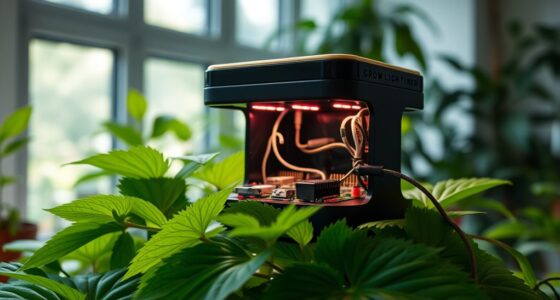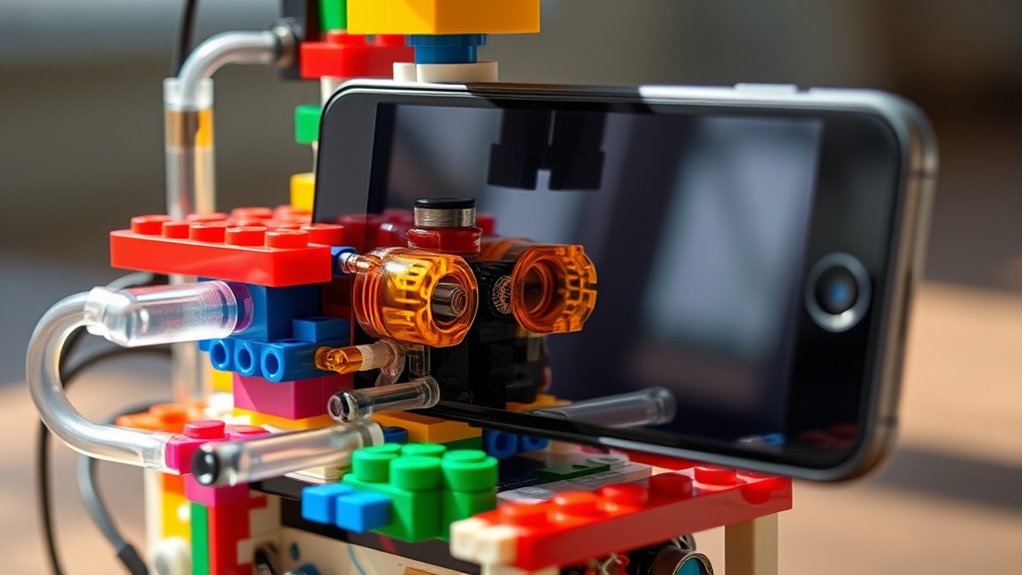

To build a smartphone spectrometer with LEGO bricks, gather LEGO pieces, a diffraction grating (from an old CD or online purchase), and your phone. Construct a simple enclosure that holds the diffraction grating at a precise angle, aligning it with your phone’s camera to capture spectra. Fine-tune the setup for clear spectral separation, then point it at different light sources. If you keep exploring, you’ll discover how to analyze spectral patterns and identify various light sources.

Get the latest gadgets delivered free with Prime
- Fast, free delivery on millions of items
- Prime Video, Amazon Music and more included
- Member-only deals all year
Key Takeaways
- Use LEGO bricks to construct a stable enclosure that holds the diffraction grating at a precise angle.
- Align the diffraction grating with the smartphone camera to capture spectral patterns accurately.
- Incorporate a slit or narrow opening in the LEGO setup to improve spectral resolution.
- Position the spectrometer to point at various light sources for spectral analysis.
- Capture and analyze images of spectra with a smartphone app to identify different light sources.

If you’ve ever wondered how to analyze light spectra using just your smartphone, building a LEGO spectrometer is a fun and educational project you can try. This DIY science activity allows you to explore spectral analysis firsthand, turning simple LEGO bricks into a powerful scientific tool. By creating your own spectrometer, you get to see the spectrum of different light sources, revealing details often hidden to the naked eye. It’s a perfect way to learn about the science behind light and color, all while engaging your creativity and problem-solving skills.
To get started, you’ll need a few basic materials: LEGO bricks, a small piece of diffraction grating (which you can order online or repurpose from old CDs), a smartphone, and some tape or glue. The key is to build a simple enclosure that holds your diffraction grating at a precise angle, directing the light into your phone’s camera. The LEGO bricks make it easy to create a sturdy frame and adjustable components, so you can fine-tune the alignment for ideal spectral analysis. The goal is to direct incoming light through the diffraction grating, which separates the light into its component wavelengths, creating a spectrum that your smartphone camera can record.
Once assembled, you can point your LEGO spectrometer at different light sources—such as LEDs, fluorescent bulbs, or sunlight—and capture images of the resulting spectra. Using free apps or your phone’s camera features, you can analyze the spectral lines and identify the unique signatures of each light source. This process exemplifies DIY science at its best, giving you a hands-on way to understand how light behaves and how spectral analysis helps us identify different elements or compounds based on their light emission. With a little experimentation, you’ll notice how different lights produce distinct patterns, revealing the composition of the sources you’re studying. Understanding the contrast ratio of your setup can also help improve the clarity of your spectral images, as higher contrast ratios yield more distinct spectral lines.
Point your LEGO spectrometer at various light sources to analyze their unique spectral signatures.
This project not only deepens your understanding of optical physics but also emphasizes the importance of precision in scientific measurements. Adjusting the LEGO structure to improve the clarity of the spectral lines teaches you about alignment and calibration, crucial skills in scientific experiments. Plus, building the spectrometer yourself makes the learning process interactive and memorable. Whether you’re a student, a hobbyist, or just curious about how light works, creating a LEGO spectrometer offers a rewarding way to explore spectral analysis and DIY science. It’s a simple, affordable project that transforms everyday materials into a window into the fascinating world of light and spectra.
As an affiliate, we earn on qualifying purchases.
Frequently Asked Questions
Can I Use Any Smartphone Model for This Spectrometer?
You might wonder about smartphone compatibility for this project. Most smartphones work, but check your device’s camera quality and size to guarantee it fits well in the brick assembly tips. Pay attention to the camera lens position, as it impacts the spectrometer’s accuracy. Using a stable, snug fit will give better results. Always test your setup first to confirm your phone’s compatibility before proceeding with the full assembly.
What Safety Precautions Should I Take During Assembly?
Ever wondered how to stay safe during assembly? You should always wear safety gear like goggles and gloves to protect your eyes and hands. Is electrical safety important? Absolutely—avoid touching exposed wires and keep your workspace dry. Before starting, make certain your tools are in good condition, and work in a well-lit area. Following these precautions helps prevent accidents and keeps your project fun and safe!
How Accurate Are the Spectral Readings From This Device?
You might wonder about the spectral precision of your device. While it provides useful readings, it’s not as accurate as professional instruments due to calibration challenges and limitations in DIY setups. Your spectrometer can detect broad spectral features but may struggle with fine details. Regular calibration using known light sources can improve accuracy, but expect some variability. Overall, it’s great for educational purposes, though less precise for detailed scientific analysis.
Can This Spectrometer Analyze Gases or Liquids?
Oh, sure, your LEGO spectrometer can now perform groundbreaking gas analysis and liquid detection. Just hold your breath and point it at the mysterious vapor, or dip a drop into the device—because who wouldn’t want a toy to do serious science? In reality, this device isn’t designed for precise gas analysis or liquid detection. It’s mainly for educational fun, not for analyzing gases or liquids with any scientific accuracy.
How Long Does It Take to Build the Spectrometer?
The assembly time for building the spectrometer depends on your skill level, but generally, it takes about 30 minutes to an hour. If you’re familiar with LEGO and basic electronics, you’ll finish more quickly. For beginners, it might take a little longer as you follow instructions carefully. Overall, it’s a manageable project that doesn’t require a lot of time, making it a fun and educational activity.
diffraction grating for spectrometer
As an affiliate, we earn on qualifying purchases.
As an affiliate, we earn on qualifying purchases.
Conclusion
Now that you’ve built your LEGO smartphone spectrometer, you’ve turned a simple toy into a powerful scientific tool. With a little patience and curiosity, you can uncover the secrets of light and spectra right from your phone. Remember, sometimes the best discoveries come from thinking outside the box—so keep experimenting and exploring. Your DIY project proves that with ingenuity, even the smallest tools can open a world of knowledge just waiting to be uncovered.
smartphone camera lens attachment
As an affiliate, we earn on qualifying purchases.
As an affiliate, we earn on qualifying purchases.
As an affiliate, we earn on qualifying purchases.
Halloween Picks
halloween
As an affiliate, we earn on qualifying purchases.