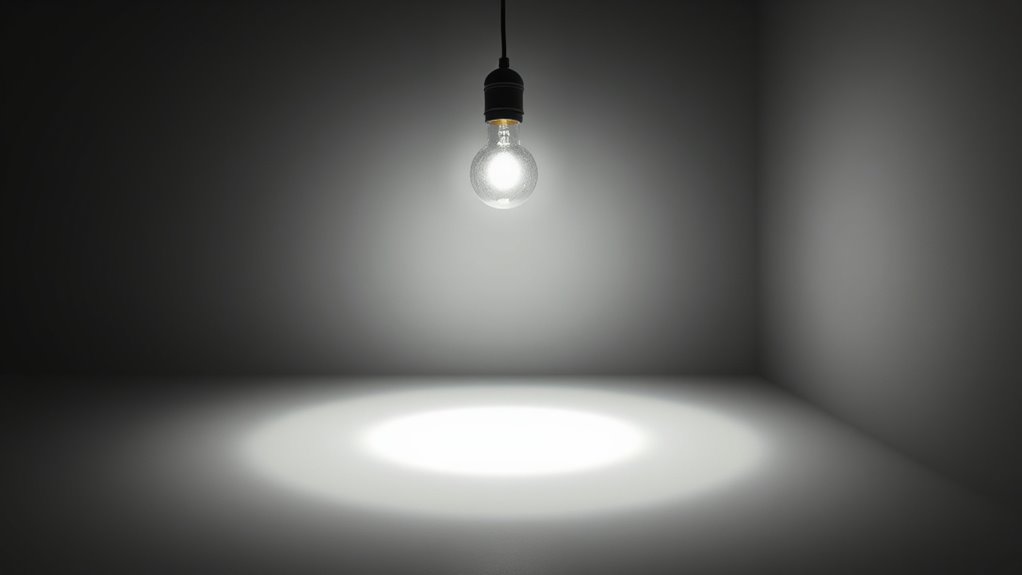

The inverse square law in lighting means that as you move farther from a light source, its brightness decreases rapidly. Specifically, the intensity drops proportionally to the square of the distance—doubling the distance makes the light four times dimmer, tripling reduces it to a ninth. This law explains why objects look dimmer as they get farther away. To understand how to use this principle effectively in your lighting setup, keep exploring how the law works in detail.

Get the latest gadgets delivered free — and shop member deals
- Fast, free delivery on millions of items
- Access to Prime Big Deal Days deals on October 6–7
- Prime Video, Amazon Music and more included
Key Takeaways
- Light intensity decreases proportionally to the square of the distance from the source.
- Doubling the distance reduces brightness to one-quarter; tripling reduces it to one-ninth.
- Light spreads uniformly in all directions, forming a spherical surface whose area increases with the square of the radius.
- The law helps in accurately positioning lights and predicting brightness changes in photography and stage lighting.
- Understanding this law enables energy-efficient lighting design by optimizing light placement relative to the target area.
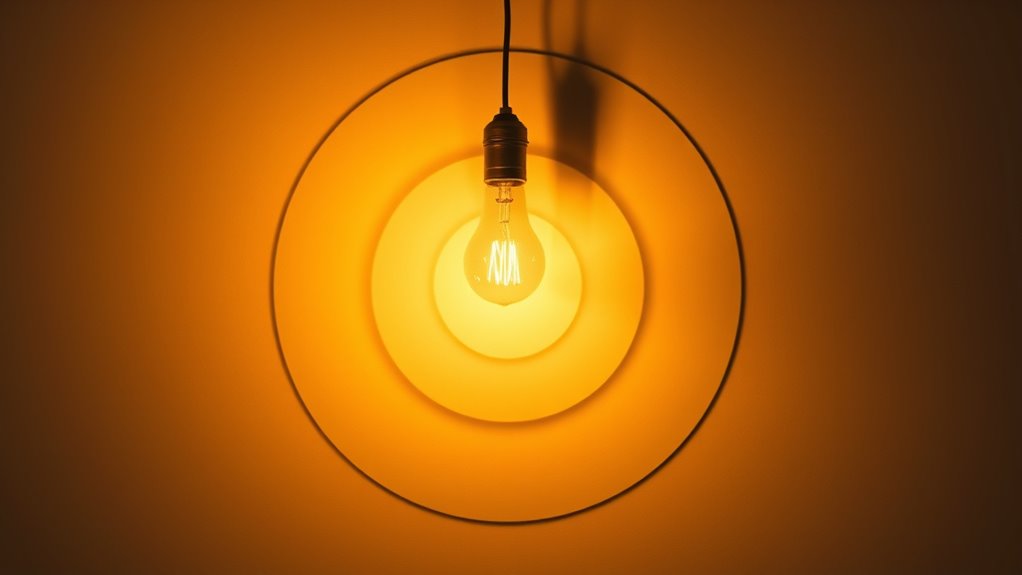
Have you ever wondered why a light source appears dimmer as you move farther away from it? The answer lies in the way light spreads out in space and how its light intensity diminishes with distance. When you stand close to a lamp, the light feels bright because the energy is concentrated over a smaller area. As you step back, the same amount of light energy disperses over a larger surface, making the light seem weaker. This phenomenon is explained by the inverse square law, which describes the relationship between light intensity and distance from the source.
The inverse square law states that the light intensity decreases proportionally to the square of the distance from the source. In simple terms, if you double your distance from the light, the light intensity becomes one-quarter of what it was. Tripling your distance reduces the intensity to just one-ninth. This clear distance relationship means that small changes in how far you are from the light source can lead to large differences in brightness. It’s a fundamental principle in lighting design, photography, and even astronomy, where understanding how light behaves over distances is vital.
Light intensity diminishes with the square of the distance from the source.
As you move away from a point light source, the light spreads out uniformly in all directions. Imagine shining a flashlight in a dark room; the beam radiates outward in a spherical pattern. The surface area of this sphere increases with the square of the radius, meaning that the same amount of light energy is distributed over a larger area as you move farther away. Since light intensity refers to how much light energy hits a specific area, it decreases as the surface area grows. This inverse square relationship explains why objects appear dimmer the farther they are from the light source.
Understanding this distance relationship is essential for controlling lighting in various settings. For example, in stage lighting or photography, you need to position lights carefully to achieve the desired brightness. Knowing that increasing the distance reduces light intensity exponentially helps you predict how much to adjust your setup. Similarly, in designing outdoor lighting, understanding the inverse square law allows you to calculate how far lights should be placed to illuminate a space effectively without wasting energy. Additionally, light distribution patterns depend heavily on this principle to optimize illumination.
As an affiliate, we earn on qualifying purchases.
Frequently Asked Questions
How Does the Inverse Square Law Apply to LED Lighting?
You’ll notice that as you move an LED light closer or farther away, its brightness changes considerably, following the inverse square law. This affects LED efficiency because positioning influences how much light reaches your target. Also, adjusting distance can impact perceived color temperature, making it seem warmer or cooler. To optimize lighting, keep LED fixtures at the right distance, ensuring consistent brightness and color quality for your space.
Can the Inverse Square Law Be Used for Natural Sunlight?
You can’t use the inverse square law for natural sunlight, but it’s still pretty powerful! As you move away from the sun, solar exposure decreases, but atmospheric scattering complicates things. This scattering diffuses sunlight, making the decrease less predictable than with artificial light sources. So, while the law gives a rough idea, natural sunlight’s intensity depends on atmospheric conditions and distance, creating a more complex relationship.
What Are Common Misconceptions About the Inverse Square Law?
A common misconception about the inverse square law is that it applies perfectly in all real-world scenarios. In reality, there’s often a lack of clarity about its practical limitations, such as environmental factors and obstacles that affect light intensity. You might think the law always predicts brightness accurately, but it’s most reliable in ideal conditions. Recognizing these misconceptions helps you better understand how light behaves in everyday situations.
How Does Distance Affect Light Intensity in Photography?
When you increase the distance between your light source and your subject, the light dims considerably because it spreads out over a larger area. This means that moving your flash farther away reduces its intensity, causing light dimming effects. Conversely, decreasing the flash distance intensifies the light, making your subject brighter. Understanding this relationship helps you control exposure and achieve desired lighting effects in your photography.
Are There Exceptions to the Inverse Square Law in Real-World Applications?
In real-world applications, exceptions to the inverse square law do exist, especially with artificial lighting and space applications. You might notice that in enclosed spaces, reflections and diffusions alter light behavior, making the law less predictable. Similarly, in space, the law applies differently because there’s no atmosphere, and light travels in a straight line without interference. So, while the law provides a solid foundation, consider these factors for accurate lighting calculations.
As an affiliate, we earn on qualifying purchases.
Conclusion
Think of the inverse square law like a ripple spreading from a stone you toss into a pond. As you move away from the light source, the brightness drops off rapidly, just like those ripples fade. Understanding this law helps you control lighting with precision, ensuring your space is perfectly illuminated without waste. Remember, in lighting, as in ripples, the farther you go, the dimmer it gets—so place your light wisely.
As an affiliate, we earn on qualifying purchases.
As an affiliate, we earn on qualifying purchases.
Fall Picks
fall essentials
As an affiliate, we earn on qualifying purchases.