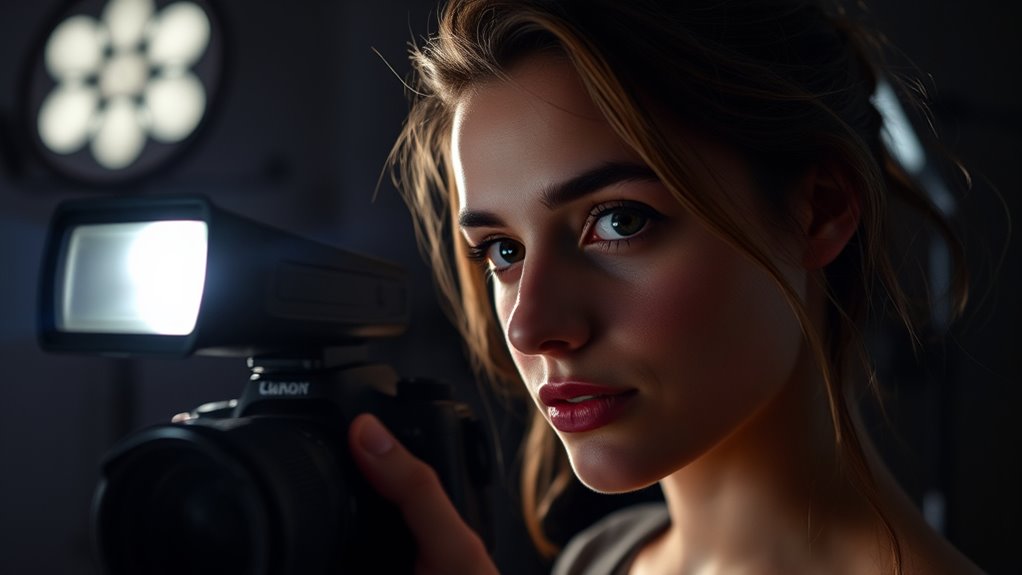

Off-camera flash gives you greater control over your lighting, letting you create more professional and dynamic images. By using modifiers like softboxes or umbrellas, you shape and soften light to reduce harsh shadows and achieve desired effects. Synchronizing your camera shutter speed with the flash guarantees even illumination, especially when using high-speed sync options. Mastering these basics allows you to open your creative potential and improve your photos—continued exploration will reveal even more ways to enhance your lighting techniques.
Key Takeaways
- Off-camera flash provides greater light control and creates professional, dynamic images.
- Using flash modifiers shapes and softens light for desired effects and reduces harsh shadows.
- Synchronize your camera and flash within the sync speed to avoid exposure issues.
- Balance flash power, modifiers, and shutter speed to prevent overexposure and achieve optimal lighting.
- Practice and experiment with different setups to master off-camera flash techniques and enhance photo quality.
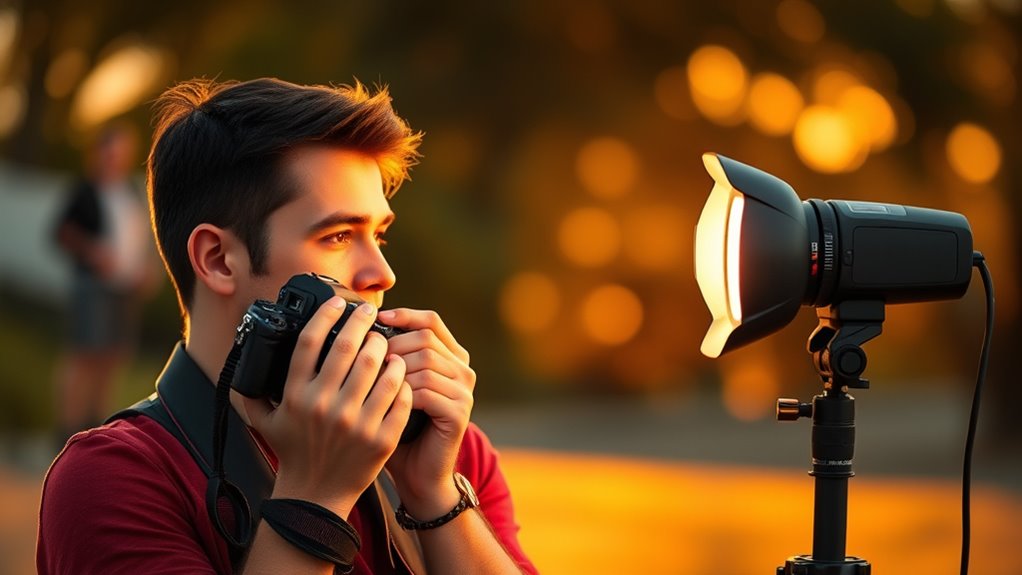
Have you ever wondered how professional photographers achieve those stunning, well-lit images? The secret often lies in off-camera flash, which gives you greater control over lighting and helps you create more dynamic photos. One of the key aspects of mastering off-camera flash is understanding how to manipulate your light with tools like flash modifiers and how to synchronize your camera and flash effectively. These elements can dramatically improve your images and add a professional touch to your work.
Flash modifiers are essential because they shape and soften the light, giving you more creative control. Softboxes, umbrellas, and diffusers are popular choices that help spread light evenly and reduce harsh shadows. When you attach a modifier to your flash, you can achieve a more natural look or create dramatic effects, depending on your goal. Using these modifiers allows you to control the quality and direction of light, making your subject stand out without overexposing the background or creating unflattering highlights.
Another crucial aspect is understanding your camera’s sync speed. Sync speed refers to the fastest shutter speed at which your camera can synchronize with the flash without causing issues like black bars or partial exposure. When shooting with off-camera flash, staying within your camera’s sync speed ensures the entire frame is properly illuminated. If you push beyond this limit, part of your image might be dark or unevenly lit, ruining the shot. To avoid this, you can either lower your shutter speed or use high-speed sync (HSS) if your flash supports it. HSS allows you to use faster shutter speeds, giving you more flexibility in bright conditions or when trying to freeze motion.
Understanding how to balance your sync speed with flash power and modifiers is fundamental. For example, in outdoor situations with bright sunlight, you might need to use a higher shutter speed combined with HSS to properly expose your subject while maintaining creative control over the background. Conversely, in studio settings, you can keep your shutter speed at or below the sync speed and focus on shaping the light with modifiers for a polished look.
Additionally, being aware of your camera’s vibration synchronization can help prevent motion blur when working with off-camera flash, especially in handheld situations. Practicing these techniques helps you become more confident in controlling light, which is instrumental for off-camera flash photography. By experimenting with different modifiers and carefully managing your sync speed, you’ll develop a style that stands out and produces professional-looking images. Mastering these basics opens up a world of creative possibilities and transforms your photography from simple snapshots into compelling visual stories.

Elinchrom Three Off Camera Flash Kit (EL20941.1)
- Powerful Output: 261 Ws for vibrant images
- Quick Recycling Time: 1.2 seconds at full power
- Integrated Battery: 525 full-power flashes available
As an affiliate, we earn on qualifying purchases.
As an affiliate, we earn on qualifying purchases.
Frequently Asked Questions
How Do I Choose the Right Off-Camera Flash for My Camera?
To select the appropriate off-camera flash, first verify its compatibility with your camera’s hot shoe or wireless system. Consider the flash’s power adjustment features to match your lighting needs and avoid overexposure. Look for a model that offers adjustable angles for versatility. Make certain it has reliable TTL (through-the-lens) metering if you prefer automatic exposure, and confirm it’s compatible with your existing gear for seamless integration.
Can I Use Off-Camera Flash Indoors Without Additional Modifiers?
Yes, you can use off-camera flash indoors without additional modifiers, but your results will vary. To soften the light and reduce harsh shadows, try bounce techniques by directing the flash at the ceiling or walls. Diffuser attachments also help diffuse the light evenly, making your photos look more natural. Experiment with different angles and distances to find what works best for your indoor space.
What Safety Precautions Should I Take With Off-Camera Flash Setups?
Imagine your setup as a delicate dance; safety is the steady rhythm. Always check electrical safety by inspecting cords and connections for damage. Secure your equipment firmly, like anchoring a ship before a storm, to prevent falls or damage. Keep your workspace dry and avoid overloading outlets. Wearing protective gear minimizes risk. Prioritize these steps to guarantee your off-camera flash setup remains a safe, steady rhythm throughout your shoot.
How Do I Prevent Harsh Shadows When Using Off-Camera Flash?
To prevent harsh shadows with off-camera flash, you should diffuse the light using softboxes or umbrellas, which spread the light evenly. Adjust the angle of your flash to bounce or direct light at the subject more gently. Experiment with different positions until you find a flattering, soft look. Remember, the key is to soften and spread the light, reducing stark shadows and creating a natural, pleasing glow.
Is It Necessary to Use a Trigger or Remote for Off-Camera Flash?
Imagine your camera as the heartbeat of your shot, and the flash as its guiding light. To harness this power, you’ll want a trigger or remote—think of it as your wireless connection to control your off-camera flash effortlessly. With it, you gain precise wireless connectivity and power control, letting you craft perfect lighting from afar. It’s essential for seamless, dynamic shots that truly stand out.

amaran Light Box 30120 Softbox,Foldable One-snap Quick-Setup Narrow Rectangular Bowens Mount softbox for amaran 60/100/200 /150c 300c(Light Box 30×120)
- Size: 30x120cm (1x4ft) softbox
- Design: Narrow for portrait and full-body shots
- Setup: One-snap for quick installation
As an affiliate, we earn on qualifying purchases.
As an affiliate, we earn on qualifying purchases.
Conclusion
Now that you know the basics of off-camera flash, you’re ready to take your photography to the next level. Practice makes perfect, so experiment with different angles and settings to see what works best for you. Remember, a picture is worth a thousand words, and mastering off-camera flash can help you tell even more compelling stories. Keep learning and experimenting, because in photography, as they say, the sky’s the limit.

Foto&Tech 3.5 mm to Male Flash PC Sync Cable, 14 Inch Coiled Cord with Screw Lock, Compatible with Nikon Canon and Most DSLR Cameras PocketWizard Plus III Plus II Mini Phone PC1 (1 Piece)
- Camera Compatibility: Connects DSLR cameras to strobes
- Stable Connection: Reliable sync for flash triggers
- External Flash Triggering: Used for triggering external flashes
As an affiliate, we earn on qualifying purchases.
As an affiliate, we earn on qualifying purchases.

GODOX TT685II-C Flash for Canon Speedlight Camera Flash E-TTL Speedlite High-Speed Sync, 2.4G Wireless X System Compatible for Canon Flash 5D Mark IV 6D Mark II 7D 90D 250D R5 850D (Upgraded TT685C)
- Upgraded Overhead Flash: Enhanced features based on user feedback
- 2.4G Wireless X System: Seamless connectivity with compatible devices
- Quick-release Lock: Smooth setup for critical moments
As an affiliate, we earn on qualifying purchases.
As an affiliate, we earn on qualifying purchases.