
TL;DR

Get the latest gadgets delivered free with Prime
- Fast, free delivery on millions of items
- Prime Video, Amazon Music and more included
- Member-only deals all year
Immersix has developed a retina-based eye-tracking solution that may revolutionize XR devices with its high accuracy and persistent calibration. Early hands-on testing suggests promising performance, but full validation is ongoing.
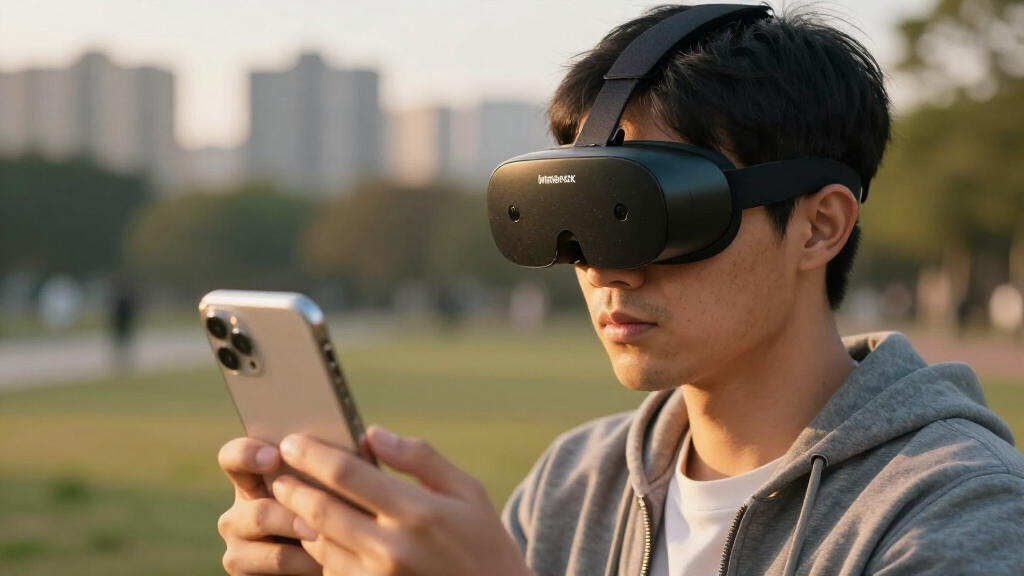
Immersix, a Western startup focused on XR eye-tracking, has introduced a novel retina-based tracking system that claims to offer unprecedented accuracy and stability, potentially transforming the industry. The company demonstrated its technology at the VR/AR Expo China in Shanghai, showcasing a solution that uses retinal imaging rather than traditional pupil tracking. This approach aims to solve common issues like calibration degradation and movement sensitivity, which have limited current systems.
The core innovation from Immersix involves tracking the user’s retina, which is unique and stable over many years. The system employs a small, low-power module with a single IR LED and a camera placed near the nose, capable of tracking at up to 120Hz with sub-degree precision, according to the company.
During calibration, users perform eye movements that allow the system to reconstruct a full retinal map, which then serves as a permanent biometric fingerprint. Once calibrated, the system can track eye movements accurately without needing recalibration, even if glasses are removed and put back on or if the device shifts slightly. This is a significant departure from existing pupil-based eye trackers that often require repeated calibration and are sensitive to head movement.
In a hands-on demo, a prototype glasses frame was connected to a laptop, and the user was asked to move a pointer on the screen by eye movement. The company claims the tracking was precise, with minimal lag, although the test was limited by the prototype’s early stage and the demo setup. The technology’s potential to improve user experience in XR devices is considerable, especially for applications requiring high accuracy or biometric security.
Immersix May Revolutionize Eye Tracking With Its Accuracy
A retina-based system promises sub-degree precision, tracking at up to 120Hz, and a calibration map designed to persist—even after glasses are removed, replaced, or slightly shifted.
Track the retina, not merely the pupil
Conventional systems infer gaze from pupil position and corneal reflections. Immersix instead maps retinal features that are highly distinctive and comparatively stable over time, creating both a tracking reference and a potential biometric identifier.
A long-lived retinal map
Calibration reconstructs a map of retinal blood-vessel features. Immersix says that map can remain useful for years rather than being rebuilt during routine headset use.
Minimal optical module
The prototype uses a camera and a single infrared LED near the nose, aiming to reduce power and integration demands inside glasses or XR headsets.
Gaze plus identity
Because retinal patterns are unique, the same sensing approach may support secure authentication—provided privacy, storage, and consent are handled rigorously.
From infrared image to persistent gaze
The proposed workflow turns an initial calibration exercise into a reusable retinal reference. Subsequent frames are matched against that reference to estimate eye movement.
Illuminate
A low-power IR LED lights retinal structures.
Capture
The near-nose camera records retinal imagery.
Calibrate
Guided eye movements build a fuller retinal map.
Match
Live features align with the stored reference.
Estimate gaze
The system translates retinal movement into input.
Where retina tracking could gain ground
The most consequential promise is not accuracy alone. It is the combination of accuracy, stable calibration, tolerance for headset movement, and biometric potential.
| Capability | Typical pupil-based tracking | Immersix retina-based approach | Evidence status |
|---|---|---|---|
| Calibration persistence | ~ Recalibration may be required | ✓ Intended to persist for years | Company claim |
| Tolerance of frame shifts | ✗ Often movement-sensitive | ✓ Designed for minor shifts | Early demonstration |
| After device removal | ~ Fit changes can reduce accuracy | ✓ Calibration is expected to remain valid | Needs broader testing |
| Biometric authentication | ~ Limited identity signal | ✓ Unique retinal pattern | Potential application |
| Commercial maturity | ✓ Already deployed in products | ✗ Prototype stage | Not commercially validated |
Promising performance, narrow evidence
At the VR/AR Expo China in Shanghai, a prototype glasses frame controlled a laptop pointer through eye movement. The response appeared precise with little visible lag, but the controlled demo was too limited to establish real-world reliability.
How strong is the current case?
These bars summarize the qualitative strength of the available reporting; they are not laboratory measurements or product scores.
Immersix has shown an intriguing proof of concept, not a finished consumer solution. Its revolution depends on reproducing the demo’s accuracy across users, lighting conditions, frame geometries, movement patterns, and production hardware.
Four questions still decide the outcome
Accuracy is only the entry ticket. Commercial adoption will also depend on manufacturability, privacy safeguards, integration effort, and consistent performance outside controlled demonstrations.
Will accuracy survive real life?
Performance must remain stable across diverse eyes, prescriptions, lighting conditions, motion, fit changes, and extended wear.
Can the module scale?
Headset makers will need acceptable cost, yield, power use, thermal behavior, durability, and production consistency.
How will biometric data be protected?
Retinal maps demand clear consent, secure storage, limited retention, and strong controls against unauthorized reuse.
Can it fit existing XR platforms?
Software pipelines, optics, industrial design, latency budgets, and authentication systems all require practical integration.
Prototype with meaningful upside
Why the concept matters for XR
The technology’s strategic value follows a direct chain: stable anatomy may enable persistent calibration, which can improve interaction and unlock identity-aware experiences.
Potential Impact on XR Eye-Tracking and Authentication
If validated at scale, Immersix’s retina-based eye-tracking could provide highly accurate, calibration-free tracking that remains stable over time. This may contribute to improvements in user experience, reduce setup time, and support biometric security features, which could be beneficial for various XR applications.
As an affiliate, we earn on qualifying purchases.
Current Limitations of Pupil-Based Eye Tracking in XR Devices
Most existing eye-tracking solutions in XR headsets rely on pupil detection, which can be affected by head movement, often requiring recalibration, and may degrade over time. These limitations can impact the performance and usability of current devices, especially in applications such as gaming, training, or secure authentication.
Immersix’s approach to using retinal imaging offers a potential alternative, leveraging the retina’s stability and uniqueness. The technology is still in the prototype stage, with further validation and commercial deployment yet to be confirmed.
“Our retina-tracking system provides sub-degree accuracy, requires only a single calibration, and remains stable over many years, even with device removal or slight shifts.”
— Immersix representative
As an affiliate, we earn on qualifying purchases.
Validation and Scalability of Retina-Based Tracking
Further validation is necessary to determine how the technology performs in diverse real-world environments and in consumer-grade XR devices. Considerations related to long-term stability, manufacturing processes, and privacy concerns regarding biometric data are also ongoing topics of discussion.
As an affiliate, we earn on qualifying purchases.
Next Steps for Immersix and Industry Adoption
Immersix plans to conduct additional testing, increase prototype production, and explore partnerships with headset manufacturers. Validation in various real-world scenarios and eventual commercial deployment are expected within the next 12-24 months. Industry stakeholders will observe whether the technology can meet the requirements for broader adoption in XR devices.
As an affiliate, we earn on qualifying purchases.
Key Questions
How does retina-based eye tracking differ from traditional methods?
Retina-based tracking uses imaging of the blood vessels inside the retina, which are unique and stable over time, unlike the pupil position, which can shift and require recalibration.
What are the main advantages of Immersix’s system?
The system offers high accuracy, persistent calibration, biometric security, and insensitivity to device movement or removal, potentially improving user experience significantly.
Is this technology ready for commercial use?
Not yet. The technology is still in prototype and demonstration stages. Further validation, testing, and partnerships are needed before commercial deployment.
What challenges might this technology face before widespread adoption?
Technical validation in diverse environments, manufacturing scalability, privacy concerns regarding biometric data, and integration into existing XR platforms are potential hurdles.
Could retina tracking be used for biometric authentication?
Yes, since the retina is unique to each individual and stable over time, it has potential for secure biometric authentication in XR devices.
Source: The Ghost Howls
Halloween Picks
halloween
As an affiliate, we earn on qualifying purchases.