
TL;DR

Get the latest gadgets delivered free — and shop member deals
- Fast, free delivery on millions of items
- Access to Prime Big Deal Days deals on October 6–7
- Prime Video, Amazon Music and more included
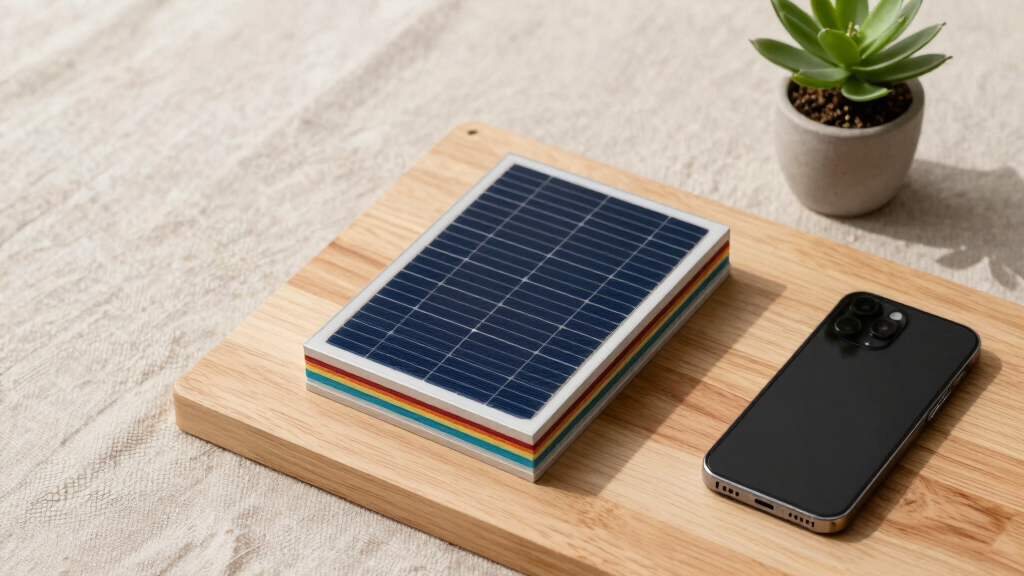
Scientists from China have created a pseudo-planar heterojunction organic solar cell with a record efficiency of 20.21%. This breakthrough was achieved through a novel interfacial buffering strategy that improves stability and performance. The development could advance scalable, high-efficiency organic photovoltaics.
Chinese researchers have achieved a new world record for pseudo-planar heterojunction organic solar cells, reaching an efficiency of 20.21%. This milestone was attained by implementing a novel interfacial buffering strategy that enhances device stability and fabrication reliability, marking a significant advance in organic photovoltaic technology.
The research team, comprising scientists from Jiangxi Normal University, Zhejiang University, and other institutions, developed a new device architecture involving a crystalline polymer buffer layer called D18 between the donor and acceptor layers. This buffer layer prevents solvent-induced swelling during fabrication, which traditionally degrades device performance.
The team fabricated three different cell structures: a conventional layer-by-layer (LBL) device without protection, a device with D18 blended into the donor layer, and a device with D18 as a separate buffer layer. The device with the buffer layer, designated as PM6/D18/L8-BO, achieved a power conversion efficiency (PCE) of 19.80%, surpassing the other configurations.
Further modifications included incorporating a non-fullerene acceptor, BTP-eC9, pre-blended with the acceptor layer. This adjustment increased the efficiency to 20.21%, setting a new record for this class of organic solar cells. The improved morphology facilitated better exciton separation, reduced recombination, and enhanced charge transport, according to the researchers.
Implications of the 20.21% Efficiency Record
This breakthrough demonstrates that interfacial engineering can significantly boost the performance of organic solar cells, making them more competitive with inorganic alternatives. Achieving over 20% efficiency in PPHJ OSCs could accelerate their commercial viability, especially given their potential for flexible, lightweight, and low-cost applications. The novel buffering strategy also addresses longstanding stability issues, which are critical for real-world deployment.
As an affiliate, we earn on qualifying purchases.
Advances in Organic Solar Cell Technology
Organic solar cells have historically lagged behind silicon-based photovoltaics in efficiency, but recent innovations have pushed their performance upward. Pseudo-planar heterojunction architectures are popular due to their efficient charge separation and well-defined interfaces. However, fabrication challenges, particularly solvent-induced damage during layer deposition, have limited their practical application.
The development of buffer layers to mitigate these issues has been an ongoing research focus. Previous efforts often involved complex or unstable materials, but the use of crystalline polymers like D18 offers a promising pathway. The new record efficiency builds on these prior advances, representing a significant milestone in the evolution of OSCs.
“The introduction of a crystalline buffer layer effectively prevents solvent erosion, leading to higher device stability and performance.”
— an anonymous researcher
As an affiliate, we earn on qualifying purchases.
Remaining Questions About Long-Term Stability
It is not yet clear how these devices perform under long-term operational conditions, including exposure to environmental factors such as moisture, heat, and sunlight. The durability and stability of the crystalline buffer layer over extended periods require further testing before commercial deployment can be considered viable.
As an affiliate, we earn on qualifying purchases.
Next Steps for Commercial Viability and Scaling
The research team plans to conduct extended stability testing and explore scalable manufacturing processes. Industry partners may also investigate integrating this architecture into flexible or tandem solar modules. Further validation in real-world conditions will determine whether this record-breaking efficiency can translate into commercial products.
As an affiliate, we earn on qualifying purchases.
Key Questions
How does the buffer layer improve the solar cell’s performance?
The buffer layer prevents solvent swelling and erosion during fabrication, preserving the integrity of the donor-acceptor interface, which enhances charge separation and reduces recombination, leading to higher efficiency.
Is this efficiency record applicable to commercial solar panels?
While the efficiency achievement is promising, further research is needed to assess long-term stability and scalability before commercial applications are feasible.
What materials are used in this new solar cell design?
The design incorporates a crystalline polymer called D18 as a buffer layer, along with a non-fullerene acceptor BTP-eC9, and standard donor and acceptor materials used in organic photovoltaics.
When might this technology be available commercially?
It is too early to specify a timeline; additional testing and development are required to translate this research into market-ready products.
Does this development impact the cost of organic solar cells?
Potentially, if the fabrication process remains simple and scalable, it could lower costs by improving yield and device stability, but economic assessments are still underway.
Source: PV Magazine
Fall Picks
fall essentials
As an affiliate, we earn on qualifying purchases.