TL;DR

Get the latest gadgets delivered free — and shop member deals
- Fast, free delivery on millions of items
- Access to Prime Big Deal Days deals on October 6–7
- Prime Video, Amazon Music and more included
A July 1, 2026 ISR Briefing report described Ukraine’s Delta battlefield-management system as a leading example of software-defined warfare. The system is reported to fuse drone, satellite, sensor and unit data into a shared live map, but some performance claims remain unverified.
A July 1, 2026 ISR Briefing report has placed Ukraine’s Delta system at the center of a wider defense debate, describing it as a browser-based platform that turns battlefield data into a shared live operating picture for troops and commanders.
Delta is described in the source material as a situational-awareness and battlefield-management system developed through Ukraine’s military, the NGO Aerorozvidka, the Defense Ministry’s innovation structures and the Ministry of Digital Transformation. It fuses inputs from drones, satellites, sensors, reports from units and partner intelligence into a geolocated map.
The key confirmed design point is that Delta runs through ordinary browsers on phones, laptops and tablets, while its backend is described as a cloud-native environment hosted outside Ukraine. The reported aim is to keep the system available even if Ukrainian infrastructure is hit by missiles or cyberattacks.
The briefing presents Delta as an example of software-defined warfare, a term also used in a 2024 CSIS analysis by Kateryna Bondar. That framing shifts attention from weapons platforms alone to data fusion, fast software updates and getting a trusted battlefield picture to frontline users.
Software-defined warfare: how Ukraine’s Delta turned the battlefield into a shared, real-time map
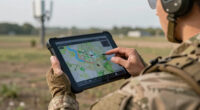
A soldier opens a browser and sees the fused war — drones, satellites, sensors and vetted reports on one live map. The backend is a cloud deliberately hosted abroad so a missile can’t take it down. The clearest case yet of treating warfare as software.
Optical sensors go blind in cloud & dark; an all-weather SAR radar layer — the kind VigilSAR produces — slots into a picture like this as one resilient, sovereign input. vigilsar.com · And note the paradox: to survive missiles & cyberattack, Ukraine hosted its crown-jewel cloud outside its own borders — trading physical sovereignty for operational survivability. Resilience through distribution.
Delta’s lasting lesson isn’t a piece of software — it’s a model of how to build: commodity clients, cloud backend, open standards, relentless iteration, fusion over hardware, and resilience through distribution. It’s why a wartime NGO out-shipped procurement bureaucracies on a fraction of the budget. The platform mattered less than the picture — and the picture is software. Own the fusion layer, own the sovereign feeds into it, and get it to the edge.
Battlefield Data Becomes Command Power
The report matters because Delta points to a change in how modern militaries may measure advantage. Instead of relying only on expensive bespoke hardware, Ukraine has reportedly pushed a common operating picture to more users through commodity devices and cloud infrastructure.
For allies, defense firms and rival militaries, the lesson is that the scarce asset may be the fusion layer, not the sensor itself. A platform that combines drone video, satellite imagery, radar, human reporting and intelligence feeds can shorten the time between detection, decision and action.
The model also carries risk. A system that concentrates battlefield data becomes a high-value cyber target, and its usefulness can depend on connectivity under jamming. The same speed that helps commanders can also make mistakes faster if data is corrupted or wrongly trusted.
cloud-based battlefield management software
As an affiliate, we earn on qualifying purchases.
As an affiliate, we earn on qualifying purchases.
Delta’s Wartime Software Origins
Delta did not appear as a single conventional procurement program. The source material traces it to a mix of wartime necessity, Ukraine’s digital-policy push and earlier NATO-linked efforts to break Soviet-style information silos. Its development has been associated with Aerorozvidka, Ukraine’s Defense Ministry and the Ministry of Digital Transformation.
That background helps explain why analysts see Delta as different from legacy defense IT. Traditional command systems are often hardware-locked, slow to update and separated by unit or vendor. Delta is described instead as a web application that can change quickly and reach users through devices they already have.
The briefing also highlights what it calls a sovereignty paradox: Ukraine’s reported decision to host core cloud infrastructure abroad trades some physical control for operational survivability. In that design, resilience comes from distribution across borders, not from keeping every part of the system inside national territory.
“The clearest case yet of treating warfare as software.”
— ISR Briefing AI Dispatch, July 1, 2026
real-time situational awareness tools
As an affiliate, we earn on qualifying purchases.
As an affiliate, we earn on qualifying purchases.
Claims Still Need Verification
Several points remain unclear from the available material. The reported 1,500 targets per day figure is attributed to Ukraine’s Defense Ministry, but the source material says it has not been independently verified.
It is also not clear how Delta performs across all battlefield conditions, including heavy electronic warfare, disrupted connectivity or deliberate data poisoning. The briefing identifies phishing, malware and jamming as hazards, but does not provide a public technical audit of system resilience.
The full architecture, hosting arrangements and security controls are also not public in detail, which is expected for a wartime system. That means outside readers should treat broad claims about battlefield impact as partly supported by reporting and partly dependent on Ukrainian and analyst accounts.
drone mapping systems for military use
As an affiliate, we earn on qualifying purchases.
As an affiliate, we earn on qualifying purchases.
Allies Study The Delta Model
The next test is whether Ukraine and its partners can keep improving Delta while defending it from cyberattacks, jamming and bad data. The platform’s value depends on whether users continue to trust the map when the battlefield is noisy, fast-moving and contested.
For NATO countries and defense planners, Delta is likely to remain a case study in cloud-based command systems, open standards and faster software cycles. Future attention will center on which militaries can build similar fusion layers without creating brittle single points of failure.
satellite imagery analysis software
As an affiliate, we earn on qualifying purchases.
As an affiliate, we earn on qualifying purchases.
Key Questions
What is Ukraine’s Delta system?
Delta is described as a battlefield-management and situational-awareness platform that combines drone, satellite, sensor and unit reports into a shared live map.
Why is Delta linked to software-defined warfare?
The link comes from Delta’s focus on software, data fusion and rapid updates, rather than a single weapons platform. A 2024 CSIS analysis used the phrase in relation to Ukraine’s battlefield technology.
Is Delta’s impact independently verified?
Some details about Delta’s design and use are widely reported, but specific performance claims such as 1,500 targets per day are described in the source material as Ukrainian claims, not independently verified facts.
What are the main risks?
The main risks cited are cyberattack, phishing, malware, connectivity loss and the possibility that fused inputs could include false or poisoned data.
Why does hosting Delta abroad matter?
The reported foreign cloud hosting is meant to protect Delta from physical attacks inside Ukraine. It also creates harder questions about sovereignty, dependency and wartime control.
Source: Thorsten Meyer AI
Fall Picks
fall essentials
As an affiliate, we earn on qualifying purchases.