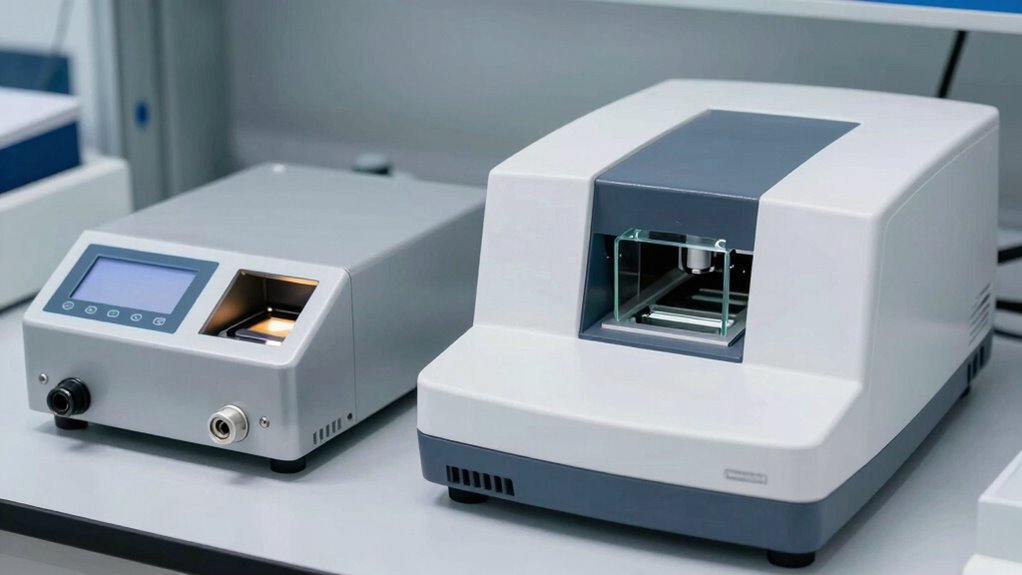
A spectrometer measures a wide range of wavelengths, analyzing detailed spectral data for identifying elements or compounds. In contrast, a spectrophotometer focuses on specific wavelengths to quickly measure absorbance or transmittance, often for routine or biochemical tests. Both tools are essential for different tasks—spectrometers for in-depth analysis and spectrophotometers for targeted measurements. If you want to understand exactly when to use each device, keep exploring more insights.

Get the latest gadgets delivered free — and shop member deals
- Fast, free delivery on millions of items
- Access to Prime Big Deal Days deals on October 6–7
- Prime Video, Amazon Music and more included
Key Takeaways
- Spectrometers analyze broad spectral ranges for detailed element identification, while spectrophotometers measure specific wavelengths for quantifying substances.
- Spectrometers provide comprehensive spectral data, useful for complex research; spectrophotometers offer quick, targeted absorbance measurements.
- Spectrometers use prisms or diffraction gratings; spectrophotometers typically use filters or monochromators for precise wavelength selection.
- Spectrometers are ideal for detailed spectral analysis; spectrophotometers are suited for routine, specific wavelength-based measurements.
- Proper calibration is essential for both, but spectrometers require more detailed setup due to their broad analysis capabilities.
As an affiliate, we earn on qualifying purchases.
What Are Spectrometers and How Do They Work?
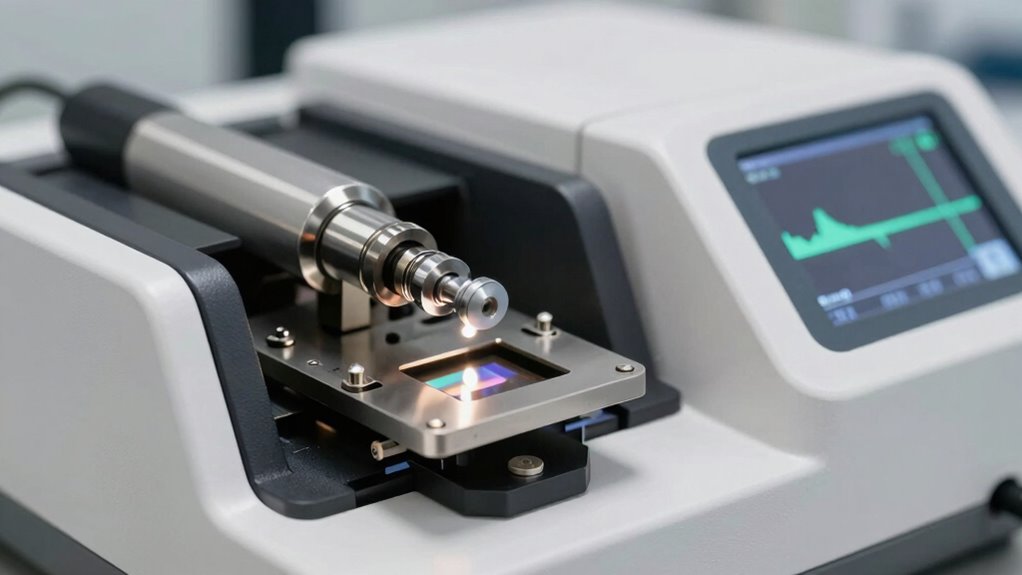
Have you ever wondered how scientists analyze the composition of substances? Spectrometers are essential tools for this task. They work by measuring the interaction between light and matter, often detecting absorption or emission at specific wavelengths. To guarantee accurate results, calibration procedures are critical—they align the instrument’s readings with known standards. Once data is gathered, data analysis techniques help interpret the results, revealing the substance’s composition. Spectrometers can analyze solids, liquids, or gases by dispersing light through prisms or diffraction gratings. This process produces spectra that show characteristic peaks. These peaks correspond to particular elements or molecules, making spectrometers invaluable for scientific research, quality control, and environmental testing. Their precision depends on proper calibration and effective data analysis. Furthermore, ethical considerations in testing play a vital role in ensuring responsible use of spectrometry in various applications. Additionally, lab measurement tools can significantly enhance the accuracy and reliability of spectrometry results. Moreover, understanding the importance of color accuracy in various applications can lead to more precise measurements in spectrometry. In addition, understanding digital content formats can enhance the presentation and accessibility of spectrometry data for broader audiences.
As an affiliate, we earn on qualifying purchases.
Spectrometer vs Spectrophotometer: Key Differences
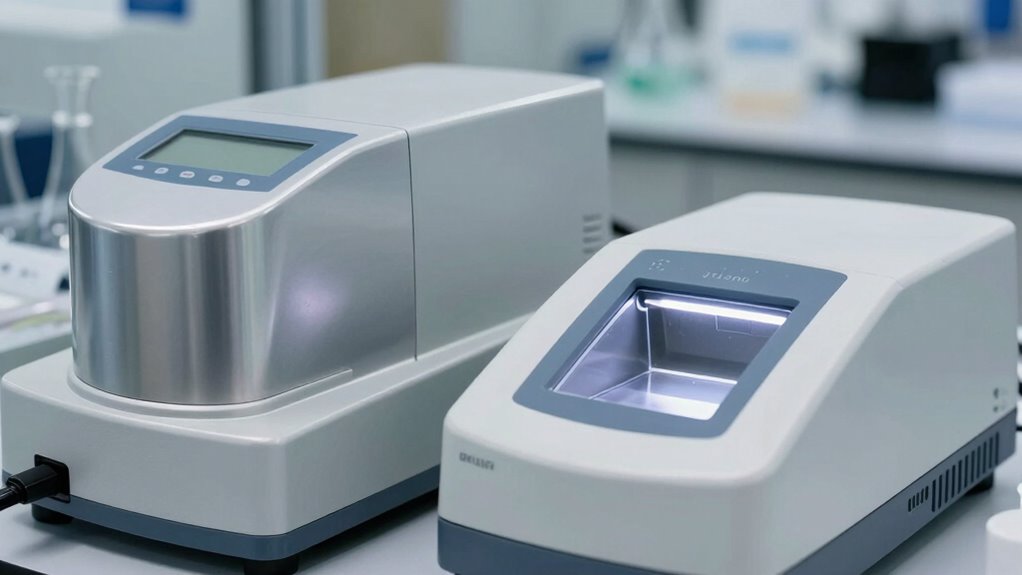
You’ll notice that spectrometers and spectrophotometers use different measurement techniques—spectrometers analyze a broad range of wavelengths, while spectrophotometers focus on specific wavelengths with higher precision. These differences influence their applications, with spectrometers suited for detailed spectral analysis and spectrophotometers ideal for quantifying particular substances. Understanding these distinctions helps you choose the right instrument for your analytical needs. Additionally, early detection of Frühwarnzeichen für Brustkrebs can significantly improve treatment outcomes.
Measurement Techniques Compared
While both spectrometers and spectrophotometers are essential tools for measuring light properties, they differ markedly in their techniques and capabilities. Spectrometers typically split light into its constituent wavelengths, allowing detailed data interpretation through precise calibration techniques. Spectrophotometers, on the other hand, measure the intensity of light at specific wavelengths, often using filters or monochromators. Their measurements are generally simpler but less detailed. Additionally, understanding engine performance upgrades can enhance your knowledge of how different tools affect various applications.
| Tool | Measurement Approach | Calibration Techniques |
|---|---|---|
| Spectrometer | Disperses light into spectra for analysis | Uses calibration with known light sources |
| Spectrophotometer | Measures absorbance at specific wavelengths | Calibrates with standard solutions or references |
| Data Interpretation | Analyzes spectral data for detailed insights | Converts absorbance or spectra into quantitative results |
Application Differences Explained
Spectrometers and spectrophotometers serve different roles depending on the application, largely due to their distinct measurement capabilities. A spectrometer’s versatility allows it to analyze a broad range of wavelengths, making it ideal for detailed spectral analysis. Proper spectrometer calibration is essential to guarantee accurate results across various applications. Conversely, spectrophotometers are tailored for measuring the absorbance or transmittance of specific wavelengths, often used in biochemical or pharmaceutical testing. Maintenance tasks for spectrophotometers tend to be simpler, focusing on cleaning and calibration to maintain precision. Understanding these differences helps you choose the right instrument for your needs, whether it’s detailed spectral data or quick absorbance measurements. Accurate application relies on knowing each tool’s strengths and maintenance requirements.
As an affiliate, we earn on qualifying purchases.
How Spectrometers Analyze Light Properties
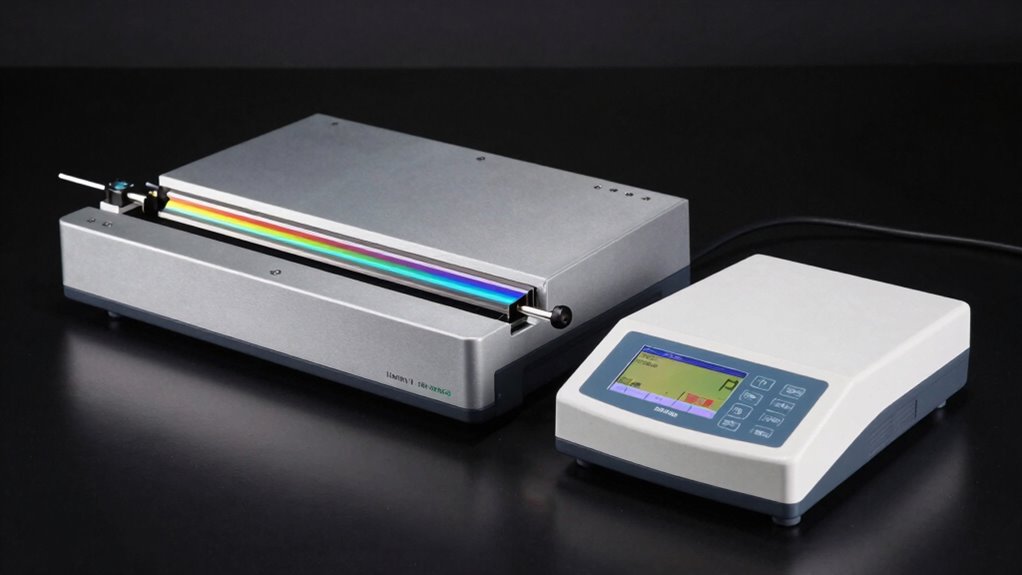
When you use a spectrometer, it separates light into its component colors through dispersion, creating a spectrum. This allows you to analyze specific wavelengths and their intensities precisely. By examining these properties, you can gather detailed information about the light source’s characteristics. Additionally, understanding natural filtration systems can enhance your knowledge of how light interacts with different materials in various environments.
Light Dispersion and Spectrum
Light dispersion is a fundamental process that allows spectrometers to analyze the properties of light. When light passes through a prism or diffraction grating, it bends—a phenomenon called light refraction—spreading into a spectrum of colors. This separation lets you see the distinct wavelengths that make up a light source. Spectral resolution determines how precisely you can distinguish between closely spaced wavelengths, revealing subtle details in the spectrum. With this, you’re able to identify specific elements or compounds based on their light signatures. Imagine uncovering hidden secrets in a rainbow or detecting faint signals in scientific research. In the context of climate and regenerative investing, understanding these light properties can enhance the analysis of environmental data. Additionally, the integration of innovative architectural solutions** can provide a framework for applying these insights in practical, eco-friendly designs.
- Feel the power of uncovering unseen details
- Witness the beauty of nature’s spectrum
- Experience the thrill of precise measurement
- Reveal the mysteries of light itself
Analyzing Wavelengths and Intensity
To analyze light properties effectively, spectrometers measure both the wavelengths and intensity of the incoming light. They use calibration procedures to guarantee accuracy, adjusting for device-specific deviations. Once calibrated, the device disperses light into its spectrum, capturing data for interpretation. The data reveals the specific wavelengths and their intensities, indicating the presence of particular substances or features. Proper calibration is essential for reliable results, and understanding the spectrum allows you to interpret data precisely. Here’s a quick overview:
| Step | What It Does |
|---|---|
| Calibration | Ensures accurate wavelength and intensity readings |
| Light Dispersion | Separates light into its spectrum |
| Data Interpretation | Analyzes spectrum for meaningful insights |
As an affiliate, we earn on qualifying purchases.
How Spectrophotometers Measure Absorbance and Transmission

Have you ever wondered how a spectrophotometer determines the amount of light absorbed or transmitted by a sample? It uses precise measurements based on calibration protocols that ensure accuracy, giving you confidence in your results. As light passes through your sample, the device records the intensity of transmitted light, which is then converted into absorbance values. These readings are processed with data analysis methods to quantify how much light your sample absorbs. The entire process is designed to be sensitive and reliable, making your data meaningful.
A spectrophotometer accurately measures light absorption, ensuring reliable data for meaningful scientific insights.
- Feel the thrill of uncovering hidden details in your sample
- Experience confidence with accurate, calibrated measurements
- Rely on robust data analysis to interpret your results
- Trust in consistent, reproducible outcomes that advance your work
When to Use a Spectrometer or Spectrophotometer in Your Work
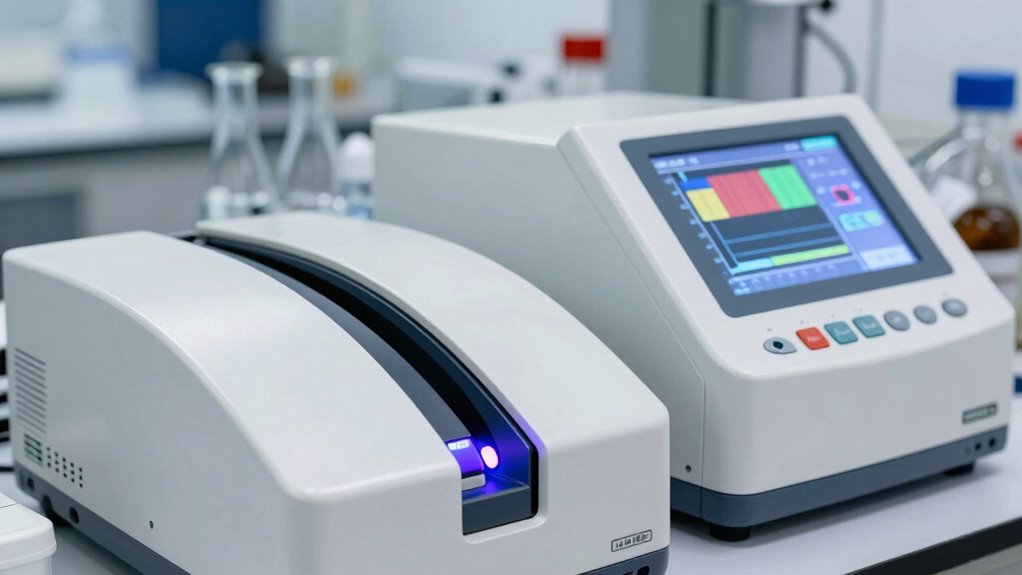
Choosing between a spectrometer and a spectrophotometer depends on your specific analytical needs. If you require detailed spectral data across a broad range, a spectrometer is ideal, especially when precise calibration procedures are necessary for accurate results. Use a spectrophotometer when your focus is on measuring absorbance or transmission at specific wavelengths, simplifying data interpretation for routine tests. Consider the complexity of your samples and the level of detail needed; spectrometers handle complex, multi-wavelength analyses, while spectrophotometers excel in straightforward, targeted measurements. Your decision should also factor in how easily you can interpret the data, as spectrometers often demand more advanced analysis, whereas spectrophotometers provide clearer, more direct results.
Features and Capabilities of Spectrometers and Spectrophotometers

Spectrometers and spectrophotometers each possess unique features that suit different analytical needs. A spectrometer offers broad light filtering, enabling detailed analysis of various wavelengths, making it ideal for complex research. Spectrophotometers excel at precise data calibration, guaranteeing accurate measurements for specific wavelengths. Both tools provide powerful capabilities to uncover hidden details in your samples. With a spectrometer, you can explore the spectrum’s full range, revealing subtle spectral features. A spectrophotometer’s focused light filtering ensures consistency for routine measurements. Their capabilities evoke confidence in your data, empowering you to make informed decisions. Here are some features to contemplate:
- Precise light filtering for accurate readings
- Robust data calibration for reliability
- Flexibility in analyzing multiple wavelengths
- Enhanced sensitivity for detecting minute differences
Which Instrument Is Best for Chemistry, Physics, or Environmental Science?
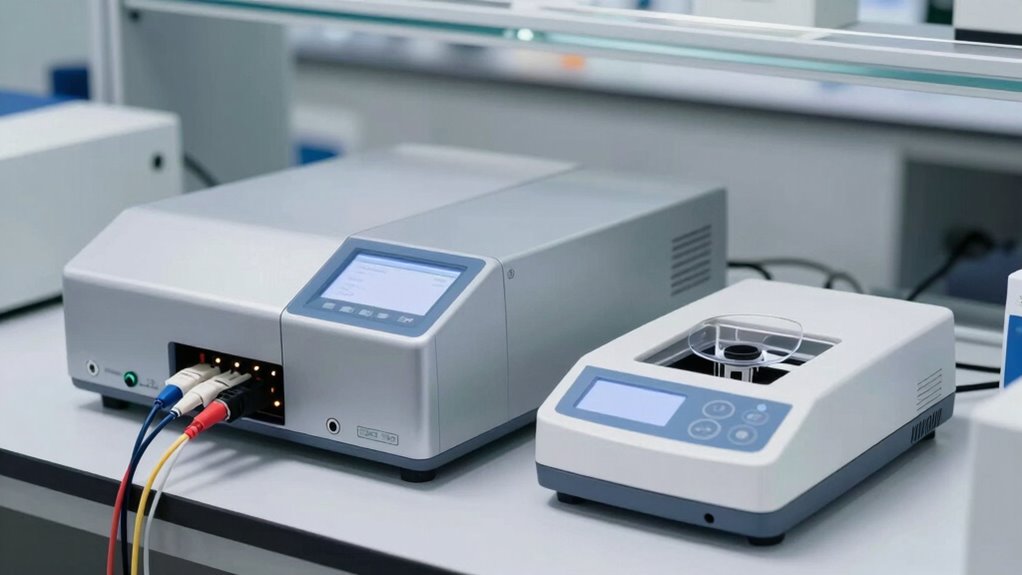
Certainly! Here’s your article subheading content with the requested modifications:
—
Selecting the right instrument depends on your specific application in chemistry, physics, or environmental science. For chemistry labs analyzing chemical concentrations, a spectrophotometer often suffices, with straightforward calibration procedures and simple data analysis techniques. Additionally, maintaining a clean workspace can significantly improve the accuracy of your measurements. Understanding chemical innovations can also enhance your ability to choose the most suitable instrument for your experiments. Furthermore, implementing auditory processing techniques can sharpen your focus when working with intricate data sets.
Physics applications, such as studying light properties or atomic spectra, typically require a spectrometer for its higher resolution and versatility. In environmental science, understanding indoor air quality is crucial for evaluating the effects of pollutants on measurements. Environmental science often demands field-ready instruments capable of handling complex samples, where calibration procedures must be robust and data analysis techniques capable of managing noisy data. Consider how precise your measurements need to be and whether portable or laboratory-based devices suit your setting. Ultimately, choosing the right tool hinges on understanding your measurement goals and ensuring your calibration procedures and data analysis methods align with those objectives. Additionally, incorporating mind-body healing techniques can enhance focus and clarity during the measurement process.
—
Let me know if you need any further modifications!
Common Mistakes to Avoid When Choosing Optical Measurement Tools

One common mistake is focusing solely on instrument specifications without taking into account how well they align with your specific measurement needs. Overlooking calibration accuracy can lead to unreliable results, wasting time and resources. Additionally, neglecting cost considerations might cause you to overspend on features you don’t need or settle for low-quality equipment that compromises data integrity. Understanding coffee and tea flavor profiles can also aid in making more informed decisions about tool selection. Furthermore, considering energy-efficient models can help you choose tools that save on operational costs.
Be cautious of these pitfalls:
- Ignoring the importance of calibration accuracy for precise measurements
- Prioritizing price over long-term reliability and performance
- Choosing an instrument without evaluating your actual measurement requirements
- Overlooking ongoing maintenance and calibration costs
Making thoughtful decisions ensures you select optical tools that deliver accurate, consistent results without breaking your budget. Furthermore, understanding color matching principles can enhance your ability to analyze data effectively.
How to Decide Which Instrument Fits Your Measurement Needs
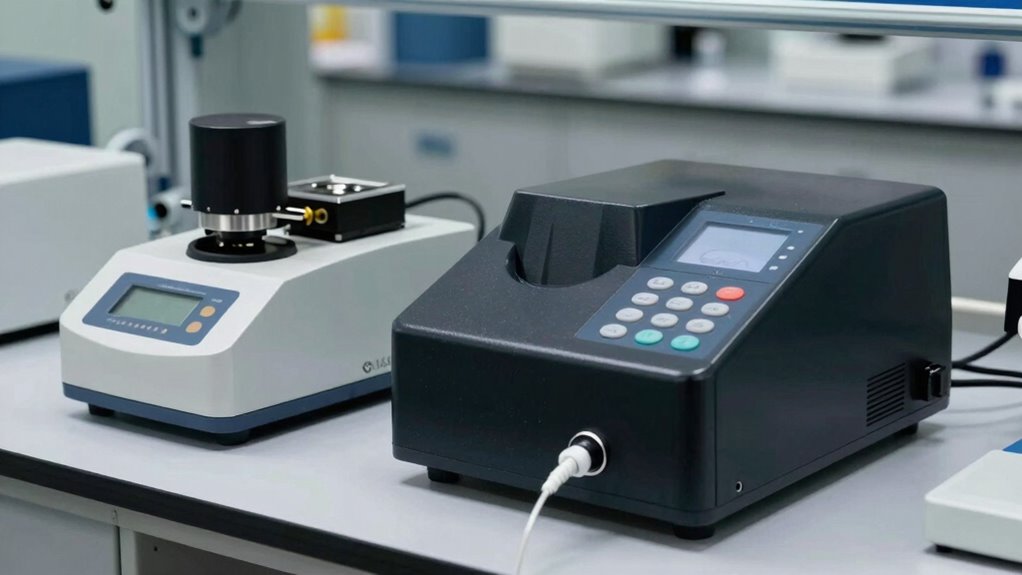
Choosing the right optical measurement instrument depends on understanding your specific needs and the types of measurements you’ll perform. If your work requires precise optical alignment, a spectrometer’s detailed spectral data can be invaluable. Consider calibration procedures—spectrometers often need more frequent calibration to guarantee accuracy, especially when measuring over broad wavelength ranges. Spectrophotometers, on the other hand, excel at rapid, accurate absorbance measurements with simpler calibration processes. Think about your measurement environment and required precision. If you need to analyze complex spectral features or perform detailed optical characterization, a spectrometer is the better fit. For routine measurements like solution absorbance, a spectrophotometer offers speed and ease. Matching your measurement goals with these factors helps you choose the most suitable instrument.
Frequently Asked Questions
Can Spectrometers Measure Non-Optical Properties?
Yes, spectrometers can measure non-optical properties through techniques like infrared analysis and magnetic sensing. Infrared analysis uses infrared light to identify molecular structures, while magnetic sensing detects magnetic fields and properties. You can leverage these methods to analyze material composition, magnetic characteristics, or other non-optical attributes. This versatility makes spectrometers valuable beyond traditional optical measurements, extending their use into fields like materials science, chemistry, and physics.
How Do Calibration Procedures Differ Between the Two Instruments?
Calibration procedures differ like night and day for these instruments. You focus on calibration accuracy for the spectrometer by using standards traceable to national references, ensuring precise measurements. For a spectrophotometer, you prioritize instrument stability, regularly checking lamp intensity and baseline noise. Both require routine calibration, but the spectrometer’s complex optics demand meticulous adjustments, while the spectrophotometer’s focus on optical components keeps calibration straightforward and reliable.
Are Portable Spectrometers Suitable for Fieldwork?
Yes, portable spectrometers are suitable for fieldwork because they combine durability with high field accuracy. You can depend on them in tough conditions, as they’re designed for portability and resilience. Their compact size makes it easy to carry them to remote locations, while advanced features ensure precise measurements outside of laboratory settings. This balance of portability and accuracy makes them ideal for on-the-go analysis in diverse environments.
What Industries Primarily Use Spectrophotometers?
You’ll find spectrophotometers mainly used in healthcare, environmental testing, and food industries, focusing on analyzing liquid samples for their absorbance. Their applications include quality control and research. However, spectrophotometer limitations, like less versatility for solid samples and lower wavelength range, mean some industries prefer spectrometers for broader applications. Understanding these differences helps you choose the right tool for precise measurements in your industry.
How Do Cost and Maintenance Compare Between Spectrometers and Spectrophotometers?
You’ll find spectrophotometers generally cost less upfront and have lower maintenance needs, making them budget-friendly for many labs. Spectrometers, however, often require a larger investment due to advanced features, but their longevity and durability can justify the higher cost over time. Consider your budget considerations and how long you need the equipment to last; this helps determine which tool offers the best value for your needs.
Conclusion
Ultimately, understanding your specific scientific or sensory needs helps you select the superior spectrometer or spectrophotometer. By balancing brilliance with precision, you’ll better grasp the nuances of light and matter. Remember, choosing the correct tool isn’t just a technical task; it’s a thoughtful, tailored decision that transforms trials into triumphs. So, scrutinize your standards, stay savvy, and select the spectroscopic solution that sincerely suits your scientific or sensory endeavor.
Fall Picks
fall essentials
As an affiliate, we earn on qualifying purchases.