
TL;DR

Get the latest gadgets delivered free — and shop member deals
- Fast, free delivery on millions of items
- Access to Prime Big Deal Days deals on October 6–7
- Prime Video, Amazon Music and more included
Researchers have created a Voronoi diagram based on Earth’s spherical geometry, assigning regions to the nearest capital cities. This approach redefines traditional territorial boundaries and offers new perspectives on global geography.
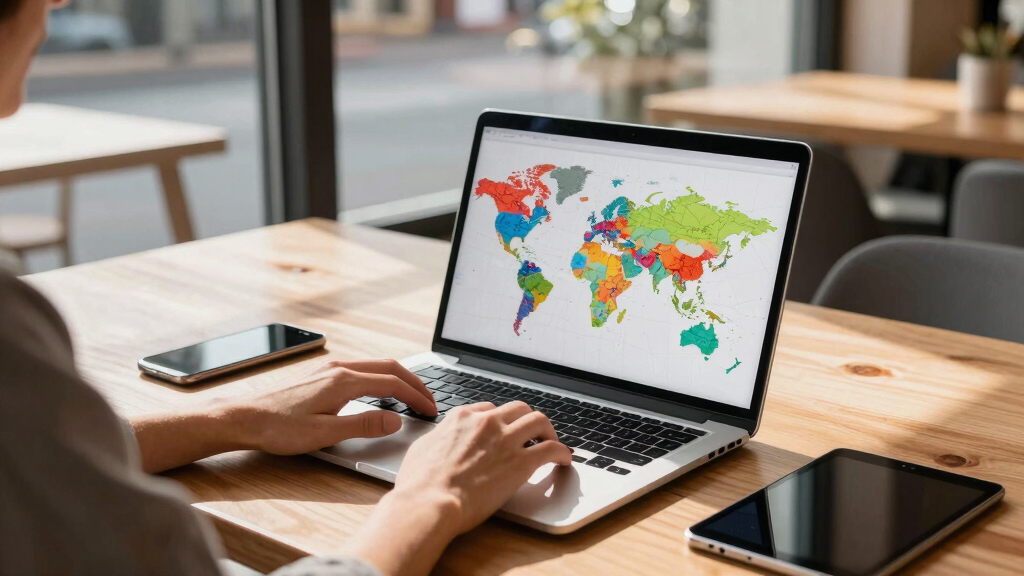
A new map of the world’s territories has been generated using a spherical Voronoi diagram that assigns regions to the closest capital city, accounting for Earth’s curvature. This development offers a novel way to visualize geopolitical proximity and regional boundaries, with potential implications for geographic analysis and political geography.
Using data from Natural Earth and the 1:10 million cultural vectors for populated places, researchers have applied a spherical Voronoi diagram to define territories based on proximity to capital cities around the globe. Unlike traditional boundary maps, this method considers Earth’s curvature, resulting in more geographically accurate regions. The calculation determines each point on the Earth’s surface as belonging to the nearest capital, effectively creating a new partitioning of the world.
This approach has been dubbed the ‘United States of Voronoi’ in some circles, highlighting its focus on proximity-based regional division rather than historical or political boundaries. The method relies on computational geometry techniques that adapt Voronoi diagrams to a spherical surface, which is more complex than flat-plane calculations but yields more precise regional delineations.
While the visualization is primarily a mathematical and geographic exercise, it raises questions about the fluidity of borders and how proximity influences regional identity, especially in areas with overlapping or ambiguous boundaries. Experts note that this model could inform studies in geopolitics, logistics, and regional planning, although it does not replace existing political boundaries.
Implications for Geographic and Political Analysis
This new Voronoi-based mapping approach matters because it offers a different perspective on how regions can be defined purely by proximity to capital cities, rather than historical or political boundaries. It could influence geographic research, regional planning, and even discussions about sovereignty by highlighting the importance of physical proximity in territorial delineation. Although it does not replace traditional borders, it provides a tool for understanding spatial relationships on a global scale, especially in contexts like logistics, resource distribution, or regional cooperation.
As an affiliate, we earn on qualifying purchases.
Background on Voronoi Diagrams and Geographic Mapping
Voronoi diagrams are a well-established mathematical tool used to partition space based on proximity to a set of points, typically called seeds or sites. Traditionally applied in fields like computer science, biology, and geography, they are often computed on flat surfaces. This new application adapts the concept to Earth’s spherical surface, using geospatial data from Natural Earth and the locations of world capitals. The approach is inspired by recent computational advances and interest in redefining regional boundaries based solely on proximity rather than political history.
Previous efforts, such as the ‘United States of Voronoi,’ have demonstrated how Voronoi diagrams can be used to analyze regional relationships within specific countries. Extending this to a global scale involves complex calculations that account for Earth’s curvature, which has now been achieved through recent computational techniques shared on Hacker News.
“Applying a spherical Voronoi diagram to global capitals allows us to see regions defined purely by proximity, offering a novel perspective on geopolitical geography.”
— an anonymous researcher
geographic information system software
As an affiliate, we earn on qualifying purchases.
As an affiliate, we earn on qualifying purchases.
Limitations and Open Questions About the Model
It is not yet clear how this proximity-based model compares with existing political boundaries in terms of practical application or accuracy. The map does not account for cultural, historical, or political factors that influence borders, and its relevance to sovereignty or governance remains uncertain. Additionally, the computational complexity of global spherical Voronoi diagrams raises questions about scalability and precision in different regions.
Further research is needed to assess how these regions align with or differ from established borders, and whether this approach can be integrated into geopolitical or logistical planning tools.
As an affiliate, we earn on qualifying purchases.
Future Applications and Research Directions
Researchers plan to explore how this proximity-based mapping can inform studies in political geography, logistics, and regional development. There may also be efforts to compare these regions with existing political boundaries to identify overlaps or discrepancies. Additionally, further refinement of the computational models could improve the accuracy and usability of global Voronoi diagrams, potentially leading to new geographic visualization tools.
As an affiliate, we earn on qualifying purchases.
Key Questions
How does the spherical Voronoi diagram differ from traditional maps?
It defines regions based solely on the closest capital city, considering Earth’s curvature, rather than political or historical boundaries.
Can this model replace existing political maps?
No, it is primarily a geographic and mathematical visualization tool that offers a different perspective but does not account for cultural or political factors.
What practical uses could this mapping have?
It could aid in logistics, regional planning, resource allocation, and understanding spatial relationships in a purely proximity-based context.
Is this approach scalable to smaller regions or specific countries?
Yes, similar methods have been applied at national levels, but scaling to a global map involves complex calculations that are still being refined.
Source: Hacker News
Fall Picks
fall essentials
As an affiliate, we earn on qualifying purchases.