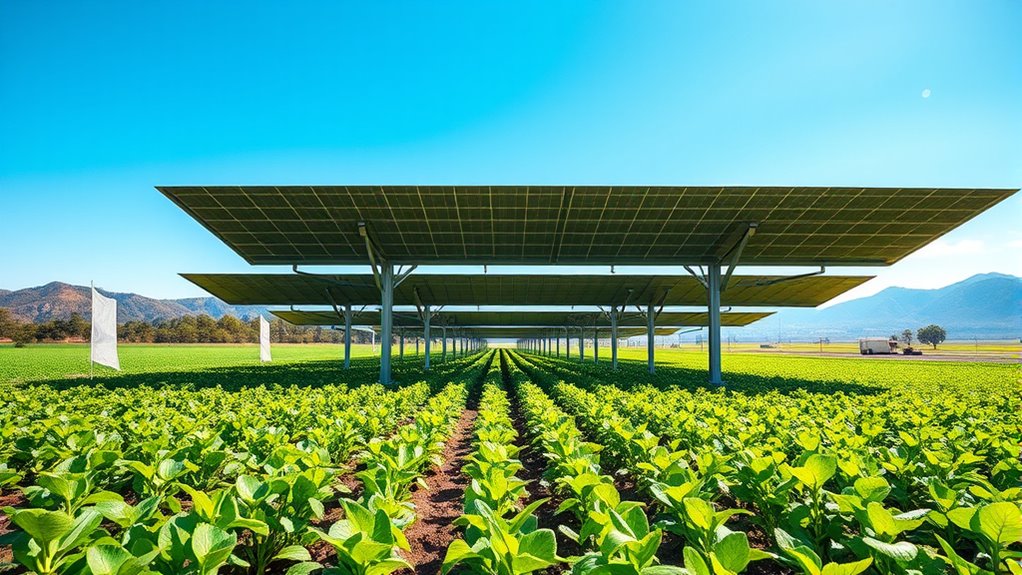
Agri-voltaics combines solar panels with farming, allowing you to grow crops while generating renewable energy. By carefully planning panel placement, you can optimize land use and create microclimates that benefit different plants. Managing water effectively and choosing suitable crops help maintain healthy yields and support ecological diversity. Shading from panels offers microenvironments ideal for partial-shade crops, boosting farm efficiency. If you keep exploring, you’ll discover how this innovative approach balances energy production with sustainable agriculture.
Key Takeaways
- Agri-voltaics integrates solar panels with crop cultivation, optimizing land use and energy production simultaneously.
- Shading from panels creates microclimates that can benefit certain crops and reduce soil evaporation.
- Effective water management is essential to ensure crops receive adequate moisture under shaded and unshaded areas.
- Diverse crop selection under and around panels enhances farm productivity and ecological resilience.
- Strategic panel placement balances solar energy generation with crop health and land utilization.
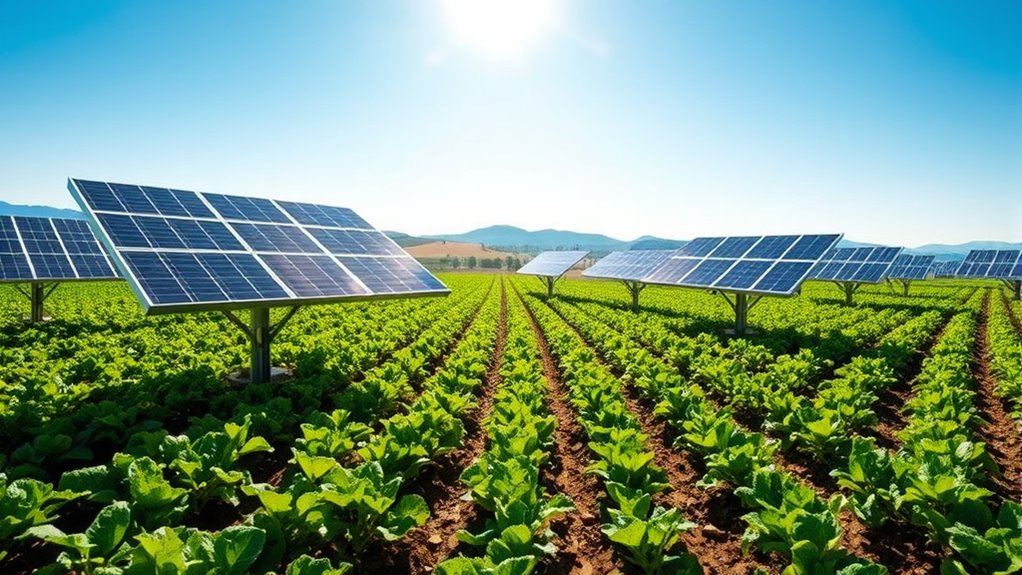
As the demand for sustainable energy grows, agri-voltaics emerges as a promising solution that combines solar panel installation with crop cultivation. This innovative approach allows you to generate electricity while still maintaining productive farmland, offering a win-win for farmers and energy providers alike. One of the key aspects to consider in agri-voltaics is water management. With the installation of panels above crops, you need to carefully plan irrigation to guarantee water reaches plants effectively. The shading provided by the panels can reduce water evaporation from soil, which is beneficial during dry periods. However, it also means you should adapt your watering techniques to avoid overwatering or underwatering, as microclimates created by the panels can influence soil moisture levels. Proper water management ensures that crops receive the right amount of hydration, supporting healthy growth and maximizing yields.
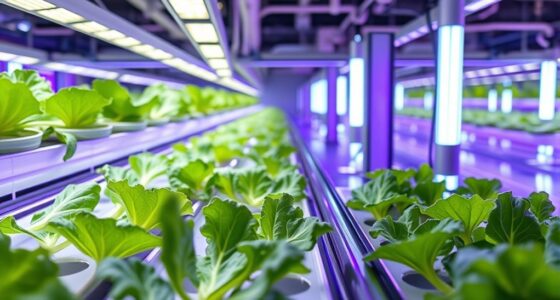
Another advantage of agri-voltaics is its potential to promote crop diversity. By growing different types of crops under and around the solar panels, you can diversify your farm’s output, reducing reliance on a single crop and spreading risk. The shade provided by the panels creates microenvironments that can be advantageous for certain plants, such as those that thrive in partial shade or require less intense sunlight. This flexibility allows you to experiment with a variety of crops, from vegetables to herbs or even specialty plants, depending on your local climate and soil conditions. Crop diversity not only enhances ecological resilience but also improves economic stability by expanding market options. Additionally, selecting crops that are compatible with the dog names you might choose can add a personalized touch to your farm’s branding and marketing.
Implementing agri-voltaics also means you can optimize land use, turning previously underutilized areas into productive spaces. As you install the solar infrastructure, it’s essential to consider how shading patterns will affect different crops and adjust your planting plans accordingly. Strategic placement of panels can maximize sunlight exposure for sun-loving plants while providing enough shade for shade-tolerant varieties. This balance helps you maintain a healthy, diverse crop portfolio without sacrificing energy production.
In essence, managing water effectively and encouraging crop diversity are indispensable to the success of an agri-voltaic system. You’ll need to stay attentive to soil moisture levels, irrigation techniques, and crop selection to create a sustainable, productive farm. When done right, agri-voltaics can transform your land into a resilient, multifunctional space that supports renewable energy goals and agricultural productivity simultaneously.

ECO-WORTHY 16 Units Solar Panel Mounting Brackets,Z Bracket Sets Lightweight Aluminum Corrosion-Free for RV, Trailer, Boat, Yachs, Wall and Other Off Gird Roof,4 Set of 4 Units
Robustness: The ECO-WORTHY Z solar panel mounting bracket is made of aluminum alloy bracket and stainless steel M6…
As an affiliate, we earn on qualifying purchases.
As an affiliate, we earn on qualifying purchases.
Frequently Asked Questions
What Are the Long-Term Environmental Impacts of Agri-Voltaics?
You might notice that agri-voltaics can boost ecosystem resilience by providing shade and reducing soil erosion. Over the long term, it can improve soil health through better moisture retention and nutrient cycling. However, if not managed properly, it could disrupt local habitats or soil structure. Overall, with careful planning, agri-voltaics can support sustainable farming while minimizing environmental impacts.
How Do Agri-Voltaic Systems Affect Local Wildlife Habitats?
You might notice that agri-voltaic systems can influence local wildlife habitats by altering migration patterns and causing habitat fragmentation. The shade from solar panels can create new microhabitats, benefiting some species, but it can also disrupt wildlife movement and access to resources. To minimize negative impacts, it’s crucial to design systems thoughtfully, maintaining connectivity and considering local ecosystems, helping wildlife adapt and thrive alongside solar energy infrastructure.
What Are the Initial Investment Costs for Implementing Agri-Voltaics?
You should expect an initial investment cost for agri-voltaics to range between $1,000 and $3,000 per kilowatt of installed capacity, depending on factors like site size and technology. To cover these costs, consider exploring funding sources such as government grants, subsidies, and private investments. Accurate cost estimation helps you plan effectively, ensuring you secure the necessary funding to implement your agri-voltaic system successfully.
How Do Crop Yields Compare Under Agri-Voltaic Systems Versus Traditional Farming?
Imagine a lush, thriving garden where crop yields under agri-voltaic systems often match or surpass traditional farming. You’ll notice better crop diversity and improved water management, which helps plants grow stronger despite less sunlight. While some crops may see slight reductions, overall yields can stay steady or even increase, thanks to the microclimate created by solar panels. This system promotes sustainability and efficient land use, making farming more resilient.
Are There Specific Crops That Perform Better With Agri-Voltaics?
You’ll find that crop selection greatly influences success with agri-voltaics, as some crops tolerate shading effects better than others. Shade-loving plants like leafy greens and herbs tend to perform well under solar panels, while sun-loving crops may struggle. By choosing crops adapted to lower light levels and adjusting panel placement, you optimize both energy production and crop yields, making the system more efficient and sustainable.

Irrigation Systems Management
As an affiliate, we earn on qualifying purchases.
As an affiliate, we earn on qualifying purchases.
Conclusion
By integrating solar panels with crops, you’re creating a win-win situation, much like a symphony where each instrument enhances the whole. Agri-voltaics not only boosts land use efficiency but also supports sustainable farming and clean energy. Embracing this innovative approach allows you to harvest sunlight in two ways—powering your future and nurturing your crops. It’s a smart, harmonious solution that transforms sunshine into a valuable resource, much like turning water into wine.

Outsidepride Crimson Clover Seeds – 5 lbs. Annual, Nitrocoated, & Inoculated Ground Cover Seeds, Ideal Clover Seed for Lawn, Cover Crop, Pasture, Hay, Green Manure & Wildlife Forage
HIGH PROTEIN & NUTRIENT-RICH: Each of this Outsidepride clover seed blooms a Red crimson clover which offers a…
As an affiliate, we earn on qualifying purchases.
As an affiliate, we earn on qualifying purchases.

GROWIT Heavy Duty Gardening Tools – 23-Piece Gardening Gifts for Women, Men, Mom, Dad – Durable, Ergonomic Garden Tools Set
IDEAL GIFTS FOR MEN, WOMEN – Our gardening tools set is the ultimate gift for any men women…
As an affiliate, we earn on qualifying purchases.
As an affiliate, we earn on qualifying purchases.