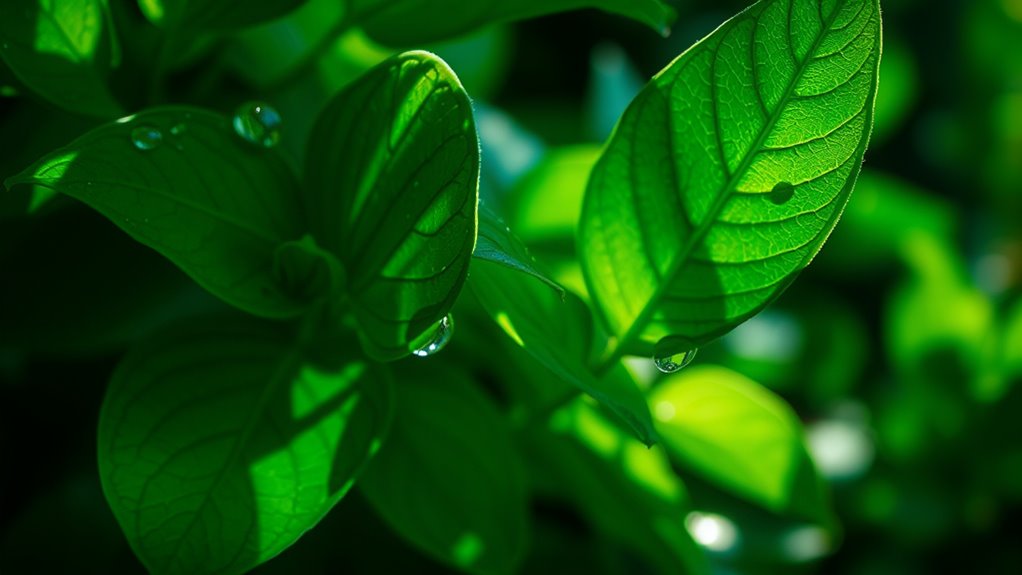
Green light plays a subtle yet essential role in plant growth by penetrating deeper into the canopy and reaching shaded leaves. It supports overall health by balancing development, helping lower foliage receive light, and promoting uniform growth. Although not as intense as red or blue, green light activates pigments that assist in photosynthesis and influences plant shape and flowering. To uncover more about green light’s hidden effects, keep exploring how it truly impacts plant vitality.
Key Takeaways
- Green light penetrates deeper into plant canopies, reaching shaded leaves and promoting uniform growth.
- It activates accessory pigments, supporting overall photosynthesis efficiency, especially when red and blue lights are limited.
- Green light influences plant morphology, affecting leaf expansion, stem growth, and flowering timing subtly.
- Incorporating green light balances growth conditions, leading to healthier, more vigorous plants.
- Its role in light spectrum balance enhances overall plant resilience and development.
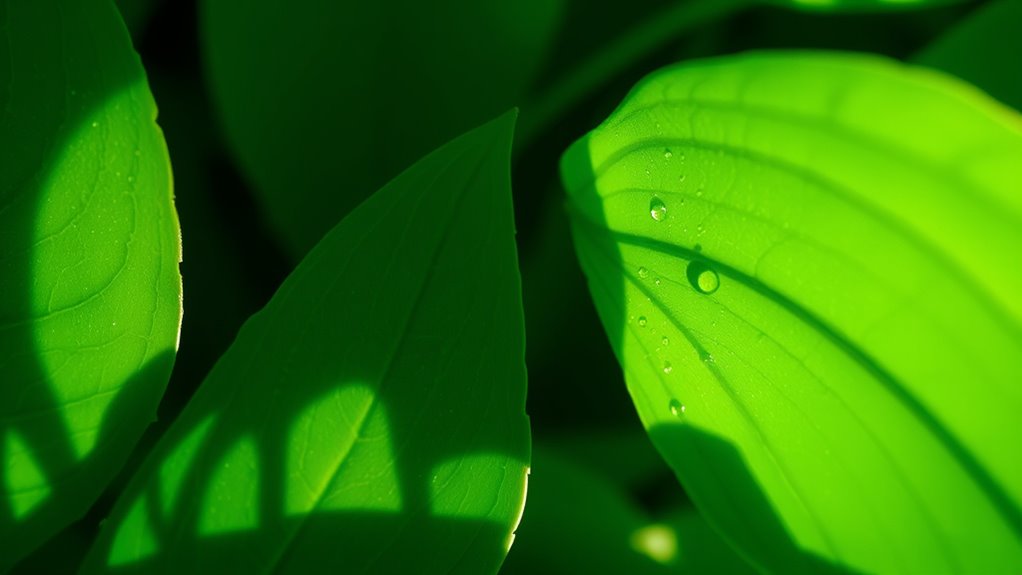
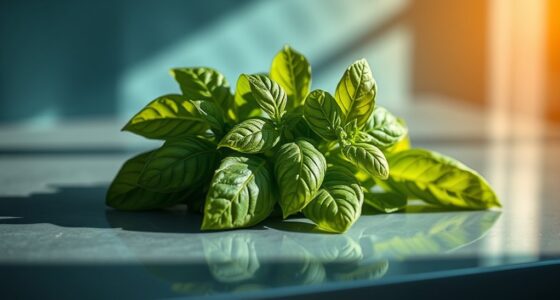
Green light plays a unique role in plant growth, often overlooked compared to red and blue wavelengths. While red and blue lights are widely recognized for their direct influence on photosynthesis, green light’s contribution is subtler but still significant. You might assume that green light is less important because plants seem to reflect it, giving them their characteristic color. However, recent research shows that green light can penetrate deeper into the plant canopy, reaching leaves that red and blue lights might not effectively access. This ability to penetrate can influence overall plant health and growth, making it an essential component of a balanced light spectrum.
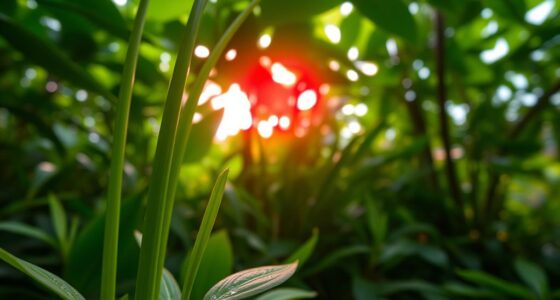
Green light penetrates deeper into the canopy, supporting healthier, more uniform plant growth.
When it comes to photosynthesis efficiency, green light plays a nuanced role. You might think that since chlorophyll absorbs mostly red and blue light, green light is less useful for photosynthesis. But in reality, green light can enhance the process indirectly. It contributes to photosynthesis by activating other pigments within the plant, such as carotenoids and accessory pigments, which can transfer energy to chlorophyll. This means that green light can help maximize photosynthesis efficiency, especially under conditions where red and blue lights are limited or unevenly distributed. In dense plant canopies, for example, green light can reach lower leaves that are shaded from red and blue wavelengths, promoting more uniform growth across the entire plant.
Additionally, green light’s ability to penetrate deeper into foliage means that it can influence plant morphology and development in subtle ways. It can modulate processes like leaf expansion, stem elongation, and flowering time. You might notice that in environments illuminated only with red and blue lights, plants sometimes exhibit abnormal growth patterns. Introducing green light helps balance these effects, encouraging more natural and healthy development. This balancing act supports overall plant vigor and productivity, making green light an important factor in optimizing growth conditions.
While the emphasis often falls on red and blue wavelengths for driving photosynthesis and plant growth, neglecting green light would be a mistake. It plays a supporting yet essential role in ensuring that plants use light efficiently and develop properly. You should consider incorporating a spectrum that includes green wavelengths if you want to promote healthier, more resilient plants. Its ability to penetrate deeper into foliage and influence various developmental processes makes green light a subtle but powerful player in the complex dance of plant growth. In essence, green light helps create a more holistic lighting environment, ultimately enhancing plant health and photosynthesis efficiency in ways that are easy to overlook but indispensable for optimal growth.

RWNTAO LED Plant Growing lamp, 3500K Full Spectrum Grow Light Strips for Indoor Plants with 3/9/12H Timer & 10 Dimmable Levels, Led Growth Light for Green House Hydroponics Succulent 13In 4Head
【Full Spectrum】Same as natural sunlight. It has been proven to promote photosynthesis and indoor plant growth, so you…
As an affiliate, we earn on qualifying purchases.
As an affiliate, we earn on qualifying purchases.
Frequently Asked Questions
How Does Green Light Influence Plant Flowering Cycles?
Green light influences plant flowering by interacting with plant photoreceptors, though its effects are subtle. When exposed to green light during flowering, you might notice delayed or altered flowering times, as green light can modulate the activity of photoreceptors responsible for flowering signals. While it isn’t as potent as red or blue light, green light still plays a role in fine-tuning your plant’s flowering cycle, helping you optimize growth conditions.
Can Green Light Improve Plant Disease Resistance?
Ever wondered if green light can boost your plants’ defenses? It can, by enhancing green light immunity and increasing plant pathogen resistance. While not a cure-all, green light exposure helps strengthen the plant’s natural defenses, making them less vulnerable to diseases. Isn’t it satisfying to know you can support your plants’ health naturally? Incorporating green light could be a simple step toward healthier, more resilient plants.
Does Green Light Affect Plant Nutrient Absorption?
Green light influences plant nutrient absorption by subtly affecting chlorophyll activation, which can boost photosynthesis efficiency. When exposed to green light, your plants may optimize their nutrient uptake since chlorophyll absorbs this wavelength less but still plays a role in overall energy processing. This can lead to improved nutrient absorption, supporting healthier growth. While green light isn’t the most effective for photosynthesis, it still contributes to the plant’s ability to absorb essential nutrients.
How Do Green Light Effects Vary Among Different Plant Species?
You’ll find that green light’s effects vary substantially among plant species, especially in shade adaptation. For example, plants with leaf pigment variation tend to reflect green light more, influencing their growth strategies. Some species thrive with green light exposure, enhancing photosynthesis, while others show minimal response. This diversity highlights how different plants adapt to their environments, making green light’s role essential in understanding species-specific growth and survival tactics.
What Is the Optimal Green Light Intensity for Plant Growth?
You should aim for a green light spectrum intensity of around 10-20 μmol/m²/s for ideal plant growth. Too much green light can hinder photosynthesis, while too little won’t provide enough energy. Adjust the light intensity based on your plant’s species and growth stage, ensuring it receives consistent, moderate exposure. Remember, balancing green light with other spectra enhances overall plant health and growth efficiency.
RWNTAO LED Plant Growing lamp, 3500K Full Spectrum Grow Light Strips for Indoor Plants with 3/9/12H Timer & 10 Dimmable Levels, Led Growth Light for Green House Hydroponics Succulent 13In 4Head
【Full Spectrum】Same as natural sunlight. It has been proven to promote photosynthesis and indoor plant growth, so you…
As an affiliate, we earn on qualifying purchases.
As an affiliate, we earn on qualifying purchases.
Conclusion
As you explore the gentle influence of green light, you might find it quietly nurturing your plants in ways you hadn’t expected. Though subtle, its effects can subtly guide growth and resilience, adding a touch of harmony to your garden’s symphony. Embrace these softer hues, and you’ll discover a delicate balance that encourages your plants to flourish naturally. Sometimes, it’s the quietest influences that leave the most lasting, beautiful impressions.

Plant Grow Light,yadoker LED Growing Light Full Spectrum for Indoor Plants,Height Adjustable, Automatic Timer, 5V Low Safe Voltage,Idea for Large Plant Light
72 LED Grow Light Full Spectrum – Compact grow light with high quality super bright LEDs, offer full…
As an affiliate, we earn on qualifying purchases.
As an affiliate, we earn on qualifying purchases.

VIVOSUN 19-Bulb High Intensity LED Green Light Grow Room Headlight
See Clearly: This hands-free headlamp for indoor horticulture emits a bright green light beam that doesn't affect your…
As an affiliate, we earn on qualifying purchases.
As an affiliate, we earn on qualifying purchases.