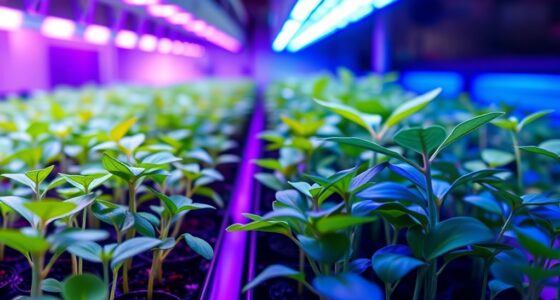

Your plant’s nutrient content depends heavily on light intensity because it impacts photosynthesis efficiency. When you provide the right amount of light, your plants produce more sugars and metabolic compounds, which support better absorption and transport of essential nutrients like nitrogen, phosphorus, and potassium. Too little or too much light can hinder this process, leading to deficiencies and weaker growth. Keep exploring to discover how adjusting light levels can maximize your plant’s health and nutrient uptake.

Get the latest gadgets delivered free with Prime
- Fast, free delivery on millions of items
- Prime Video, Amazon Music and more included
- Member-only deals all year
Key Takeaways
- Proper light intensity enhances photosynthesis, increasing sugar production that supports nutrient transport and overall nutrient content.
- Insufficient light reduces photosynthesis, leading to lower nutrient uptake and diminished nutrient levels in plant tissues.
- Excessive light causes stress, impairing nutrient absorption and potentially decreasing nutrient content.
- Balanced light conditions optimize metabolic activity, improving mineral and nutrient assimilation in plants.
- Adjusting light intensity according to plant type maximizes nutrient accumulation and promotes healthy growth.

Light intensity plays a crucial role in determining the nutrient content of plants, directly affecting their growth and overall health. When plants receive the right amount of light, their photosynthesis efficiency increases, allowing them to convert sunlight into energy more effectively. This process is fundamental because it fuels all other aspects of plant development, including nutrient uptake. As photosynthesis efficiency improves, your plants can absorb nutrients more readily from the soil or growing medium, leading to healthier, more vigorous growth.
Optimal light boosts photosynthesis, enhancing nutrient absorption for healthier, vigorous plant growth.
If light levels are too low, photosynthesis slows down, and plants struggle to produce enough energy. This decline means they can’t sustain ideal nutrient absorption rates, resulting in deficiencies that weaken their structure and reduce yield. Conversely, excessive light can cause stress, leading to damage or sunburn, which also hampers nutrient uptake. Striking the right balance in light intensity ensures your plants maximize photosynthesis efficiency and absorb nutrients at the optimal rate, supporting robust development.
Light intensity not only influences photosynthesis but also impacts how effectively plants utilize nutrients. When photosynthesis is efficient, plants generate more sugars and metabolic compounds needed for growth and nutrient transport. This enhanced metabolic activity boosts the plant’s ability to assimilate essential minerals and nutrients from the soil, improving overall nutrient content. For example, with proper light, your plants can better absorb nitrogen, phosphorus, and potassium—key elements that contribute to healthy leaves, roots, and flowers.
Adjusting light exposure based on the specific needs of your plants can make a significant difference. For leafy greens, moderate to high light levels promote dense, nutrient-rich foliage. For flowering plants, ideal light promotes not just better growth but also the accumulation of nutrients necessary for vibrant blooms. In controlled environments like greenhouses or indoor gardens, using grow lights with adjustable intensity helps you fine-tune conditions, maximizing photosynthesis efficiency and nutrient absorption rates.
adjustable grow lights for indoor plants
As an affiliate, we earn on qualifying purchases.
As an affiliate, we earn on qualifying purchases.
Frequently Asked Questions
How Does Light Intensity Affect Root Nutrient Uptake?
Higher light intensity boosts photosynthesis efficiency, which in turn enhances root absorption capacity. As your plant receives more light, it produces more energy, supporting active nutrient uptake from the soil. This means roots can absorb nutrients more effectively, leading to healthier growth. Keep in mind, ideal light levels are essential—too much or too little can hinder photosynthesis and root function, so find that perfect balance for your plant’s needs.
Can Low Light Conditions Increase Certain Plant Nutrients?
Think of your plant as a storyteller. Under low light, it might turn to other sources, like altering its photoperiod effects, to maintain balance. Surprisingly, this can sometimes lead to increased levels of certain nutrients, as the plant adapts to avoid nutrient deficiency. You might notice changes in nutrient content, especially in leaves, as the plant adjusts its internal processes to survive in dim conditions.
What Is the Optimal Light Intensity for Maximum Nutrient Content?
You should aim for a moderate light intensity to maximize nutrient content. This level boosts photosynthesis efficiency, helping plants produce more energy for growth and nutrient translocation. Too much light can cause stress, reducing nutrient uptake, while too little limits photosynthesis. Find a balanced light level that promotes ideal photosynthesis efficiency, ensuring nutrients are effectively translocated, leading to healthier, more nutrient-rich plants.
How Do Different Light Spectra Influence Nutrient Synthesis?
Your plants’ growth depends on how different light spectra influence nutrient synthesis, which can be as dramatic as a lightning strike. Blue light boosts photosynthesis efficiency, enhancing chlorophyll production, while red light regulates nutrient pathways, promoting flowering and fruiting. By tailoring light spectra, you optimize nutrient synthesis, ensuring your plants develop stronger, healthier, and more nutrient-rich. This precise control makes your garden a powerhouse of energy and productivity.
Does Fluctuating Light Intensity Impact Long-Term Plant Health?
Fluctuating light intensity can impact your plant’s long-term health by causing light stress, which may reduce photosynthetic efficiency. When light levels change unpredictably, your plants struggle to adapt quickly, potentially leading to weakened growth or stress-related issues. To maintain healthy plants, guarantee consistent light conditions or gradual adjustments, allowing them to optimize photosynthesis and avoid long-term damage caused by fluctuating light intensity.
As an affiliate, we earn on qualifying purchases.
Conclusion
Understanding how light intensity affects plant nutrient content helps you optimize growth conditions. Did you know that plants exposed to higher light levels can increase nutrient accumulation by up to 30%? This shows just how essential proper lighting is for healthy plants. By adjusting light exposure, you can boost nutrient levels and improve overall plant health. So, pay attention to light intensity—your plants will thank you with better growth and vitality.
plant nutrient supplements for indoor gardening
As an affiliate, we earn on qualifying purchases.
As an affiliate, we earn on qualifying purchases.
As an affiliate, we earn on qualifying purchases.
Fall Picks
fall essentials
As an affiliate, we earn on qualifying purchases.