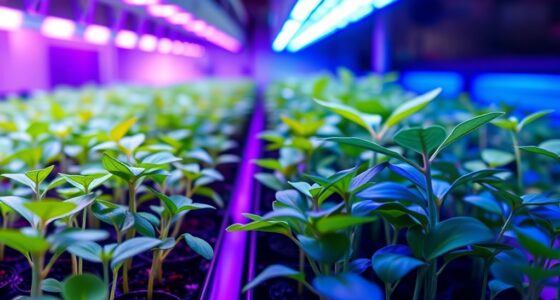

Light wavelengths play a key role in how you influence plant secondary metabolites. By adjusting light spectra, you can activate specific photoreceptors—like phytochromes and cryptochromes—that control pathways producing compounds like flavonoids, alkaloids, and terpenoids. Blue light boosts flavonoids, while red light can enhance alkaloids. Understanding these effects helps you optimize growing conditions for better phytochemical yields and plant health. Keep exploring, and you’ll uncover how to harness light to boost plant metabolite production effectively.

Get the latest gadgets delivered free with Prime
- Fast, free delivery on millions of items
- Prime Video, Amazon Music and more included
- Member-only deals all year
Key Takeaways
- Specific light wavelengths activate photoreceptors that regulate genes involved in secondary metabolite biosynthesis.
- Blue light enhances flavonoid production via cryptochrome activation, increasing antioxidant levels.
- Red light influences alkaloid synthesis and defense compounds through phytochrome pathways.
- UV and blue light exposure boost flavonoid accumulation, improving plant health and phytochemical content.
- Manipulating light spectrum in controlled environments directs plant metabolism toward desired secondary metabolites.

Light wavelengths play a essential role in influencing the production of secondary metabolites in plants. These compounds—like alkaloids, flavonoids, and terpenoids—are fundamental for plant defense, survival, and interaction with their environment. Your understanding of how different light wavelengths affect metabolite biosynthesis can help optimize growth conditions and enhance the production of valuable phytochemicals. When plants are exposed to specific wavelengths, they detect these signals through specialized photoreceptors, which then trigger a cascade of cellular responses. This process, known as photoreceptor activation, directly impacts the biosynthesis pathways that lead to secondary metabolite formation.
Different wavelengths of light activate distinct photoreceptors, such as phytochromes, cryptochromes, and phototropins. Phytochromes primarily respond to red and far-red light, while cryptochromes are sensitive to blue and UV-A light. When these photoreceptors absorb their respective wavelengths, they undergo conformational changes that initiate signal transduction pathways. These pathways modulate gene expression, especially genes involved in secondary metabolite biosynthesis. For instance, exposure to blue light often enhances flavonoid production, as cryptochrome activation upregulates enzymes in the flavonoid pathway. Similarly, red light via phytochromes can influence the synthesis of alkaloids and other defense-related compounds.
Additionally, understanding the specific light spectrum that stimulates certain biosynthetic pathways allows for more precise control over plant chemistry. By manipulating light quality, you can steer plant metabolic processes toward desired outcomes. For example, providing plants with specific wavelengths can increase the accumulation of antioxidants, which are secondary metabolites with health benefits. Blue and UV light are particularly effective at boosting flavonoid levels, offering a natural way to enhance plant nutritional value. On the other hand, red light can promote biomass growth while also influencing certain metabolite pathways. This targeted approach allows you to optimize both plant growth and secondary metabolite production simultaneously.
Understanding the relationship between light wavelengths, photoreceptor activation, and metabolite biosynthesis enables you to design better lighting strategies, whether for controlled environment agriculture, horticulture, or research purposes. By adjusting the light spectrum, you can stimulate specific biosynthetic pathways, leading to increased yields of desired secondary metabolites. This knowledge empowers you to harness the natural signaling mechanisms in plants, ensuring they produce more of the compounds that benefit both their health and your applications. Ultimately, the strategic use of light wavelengths becomes a powerful tool to influence plant chemistry, supporting sustainable and efficient cultivation practices.
As an affiliate, we earn on qualifying purchases.
Frequently Asked Questions
How Do Different Light Wavelengths Affect Plant Growth Rates?
Different light wavelengths substantially influence your plant’s growth rates by affecting photosynthesis efficiency and leaf pigmentation. Blue light boosts photosynthesis and promotes compact, healthy growth, while red light enhances flowering and fruiting. Green light penetrates deeper into leaves, aiding overall development. By providing the right combination of wavelengths, you help maximize your plant’s growth, ensuring vibrant foliage and better yields through improved photosynthesis efficiency and ideal leaf pigmentation.
Can Specific Light Spectra Enhance the Production of Particular Secondary Metabolites?
Imagine your plants whispering secrets through spectral tuning—yes, specific light spectra can boost the production of particular secondary metabolites. You can manipulate light wavelengths to target metabolite specificity, enhancing desirable compounds like antioxidants or alkaloids. By fine-tuning the spectrum, you actively influence metabolic pathways, encouraging plants to produce more of what you need. This strategic approach unleashes potential in crop quality, medicinal use, and flavor enhancement.
Are There Optimal Light Conditions for Maximizing Secondary Metabolite Yield?
You can optimize light conditions by focusing on wavelengths that boost photosynthesis efficiency and pigment synthesis. Use specific light spectra, like blue and red light, to enhance secondary metabolite production. Adjust light intensity and duration to create ideal conditions, ensuring your plants or microbes maximize their metabolic pathways. This targeted approach helps increase yield while maintaining healthy growth, making your process more efficient and productive.
How Does Light Wavelength Influence Plant Defense Mechanisms?
You see that specific light wavelengths activate photoreceptors, which trigger signal transduction pathways in plants. This process enhances their defense mechanisms by stimulating production of secondary metabolites and activating defense genes. When you expose plants to targeted wavelengths, you’re effectively boosting their ability to respond to stress or pests. By understanding this, you can manipulate light conditions to strengthen plant defenses and improve resilience naturally.
Do Secondary Metabolites Vary Under Artificial Versus Natural Lighting Conditions?
Ever wonder if your plants produce different secondary metabolites under artificial versus natural lighting? They definitely can. The light spectrum influences metabolite variation, prompting plants to adjust their chemical defenses based on their environment. Under natural light, plants often develop a diverse range of secondary metabolites, while artificial lighting might limit this diversity. So, yes, the type of light can alter how plants defend themselves, affecting their overall health.
As an affiliate, we earn on qualifying purchases.
Conclusion
By understanding how different light wavelengths influence secondary metabolites, you reveal nature’s hidden strategies. Just as sunlight can both nurture and hinder plant growth, your choices can either open or suppress these compounds. Light’s dual role, like a mirror reflecting nature’s intricate balance, reminds you that what seems simple often hides complexity. Embrace this interplay, and you’ll deepen your appreciation for how light shapes not just plants, but the very essence of their resilience and beauty.
As an affiliate, we earn on qualifying purchases.
As an affiliate, we earn on qualifying purchases.
Columbus Day / Indigenous Peoples' Day Picks
long weekend sales
As an affiliate, we earn on qualifying purchases.