
TL;DR

Get the latest gadgets delivered free with Prime
- Fast, free delivery on millions of items
- Prime Video, Amazon Music and more included
- Member-only deals all year
Nvidia released the GeForce 256 on Oct. 11, 1999, describing it as the company’s first GPU. Its transform-and-lighting hardware could move some graphics work from the CPU to the graphics card, though the card’s advantage depended on the computer using it.
Nvidia released the GeForce 256 on October 11, 1999, marketing it as the company’s first graphics processing unit, or GPU. The card’s hardware transform-and-lighting capabilities helped define the product category Nvidia would continue to use, although the label does not settle whether it was the first graphics card to perform work now associated with GPUs.
The Silicon Underground retrospective identifies the GeForce 256 as Nvidia’s first product marketed as a GPU, not its first product or first graphics card. The article points to the card’s transform-and-lighting engine as a possible distinction from Nvidia’s earlier TNT2, but treats that explanation as uncertain rather than a definitive boundary between a GPU and other graphics hardware.
Transform and lighting processing handles parts of preparing a 3D scene for display. The GeForce 256 could perform those tasks in hardware, offloading work from the CPU. The underlying idea was not new: the account notes earlier graphics coprocessors, including Commodore’s Amiga hardware and PC products from 3dfx. Nvidia’s milestone was its use of the GPU term for the GeForce 256.
The card’s practical benefit varied with the rest of a system. According to the retrospective, it could help computers with lower-end processors, such as 300 MHz Celerons, while faster CPUs could sometimes perform transform and lighting in software faster than the GeForce 256’s hardware. The source does not provide benchmark figures or a single performance comparison across systems.
How the GPU Label Took Hold
The GeForce 256 matters both as a graphics card and as a product-naming milestone. Nvidia adopted the GPU label for a product that moved more graphics processing onto dedicated hardware, giving the company a term it would continue to use alongside the GeForce brand. The name helped frame graphics cards as processors with work of their own, rather than simply display adapters.
That shift had practical relevance for gamers who could not afford high-end CPUs. A graphics card that took on some processing could improve a system’s ability to handle 3D games without requiring all of that work to be done by the central processor. The retrospective cautions, however, that this was not an across-the-board performance win: the value depended on the CPU and workload.
The milestone should not be read as proof Nvidia invented graphics processing hardware or CPU offloading. The source itself notes earlier examples. Its more limited claim is that the GeForce 256 was the first Nvidia product sold under the GPU name, a distinction that helped shape the company’s later product identity.
As an affiliate, we earn on qualifying purchases.
From Riva Chips to GeForce
The GeForce 256 followed Nvidia’s Riva 128 and TNT2 products. The retrospective says Sega’s $5 million investment in 1996 helped Nvidia continue after the company struggled to complete a video chip project for the Dreamcast. It says Sega later recovered its investment and made an additional $10 million profit. The Dreamcast ultimately used a chip manufactured by NEC.
After the GeForce 256, Nvidia released further GeForce cards and, according to the source, brought out follow-up products more frequently than it had previously. Nvidia later acquired most of 3dfx’s intellectual property on December 15, 2000. 3dfx wound down operations and went bankrupt in 2002. These events show the competitive setting around Nvidia’s rise, but they do not establish that the GeForce 256 alone caused the company’s later success.
““The GeForce 256 from 1999 was the first product Nvidia marketed as a GPU.””
— The Silicon Underground
As an affiliate, we earn on qualifying purchases.
Where the GPU Boundary Lies
The source does not establish a universal technical definition for what made the GeForce 256 a GPU while the TNT2 or earlier cards were not. It raises transform and lighting as a possible distinction, while acknowledging that competitors such as 3dfx could also be described as making GPUs. The boundary is partly about Nvidia’s chosen terminology and partly about hardware capabilities.
The retrospective also gives no benchmark data to quantify performance against software processing on different CPUs. Its account that faster processors could outperform the card on transform and lighting should be understood as a qualified observation, not a result for every system or game. The article is a historical account, not a new technical test or company announcement.
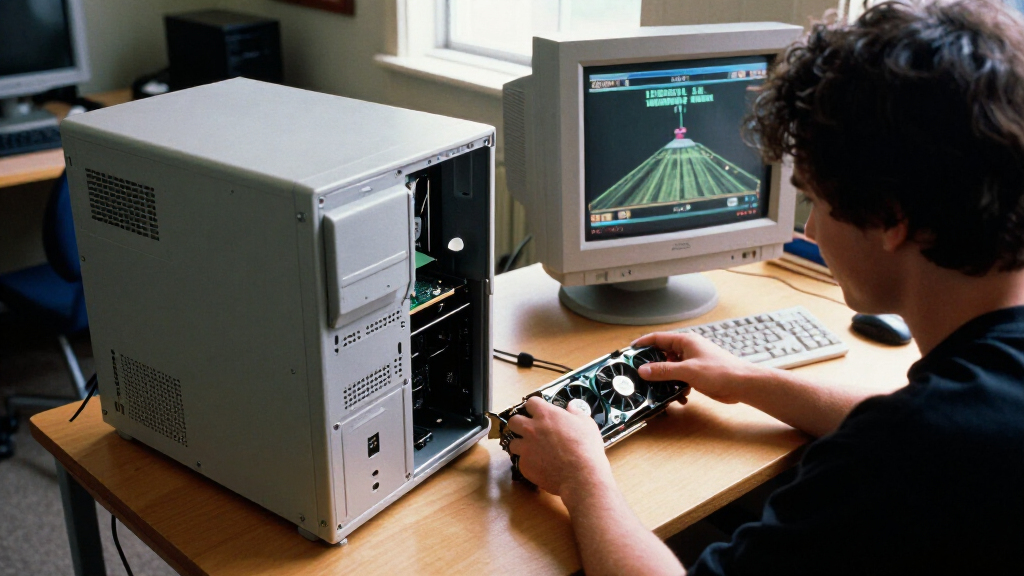
graphics card with transform and lighting
As an affiliate, we earn on qualifying purchases.
As an affiliate, we earn on qualifying purchases.
A Legacy in Nvidia’s Naming
There is no new product launch or pending decision described in the source. The immediate next step for readers is to understand the GeForce 256 as an historical milestone in Nvidia’s product language, rather than an uncontested invention of the GPU concept. Nvidia continues to use both the GPU category and GeForce branding, according to the retrospective.
Any stronger claim about the card’s technical priority would require a clear definition of “GPU” and comparisons with earlier hardware. The supplied account does not offer that technical survey, so the question of which device first qualifies under a broader definition remains open.
As an affiliate, we earn on qualifying purchases.
Key Questions
When did Nvidia release the GeForce 256?
Nvidia released the GeForce 256 on October 11, 1999, according to The Silicon Underground.
Why does Nvidia call it its first GPU?
It was the first Nvidia product the company marketed as a GPU. Its transform-and-lighting hardware may help explain the distinction from earlier Nvidia cards, but the source does not present that as a settled technical definition.
Was the GeForce 256 the first graphics hardware to offload work from a CPU?
No such broad priority claim is supported by the source. It says CPU offloading had earlier examples, including the Amiga and PC graphics products from 3dfx.
Did the GeForce 256 make every computer faster?
No. The retrospective says it could benefit systems with lower-end CPUs, but faster processors could sometimes perform transform and lighting in software more quickly. It supplies no benchmark results establishing performance across all systems.
Source: hn
Halloween Picks
halloween
As an affiliate, we earn on qualifying purchases.