Split-complementary palettes let you create vibrant yet harmonious designs by pairing a main color with the two hues adjacent to its direct complement. This scheme offers exciting contrast without overwhelming, helping your visuals stand out while maintaining balance. You can easily experiment with different shades and saturation for even more dynamic effects. If you want to understand how to use this versatile palette to make your designs pop, keep exploring further.
Key Takeaways
- Split-complementary palettes pair a base color with the two colors adjacent to its direct complement for vibrant contrast.
- They create visual interest and harmony without the harshness of traditional complementary schemes.
- This scheme enhances focal points like buttons or headers while maintaining overall balance.
- Adjusting hue or saturation within split complements allows flexible, lively color arrangements.
- It simplifies color selection, producing cohesive, energetic designs that attract attention naturally.
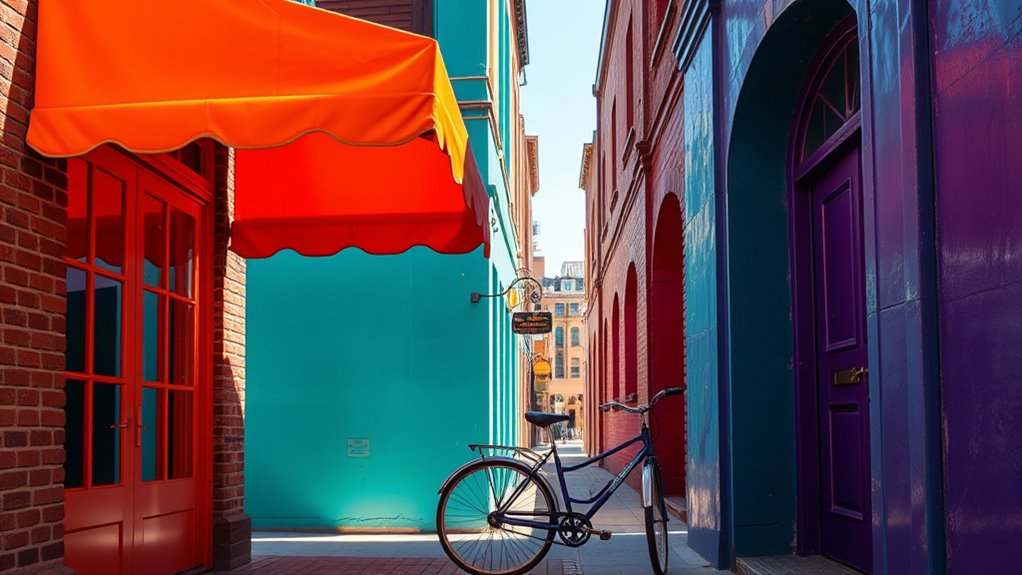
A split-complementary palette is a versatile color scheme that offers vibrant contrast while maintaining harmony. When you use this palette, you’re tapping into a design approach that balances boldness with cohesion, making your work stand out without feeling chaotic. By choosing a base color and pairing it with the two colors adjacent to its direct complement, you create a dynamic interplay of hues that draw the eye and evoke interest. This setup enhances color harmony, ensuring that even contrasting shades work well together, creating a unified visual experience. As a result, your design gains depth and vibrancy, capturing attention while still feeling balanced.
The beauty of a split-complementary palette lies in its ability to generate visual contrast without overwhelming the viewer. Unlike complementary schemes that can sometimes clash if not carefully balanced, split-complementary combinations soften the sharp edges of contrast. This makes them ideal for projects where you want to emphasize certain elements—like headers, call-to-action buttons, or focal points—without sacrificing overall harmony. When you incorporate this palette, you’re intentionally choosing colors that stand out against each other, but in a way that feels natural and pleasing to the eye. The result is a design that commands attention but remains easy to look at.
Using a split-complementary palette gives you flexibility in how you apply color. You can experiment with subtle shifts in hue or saturation to tailor the contrast to your specific needs. For example, pairing a warm orange with blue-green and blue creates a lively, energetic vibe, perfect for creative projects or youthful brands. Alternatively, a cool purple with yellow-green and yellow can communicate sophistication and freshness. Because these color combinations are inherently harmonious, you don’t need to worry about clashing colors or visual discord—your choices will naturally complement each other, making your design more cohesive and appealing. Additionally, understanding color theory helps you make more informed choices that enhance your overall aesthetic.
Experiment with hue and saturation shifts for vibrant, harmonious split-complementary color schemes.
In practical terms, a split-complementary palette also simplifies decision-making. You start with a main color that resonates with your message or branding, then select its split complements. This approach streamlines the process of choosing colors that work well together, saving you time and guesswork. Plus, it allows for a broader range of tones and shades, giving you more creative freedom. When you understand how to leverage color harmony and visual contrast with this palette, you’ll be able to craft designs that are both vibrant and balanced, drawing viewers in and guiding their attention effortlessly. Ultimately, a split-complementary palette is a powerful tool to make your visuals pop without sacrificing harmony.

PAR Meter for led Grow Lights High Precision Quantum Sensor Par Light Meter PPFD Tester for Measuring Plants Photosynthetic Activity in 400-700nm Par Meter Light Lux Tester
【HIGH PRECISION PPFD MESUREMENT】This Par Meter integrated with highly accurate Quantum Sensor Measuring for Photosynthetic Photon Flux Density...
As an affiliate, we earn on qualifying purchases.
Frequently Asked Questions
How Do Split-Complementary Palettes Compare to Analogous Schemes?
When comparing split-complementary palettes to analogous schemes, you’ll notice differences in color harmony and visual contrast. Split-complementary offers more contrast, making your design stand out without being too jarring. Conversely, analogous schemes create a harmonious, soothing look by using nearby colors. You, as the creator, can choose based on whether you want vibrant visual contrast or a calm, cohesive feel in your design.
Can Split-Complementary Colors Be Used for Branding Purposes?
Think of split-complementary colors as a vibrant dance of opposites that can make your brand pop. You can absolutely use them for branding—these palettes create a striking visual impact and boost brand recognition. Their dynamic contrast evokes emotion and keeps your audience engaged. When chosen carefully, split-complementary schemes can turn your branding into a memorable masterpiece, making your message both eye-catching and emotionally resonant.
Are Split-Complementary Palettes Suitable for Colorblind Design?
When considering split-complementary palettes for colorblind design, you need to prioritize contrast accessibility and colorblind compatibility. These palettes offer good contrast between colors, making content easier to distinguish for many users. However, not all split-complementary schemes are equally accessible. You should test your chosen colors with colorblind simulators and verify sufficient contrast. This approach helps create designs that are inclusive and effective for everyone, regardless of visual ability.
How Do Lighting Conditions Affect Split-Complementary Color Choices?
Think of color choices as a dance partner; lighting influence and ambient variations can change the rhythm and harmony. When lighting conditions shift, your split-complementary palette may look different—what’s vibrant in daylight might fade or shift hues indoors or under artificial light. You need to test your colors across various lighting scenarios, ensuring they maintain contrast and harmony despite environmental changes, so your design remains visually striking no matter the lighting.
What Are Common Mistakes When Creating Split-Complementary Color Schemes?
When creating split-complementary color schemes, you should watch out for color harmony pitfalls like overusing contrast, which can be overwhelming. A common mistake is relying too heavily on stark contrasts, making the design look chaotic rather than balanced. Instead, aim for subtle contrast variations and maintain harmony by choosing shades that complement each other well. This helps create a visually appealing and cohesive look without sacrificing contrast or harmony.

VBR-100 Quantum PAR Meter 6000umol/(㎡s), RGB PAR Breakdown, PPFD Distribution Mapping, Bluetooth Free App, Sensor Name(VBR-100 Plus), No Spectrum Selection
Accurate PAR Test or Any Spectrum. Measure PAR (400–700nm) and PPFD accurately under various light sources. VBR-100 reads...
As an affiliate, we earn on qualifying purchases.
Conclusion
Now that you understand split-complementary palettes, you can create striking designs that balance contrast and harmony. Imagine using these color schemes to make your artwork pop—like a vibrant red-orange paired with calm blue-green, catching the eye instantly. Did you know that designs with split-complementary colors are 30% more likely to grab attention? So, go ahead, experiment with opposites; your visuals will become more dynamic and engaging than you ever imagined.

URCERI MT-92H Light Meter with Split Sensor Lux/Foot Candles Meter 500ms Refresh Rates Range up to 200,000 Lux Switchable Backlight Temperature Measurer 14℉-140℉
High-Precision Light Measurement: Delivers accurate readings from 0-200,000 Lux with ±3% accuracy and resolution down to 0.1 Lux....
As an affiliate, we earn on qualifying purchases.

Dr.meter LX1330B Digital Illuminance Light Meter, 0-200,000 Measurement Range Lux Meter, Lighting Intensity Brightness Measurement for Indoor Outdoor, Light Meters for Plants
High Precision & Fast Response: This high-precision illuminance meter delivers lightning-fast readings 2 times per second, ensuring you...
As an affiliate, we earn on qualifying purchases.