
With kitchen spectroscopy, you can use your smartphone to identify food dyes quickly and easily. By capturing the reflected or emitted light from a sample with a special app, you can analyze its spectral signature to determine if dyes are natural or artificial. This portable method allows you to verify ingredients and guarantee food safety at home. Keep exploring, and you’ll discover how this technology makes food analysis more accessible than ever.
Key Takeaways
- Use a smartphone app to analyze reflected or emitted light from food samples for dye identification.
- Capture spectral data with the phone’s camera and flashlight or external light sources.
- Compare the spectral signatures obtained to a database of known artificial and natural dyes.
- Detect synthetic dyes that may cause allergies or are added as food colorings.
- Turn your smartphone into a portable spectrometer for quick, non-invasive food dye verification at home.
Have you ever wondered how your kitchen appliances can reveal the secrets of what you’re cooking? The answer lies in the fascinating world of kitchen spectroscopy, a technique that harnesses the power of your smartphone to perform food dye detection and analysis right at home. With just a few simple steps, you can turn your phone into a portable spectrometer, allowing you to identify artificial dyes in processed foods or homemade recipes. This technology makes it easier than ever to determine whether a food contains unwanted additives or to verify the authenticity of natural ingredients.
Using smartphone analysis for food dye detection involves capturing the light spectrum reflected or emitted by a sample. When you shine a light—such as your phone’s flashlight—through or onto a food item, certain wavelengths are absorbed or scattered differently depending on the dyes present. By analyzing the resulting spectrum with a dedicated app, you can identify specific dyes based on their unique spectral signatures. This process is quick, non-invasive, and doesn’t require any specialized lab equipment, making it perfect for everyday use.
Capture reflected or emitted light with your phone to identify food dyes quickly and non-invasively.
The key to effective food dye detection with your smartphone is the use of specialized apps that interpret spectral data. These apps process the light captured via your phone’s camera or external attachments, providing a visual representation of the spectrum. With this data, you can compare it to a database of known dye signatures, spotting artificial colors or confirming natural hues. As you become more familiar with the spectral patterns of common food dyes, you gain a powerful tool to scrutinize ingredients, whether you’re checking the authenticity of a packaged snack or evaluating the color of a homemade smoothie.
This approach to kitchen spectroscopy also makes food safety and labeling more transparent. You no longer have to rely solely on ingredient lists, which can sometimes be misleading or incomplete. Instead, you can perform quick, on-the-spot analysis to verify your food matches what’s advertised. Additionally, it’s a valuable resource for parents, chefs, or anyone interested in clean eating, helping to identify synthetic dyes that may cause allergies or sensitivities. Moreover, advancements in spectroscopy technology are making these tools increasingly accurate and accessible for everyday consumers.
In essence, your smartphone becomes a versatile device for food dye detection, offering an accessible way to explore the chemical makeup of what’s on your plate. By leveraging simple smartphone analysis techniques, you can unearth insights about your food’s composition, making your kitchen not just a place for cooking but also a hub for scientific discovery. This fusion of technology and culinary curiosity empowers you to make more informed choices, guaranteeing your meals are as natural and safe as you want them to be.

Sekonic C-4000 Spectrometer, Professional Light Meter with Bluetooth, 1600K-40000K Range, Smartphone App Compatible, USB-C Connection
COMPREHENSIVE DATA: Displays essential lighting metrics including lux, color temperature (TCP), luminance (Δuv), and color rendering index (Ra)…
As an affiliate, we earn on qualifying purchases.
As an affiliate, we earn on qualifying purchases.
Frequently Asked Questions
Can Smartphone Spectroscopy Detect Artificial Versus Natural Dyes?
Smartphone spectroscopy can help you distinguish artificial from natural dyes, but its accuracy depends on color accuracy and proper sample preparation. You need to guarantee your device’s camera captures true colors, possibly calibrating it with a reference. Properly preparing your sample—like grinding or diluting—improves spectral readings. While not foolproof, this method offers a quick, accessible way to analyze dye sources with some careful setup and attention to detail.
What Are the Limitations of Using a Smartphone for Dye Identification?
You might wonder about the limitations of using a smartphone for dye identification. Variations in sensor calibration can affect accuracy, making it hard to get consistent results. Lighting conditions also play a big role; poor or inconsistent lighting can distort the spectrum readings. These factors combined mean your smartphone might not reliably distinguish between natural and artificial dyes without proper calibration and controlled lighting, limiting its effectiveness for precise analysis.
Is Specialized App Required for Food Dye Spectroscopy?
Think of your smartphone as a paintbrush for spectral analysis — you can’t just dip it in paint and expect perfect art. To identify food dyes accurately, you often need a specialized app, developed specifically for this purpose. Such an app guides your spectral analysis, making dye detection more reliable. Without it, your results might be muddled, like a painting with unintended streaks. So, yes, a dedicated app is usually required.
How Accurate Is Smartphone Spectroscopy Compared to Lab Tests?
Smartphone spectroscopy offers a convenient way to identify food dyes, but its accuracy depends on technological precision and user variability. While it’s useful for quick tests, it generally doesn’t match laboratory standards. Environmental factors, camera quality, and user handling can affect results. So, you should see it as a helpful tool rather than a definitive test, especially when precise identification matters.
Can This Method Identify All Food Dyes Reliably?
You wonder if this method can reliably identify all food dyes through dye detection and color analysis. While smartphone spectroscopy offers a quick, accessible way to analyze food colors, it may not detect every dye accurately due to factors like lighting and dye concentration. For precise results, especially with complex or similar colors, lab testing remains more reliable. This approach is great for general screening but isn’t foolproof for all dyes.

Pool Leak Detection Dye Kit – with 2 Precision Applicators – 75+ Tests – Superior Long Lasting UV Pool Dye Easily Locates Leaks – for All Pool, Spa, & Hot Tub Types – 8 OZ (Fluorescent Yellow)
Easily Identify & Locate Leaks – 75+ tests per kit! This pool leak detection kit delivers a High-Contrast…
As an affiliate, we earn on qualifying purchases.
As an affiliate, we earn on qualifying purchases.
Conclusion
By using your smartphone for kitchen spectroscopy, you can easily identify food dyes and guarantee what you’re eating is safe. This innovative approach makes food analysis accessible and fun. Did you know that the global food colorants market is expected to reach over $4 billion by 2025? With such rapid growth, understanding food dyes becomes even more important. So, next time you’re in the kitchen, remember that your phone can be a powerful tool for smarter, safer food choices.

Color Spectrometer Portable Spectrophotometer for Industrial Color Analysis with Integrated Physical Positioning Hole Supported
[ Performance] This digital lab spectrophotometer boasts a nano spectroscopic device, achieving a dexab value of ≤0.02 for…
As an affiliate, we earn on qualifying purchases.
As an affiliate, we earn on qualifying purchases.
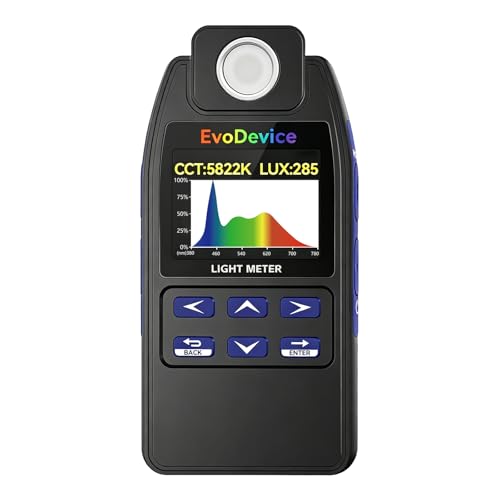
E130 Light Meter – Accurate Lux & Color Temperature (CCT) for Any Light Source, 99-Point Light Mapping, Hold Freeze, Spectrum Mode Accurate for 420/450nm White LEDs
Accurate Lux & CCT for Any Light Source. Measure illuminance (LUX) and color temperature (CCT) accurately across LED,…
As an affiliate, we earn on qualifying purchases.
As an affiliate, we earn on qualifying purchases.