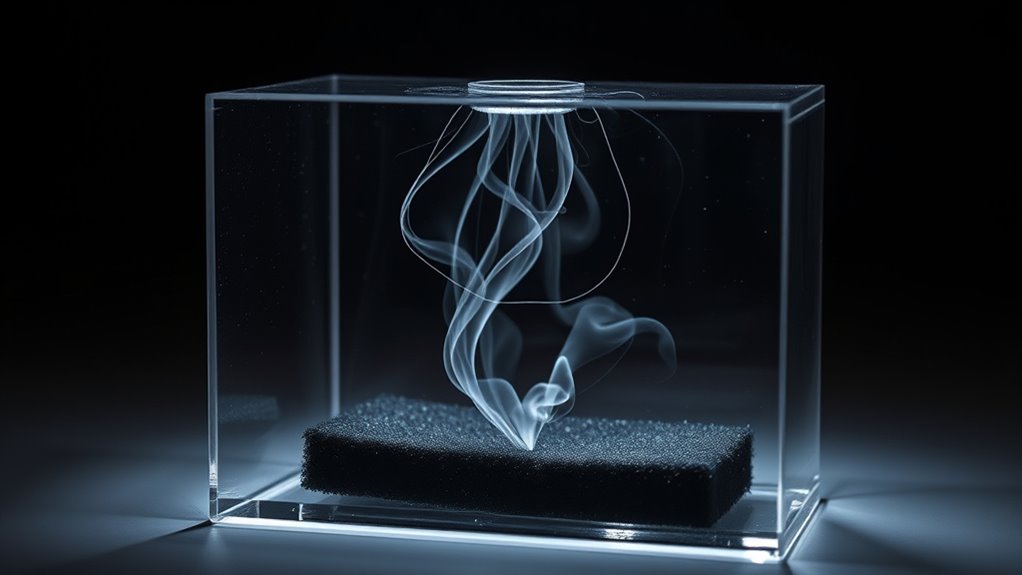

To build a DIY cloud chamber to view cosmic rays, gather a clear airtight container, rubbing alcohol, black construction paper, and a low heat source. Create a temperature gradient by warming one side and keeping the other cool, causing alcohol vapor supersaturation. When particles like cosmic rays pass through, they ionize the vapor, prompting tiny droplets to condense into visible trails. If you keep exploring, you’ll learn more about how environmental factors influence trail visibility and what they reveal about high-energy particles.
Key Takeaways
- Build a sealed container with a temperature gradient using warm and cool sides to create vapor supersaturation.
- Use rubbing alcohol to produce alcohol vapor that condenses on ionized particles, forming visible trails.
- Introduce a radiation source or rely on cosmic rays to ionize vapor particles, making trails visible inside the chamber.
- Enhance visibility by adjusting contrast and using reflective materials to improve trail detection of high-energy particles.
- Observe and record particle trails to study cosmic rays and radioactive decay phenomena directly at home.
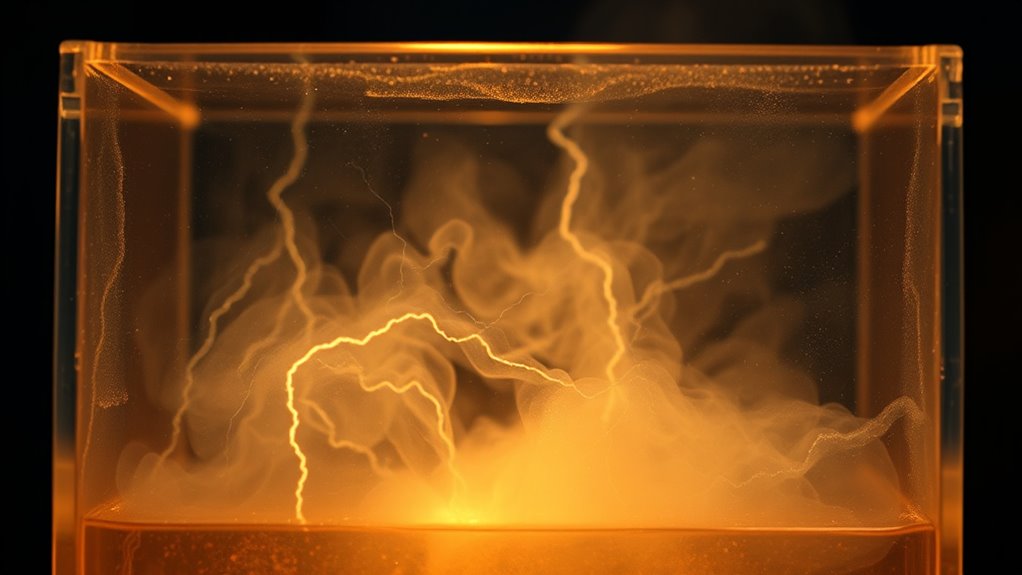
A DIY cloud chamber offers an exciting way to observe cosmic rays and radioactive particles firsthand, all with simple materials you can find at home or in a hardware store. When you set up your chamber, you’re essentially creating a controlled environment where radioactive decay becomes visible in real-time. As radioactive particles pass through the chamber, they ionize the supersaturated alcohol vapor inside, leaving behind visible trails that you can track and analyze. This process turns invisible particles into observable streaks, giving you a direct glimpse into the world of subatomic interactions.
Your first step is to gather the necessary materials: a clear, airtight container like a shallow metal tin or a plastic box, rubbing alcohol (isopropyl alcohol), black construction paper, a source of low heat like a small lamp or a warm water bath, and some optional reflective materials to enhance visibility. Once assembled, you’ll need to create a temperature gradient inside your chamber—warming one side while keeping the other cool. This encourages alcohol vapor to condense on the cooler side, forming a supersaturated environment ideal for particle visualization. When cosmic rays or naturally occurring radioactive decay particles pass through, they ionize the alcohol vapor, creating tiny ions that serve as nucleation points for alcohol droplets to condense upon, rendering the otherwise invisible particles as streaks of vapor.
As you observe, you’ll notice faint, straight lines or short trails crisscrossing the chamber. These are the ionized paths left by high-energy particles from cosmic rays or decay processes. Cosmic rays constantly bombard Earth’s atmosphere, and some of their particles penetrate the chamber, creating visible trails that give you a fascinating window into the universe’s energetic particles. Similarly, naturally radioactive materials in the environment decay over time, releasing particles that your chamber can detect. Recognizing these trails as a product of radioactive decay helps connect the phenomena you see with the fundamental processes happening around you. The longer you observe, the more you’ll notice variations—trails becoming more frequent during certain times or environmental conditions—highlighting the dynamic nature of radioactive decay and cosmic radiation. Additionally, understanding the contrast ratio of your setup can improve the visibility of the trails against the background.
As an affiliate, we earn on qualifying purchases.
Frequently Asked Questions
How Long Does a Homemade Cloud Chamber Typically Last?
Your homemade cloud chamber typically lasts around a few weeks to a month, depending on how well you maintain it. To prolong its lifespan, you should regularly check and replace the alcohol or water levels, clean the chamber to prevent dust buildup, and avoid sudden temperature changes. Proper maintenance frequency, like weekly checks, helps ensure you can enjoy observing cosmic rays for as long as possible.
Can a Cloud Chamber Detect All Types of Cosmic Rays?
You might imagine your cloud chamber as a delicate net, catching fleeting whispers from the universe. While it excels at particle detection, it can’t reveal the entire radiation spectrum or all cosmic ray types. Some high-energy particles pass through unnoticed, like shadows in a dim room. So, your homemade chamber offers a glimpse, but it doesn’t capture every cosmic ray, especially the most elusive or energetic ones.
What Safety Precautions Are Necessary When Building a Cloud Chamber?
When building a cloud chamber, you need to prioritize safety. Always wear safety goggles and gloves to protect your eyes and skin from chemicals. Use radiation shielding, like lead or thick plastic, to minimize exposure to any radiation or radioactive materials involved. guarantee electrical safety by checking all wiring and connections to prevent shocks or fires. Work in a well-ventilated area, and follow all instructions carefully to keep your experiment safe.
How Often Should the Chamber Be Cleaned or Maintained?
Ever wonder how often you should clean or maintain your chamber? You should perform regular chamber cleaning and follow a consistent maintenance schedule, ideally every few weeks or after noticing any buildup or fogging. Keeping your cloud chamber clean ensures clear visibility of cosmic rays. Don’t wait until it’s too dirty; routine maintenance keeps your experiments accurate and your observations sharp. Wouldn’t you want peak results every time?
Are There Any Alternative Methods to Visualize Cosmic Rays?
You can explore alternative methods like using particle detectors or scintillation screens to visualize cosmic rays. Particle detectors, such as Geiger counters, directly detect ionizing radiation, providing clear signals. Scintillation screens emit light when struck by particles, allowing you to visually observe cosmic ray interactions. Both methods offer effective ways to study cosmic rays without building a cloud chamber, making your experiments more versatile and easier to set up.
isopropyl alcohol for experiments
As an affiliate, we earn on qualifying purchases.
As an affiliate, we earn on qualifying purchases.
Conclusion
As you watch the cloud chamber come to life, tiny trails shimmer like stars crossing a night sky, reminding you that cosmic secrets are within reach. Your DIY creation becomes a window to the universe, symbolizing curiosity’s spark that ignites discovery. With each particle you glimpse, you’re not just observing science—you’re witnessing the universe’s dance, echoing the endless voyage of exploration. This chamber isn’t just a device; it’s a gateway to infinite wonder.
As an affiliate, we earn on qualifying purchases.
As an affiliate, we earn on qualifying purchases.