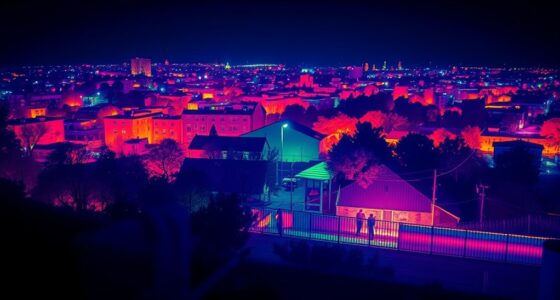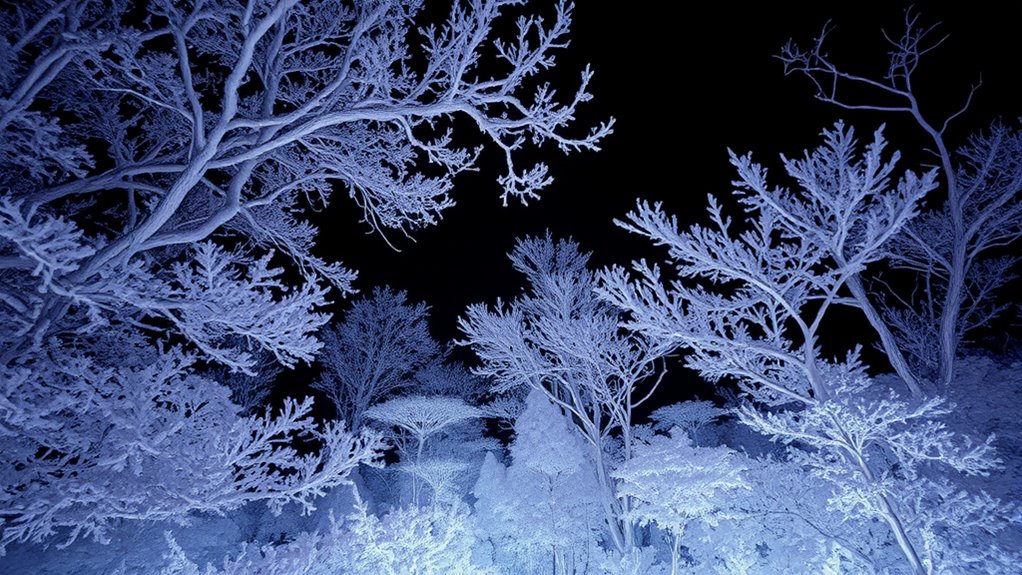

Infrared photography takes you beyond what your eyes can see by capturing light invisible to humans. It uses special filters or sensors to reveal hidden colors, textures, and details in natural and urban scenes, giving landscapes a surreal glow and skies otherworldly hues. This technique was originally created for scientific purposes but now inspires artists and explorers alike. To discover how this fascinating view of the world is created and what it reveals, keep exploring further.
Key Takeaways
- Infrared photography captures light beyond human vision, revealing hidden details and surreal colors in landscapes and objects.
- It employs special cameras or filters to detect infrared light, creating dreamlike, otherworldly imagery.
- Originally developed for scientific purposes like plant health and atmospheric studies, now also used for artistic expression.
- Infrared images highlight environmental issues, such as deforestation and urbanization, by exposing unseen layers.
- This technique challenges perception, expanding human understanding of reality and perception through technological innovation.
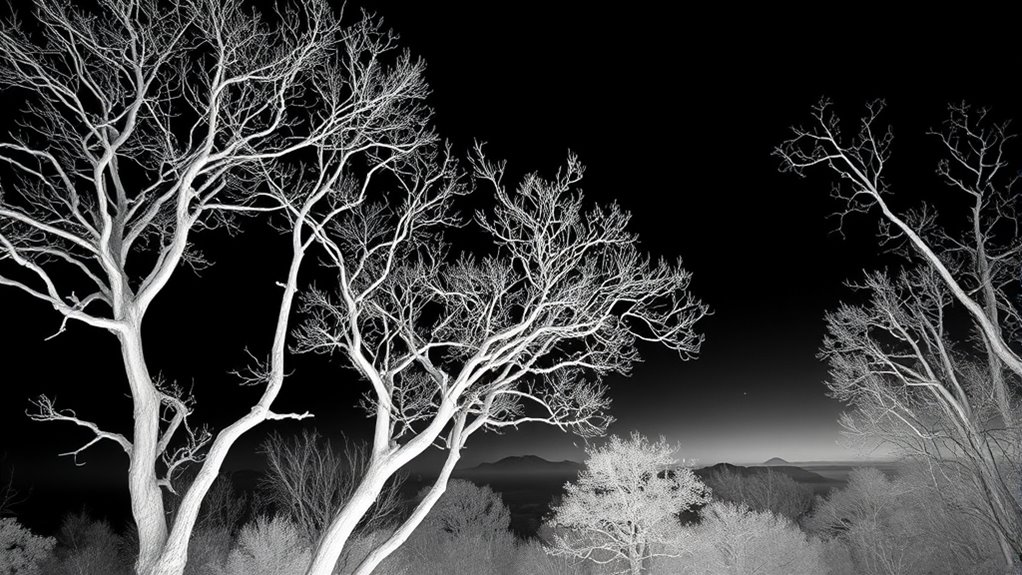
Infrared photography captures the world beyond what the human eye can see by using special cameras or filters to detect infrared light. This technique opens a new perspective, revealing details and colors that are invisible in regular photography. As you explore infrared images, you’ll notice how foliage glows eerily bright, skies turn surreal, and textures become accentuated in ways that challenge your usual perception. But this art form is more than just a visual curiosity; it carries significant cultural implications and has a rich historical development. The unique properties of infrared light also make it invaluable for scientific applications, such as color accuracy in capturing true-to-life images in various conditions. Historically, infrared photography emerged in the early 20th century, initially as a scientific tool rather than a means of artistic expression. Researchers used it to study plant health, atmospheric conditions, and even military applications during wartime. Its ability to penetrate haze and reveal hidden details made it invaluable for environmental monitoring and reconnaissance. Over time, photographers began to experiment with infrared techniques, pushing the boundaries of how we see the world. The development of infrared-sensitive film in the 1930s and 1940s marked a turning point, allowing artists and scientists alike to capture images with distinctive, dreamlike qualities. The cultural implications of infrared photography are profound because it challenges our perception of reality, encouraging viewers to see the world differently and question what is truly visible. It has been used to highlight environmental issues, such as deforestation and urbanization, by exposing the health of vegetation and the extent of human impact. Artists have embraced infrared photography to evoke emotional responses, often creating haunting, otherworldly landscapes that evoke a sense of mystery and introspection.
As you explore infrared photography, you’ll notice its unique ability to reveal unseen layers of reality, which has influenced both scientific understanding and artistic expression. The historical development of this technique shows a trajectory from scientific inquiry to creative exploration, reflecting how technology can expand human perception. The cultural implications are equally significant, as infrared imagery prompts society to reconsider what is visible and what remains hidden, both in nature and in our cultural narratives. Whether used for environmental awareness, artistic projects, or scientific research, infrared photography continues to evolve, offering a compelling lens through which to view our world—one that’s shaped by its history and rich with cultural meaning.
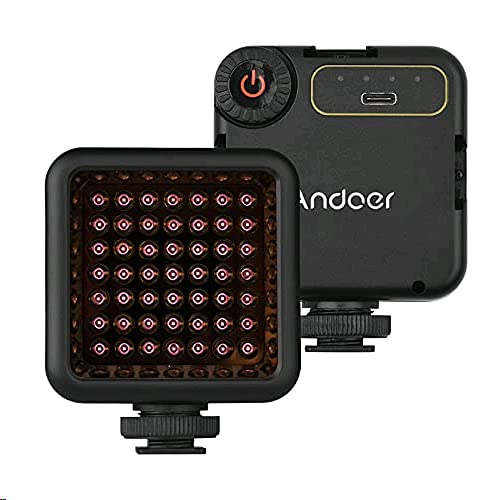
Mini IR Night Vision Light Infrared Photography Light for Video Camera Camcorder Built-in Rechargeable Battery with 3 Cold Shoe Mount for Vlog Video Recording
Versatile Lighting: Ideal for vlogging, video recording, and photography, this compact IR light ensures you're always ready to…
As an affiliate, we earn on qualifying purchases.
As an affiliate, we earn on qualifying purchases.
Frequently Asked Questions
How Do Infrared Filters Affect Image Quality?
Infrared filters impact your image quality by affecting sensor sensitivity and causing potential image distortion. They block visible light, allowing only infrared rays to reach the sensor, which enhances certain details but reduces overall sensitivity to visible colors. This can lead to softer images or unexpected distortions, especially with wide-angle lenses. To get the best results, you need to understand how the filter interacts with your camera’s sensor and adjust your settings accordingly.
Can Infrared Photography Be Done With Smartphone Cameras?
Imagine your smartphone as a magic window, capable of revealing hidden worlds. Yes, you can do infrared photography with your smartphone camera. You just need compatible hardware or an infrared filter, and there are plenty of infrared app options to help you capture these unseen images. Keep in mind, some phones are more suited for this than others, so check your device’s compatibility first.
What Are the Best Subjects for Infrared Photography?
You should focus on subjects like plant life and architectural features for infrared photography. Plants appear vibrant and detailed, highlighting healthy foliage, while buildings and structures take on surreal, glowing qualities. These subjects respond well to infrared light, creating striking images. Keep your camera steady and experiment with different angles to capture the best contrasts and textures. Infrared photography transforms everyday scenes into mesmerizing, otherworldly visuals.
How Do You Process Infrared Images Digitally?
To process infrared images digitally, start with digital infrared conversion by adjusting the color channels in photo editing software, enhancing contrast, and fine-tuning brightness. Use infrared image editing techniques like false-color or monochrome conversions to bring out details. You can also apply noise reduction and sharpening to improve clarity. Experiment with these steps to achieve your desired infrared look, making your images stand out creatively.
Is Infrared Photography Harmful to the Camera Sensor?
Infrared photography isn’t inherently harmful to your camera sensor if you use proper filters and techniques. However, prolonged exposure to infrared light can potentially cause sensor damage over time, affecting your camera’s longevity. To avoid this, always use high-quality infrared filters, limit exposure durations, and make sure your camera is designed or modified for infrared shooting. This helps preserve your gear and keeps your images sharp.

GREEN.L 43mm Infrared Filter, 43mm IR 720nm (R72) Filter for Camera Lens
【Infrared Filter】These filters are ideal for creating special affects or for changing the lighting in photography, and also…
As an affiliate, we earn on qualifying purchases.
As an affiliate, we earn on qualifying purchases.
Conclusion
So, step into the stunning spectrum of infrared, where light’s hidden hues hold haunting beauty and hidden worlds. With wonder and wit, you’ll wield your camera to reveal radiant reds and mysterious magentas, turning the mundane into mesmerizing masterpieces. Embrace the extraordinary, explore the ethereal, and elevate your photography beyond the visible. Infrared invites imagination, ignites inspiration, and transforms your view—making every shot a stunning story of spectral splendor.

ORDRO LN-3 Studio IRLight LED Light USB Rechargeable Infrared Night Vision Infrared Illuminator Replacement Compatible with DSLR Camera Photography Lighting Accessory
20 infrared light beads, adjustable brightness, uniform light brightness, can clearly capture objects even in low light environments,…
As an affiliate, we earn on qualifying purchases.
As an affiliate, we earn on qualifying purchases.

Ktsxxops 35mm Color Print Film Professional Wide Exposure Range ECN 2 Process Colour Print Camera Film for 135 Camera, 8 Sheet, 200-250, 1.9 x 1.1 in
Superior Performance: 35mm color print film offers fine grainedness, wide exposure range, high definition, and high resolution.
As an affiliate, we earn on qualifying purchases.
As an affiliate, we earn on qualifying purchases.