
MacAdam ellipses show the regions in color space where your eyes barely notice a difference. They reveal how your ability to discriminate colors varies across different hues and brightness levels. These ellipses are shaped based on how sensitive your visual system is to specific color changes. When color differences fall inside an ellipse, you see them as almost identical; outside, you notice a difference. Keep exploring to understand how these concepts reveal the limits of your color perception.

Get the latest gadgets delivered free with Prime
- Fast, free delivery on millions of items
- Prime Video, Amazon Music and more included
- Member-only deals all year
Key Takeaways
- MacAdam ellipses represent regions in color space where color differences are barely perceptible to the human eye.
- Their shape and size reflect the non-uniform sensitivity of the human visual system across the spectrum.
- Crossing an ellipse boundary indicates a detectable color difference, aiding in understanding color discrimination limits.
- These ellipses are used in industry to optimize color matching and ensure color consistency in manufacturing.
- Visual perception models incorporate MacAdam ellipses to predict how humans perceive subtle color variations.
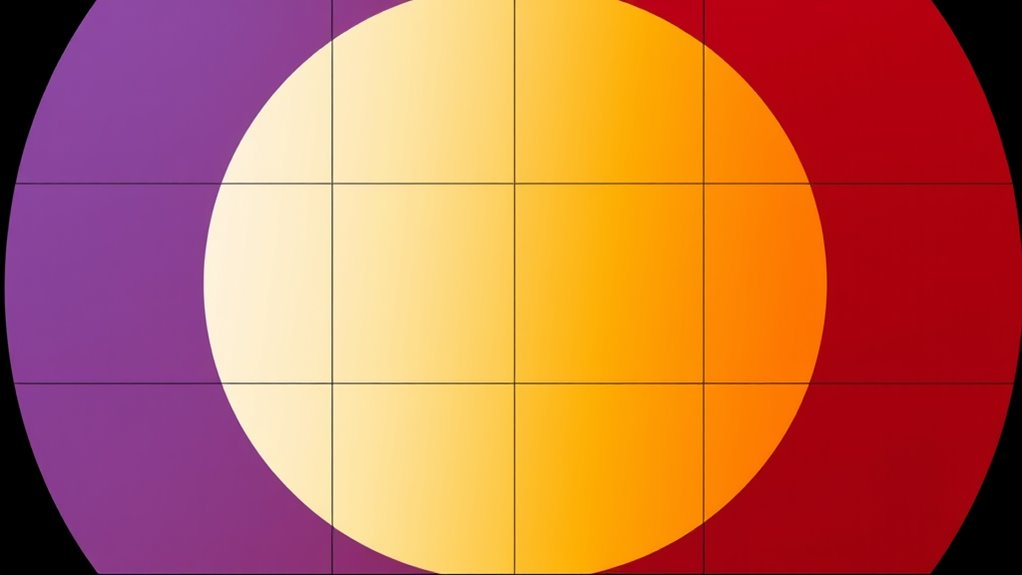
Have you ever wondered why some color differences seem obvious while others are nearly indistinguishable? It all comes down to how our eyes and brains interpret subtle variations in hue, saturation, and brightness. To understand this, scientists have developed tools like color vision tests and visual perception models that help quantify the limits of human color discrimination. One of the most significant concepts in this area is the MacAdam ellipse, which visually represents how sensitive your eyes are to differences in color. When you look at a color space diagram, these ellipses show the regions within which color differences are barely noticeable to the average observer.
Color vision tests are designed to assess your ability to distinguish between similar shades, often by presenting a series of carefully calibrated colors. These tests reveal the thresholds of your color discrimination and help identify color deficiencies, such as color blindness. The results align with visual perception models that explain how your visual system processes color information. These models suggest that your eyes do not perceive color changes uniformly across the spectrum; instead, some regions are more sensitive than others. For example, small shifts in color within certain areas of the spectrum are detectable, while in others, even larger differences go unnoticed. That’s where MacAdam ellipses come into play—they map out the zones of indistinguishability in the color space, illustrating the degree of perceptual similarity between nearby colors.
Color vision tests identify color deficiencies and reveal how our eyes perceive subtle color differences across the spectrum.
These ellipses are not perfect circles; they are elongated and shaped according to the sensitivity of your visual system in different parts of the spectrum. When you compare colors that fall within a single MacAdam ellipse, your eyes won’t detect a significant difference, but crossing the boundary into another ellipse usually results in a noticeable change. By understanding these regions, manufacturers can create displays and lighting that optimize color consistency and accuracy. Visual perception models incorporate data from color vision tests and MacAdam ellipses to predict how people perceive color differences in real-world scenarios. This understanding is essential in industries like printing, photography, and design, where precise color matching matters. Additionally, advances in visual perception modeling continue to improve our ability to simulate and understand human color discrimination more accurately.
Ultimately, your ability to discriminate colors depends on the complex interplay between the physical properties of light and your visual system’s sensitivity. MacAdam ellipses serve as a practical tool to visualize this relationship, illustrating why some colors look distinct while others seem almost identical. They remind us that color perception isn’t just about the wavelength of light but also about how our eyes and brains interpret subtle differences in that light.
As an affiliate, we earn on qualifying purchases.
Frequently Asked Questions
How Do Macadam Ellipses Vary With Different Lighting Conditions?
Under different lighting conditions, MacAdam ellipses vary because ambient lighting and observer adaptation influence your color discrimination. In bright light, ellipses are smaller, meaning you can distinguish subtle color differences. In dim or changing light, they expand, reducing your sensitivity. Your eyes adapt to ambient lighting, which shifts your perception. So, as lighting changes, the size of MacAdam ellipses adjusts, affecting how precisely you can tell colors apart.
Can Macadam Ellipses Be Applied to Digital Display Calibration?
Yes, MacAdam ellipses can be applied to digital display calibration, making your color matching more precise. By understanding the human eye’s sensitivity to color differences within these ellipses, you can fine-tune your display settings to guarantee accurate color reproduction. This technique helps you achieve consistent, high-quality visuals, especially important for professional work like photography or graphic design. Trusting this method elevates your display calibration to match human perception more closely.
What Is the Historical Development of the Macadam Ellipse Concept?
You can trace the historical evolution of the MacAdam ellipse back to the early 20th century when David MacAdam developed it to quantify human color discrimination. Its foundational principles involve mapping how humans perceive color differences within a visual field, highlighting the variability in sensitivity. Over time, researchers refined these concepts, leading to a better understanding of color perception and influencing color science and display calibration methods today.
How Do Individual Differences Affect Color Discrimination Within Ellipses?
Your individual differences, like genetic variability, influence how precisely you can discriminate colors within an ellipse. Some people naturally have sharper color perception, while others might need perceptual training to improve. This variability affects your ability to distinguish subtle color differences, making the ellipse a useful tool but not a perfect measure for everyone. With practice and training, you can enhance your color discrimination abilities, reducing the impact of genetic differences.
Are There Technological Advances Improving the Precision of Macadam Ellipses?
Imagine you’re using a modern smartphone with enhanced color vision features—technological improvements have markedly boosted the precision of MacAdam ellipses. These advances incorporate high-resolution sensors and sophisticated algorithms, allowing for more accurate color discrimination. As a result, you can perceive subtle differences in hues better than ever before. Today’s tech pushes the boundaries of color perception, making it possible for you to distinguish even the tiniest variations within the ellipses.
MacAdam ellipse color discrimination tools
As an affiliate, we earn on qualifying purchases.
As an affiliate, we earn on qualifying purchases.
Conclusion
So, next time you marvel at a vibrant color, remember it’s all about tiny differences you can’t see. Thanks to MacAdam ellipses, what seems perfectly distinct might just be a whisper away from sameness. Ironically, your eye’s incredible sensitivity is both a gift and a illusion—making you believe you see a world full of vibrant variety, when really, it’s often just a subtle shade of the same. Enjoy the illusion, color enthusiast!
color perception training materials
As an affiliate, we earn on qualifying purchases.
As an affiliate, we earn on qualifying purchases.
As an affiliate, we earn on qualifying purchases.
Halloween Picks
halloween
As an affiliate, we earn on qualifying purchases.