The Color Rendering Index (CRI) measures how accurately a light source displays colors compared to natural light, but it’s limited to a small color sample and may not reflect true color perception. TM-30 offers a more detailed view by evaluating a broader range of colors and providing two metrics—Fidelity (Rf) for accuracy and Gamut (Rg) for vibrancy. Exploring these differences further reveals which metric best suits your needs for precise color evaluation.
Key Takeaways
- The CRI offers a simple score indicating overall color fidelity, but it covers only a limited set of colors.
- TM‑30 provides a more comprehensive evaluation by analyzing a broader range of colors and offering metrics like Rf and Rg.
- While CRI focuses on color accuracy, TM‑30 assesses both fidelity and vibrancy, giving a fuller picture of a light source’s color rendering.
- Spectral power distribution data enhances understanding of how lighting covers the entire spectrum, complementing CRI and TM‑30.
- Using both metrics helps ensure accurate, natural color perception in critical applications like art, medical, and retail environments.
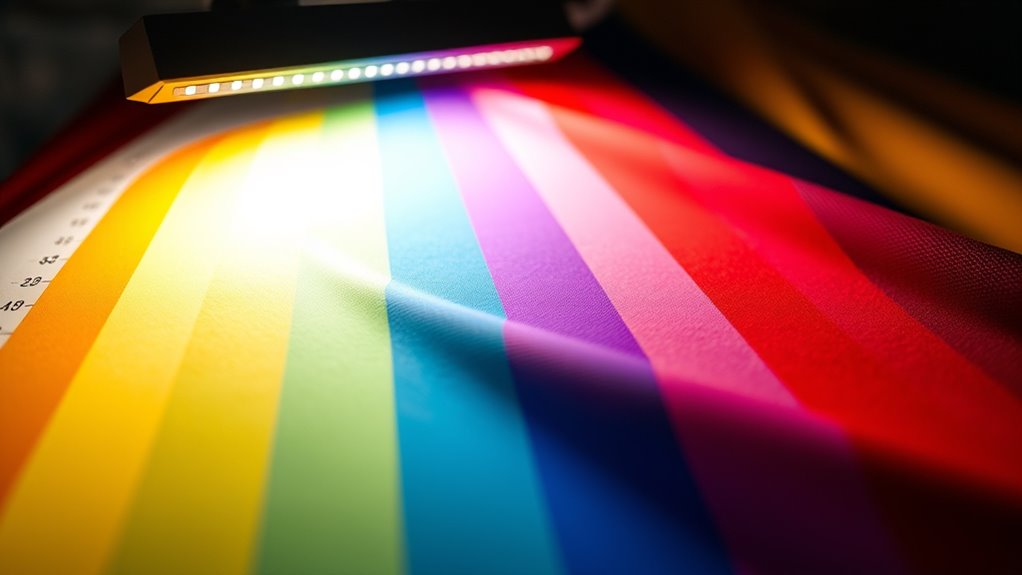
Understanding how light sources reveal colors accurately is essential for many applications, which is why metrics like the Color Rendering Index (CRI) and TM‑30 are so important. When you evaluate lighting, you’re not just concerned with brightness—you need to understand how well the light displays the true colors of objects. This is where color accuracy becomes critical. Good color accuracy ensures that the colors you see under a light source match how they appear in natural daylight or other reference conditions. Poor color rendering can distort hues, making objects look unnatural or misleading your perception of their true appearance. Whether you’re working in retail, photography, art, or medical settings, accurate color perception is vital for making correct judgments.
Accurate color perception under lighting is vital across retail, art, photography, and medical fields.
CRI has been a standard measure for decades, providing a simple numerical score from 0 to 100 that indicates how faithfully a light source reproduces colors compared to a reference light. A higher CRI score means better color rendering, allowing you to see the true hues of clothing, food, artwork, or skin tones. However, CRI has limitations because it mainly considers a small set of colors and doesn’t fully capture how a light source affects the entire color spectrum. This can lead to situations where a light source has a high CRI but still doesn’t render certain colors accurately, which impacts your visual perception in subtle but significant ways.
TM‑30 was introduced to address these shortcomings. It offers a more detailed analysis by evaluating a broader range of colors and providing two key metrics: the Fidelity Index (Rf) and the Gamut Index (Rg). Rf measures how accurately colors are rendered, while Rg assesses the overall vividness or saturation of colors. This dual approach gives you a clearer picture of how a light source will influence your visual perception of different objects. TM‑30 helps you understand not just whether colors are generally accurate but also how they might appear more vibrant or dull under specific lighting. Such insights are especially valuable in environments where color discrimination is critical, like art galleries or medical facilities.
In essence, these metrics help you choose lighting that enhances color accuracy and improves your visual perception. When you understand the differences between CRI and TM‑30, you can better assess how a light source will perform in real-world settings. High-quality lighting isn’t just about brightness; it’s about ensuring colors look natural and true to life, so you can make informed decisions and appreciate the full richness of your environment. Additionally, advancements like spectral power distribution provide even more precise information about how a light source renders colors across the entire spectrum, further aiding in accurate color evaluation.

DiCUNO ProOE A19 LED Bulb 60W Equivalent, 3000K Warm White, CRI 98, 6-Pack
【Parameters】DiCUNO ProOE warm white 3000k A19 LED bulb gives out high output of 806 lumen , equivalent to…
As an affiliate, we earn on qualifying purchases.
As an affiliate, we earn on qualifying purchases.
Frequently Asked Questions
How Does Tm‑30 Compare to Traditional CRI in Practical Applications?
You’ll find TM-30 offers a more detailed view of color accuracy and visual perception than traditional CRI. It assesses how colors truly appear under different lighting, capturing nuances CRI might miss. With TM-30, you get a thorough understanding of how a light source impacts color fidelity and overall visual experience, making it more practical for applications where precise color rendering and true visual perception are vital.
Can Tm‑30 Be Used for Assessing Color Rendering of All Light Sources?
Think of TM‑30 as a versatile artist’s palette; it can assess the color quality of all light sources. You can use it because it accounts for spectral sensitivity, which influences visual perception. Unlike traditional methods, TM‑30 captures a broader spectrum, making it suitable for various lighting types. So, yes, it helps you evaluate how different lights will influence what you see, regardless of their source.
What Are the Limitations of Tm‑30 in Real-World Lighting Design?
TM‑30 offers detailed color rendering insights but has limitations in real-world lighting design. You might face issues with color consistency across different fixtures, as TM‑30‘s measurements can be complex and may not account for all environmental factors. It’s useful but not foolproof; you’ll need to combine it with other assessments to verify lighting quality. Rely on TM‑30 as a guide, not a definitive solution, for thorough lighting design.
How Do Different Light Sources Impact Tm‑30 Scores?
Imagine a chameleon changing colors—different light sources impact TM-30 scores by altering spectral sensitivity and color fidelity. You’ll see higher scores with full-spectrum LEDs, which mimic natural light, while fluorescents often reduce scores due to uneven spectral output. Variations in spectral sensitivity affect how colors appear, so choosing the right source guarantees accurate color rendering, helping you achieve consistent, vibrant lighting for your space.
Is Tm‑30 Suitable for Evaluating Color Rendering in Specialized Environments?
Yes, TM‑30 is suitable for evaluating color rendering in specialized environments because it provides detailed insights into lighting accuracy. You can rely on TM‑30 to assess how well a light source reproduces colors, which is essential in settings like healthcare, art, or manufacturing. Its thorough metrics help you make informed choices, ensuring ideal visual performance and color fidelity tailored to the specific needs of specialized environments.

sunsy Shine BR30 Full-Spectrum LED, 4000K Neutral, CRI 97, Flicker-Free
AMONG THE HIGHEST COLOR FIDELITY IN THE CATEGORY: CRI Ra 97 (R9 96) with TM-30 Rf 96 means…
As an affiliate, we earn on qualifying purchases.
As an affiliate, we earn on qualifying purchases.
Conclusion
Think of choosing lighting like picking a pair of glasses—you want clarity and true color. When I switched to TM-30, my photos suddenly looked more vibrant, just like upgrading from blurry to crystal-clear vision. The Color Rendering Index and TM-30 help you see the world in its true colors, ensuring your spaces feel genuine and inviting. Embrace these tools, and you’ll never settle for dull or distorted light again—it’s like finally seeing everything in high definition.

NiceVeedi 2-Pack Photography Lighting Kit, 36W Bi-Color Studio Lights 2700-6500K CRI 95+, Dimmable LED Video Light Kit with Remote Control & 72” Tripod Stand, Lighting for Video Recording/Photography
【BI-COLOR LIGHTING WITH POWERFUL OUTPUT】The photography lighting features a high output of 36W which provides powerful but stable…
As an affiliate, we earn on qualifying purchases.
As an affiliate, we earn on qualifying purchases.
CRI and TM-30 lighting comparison
As an affiliate, we earn on qualifying purchases.
As an affiliate, we earn on qualifying purchases.