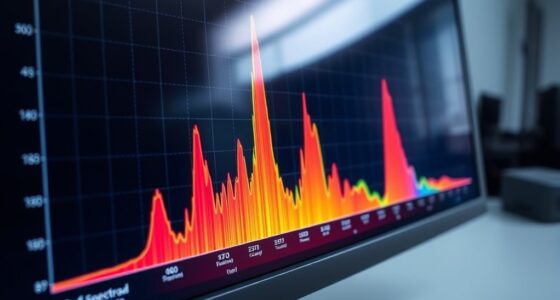
As daylight fades, your eyes adapt to low light, making flowers appear brighter and more vibrant due to the Purkinje Effect. During dusk, your cone cells become less responsive, and rod cells take over, highlighting shades of gray and shifting color perception. Reds and yellows fade, while blues and greens seem more prominent, causing flowers to look more luminous. Curious to learn why your perception changes so noticeably? Keep exploring to uncover more about this fascinating visual phenomenon.
Key Takeaways
- The Purkinje Effect causes reds and yellows to appear duller, while blues and greens become more vivid at dusk.
- As light dims, rod cells take over, enhancing perception of cooler colors and diminishing warm hues.
- Flowers often have blue or green tones that become more prominent in low-light conditions.
- Visual adaptation shifts color sensitivity, making flowers seem brighter and more luminous during twilight.
- The effect helps our eyes detect important features in low-light environments, increasing flower visibility at dusk.

The Purkinje Effect is a phenomenon that explains how our perception of colors shifts as lighting conditions change from bright to dim. When you’re outdoors during the day, your eyes are highly sensitive to bright, vivid colors. As the sun sets and light diminishes, your visual system adapts, and your color perception changes in subtle but noticeable ways. This shift isn’t just about seeing differently; it’s a result of your eyes undergoing visual adaptation, adjusting to the available light to optimize your vision.
In bright conditions, your cone cells dominate, allowing you to perceive colors with high clarity and saturation. These cells are most responsive to the wavelengths of light associated with reds, greens, and blues, making colorful objects appear vibrant. But as the light fades, your rod cells take over. These cells are more sensitive to low light but are less responsive to color, primarily detecting shades of gray. During this passage , your perception of certain colors, especially reds and yellows, diminishes, while others, like blues and greens, become relatively more prominent. This is the core of the Purkinje Effect: the way your color perception shifts during dusk or in dim environments.
This phenomenon explains why flowers, which often look bright and colorful during the day, seem to glow at dusk. Many flowers have hues that are less vibrant in bright sunlight but become striking under lower light conditions. You might notice that a deep red rose appears softer or even darker in the daylight, but at dusk, its color can seem richer or more luminous. This isn’t just a trick of the eye; it’s your visual system adapting to the changing light, enhancing your ability to distinguish essential features in different lighting. The effect influences how you perceive natural beauty, making flowers and other objects appear more vivid or striking as the environment darkens.
Understanding the Purkinje Effect helps you appreciate your eye’s remarkable ability to adapt visually. It’s a natural process that allows you to see as clearly as possible across a range of lighting conditions. As you move from bright daylight into dusk, your visual adaptation shifts your focus and perception, emphasizing different colors and details. This is why flowers seem brighter or more engaging at twilight—their colors are perceived differently due to your eyes adjusting, highlighting the importance of how your visual system interprets the world around you.

Sow Right Seeds – Moonflower Seeds for Planting – Ipomoea alba – Vining Plant – Non-GMO Heirloom – Fast Growing Fragrant Moon Flowers – Easy to Grow Annual Ideal for Gardens, Patios, Fences (1)
Beautiful – Large premium packet of Moonflower (Ipomoea alba) seeds. White, trumpet-shaped blooms create a magical atmosphere for…
As an affiliate, we earn on qualifying purchases.
As an affiliate, we earn on qualifying purchases.
Frequently Asked Questions
Does the Purkinje Effect Influence Human Eye Health?
You might wonder if the Purkinje effect impacts your ocular health or visual acuity. While it influences how your eyes perceive brightness and color at different light levels, it doesn’t harm your eye health. Instead, it helps your eyes adapt to changing lighting conditions, enhancing your visual acuity in low light. So, the effect is a natural part of your eye’s adaptation, not a threat to your ocular health.
Are Certain Flowers Specifically Adapted to Appear Brighter at Dusk?
Imagine flowers glowing like stars in a twilight sky—that’s how some plants appear at dusk. Certain flowers have dusk adaptations that enhance their visibility, making them stand out when light diminishes. These adaptations may include color changes or scent emission, maximizing flower visibility during low-light conditions. By evolving these traits, they attract pollinators efficiently at night, ensuring their survival in a world where light fades.
Can the Purkinje Effect Be Observed in Artificial Lighting?
You can observe the Purkinje effect in artificial lighting because it influences your color perception, especially under low-light conditions. As lighting dims, your eyes become more sensitive to blue and green hues, making certain colors appear brighter or more prominent. So, in dim artificial environments, you’ll notice a shift in how colors are perceived, similar to how flowers look brighter at dusk, demonstrating the Purkinje effect’s impact beyond natural light.
How Does Age Affect the Perception of Color Changes at Dusk?
Ever notice how your favorite sunset suddenly looks less vibrant? That’s age-related vision playing tricks, dulling your color perception at dusk. As you get older, your eyes become less sensitive to subtle color shifts, making flowers look less dazzling. So, don’t blame the sunset—it’s just your aging eyes trying to keep up. Embrace the mellow hues; they’re a sign you’ve earned more sunsets to enjoy.
Are Animals Affected by the Purkinje Effect in Their Environments?
You might wonder if animals experience the Purkinje effect in their environments. Many animals with specialized vision, especially nocturnal adaptations, are affected by this phenomenon. Their animal vision often shifts sensitivity toward blue and green hues at dusk and nighttime, helping them see better in low-light conditions. This adaptation enhances their ability to hunt or avoid predators, demonstrating how the Purkinje effect influences their perception during twilight hours.
bseah Grow Light Plant Lights for Indoor Plants, Full Spectrum Plant Grow Lamp, 10 Dimmable Levels, Auto ON & Off with 3/9/12H Timer
Full Spectrum LED with Yellow and White Combination: Bseah led grow light can promote photosynthesis, germination, growth, flowering…
As an affiliate, we earn on qualifying purchases.
As an affiliate, we earn on qualifying purchases.
Conclusion
So next time you admire a flower at dusk, remember the Purkinje Effect. It’s why those blooms seem brighter and more vibrant as the light fades. Isn’t it amazing how our eyes adapt to reveal beauty in unexpected ways? Nature’s subtle tricks remind us to appreciate the world’s wonders, even in dimmer moments. When you look at flowers at sunset, you’re witnessing more than just a sunset—you’re experiencing a marvel of perception.

TONULAX Solar Garden Lights – Upgraded Outdoor Light, 7-Color Changing Rose Lights for Yard,Garden Decoration, Enlarged Solar Panel, More Realistic Rose Flower (2 Packs)
【Upgraded Version】Equipped with a large solar panel which converts solar energy into power 35% more efficient than previous…
As an affiliate, we earn on qualifying purchases.
As an affiliate, we earn on qualifying purchases.

The City of Forks Welcomes You Wood Sign, Twilight Merch Wall Decor, 12×8 Inches
Twilight-Inspired Decor: Iconic welcome sign from the beloved Twilight saga featuring the City of Forks emblem with mountains,…
As an affiliate, we earn on qualifying purchases.
As an affiliate, we earn on qualifying purchases.