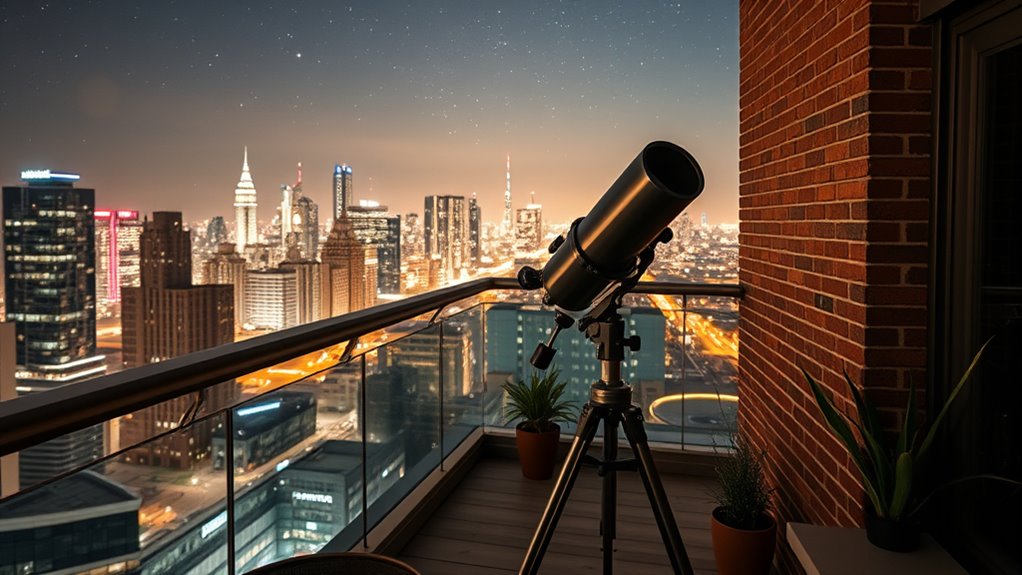

To build a balcony observatory for urban stargazing, start by choosing a spot away from bright lights and shielding your area from urban glow with curtains or shields. Select a lightweight, stable telescope mount suited for your space and guarantee it’s securely set up on sturdy furniture or a tripod. Organize and protect your equipment for outdoor use, and manage power and storage efficiently. If you keep exploring, you’ll discover further tips to create an effective and enjoyable observatory space amid city lights.

Get the latest gadgets delivered free — and shop member deals
- Fast, free delivery on millions of items
- Access to Prime Big Deal Days deals on October 6–7
- Prime Video, Amazon Music and more included
Key Takeaways
- Choose a balcony spot away from streetlights and use light shields to minimize urban light pollution.
- Select a stable, lightweight telescope mount suitable for your telescope size to ensure clear, steady views.
- Optimize space with portable, compact equipment placed on sturdy, vibration-free platforms for easy setup.
- Use outdoor-rated power sources and weatherproof storage to maintain equipment and streamline organization.
- Focus on patience, strategic positioning, and light management to maximize observing opportunities amid urban light challenges.
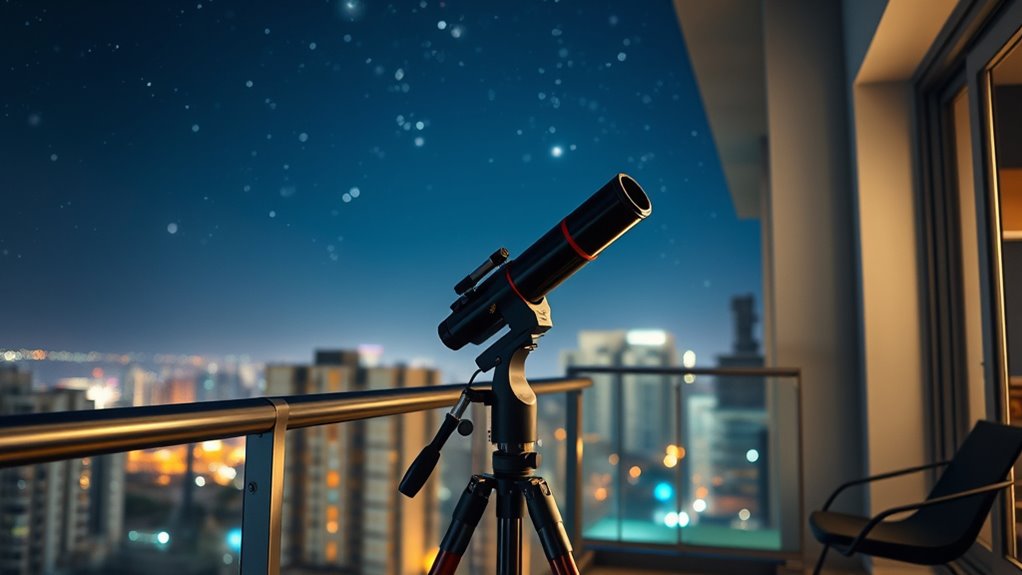
Creating a balcony observatory in an urban environment might seem challenging, but with some careful planning, it’s entirely achievable. One of the biggest obstacles you’ll face is urban light pollution, which can wash out the night sky and obscure your view of celestial objects. To counteract this, you should start by choosing the most suitable spot on your balcony—preferably one away from streetlights, porch lights, or any direct light sources. Using light shields or curtains can help block ambient light, making your observing conditions better. Keep in mind that the less ambient light, the more stars and planets you’ll be able to see through your telescope.
Choose a dark spot on your balcony and block ambient light for better stargazing.
When it comes to telescope mounting, stability is key. A sturdy, vibration-free mount ensures clear images, especially when observing planets or faint deep-sky objects. You’ll want to select a mount that’s appropriate for your telescope’s size and weight, such as a solid alt-azimuth or equatorial mount. If space permits, an equatorial mount can make tracking celestial objects easier, but it requires proper alignment. A good mounting setup not only improves image stability but also reduces frustration, letting you spend more time observing rather than adjusting.
Since balcony space is often limited, consider compact, portable telescopes that are easy to set up and store. A lightweight refractor or a small reflector telescope can provide excellent views without overwhelming your balcony. Make sure your mounting platform is secure—use a sturdy table or a dedicated tripod stand that won’t wobble when you touch the telescope or when wind picks up. Elevating your telescope slightly above the balcony railing can also help minimize vibrations and improve your viewing experience.
Additionally, think about how you’ll access power and storage for your equipment. Using extension cords designed for outdoor use guarantees safety, and keeping your accessories organized in weatherproof containers protects them from the elements. As you plan your balcony observatory, remember that patience is essential. Light pollution can never be completely eliminated in an urban setting, but with the right equipment, strategic positioning, and some light management, you can create a functional and enjoyable space for stargazing right outside your door.
Incorporating data-driven strategies can help you optimize your setup and maximize your viewing success. By focusing on a stable telescope mounting and reducing urban light pollution as much as possible, you’ll maximize your chances of catching stunning views of the night sky.
As an affiliate, we earn on qualifying purchases.
Frequently Asked Questions
What Are the Best Types of Telescopes for Balcony Use?
You’ll want a telescope with portable mounts and compact optics for balcony use. These features make setup easy and help you navigate tight spaces comfortably. A small refractor or Maksutov-Cassegrain model offers clear views without taking up much room. Look for lightweight, sturdy mounts that can handle your telescope’s weight and provide smooth movement. This setup guarantees you can enjoy sharp, detailed views of planets and stars right from your urban balcony.
How Can I Reduce Light Pollution Reflections From Nearby Buildings?
Imagine gazing at the stars, only to be thwarted by urban light pollution and building reflective surfaces that bounce unwanted light your way. To combat this, you can install anti-reflective window coatings or use blackout curtains during observation times. Position your telescope away from reflective surfaces, and consider adding a shield or barrier to block stray light. These steps help you reclaim the night sky and enjoy clearer views amid city glow.
What Safety Measures Are Recommended for Rooftop Observatories?
You should prioritize balcony railing safety by installing sturdy, high-quality railings that comply with local codes to prevent falls. Always secure rooftop access permissions before setting up your observatory to guarantee safety and legal compliance. Use non-slip surfaces and proper lighting to prevent accidents during nighttime stargazing. Regularly inspect your setup for stability, and consider adding safety features like harnesses or barriers for extra protection.
How Do I Stabilize My Telescope on a Balcony?
To stabilize your telescope on a balcony, focus on proper mounting techniques and vibration dampening. Use a sturdy, well-balanced mount to prevent wobbling, ensuring smooth tracking. Add vibration dampening pads or mats underneath the mount to absorb any external vibrations from wind or foot traffic. Securing the mount to a stable surface helps maintain stability, so your observations remain clear and steady, even in an urban environment.
What Are Affordable Options for Balcony Observatory Setups?
You might think creating a balcony observatory costs a lot, but affordable options exist. You can build DIY mounts using inexpensive materials like PVC pipes or repurposed furniture, providing stability without breaking the bank. Adding budget lighting helps you see your equipment clearly without extra expense. This way, you enjoy stargazing comfortably and affordably, making the most of limited space while enhancing your experience with simple, cost-effective solutions.
As an affiliate, we earn on qualifying purchases.
Conclusion
Now, with your balcony as a tiny spaceship, you can reach out beyond the city’s glow and touch the stars. Each night becomes a voyage through a galaxy of wonder, where your observatory acts as your personal telescope to the universe. Just like a captain charting constellations from a small deck, you hold the universe in your hands, turning your urban rooftop into a portal for endless celestial adventures.
As an affiliate, we earn on qualifying purchases.
As an affiliate, we earn on qualifying purchases.
Evergreen bestsellers Picks
bestsellers
As an affiliate, we earn on qualifying purchases.