If your star shapes are elongated or streaked outward, it’s likely coma, caused by improper optical alignment that makes stars look stretched at the edges. If stars near the edges are blurry or out of focus while the center remains sharp, you’re probably dealing with field curvature, where the edges fall out of the focal plane. Spotting these differences helps you diagnose the problem quickly—keep exploring to learn how to fix and prevent these issues effectively.
Key Takeaways
- Coma causes outward, asymmetrical star elongation, especially at edges, while field curvature results in uniform bow-shaped focus issues.
- Examine star shapes across the frame; elongated stars indicate coma, whereas uniformly blurry edges suggest field curvature.
- Coma produces streaks or flares near edges, whereas field curvature keeps stars round but out of focus at the edges.
- Proper optical alignment and calibration help distinguish and correct coma and field curvature effects.
- Use test images to analyze star shapes and focus uniformity for quick diagnosis of optical aberrations.

Astromania Laser Collimator for Newtonian Dobsonian Marca Telescopes, Telescope Alignment 1.25 Inch with 7 Red Laser Bright Levels, Great Telescope Accessories Laser Alignment Tool for Collimation
Multi-Function: Designed for Reflector telescope; fit for standard 1.25 inch diameter; this sturdy laser unit allows to swiftly…
As an affiliate, we earn on qualifying purchases.
As an affiliate, we earn on qualifying purchases.
What Causes Coma and How It Affects Star Shapes
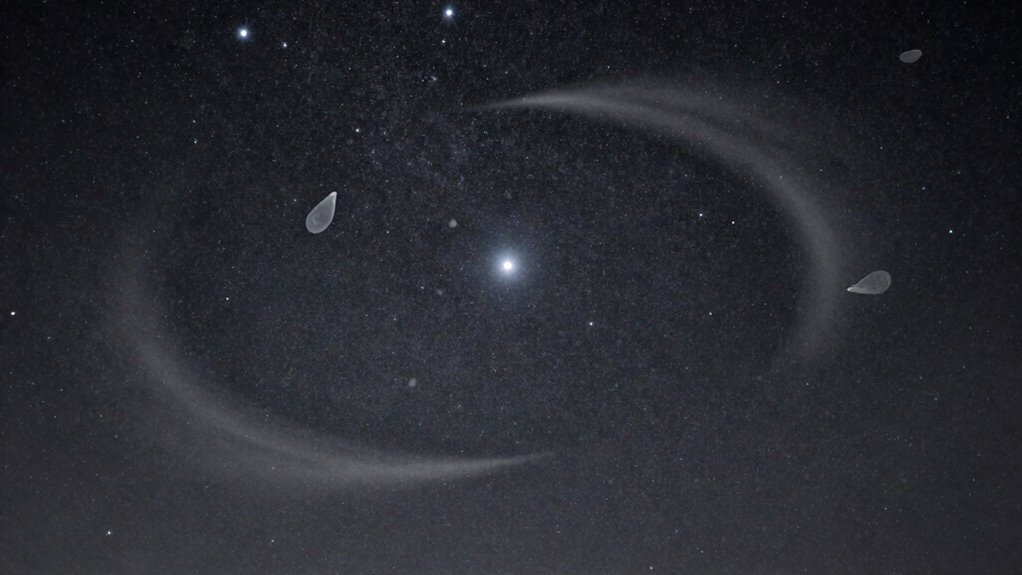
Coma occurs when light from a star doesn’t focus to a single point on your camera sensor or eyepiece but instead spreads out into a comet-like shape. This optical aberration happens because your telescope’s optics aren’t properly aligned or optimized. When your telescope isn’t correctly aligned, light rays entering the lens or mirror don’t converge accurately, causing coma. This results in star images that appear elongated or distorted, especially at the edges of your field of view. To fix this, you need to carefully adjust your telescope’s alignment, ensuring the optics are precisely calibrated. Proper alignment minimizes optical aberrations, helping stars stay sharp and point-like across the entire field, reducing coma’s distracting effects. Understanding high refresh rates in telescope design can also enhance your overall imaging experience. Additionally, investing in premium optical equipment can significantly improve the quality of your observations, much like how LPGA achievements have elevated the profile of women in sports.

ANGSO-AUTO ADAS Calibration Tool Kit Compatible with Honda Toyota Kia Ford ADAS Radar Aiming Calibration Tool,Post with 0-30 Centimeter Scale,Corner Reflector Target with Billet Aluminum Stand
Universal Compatibility: Fit for Honda, Toyota, Kia, and Ford vehicles,Whether you're a professional mechanic or a DIY enthusiast,…
As an affiliate, we earn on qualifying purchases.
As an affiliate, we earn on qualifying purchases.
How Field Curvature Makes Edges Look Out of Focus
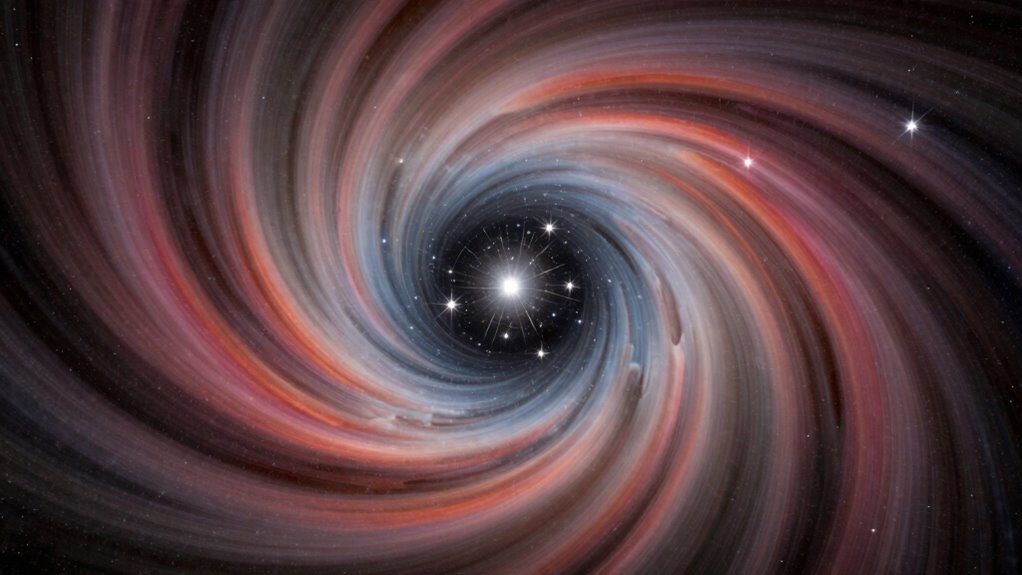
While proper alignment can reduce coma and sharpen star images across your field, field curvature presents a different challenge. It causes the edges of your images to appear out of focus, even when the center is sharp. This happens because the lens bends light differently across the field, making parts of the image fall on different focal planes. To minimize this, start with precise lens alignment; verify your optics are correctly positioned. Sensor calibration is equally vital—properly aligning your camera sensor guarantees the entire field is focused uniformly. Without these adjustments, stars at the edges might look blurry or distorted, giving the illusion of focus issues. Recognizing this effect helps you troubleshoot and fine-tune your setup for sharper, more consistent star images throughout the frame.

Telescope 70mm Aperture 500mm – for Kids & Adults Astronomical Refracting Telescopes AZ Mount Fully Multi-Coated Optics, with Diagonal Mirror Phone Adapter, Carrying Bag, Wireless Remote Black
High-Quality Optics: The astronomical telescope features 500mm(f/7.1) focal length and 70mm aperture, provides stunning views and protects your…
As an affiliate, we earn on qualifying purchases.
As an affiliate, we earn on qualifying purchases.
How to Spot Coma vs. Field Curvature in Your Images

To effectively distinguish between coma and field curvature in your images, start by examining the shape and distribution of the blur at the edges. If you notice star elongation that points outward from the center, it’s likely coma, especially if the blur varies with different star positions. Coma causes stars near the edge to appear as streaks or flares, often with asymmetrical shapes. On the other hand, field curvature produces a more uniform, bow-shaped distortion where stars at the edges are slightly out of focus but retain their round shape. Pay attention to how the star shapes change across the focal plane. With coma, star elongation varies depending on the position, while field curvature causes a consistent curvature pattern, affecting the focus across the entire field.

MB Star Diagnostic Tool C4 Plus DOIP Function Diagnostic Tool 2025 Xentry+DAS+EPC Software for MB Car Scanner with Laptop (C4 w Laptop (CF53)+2025 Xentry+DAS+EPC)
🔧 【MB SD C4 DoIP 】The new SDconnect C4 is capable of being used for DoIP. it is…
As an affiliate, we earn on qualifying purchases.
As an affiliate, we earn on qualifying purchases.
Easy Ways to Diagnose and Fix Optical Issues
Diagnosing optical issues can be straightforward if you know what signs to look for and how to interpret them. Start by checking your optical alignment; misaligned optics often cause star shapes that are elongated or distorted. Regular sensor calibration ensures your camera captures accurate images without color shifts or uneven exposure. To troubleshoot, compare test images and look for consistent patterns of distortion. Additionally, understanding astrological compatibility can enhance your confidence when discussing your findings with others.
| Issue | Fixing Method |
|---|---|
| Star elongation | Re-align optics carefully |
| Color shifts | Calibrate sensor regularly |
| Field curvature | Adjust focus and tilt |
| Weird star shapes | Verify optical alignment and sensor calibration |
Preventing Coma and Field Curvature in Your Astrophotos

Preventing coma and field curvature starts with understanding how your optical setup influences image quality. Proper camera calibration is essential; make sure your camera is well-aligned and focused before capturing images. Use flat-field calibration frames to correct for optical distortions during post-processing. Additionally, image stacking helps minimize residual aberrations and improve overall sharpness, especially in wide-field astrophotos. Select optical components designed to reduce coma and curvature, like coma correctors or field flatteners, for better results. Regularly check and adjust your telescope’s collimation and focus to maintain optimal performance. By combining precise camera calibration with thoughtful image stacking techniques, you can notably reduce the appearance of star distortions, achieving clearer, more accurate astrophotos with minimal optical issues.
Frequently Asked Questions
Can Coma or Field Curvature Be Completely Eliminated With Current Technology?
Coma and field curvature can’t be completely eliminated with current technology, but you can minimize their effects. Using high-quality lens coatings reduces unwanted reflections and distortion, improving image quality. Adaptive optics, often used in telescopes, corrects for these aberrations in real-time, enhancing sharpness and star shape accuracy. While perfection remains elusive, combining advanced coatings and adaptive optics gets you close, delivering clearer, more accurate images than ever before.
How Do Temperature Changes Influence Optical Aberrations in Telescopes?
Temperature changes cause optical aberrations in telescopes by inducing thermal expansion, which can alter the shape of lenses and mirrors. This leads to distortions like blurred or shifted star images. To combat this, you can use lens coatings that manage heat and reduce thermal effects. Maintaining a stable temperature environment for your telescope helps keep optical performance consistent, minimizing aberrations caused by temperature fluctuations.
Are Certain Star Shapes More Common in Specific Types of Telescopes?
Think of optical design like a painter choosing brushes; each creates different star shapes. You’ll find that refractors often produce crisp, point-like stars, while reflector telescopes sometimes show comatic or elongated shapes. Schmidt-Cassegrain designs can cause field curvature, leading to distorted star shapes at the edges. So, your telescope’s optical design directly influences the star shape you see, making some shapes more common in specific types of telescopes.
What Post-Processing Techniques Can Reduce Star Shape Distortions?
You can achieve star shape correction through post-processing by using image stacking techniques. First, align and combine multiple exposures to reduce distortions caused by coma or field curvature. Then, apply software filters that specifically target star shape issues, smoothing out irregularities. This approach improves the overall star sharpness and symmetry, making your images clearer and more accurate, especially when dealing with challenging distortions in astrophotography.
How Does the Focal Length Impact the Severity of Coma and Field Curvature?
Coincidence reveals that longer focal lengths tend to amplify aberrations like coma and field curvature due to their lens design. When you choose a lens with a shorter focal length, you often reduce these distortions, resulting in sharper stars across the frame. As focal length increases, these issues become more pronounced, making it essential to select optics thoughtfully based on your imaging needs to minimize star shape distortions.
Conclusion
Think of your telescope as a skilled artist’s brush—when it’s perfectly calibrated, stars look sharp and vibrant. I once struggled with weird star shapes until I realized it was like trying to paint with a shaky hand—coma and field curvature distort your masterpiece. By understanding these issues, you can fine-tune your setup, transforming those crooked stars into crisp, beautiful points. With practice, your astrophotos will shine as brightly as the stars themselves.