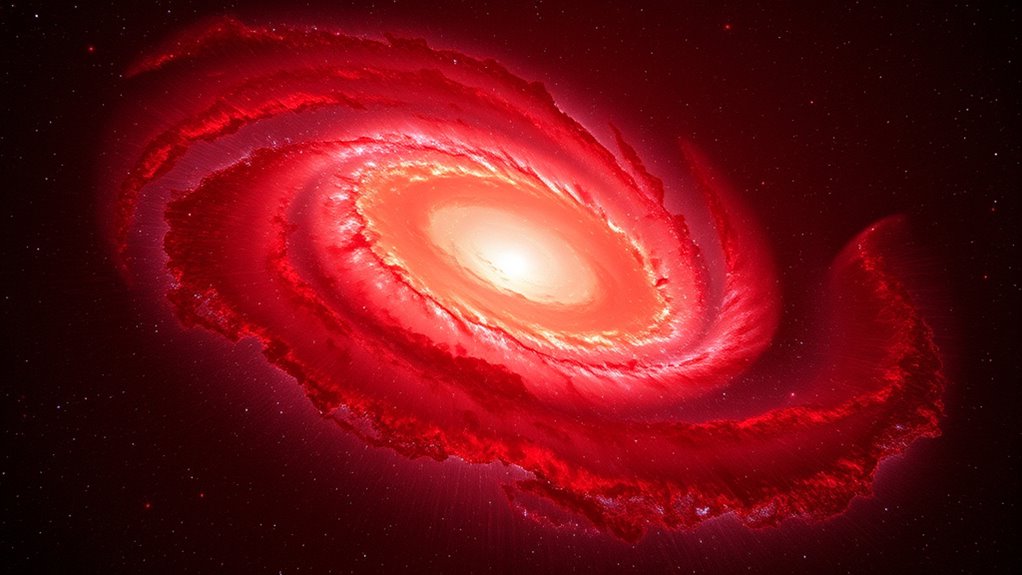

Infrared astronomy helps you discover the universe’s hidden secrets by revealing objects concealed behind thick clouds of cosmic dust and gas. Unlike visible light, infrared waves penetrate these barriers, exposing star-forming regions, dense molecular clouds, and newborn stars that are otherwise hidden. This technique also maps dust distribution and uncovers structures in galaxies and nebulae. By exploring these hidden regions, you’ll gain a deeper understanding of cosmic birthplaces and the universe’s early stages, and there’s much more to uncover if you keep exploring.
Key Takeaways
- Infrared astronomy detects dust-enshrouded objects and regions invisible in visible light, unveiling hidden structures in the universe.
- It reveals star-forming nurseries within dense molecular clouds, providing insights into stellar birth processes.
- Infrared waves penetrate cosmic dust, exposing phenomena like protostars, nebulae, and early galaxy formations otherwise hidden from optical telescopes.
- Advancements in infrared detectors enhance sensitivity, allowing observation of faint, distant objects and early universe evolution.
- Infrared observations deepen understanding of cosmic dust’s role in star formation and galaxy development, uncovering the universe’s secretive processes.
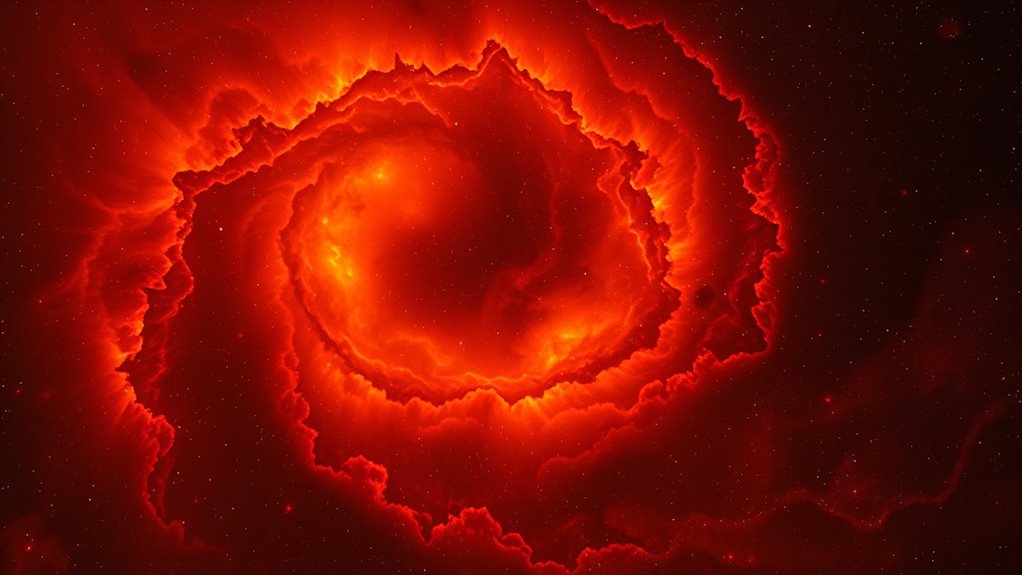
Have you ever wondered what the universe looks like beyond the visible spectrum? Infrared astronomy gives you a glimpse into those hidden worlds, revealing phenomena that are otherwise concealed in plain sight. Unlike visible light, infrared waves penetrate cosmic dust and gas clouds, allowing you to explore regions of space that are completely obscured to the naked eye. This ability transforms your understanding of how stars form and evolve, offering insights into the earliest stages of star formation. When stars are born in dense molecular clouds, thick layers of cosmic dust often block visible light, making these regions seem dark and silent. But infrared telescopes, whether on Earth or in space, can see through this dust, uncovering the glowing nurseries where new stars ignite. You can witness the process of stellar birth in real-time, observing how clouds of gas and dust collapse under gravity, heating up and eventually igniting nuclear fusion. This process is fundamental to understanding the life cycle of stars, and infrared astronomy lets you witness it firsthand. Furthermore, advancements in detector sensitivity and resolution continue to expand our ability to explore these hidden regions in greater detail.
Cosmic dust plays an essential role in this process. While it may seem insignificant, this dust acts as both a barrier and a catalyst. It absorbs and scatters visible light, making many celestial objects invisible to traditional telescopes, but it emits infrared radiation when heated by nearby stars or energy sources. By detecting this infrared emission, you can map out the distribution of cosmic dust across galaxies, revealing structures and processes hidden from optical telescopes. This dust isn’t just a nuisance; it’s a key component of star formation, providing the raw materials from which stars and planets eventually emerge. Infrared observations help you understand how dust interacts with radiation, how it cools and clumps together, and how these processes lead to the formation of stellar systems. These insights are essential for building a complete picture of the universe’s evolution. The ability of infrared astronomy to detect faint emissions from distant objects allows scientists to explore the earliest epochs of galaxy formation and evolution.
Infrared astronomy also exposes you to phenomena like protostars—embryonic stars still cloaked in their natal dust clouds—and reveals complex structures within nebulae and galaxies. It uncovers regions where new worlds are taking shape, areas so dense and dusty that visible light cannot penetrate. As you explore these hidden universes, you realize that what you see in the infrared is often just the beginning; many mysteries remain buried beneath thick layers of cosmic dust, waiting to be uncovered through this powerful window into the universe. With infrared technology, you’re not just observing the cosmos—you’re uncovering its most secretive and fascinating processes, deepening your understanding of how the universe continually creates and transforms itself.

Telescope, 90mm Aperture 900mm Astronomical Refractor Telescope for Adults High Powered – Multi-Coated Professional Telescopes for Astronomy Beginners with AZ Mount, Portable Carry Bag, Phone Adapter
High Powered Astronomical Telescope: Hawkko telescope for adults and beginners offers 36X to 270X powerful magnification with a…
As an affiliate, we earn on qualifying purchases.
As an affiliate, we earn on qualifying purchases.
Frequently Asked Questions
How Do Infrared Telescopes Withstand Extreme Temperatures in Space?
You guarantee infrared telescopes withstand extreme space temperatures by using advanced thermal insulation that minimizes heat transfer. Additionally, you rely on sophisticated cooling systems, like cryogenic coolers, to keep the instruments at ultra-low temperatures necessary for sensitive infrared observations. These combined methods protect the equipment from the harsh environment, allowing the telescope to operate efficiently and accurately detect faint infrared signals from distant cosmic objects.
Can Infrared Astronomy Detect Dark Matter?
Yes, infrared astronomy can assist in dark matter detection by analyzing infrared signatures. You might not see dark matter directly, but you can observe its effects on surrounding objects, like galaxy clusters. When dark matter interacts gravitationally, it influences the infrared emissions from nearby gas and dust, revealing its presence indirectly. By studying these infrared signatures, you gain insights into dark matter’s distribution and properties in the universe.
What Are the Limitations of Infrared Observations From Earth?
Your infrared observations from Earth are limited mainly by atmospheric interference, which absorbs and scatters infrared signals, making it hard to get clear data. Additionally, sensor sensitivity plays a vital role; if your instruments aren’t sensitive enough, faint signals get missed. These factors restrict what you can observe and often require you to use space telescopes or high-altitude observatories to get more accurate, unobstructed infrared data.
How Does Infrared Data Complement Other Wavelengths Like Visible or Radio?
You see, infrared data complements visible and radio wavelengths by piercing dust obscuration that hides star formation and other phenomena. While visible light reveals stars’ surfaces, infrared uncovers warm dust and young stars embedded within clouds. Radio waves detect cold gases. Together, they create an all-encompassing picture of the universe, allowing you to explore phenomena that other wavelengths can’t reveal alone, providing a fuller understanding of cosmic processes.
Are There Upcoming Infrared Missions or Telescopes Planned?
Upcoming infrared missions like the James Webb Space Telescope (JWST) and planned future mission concepts aim to harness technological advancements to explore the universe further. You’ll see these telescopes designed with improved sensitivity and resolution, allowing you to peer through cosmic dust and uncover hidden galaxies, stars, and planetary systems. These missions promise exciting discoveries, pushing the boundaries of your understanding of the universe’s most elusive and fascinating phenomena.

SVBONY SV305C Astrophotography Camera, 2.1MP IMX662 Color Telescope Camera with Removable UV IR Cut Glass, 1.25" Electronic Telescope Eyepiece for Planetary Moon Astrophotography&EAA
SV305C is a color entry-Level telescope camera; which has good performance in planetary photography; lunar photography; and is…
As an affiliate, we earn on qualifying purchases.
As an affiliate, we earn on qualifying purchases.
Conclusion
By exploring the universe through infrared light, you uncover secrets hidden behind cosmic dust. Imagine spotting a newborn star forming deep within a dark cloud that visible light can’t penetrate. Infrared astronomy lets you witness these hidden worlds, expanding your understanding of the universe’s mysteries. As technology advances, you’ll continue to see more wonders, revealing the cosmic story that’s been hidden just beyond your sight—waiting for you to discover it.

Stargazing Cards – Messier Catalog | Night Sky Exploration Kit for Telescopes & Binoculars | Flashcards with Star Charts, Astrophotography & Facts | Perfect Astronomy & Space Gift for Kids & Adults
⭐ PORTABLE & PRACTICAL STARGAZING TOOL. Skip the bulky astronomy books and sky atlases – Stargazing Cards are…
As an affiliate, we earn on qualifying purchases.
As an affiliate, we earn on qualifying purchases.
cosmic dust analysis tools
As an affiliate, we earn on qualifying purchases.
As an affiliate, we earn on qualifying purchases.