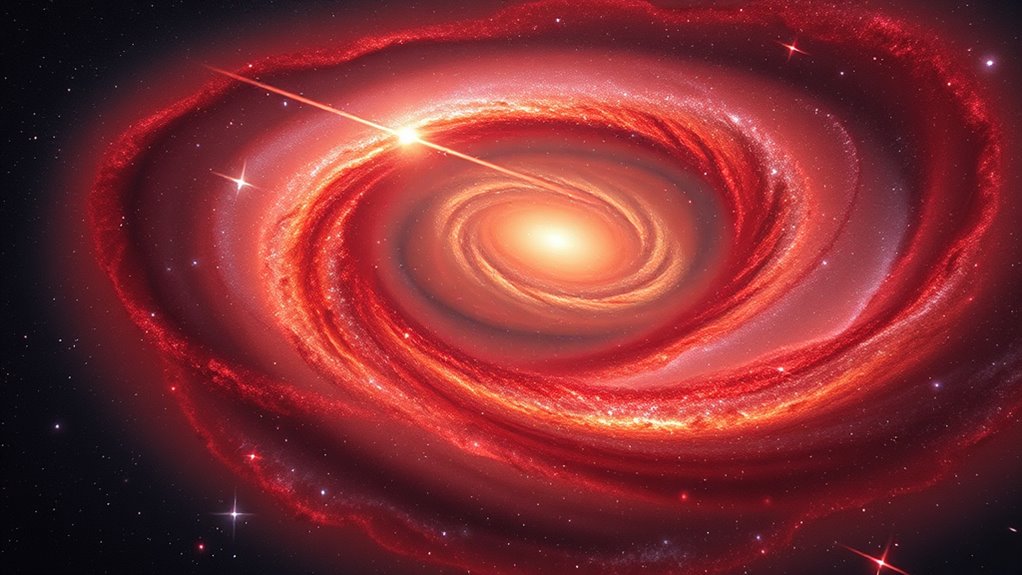
Redshift occurs when light from distant galaxies shifts toward the red end of the spectrum, revealing that the universe is expanding. This stretching of light indicates that space itself is growing, causing galaxies to move away from each other. By measuring redshift, scientists determine how fast galaxies recede and understand the universe’s growth over time. If you keep exploring, you’ll discover more about how this phenomenon shapes our understanding of the cosmos.
Key Takeaways
- Redshift occurs when light from distant galaxies shifts toward longer wavelengths, indicating space expansion.
- Measuring redshift through spectral analysis reveals galaxies’ recession velocities and distance.
- The Hubble Law relates redshift to galaxy distance, demonstrating the universe’s expansion rate.
- Observations of increasing redshift with distance support the model of an expanding universe.
- Redshift data suggest accelerated expansion, implying the influence of dark energy on the universe’s future.
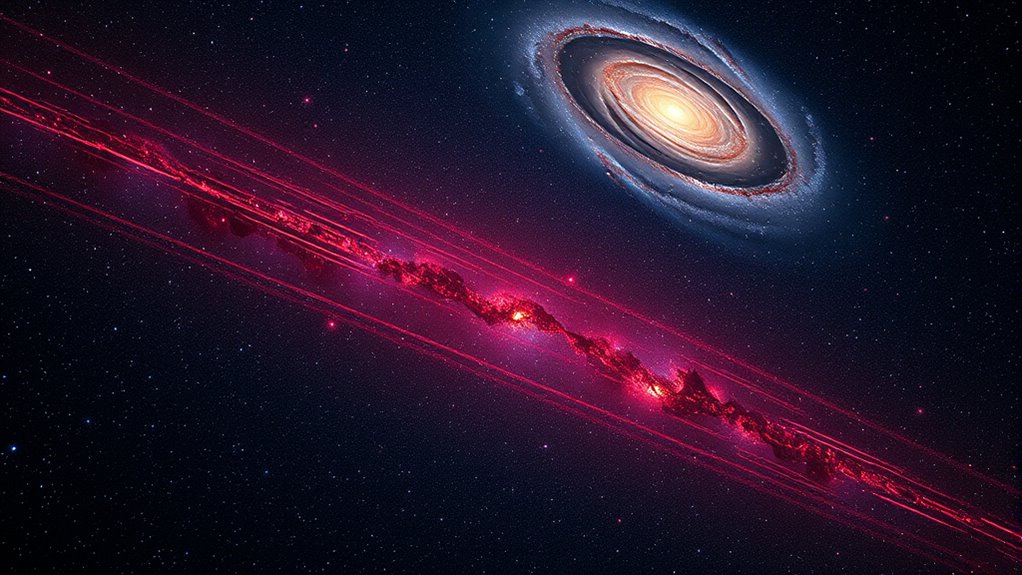
Have you ever wondered how astronomers learn that the universe is expanding? It all starts with observing the light from distant galaxies. When you look at these galaxies, you notice that their light is shifted toward the red end of the spectrum, a phenomenon known as redshift. This redshift isn’t just a curious detail; it has profound cosmological implications. It suggests that space itself is stretching, carrying galaxies away from each other. The discovery of this redshift revolutionized our understanding of the cosmos, providing strong evidence that the universe is not static but continually expanding. To grasp this, astronomers rely on observational techniques that measure the degree of redshift in the light from these galaxies. By analyzing the spectra of distant objects, you can determine how much their light has shifted and, consequently, how fast they are receding from us. These measurements form the foundation for understanding the universe’s large-scale structure and its evolution over billions of years.
Using these observational techniques, astronomers compare the observed redshift with the known properties of light sources, such as standard candles like Type Ia supernovae. These supernovae have consistent intrinsic brightness, so by measuring how bright they appear to us, you can estimate their distance. When combined with redshift data, this allows you to map out how quickly the universe is expanding at different points in its history. This method has led to the formulation of the Hubble Law, which states that the farther away a galaxy is, the faster it appears to be moving away. This relationship provides a direct way to measure the rate of expansion, known as the Hubble constant.
The implications of these observations extend beyond just measuring expansion—they influence our understanding of the universe’s fate and the nature of dark energy. If the universe continues to expand at an accelerating rate, as current evidence suggests, it could lead to a universe that grows increasingly cold and sparse over time. The interpretation of redshift data also opens questions about the cosmological parameters that define our universe’s shape and destiny. In short, through careful application of observational techniques, you can glean crucial clues about the cosmos’s past, present, and future. The study of redshift not only confirms the universe’s expansion but also deepens our grasp of its underlying fabric, guiding scientists as they unravel the universe’s most profound mysteries.

Telescope for Adults & Kids, 70mm Aperture Refractor (15X-150X) Portable Travel Telescope with Phone Adapter & Wireless Remote, Astronomy Beginners Gifts, Black
【Great Telescope for Kids& Beginners!】 The telescope meets all the needs of astronomy beginners, the adults & kids’…
As an affiliate, we earn on qualifying purchases.
As an affiliate, we earn on qualifying purchases.
Frequently Asked Questions
How Does Redshift Differ From Doppler Shift?
Redshift differs from Doppler shift because it involves the cosmological expansion, causing spectral displacement over vast distances, whereas Doppler shift results from an object’s motion relative to you. In redshift, light stretches due to universe expansion, shifting spectral lines toward the red end. Doppler shift, however, depends on an object’s velocity, affecting spectral lines based on whether it moves toward or away from you. Both cause spectral displacement but through different mechanisms.
Can Redshift Be Used to Determine Galaxy Age?
Think of redshift as a cosmic clock, revealing galaxy formation timelines. While it’s not precise enough to determine a galaxy’s exact age, it helps you understand its place in the cosmic timeline. You can compare it to reading a fingerprint’s pattern to identify a person. By measuring redshift, you gain insights into when galaxies formed, but detailed ages require additional data like stellar populations and chemical composition.
What Role Does Dark Energy Play in Redshift?
Dark energy influence drives cosmic acceleration, causing galaxies to move away from each other faster over time. This acceleration increases redshift, making distant galaxies appear more redshifted than expected if gravity alone ruled the universe’s expansion. You can see dark energy’s role in redshift by observing how the universe’s expansion speeds up, indicating that dark energy pushes galaxies apart and shapes the universe’s evolution.
Is Redshift Observable in Laboratory Settings?
Redshift isn’t directly observable in laboratory settings because it occurs over vast cosmic distances. However, you can perform laboratory experiments that simulate redshift effects using techniques like Doppler shift simulations and light manipulation. These redshift simulations help scientists understand how light behaves in expanding universe scenarios, but they don’t replicate the actual cosmic redshift observed in distant galaxies. Instead, they serve as valuable tools for studying related phenomena on a smaller scale.
How Does Redshift Affect the Future of the Universe?
You should know that redshift indicates the universe’s ongoing expansion, driven by cosmic acceleration. As this acceleration continues, galaxies will drift farther apart, making the universe increasingly vast and less connected. This means that in the future, your view of distant galaxies will fade as their light stretches beyond reach. Ultimately, this could lead to a cold, dark universe where expansion dominates, shaping its destiny for billions of years to come.
BUGUUYO 2pcs High Precision Measurement Tool for Spot Detection and Surface Defects Multi Functional Crack Gauge and Film Ruler for Flaw Inspection and Line Measurement
User-friendly design: this flaw detection measurement tool is designed with clarity in mind, ensuring accurate readings for users,precise…
As an affiliate, we earn on qualifying purchases.
As an affiliate, we earn on qualifying purchases.
Conclusion
As you explore the universe’s vastness, you realize that redshift isn’t just a phenomenon—it’s a cosmic coincidence revealing our universe’s endless expansion. Every distant galaxy’s shift reminds you that the universe is constantly growing, much like how you might feel your own horizons expanding with new knowledge. So, next time you look up at the stars, remember: the universe’s story is written in light, connecting you to a grand, unfolding mystery beyond what you see.

Cosmology
As an affiliate, we earn on qualifying purchases.
As an affiliate, we earn on qualifying purchases.

Metal Earth Fascinations Hubble Telescope 3D Metal Model Kit
HOBBY MODEL KIT – Unassembled model packed in an envelope with easy to follow instructions. Ideal for ages…
As an affiliate, we earn on qualifying purchases.
As an affiliate, we earn on qualifying purchases.