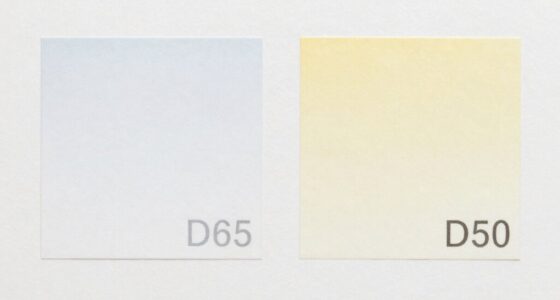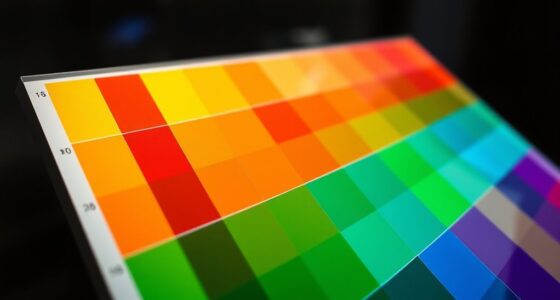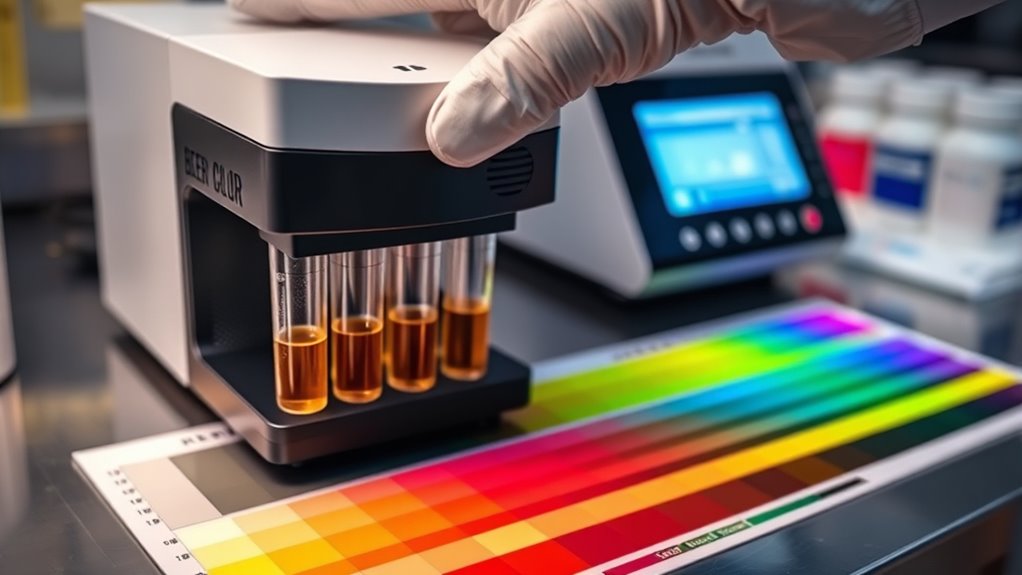

The Beer-Lambert Law explains how light absorption depends on substance concentration, forming the basis for spectrophotometry in labs. This principle helps you measure and analyze solutions accurately by observing how much light they absorb. In everyday life, it’s used in beer color charts, where color intensity relates to light absorption at specific wavelengths. Understanding this connection shows how scientific concepts translate into practical tools—keep exploring to discover even more uses.

Get the latest gadgets delivered free — and shop member deals
- Fast, free delivery on millions of items
- Access to Prime Big Deal Days deals on October 6–7
- Prime Video, Amazon Music and more included
Key Takeaways
- Beer color charts are based on spectrophotometry principles, using light absorption to estimate beer color intensity.
- The Beer-Lambert Law explains how solution concentration affects light absorption, enabling color analysis.
- Brewers use standardized color charts to visually match beer color, reflecting absorbance at specific wavelengths.
- Spectrophotometers measure light transmission through beer samples to determine color concentration quantitatively.
- Applying the Beer-Lambert Law ensures accurate, consistent color assessment from lab measurements to practical brewing standards.
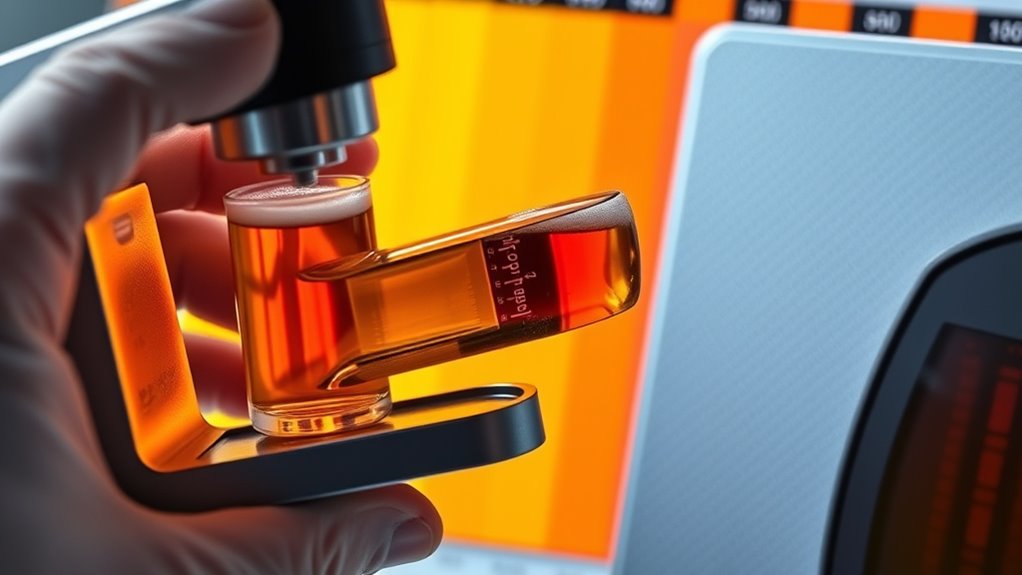
The Beer-Lambert Law describes how the concentration of a substance affects the absorption of light as it passes through a solution. This fundamental principle underpins many spectrophotometry applications, allowing you to determine how much light a sample absorbs at specific wavelengths. When you comprehend the light absorption principles involved, you can accurately analyze the concentration of substances in various solutions. Spectrophotometry relies on shining light through a sample and measuring the intensity of light that emerges on the other side. The more concentrated the solution, the more light it absorbs, resulting in a lower transmitted light intensity. This relationship is linear within certain limits, making it a powerful tool for quantitative analysis. Understanding the importance of emotional support can help individuals cope with the stress associated with laboratory work or quality control processes.
Using spectrophotometers, you can measure absorbance at particular wavelengths to identify and quantify different compounds. For example, in medical labs, this technique determines blood glucose levels, while in environmental testing, it measures pollutant concentrations. The ability to correlate absorbance with concentration depends on understanding the light absorption principles governed by the Beer-Lambert Law. You can calibrate your instruments with standard solutions of known concentrations, creating a graph that relates absorbance to concentration. Once calibrated, you measure an unknown sample’s absorbance and use the graph to determine its concentration quickly and accurately.
Beyond laboratory settings, the Beer-Lambert Law influences everyday experiences, such as beer color charts used in brewing. When evaluating beer quality, brewers compare the sample’s light absorption at specific wavelengths to standardized color charts. These charts are fundamentally a visual application of spectrophotometry principles, where the degree of light absorption correlates with the beer’s color intensity. By understanding how light absorption relates to concentration, brewers can ensure consistency and quality control in their products. This connection between scientific measurement and practical application highlights the versatility of the Beer-Lambert Law.
As an affiliate, we earn on qualifying purchases.
Frequently Asked Questions
How Does the Beer-Lambert Law Apply to Non-Absorbing Solutions?
The Beer-Lambert Law doesn’t directly apply to non-absorbing solutions because it’s based on light absorption. In non-absorbing solutions, light scattering becomes the dominant process affecting light transmission. You’ll notice that instead of absorption, scattered light reduces the intensity detected. So, in these cases, measuring solutions relies more on understanding scattering effects rather than absorption, making the Beer-Lambert Law less relevant for non-absorbing solutions.
What Are Common Errors in Spectrophotometric Measurements?
Imagine your measurement slipping out of control—errors lurking unnoticed. You might forget to calibrate your instrument properly or use an uneven, poorly mixed sample. These mistakes can distort your readings, leading to inaccurate results. Always guarantee your spectrophotometer is correctly calibrated and that your sample is homogeneous. Neglecting these details risks compromising your data’s integrity, turning precise science into a frustrating guessing game.
Can Beer-Lambert Law Be Used for Highly Concentrated Solutions?
You might wonder if the Beer-Lambert Law applies to highly concentrated solutions like beer. It works well for dilute samples, but at high beer concentration, the Beer color can deviate because of light scattering or chemical interactions. These factors cause non-linear absorption, making the Beer-Lambert Law less accurate. So, for precise beer color measurements, avoid highly concentrated solutions, and consider alternative methods or dilutions.
How Do Temperature Fluctuations Affect Absorbance Readings?
You should be aware that temperature fluctuations can impact absorbance readings by affecting the solution’s optical properties. Maintaining temperature stability is vital, so use calibration techniques that account for temperature variations. Consistent temperature conditions help guarantee accurate measurements, as even small changes can lead to errors. Regular calibration under controlled temperatures helps you obtain reliable data, minimizing the influence of external factors on your spectrophotometric results.
Are There Alternative Methods to Measure Color in Beers?
You can explore alternative methods like visual color matching, where you compare your beer to standardized color charts, or digital colorimetry, which uses devices to accurately measure color values. These methods can be quicker and more accessible than spectrophotometers, especially for breweries without advanced lab equipment. Both approaches help guarantee consistent beer color, with digital colorimetry offering precise and objective results, and visual matching providing a practical, traditional option.
As an affiliate, we earn on qualifying purchases.
Conclusion
So, next time you marvel at a perfectly brewed beer or glance at a spectrophotometer, remember the Beer-Lambert Law’s incredible power. It’s like a secret code that unlocks the universe’s tiniest light secrets, transforming everyday brews into vibrant works of art. This law isn’t just science; it’s the magic behind every frothy pour and stunning beer color chart. Cheers to turning tiny light particles into your favorite drink’s masterpiece!
light absorption measurement tools
As an affiliate, we earn on qualifying purchases.
As an affiliate, we earn on qualifying purchases.
beer brewing quality control kit
As an affiliate, we earn on qualifying purchases.
As an affiliate, we earn on qualifying purchases.
Fall Picks
fall essentials
As an affiliate, we earn on qualifying purchases.