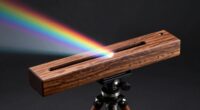
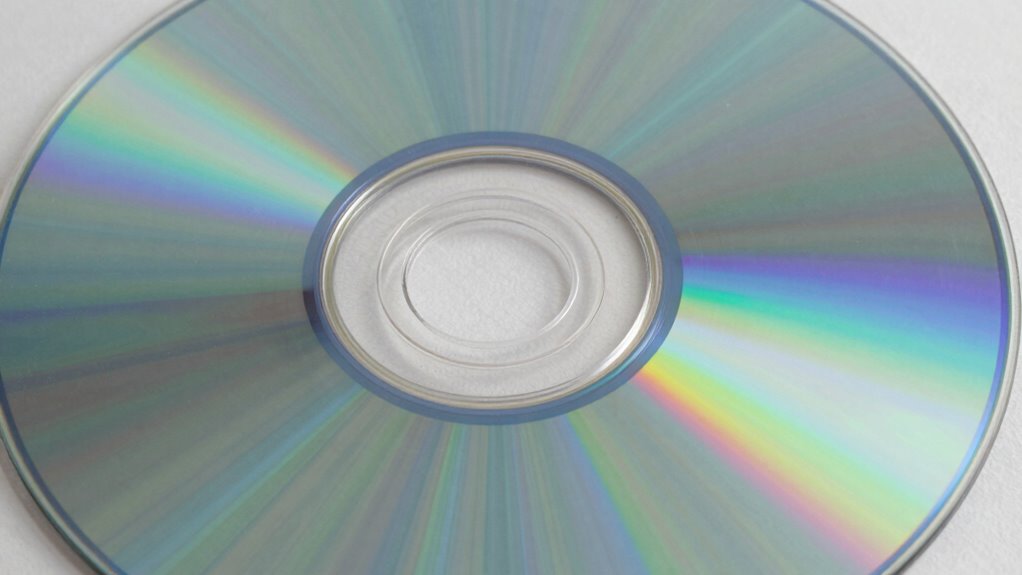
When light hits a CD’s tiny, evenly spaced grooves, they act as a diffraction grating, bending and spreading light into different directions based on wavelength. Shorter wavelengths like blue bend less, while longer wavelengths like red bend more, creating a colorful spectrum. This effect shows how light disperses into rainbow patterns through wave interference. If you want to understand exactly how these tiny lines produce such vibrant displays, keep exploring the science behind diffraction and light dispersion.

Get the latest gadgets delivered free with Prime
- Fast, free delivery on millions of items
- Prime Video, Amazon Music and more included
- Member-only deals all year
Key Takeaways
- A CD has tiny, evenly spaced spiral grooves acting as a diffraction grating that splits light into a spectrum of colors.
- When light hits the CD surface, it diffracts at different angles based on wavelength, creating rainbow patterns.
- Shorter wavelengths (blue) bend less, while longer wavelengths (red) bend more, forming a visible rainbow.
- The high precision and regular pattern of grooves determine the clarity and vibrancy of the diffraction colors.
- Viewing angle and lighting conditions influence how the rainbow pattern appears on the CD surface.
As an affiliate, we earn on qualifying purchases.
How Do Diffraction Gratings Bend Light?
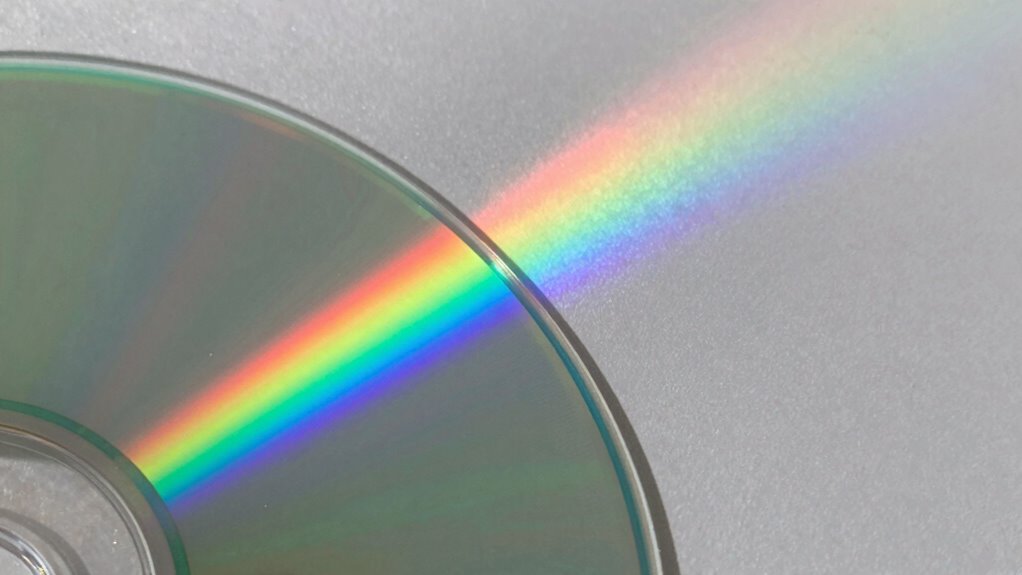
Have you ever wondered how diffraction gratings bend light? When light hits a diffraction grating, the tiny lines or grooves split it into multiple directions, creating optical illusions like rainbows. This bending isn’t random; it follows specific angles based on the wavelength of the light and the spacing of the grooves. As light passes through or reflects off the grating, it also undergoes light polarization, which affects how the light waves vibrate. This polarization can enhance or diminish certain colors in the spectrum, making the diffraction pattern more vivid. Basically, diffraction gratings manipulate light by dispersing it into its component colors, bending it at precise angles. This process reveals the hidden structure of light and creates stunning visual effects. Additionally, digital concepts like these are essential for understanding how technology interacts with our perception of light. The principles behind diffraction can also be applied to eco-friendly crafts, showcasing the versatility of light manipulation in creative ways.
As an affiliate, we earn on qualifying purchases.
What Makes a CD a Perfect Diffraction Grating?
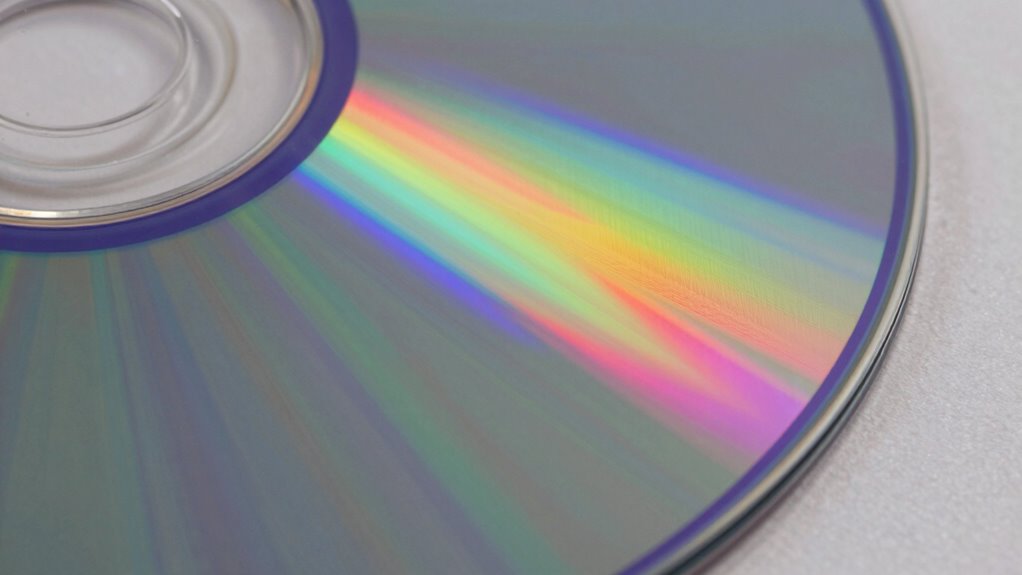
A CD acts as a perfect diffraction grating because it has fine spiral grooves etched into its surface. These grooves are precisely spaced, creating uniformity that allows light to diffract consistently. This combination of fine grooves and even spacing makes CDs ideal for producing clear, colorful spectra.
Fine Spiral Grooves
The tiny spiral grooves on a CD act as a precise diffraction grating because they are arranged with remarkable regularity and minute spacing. These spiral grooves form the core of the CD’s groove patterns, which are incredibly consistent across the disc’s surface. The fine spiral grooves are so closely spaced that they can split light into its component colors, creating the rainbow effect you see. Because of the precision in the groove patterns, each groove reflects and diffracts light in a predictable way, producing clear and vibrant spectral lines. This consistency is key to a CD functioning as a diffraction grating. Without such finely crafted spiral grooves, the diffraction and resulting rainbow effect wouldn’t be as sharp or well-defined. Additionally, the concept of color accuracy plays a significant role in how we perceive the vibrant colors produced by the diffraction. Proper cabling solutions can enhance the quality of light projection, further affecting how these colors are displayed.
Uniform Groove Spacing
Uniform groove spacing is what makes a CD an exceptional diffraction grating because it guarantees that light is split into precise spectral lines. This groove uniformity ensures the pattern remains consistent across the disc, allowing light waves to diffract predictably. When the grooves are evenly spaced, the light waves interfere constructively at specific angles, creating clear and distinct colors. Any irregularity in pattern consistency would cause the spectral lines to blur or overlap, reducing the clarity of the rainbow effect. The precision of groove spacing is vital for accurate diffraction, making your CD an effective optical element. By maintaining uniform groove spacing, manufacturers ensure that each CD produces sharp, vibrant spectral lines, highlighting why pattern consistency is essential for high-quality diffraction. Moreover, just as secure storage options are crucial for protecting your retirement assets, uniformity in groove spacing ensures optimal light diffraction.
As an affiliate, we earn on qualifying purchases.
Why Does Light Spread Into Colors on a CD?

When light hits the surface of a CD, its tiny grooves and pattern cause it to scatter into different directions. This surface structure acts like a diffraction grating, separating light into its component colors based on wavelength. As a result, you see a spread of colors because each wavelength bends differently when reflecting off the CD. Understanding how diffraction gratings work can enhance your appreciation for similar optical effects in everyday objects. Additionally, the principles of light scattering can also be applied to the design of effective car protection solutions, ensuring your vehicle’s surface stays vibrant and protected. Furthermore, choosing the right printmaking paper, including texture and weight, can greatly influence the quality of your printed images. Moreover, the concept of luxury lifestyle products often incorporates advanced materials that utilize similar optical principles in their design. Furthermore, financial planning for couples can benefit from understanding how different factors interact, much like the way light interacts with a CD.
Surface Structure and Pattern
Light spreads into vibrant colors on a CD because its surface is intricately patterned with tiny, closely spaced grooves that act like a diffraction grating. The surface’s roughness and pattern density determine how the light interacts with it. The grooves are precisely etched, creating a regular pattern that diffracts the light into different directions. Higher pattern density means more grooves per unit area, which enhances the diffraction effect and produces a more vivid rainbow. The surface roughness refers to how smooth or textured the grooves are; smoother surfaces produce clearer, more defined colors. This detailed patterning causes light waves to bend and spread apart, revealing the spectrum of colors we see. Your eye perceives this as a beautiful, shimmering display, thanks to the CD’s carefully engineered surface structure.
Light Wavelength Separation
The tiny grooves on a CD’s surface don’t just reflect light—they also cause it to split into different colors by separating the various wavelengths of light. When light hits the surface, diffraction occurs, and different wavelengths bend at slightly different angles. This separation results in the rainbow effect you see. Polarization effects can influence how light interacts with the grooves, affecting the intensity of certain colors. As some wavelengths are directed more strongly, the light’s intensity varies across the spectrum. This combination of diffraction and polarization helps explain why a CD produces a colorful display. The pattern of grooves acts like a diffraction grating, dispersing the incoming light into its component wavelengths, creating the vivid spectrum you observe.
As an affiliate, we earn on qualifying purchases.
How Tiny Lines on a CD Diffract Light?
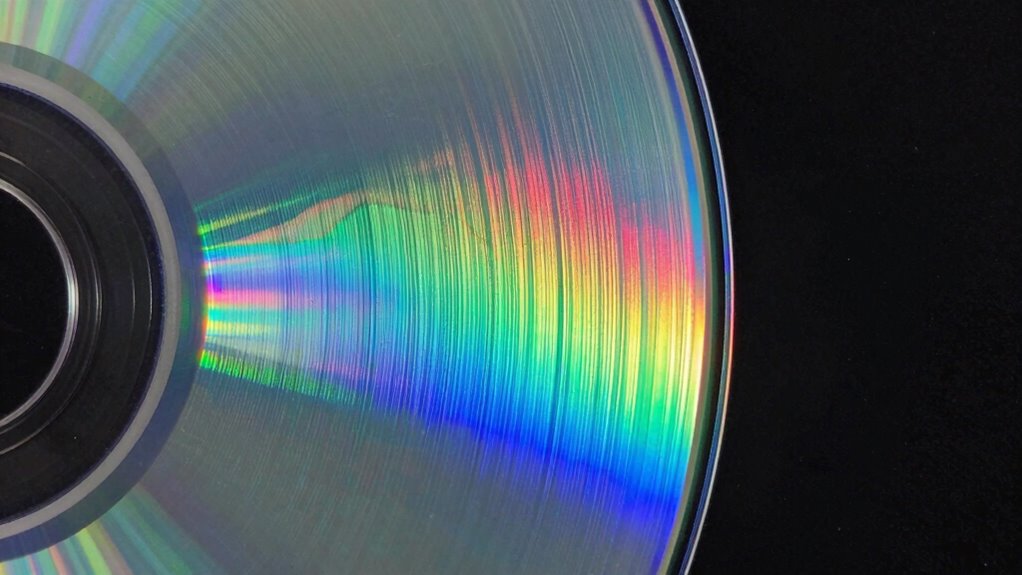
Ever wonder how tiny lines on a CD can create such colorful patterns? These lines act as a diffraction grating, splitting light through quantum interference. When light hits the surface, each tiny groove reflects and scatters photons, causing waves to overlap. Depending on their wavelength, some waves amplify while others cancel out, creating optical illusions of vibrant colors. This process relies on the precise spacing of the lines, which determines how light diffracts. The tiny grooves don’t just scatter light randomly—they direct specific wavelengths toward your eyes, producing the rainbow effect. So, those microscopic lines are more than just grooves; they’re orchestrating a complex dance of photons, turning ordinary light into a stunning display of colors through diffraction and interference at a tiny scale.
What Factors Affect the Rainbow Patterns on a CD?

Sure! Here’s the revised content with the requested changes:
—
Have you ever noticed how the rainbow patterns on a CD can change depending on your perspective? Several factors influence these colorful displays. The angle at which you view the CD affects how light interacts with its tiny grooves, creating different optical illusions and color mixing effects. Slight tilts or rotations can shift the pattern’s appearance, making the rainbow seem to move or change. The lighting also plays a role; brighter or directional light enhances color contrast, intensifying the rainbow effect. Additionally, the surface cleanliness impacts the diffraction pattern—dirt or fingerprints can distort the colors. Overall, these factors alter how light diffracts, producing the dynamic rainbow patterns you see, emphasizing the fascinating interplay between physical structure and optical illusions on a simple CD. Furthermore, just as makeup products for women over 50 focus on enhancing natural beauty, the clarity of the CD’s surface can significantly enhance the brilliance of its rainbow displays. The color coordination of light interacting with the grooves can create mesmerizing effects, adding to the visual appeal. Moreover, understanding diffraction gratings can provide insight into how various surfaces manipulate light to create stunning visual phenomena, similar to how robot mowers optimize yard care by adjusting their paths based on environmental factors. The concept of light wavelengths is essential in explaining how different colors emerge from the CD’s grooves, revealing the intricate science behind these beautiful effects.
How to Observe Diffraction Patterns With a CD

To observe diffraction patterns with a CD, start by choosing a clean, reflective disc with closely spaced lines. Make sure you have the right lighting conditions—bright, direct light works best—and position the CD so the light hits it at an angle. As you do, watch for the colorful, rainbow-like patterns that reveal the CD’s diffraction effects.
Choosing the Right CD
Choosing the right CD is essential for clearly observing diffraction patterns. Not all discs are equal—some are optimized for digital rights management or music preservation, which affects their groove quality. Look for older or well-maintained CDs with intact reflective surfaces for best results. Avoid scratched or heavily used discs, as damage can distort the pattern. Here’s a quick guide:
| Feature | Ideal Choice | Why |
|---|---|---|
| Age of the CD | Older or carefully preserved | Better groove integrity |
| Surface Condition | Smooth, clean, scratch-free | Clear diffraction pattern |
| Data Type | Standard audio or data discs | Consistent groove spacing |
Choosing the right CD guarantees crisp, vivid diffraction patterns for a better visual experience.
Proper Light Conditions
Sure! Here’s the revised content with the requested changes:
—
Ever wondered why your diffraction pattern looks blurry or faint? Proper lighting conditions are key. Bright, diffuse light works best because it minimizes unwanted surface reflection, which can obscure the pattern. Avoid direct, harsh light that causes glare or reflections off the CD’s surface, making the diffraction colors harder to see. Instead, use indirect or softer light sources at an angle, so the surface reflection is reduced. Dimmer environments can also help, as they increase contrast and make the rainbow diffraction pattern more vivid. Ensuring the light hits the CD at the right angle helps you clearly observe the diffraction effects. By controlling lighting conditions and surface reflection, you’ll improve your chances of seeing a crisp, colorful rainbow on your CD. Additionally, incorporating natural elements into your observation area can further enhance the viewing experience by reducing distractions. Engaging in mind-body healing practices can also help you focus better during your observation, making it easier to appreciate the beauty of the diffraction patterns.
—
Let me know if you need any further adjustments!
Observing Diffraction Effects
Observing diffraction patterns with a CD is straightforward once you understand what to look for. Hold the CD in bright, indirect light, and angle it toward a white surface or wall. As light hits the grooves, you’ll notice rainbow-like optical illusions spreading across the surface. These colorful effects result from diffraction and light polarization, demonstrating how light waves bend and interfere. To see the patterns clearly, experiment with different angles and distances. Using a flashlight or sunlight enhances visibility. The diffraction effects reveal the CD’s fine groove structure, turning it into a simple optical device. By observing how light separates into spectrum colors, you gain insight into diffraction principles and the fascinating behavior of light waves.
The Science Behind Rainbow Patterns in Diffraction

When light passes through a diffraction grating, it bends and spreads out into a spectrum of colors, creating the vibrant rainbow patterns we see. This happens because different wavelengths of light diffract at slightly different angles, resulting in a separation of colors. As these colors overlap, you experience color blending, which can soften or intensify certain hues. Light polarization also influences the patterns—certain polarizations enhance or diminish specific colors, affecting the rainbow’s intensity. The diffraction process effectively disperses light into its component wavelengths, revealing the underlying spectrum. Understanding how these factors interact helps explain why your CD displays such vivid rainbow patterns. Somatic therapy techniques often rely on similar principles of light manipulation, showcasing how science can unveil hidden beauty in various fields. By manipulating light’s polarization and the angles involved, you can observe subtle variations in the rainbow’s appearance, showcasing the intricate science behind these colorful displays. Additionally, the principles of smart pool automation can enhance your experience by utilizing similar light manipulation techniques for vibrant pool lighting. Furthermore, the concept of surface finishes plays a crucial role in determining how light interacts with various materials, influencing the overall aesthetic of any space.
How Wavelength and Angle Change the Colors You See?

The colors you see in a diffraction pattern depend heavily on both the wavelength of the light and the angle at which it hits the diffraction grating. When light strikes at different angles, wave interference causes certain wavelengths to constructively combine, producing vibrant colors. Changing the angle shifts the interference pattern, altering the visible color. Shorter wavelengths, like blue, bend less, while longer wavelengths, like red, bend more. This variation creates a spectrum through color mixing, based on how waves overlap. Additionally, chemical innovations can lead to advancements in materials used for creating more effective diffraction gratings. Understanding comedogenic ratings can help you choose products that won’t clog pores, enhancing your skin’s appearance, which can be visually striking when light interacts with it. Creating cozy spaces often utilizes natural light, which can enhance the visual impact of such diffraction patterns in your environment. Additionally, water-cooled mattress pads can help maintain a comfortable temperature, allowing you to fully appreciate the beauty of light patterns without distraction.
| Wavelength | Angle | Resulting Color |
|---|---|---|
| Short (blue) | Small | Blue |
| Medium | Medium | Green |
| Long (red) | Large | Red |
| Intermediate | Varies | Mix of colors |
| All wavelengths | Multiple angles | Rainbow effect |
Can Diffraction Gratings Be Used in Scientific Instruments?
Have you ever wondered how scientists analyze the light from stars or distant objects? Diffraction gratings are essential tools in many scientific instruments. They help split light into its component wavelengths, revealing details about the universe. You’ll find diffraction gratings in art, where they create colorful displays, and in telecommunications, enabling high-speed data transmission.
- In telescopes, diffraction gratings analyze light spectra from celestial bodies.
- They are used in spectrometers to identify chemical compositions and physical properties.
- Their precision makes them ideal for scientific research, as well as in practical applications like art and telecommunications.
Everyday Examples of Diffraction and Light Dispersion
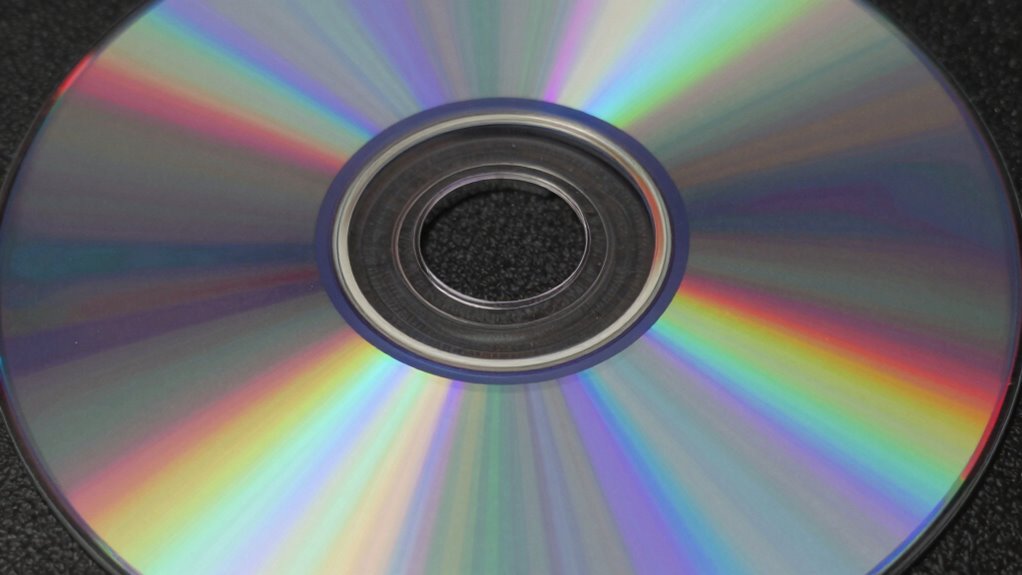
Ever notice how a rainbow appears when sunlight passes through a spray of water or a fine mist? This everyday example of light dispersion demonstrates how diffraction spreads light into its component colors. Historically, humans observed these colorful displays and used them as natural phenomena to understand light’s behavior. Today, diffraction and light dispersion have many technological applications, from spectrometers analyzing stars to optical devices like CDs and DVDs creating rainbow patterns. These principles also influence modern innovations, including diffraction gratings in scientific instruments that precisely separate light wavelengths. You see, what once was a simple natural occurrence has become a foundation for advanced technology. Understanding these everyday examples helps you appreciate how fundamental diffraction is to both nature and the tools we use daily.
Frequently Asked Questions
How Does the Material of a CD Influence Its Diffraction Properties?
Your CD’s material composition directly influences its diffraction properties by determining its reflective surface and how light interacts with it. A metallic layer, like aluminum, reflects light effectively, creating clear diffraction patterns. If the material isn’t properly reflective or smooth, the diffraction will be weaker or less distinct. So, the quality and type of material used in your CD shape its ability to produce vibrant rainbows through diffraction.
Can Diffraction Gratings Be Customized for Specific Wavelengths?
Think of a diffraction grating as a musical instrument tuned for specific notes. Yes, you can customize gratings for particular wavelengths through wavelength selectivity and custom grating design. By adjusting the spacing of the grooves, you target certain wavelengths, making the grating more efficient for specific applications. This customization allows you to enhance performance in spectroscopy, laser systems, or optical filters, tailoring the grating to meet precise wavelength needs.
What Are the Limitations of Using CDS as Diffraction Gratings?
Using CDs as diffraction gratings has limitations due to manufacturing inconsistencies and surface contamination. These issues cause uneven groove spacing, leading to less precise diffraction patterns. Surface dirt or fingerprints can distort light and reduce clarity. Additionally, the grooves aren’t designed for specific wavelengths, so the rainbow effect varies. For accurate spectral analysis, specialized diffraction gratings outperform CDs, which are more suited for casual demonstrations than precise scientific work.
How Does Temperature Affect Diffraction Patterns on a CD?
Temperature changes can influence diffraction patterns on a CD by causing thermal expansion. As the CD heats up, its plastic substrate and metallic layer expand slightly, which may alter the spacing of the pits and tracks. This expansion can affect pattern stability, making the diffraction pattern less sharp or slightly shifting its position. To maintain consistent results, keep the CD in a stable temperature environment, minimizing thermal expansion effects.
Are There Other Everyday Objects That Act as Diffraction Gratings?
Ever wonder if everyday objects can act as diffraction gratings? You bet! Items like soap bubbles, spider webs, and even insect wings can exhibit diffraction effects, influenced by polarization effects and diffraction angles. These objects scatter light in unique ways, creating colorful patterns similar to a CD’s rainbow. Their intricate structures split light into different directions, showcasing how nature and daily items can reveal fascinating wave behaviors.
Conclusion
Next time you see a rainbow shimmer on a CD, remember it’s all about diffraction. Imagine shining a laser pointer across a CD’s surface—those tiny lines split the light into vibrant colors, just like in scientific labs. This everyday example helps you see how light behaves in the world around you. Whether in gadgets or experiments, diffraction reveals the beautiful science behind the colorful patterns you often overlook.
Columbus Day / Indigenous Peoples' Day Picks
long weekend sales
As an affiliate, we earn on qualifying purchases.