
TL;DR
Listen free for 30 days with Audible
Thousands of audiobooks and originals — cancel anytime.
Start your free trialAs an affiliate, we earn on qualifying purchases.
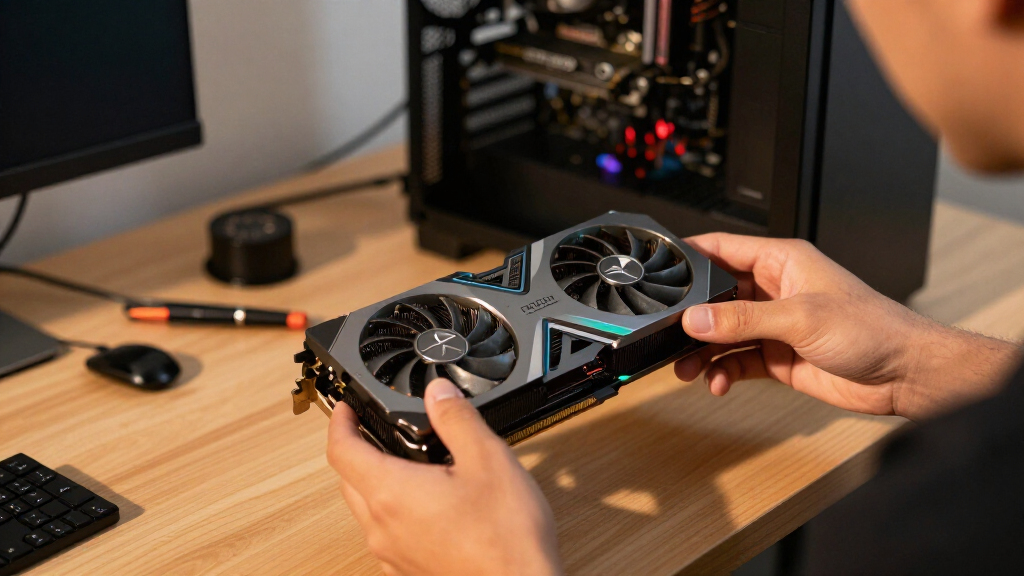
GPU Solutions now provides a service to double the VRAM of the RTX 2080 Ti from 11 GB to 22 GB. The upgrade involves replacing memory modules and BIOS adjustments. The process aims to improve performance in demanding graphics card applications.
GPU Solutions is now offering a service to upgrade the VRAM of the NVIDIA GeForce RTX 2080 Ti from 11 GB to 22 GB. This upgrade involves replacing the original GDDR6 memory modules with higher-density 2 GB modules and configuring the BIOS accordingly. The service aims to enhance the card’s performance for ultra-high-resolution gaming, 3D rendering, and AI workloads, making it a significant upgrade for power users.
The upgrade process includes removing all stock 1 GB GDDR6 modules and installing 2 GB high-density modules, accompanied by BGA rework. The GPU’s BIOS is then modified to recognize the full 22 GB VRAM capacity. Thermal paste and pads are replaced to ensure optimal cooling, and the card undergoes extensive benchmarking and stability testing using tools like Furmark and 3DMark.
This service is specifically designed for RTX 2080 Ti cards with compatible PCB layouts. It requires BIOS modifications to enable full VRAM detection. The cost varies depending on the availability of high-capacity memory modules, and the entire process takes approximately 12 days. The upgrade is covered by a 90-day warranty on workmanship and replaced components. Cards with severe damage or prior repairs may be ineligible.
RTX 2080 Ti Memory Upgrade to 22 GB
GPU Solutions is offering a specialist service that replaces the RTX 2080 Ti’s original memory modules and modifies its BIOS to double usable VRAM from 11 GB to 22 GB. The goal: give an aging flagship more room for high-resolution graphics, complex renders and memory-intensive AI workloads.
A memory transplant, not a software tweak
The upgrade requires board-level rework. Every stock 1 GB GDDR6 package is removed, higher-density parts are installed, and firmware is adjusted so the GPU can address the expanded memory.
Higher-density GDDR6
The original memory packages are replaced with compatible 2 GB modules, raising total capacity without changing the GPU core.
Modified BIOS
The card’s BIOS must be configured to recognize and expose the complete 22 GB allocation to the operating system and applications.
Cooling and stress tests
Thermal paste and pads are replaced before the modified card is benchmarked and tested with workloads such as FurMark and 3DMark.
From intake to a validated 22 GB card
Eligibility depends on PCB design and card condition. Severe damage, earlier repairs or non-standard layouts may prevent the modification.
Inspect
Confirm PCB compatibility and assess prior damage.
Desolder
Remove all stock 1 GB GDDR6 packages.
Rework
Install higher-density modules using BGA rework.
Configure
Modify firmware for full 22 GB detection.
Validate
Renew cooling materials and run stability tests.
More capacity where memory is the constraint
Doubling VRAM does not double raw compute speed. Its strongest benefit appears when a workload exceeds the original 11 GB ceiling and would otherwise spill data, reduce quality or fail to load.
Addressable memory
Where it helps
Larger textures, scenes, datasets and AI models can remain resident in GPU memory, potentially reducing memory-related slowdowns or capacity errors.
What it cannot change
The RTX 2080 Ti retains its original architecture, compute resources, memory-bus design and broader platform limitations.
Stock card versus modified card
The modification is best viewed as a capacity upgrade for a compatible, out-of-warranty card—not as a guaranteed replacement for a newer GPU generation.
| Consideration | Stock RTX 2080 Ti | 22 GB modification | Assessment |
|---|---|---|---|
| VRAM capacity | 11 GB GDDR6 | 22 GB GDDR6 | ✓ Doubled |
| Large workload headroom | Increasingly constrained | Substantially expanded | ✓ Potential gain |
| Raw GPU compute | Original specification | Original specification | ~ Unchanged |
| Manufacturer warranty | Depends on card status | May be void after modification | ✗ Material risk |
| Service protection | Not applicable | 90-day workmanship and parts warranty | ~ Limited cover |
| Compatibility | All standard functioning cards | Only approved PCB layouts and conditions | ~ Must verify |
| Price | No modification cost | Quoted according to parts availability | ~ Variable |
Performance outcomes remain application-specific; independent long-duration validation has not yet been established.
The capacity-to-workload chain
What buyers should verify first
The upgrade is technically substantial and its value depends on workload, eligibility, service cost and tolerance for modification risk.
Is the upgrade warranty-safe?
The service includes a 90-day warranty for workmanship and replaced parts, but the hardware modification may void any remaining manufacturer warranty.
Will gaming become faster?
Potentially, when a game is constrained by the original 11 GB capacity. Titles that are limited by GPU compute or CPU performance may show little improvement.
Does overclocking improve?
No consistent result has been established. Different memory parts, thermals and board conditions could increase or reduce stability headroom.
Are all RTX 2080 Ti cards eligible?
No. Compatible PCB layouts are required, and cards with severe damage, non-standard designs or previous repairs may be rejected.
Long-term reliability
Independent evidence under sustained heavy loads is still needed to assess durability, thermals and stability over extended use.
Independent benchmarks
Broader testing should clarify real application gains, model-by-model compatibility and whether similar services expand to other GPUs.
“We double the RTX 2080 Ti’s VRAM capacity by replacing all original GDDR6 memory modules with higher-density parts.”GPU Solutions · Vendor statement
Potential Impact on High-Performance Computing
This upgrade could significantly extend the usability of the RTX 2080 Ti for demanding applications, including 4K gaming, professional rendering, and AI development. Doubling VRAM capacity allows handling larger textures, datasets, and models more efficiently, which may delay the need for new hardware purchases. For enthusiasts and professionals, this service offers a cost-effective way to boost existing GPU performance.
As an affiliate, we earn on qualifying purchases.
Background on RTX 2080 Ti and Memory Upgrades
The NVIDIA RTX 2080 Ti, released in 2018, originally features 11 GB of GDDR6 VRAM, a standard for high-end GPUs of its era. While powerful at launch, modern workloads increasingly demand more memory, especially at higher resolutions and in AI tasks. Memory upgrades are uncommon but have been explored by enthusiasts, with some services offering custom modifications. This new offering by GPU Solutions marks a notable development in extending the lifespan and capabilities of this GPU model.
“We double the RTX 2080 Ti’s VRAM capacity by replacing all original GDDR6 memory modules with higher-density parts.”
— GPU Solutions
GDDR6 memory modules for RTX 2080 Ti
As an affiliate, we earn on qualifying purchases.
As an affiliate, we earn on qualifying purchases.
Unconfirmed Long-Term Reliability and Overclocking Impact
It is not yet clear how the upgrade affects the long-term reliability of the GPU, especially under sustained high loads. The impact on overclocking headroom and whether the increased VRAM introduces any stability issues remains unverified through independent testing. Additionally, compatibility with all RTX 2080 Ti models has not been fully confirmed, and some cards with prior damage or non-standard PCB layouts may be ineligible.
As an affiliate, we earn on qualifying purchases.
Expected Testing, Broader Adoption, and Future Upgrades
Further independent testing will clarify the stability and performance gains provided by the 22 GB VRAM upgrade. If successful, this service could inspire similar modifications for other high-end GPUs. GPU enthusiasts and professionals will likely monitor user feedback and benchmark results over the coming weeks. GPU Solutions may also expand their offerings to include other models or higher-capacity modules as availability improves.
BIOS modification service for graphics cards
As an affiliate, we earn on qualifying purchases.
As an affiliate, we earn on qualifying purchases.
Key Questions
Is this upgrade reversible or warranty-safe?
The upgrade is performed by professional technicians and is covered under a 90-day warranty for workmanship and parts. However, it involves hardware modifications that could void the manufacturer’s warranty if detected. Users should consider this before proceeding.
Will this upgrade improve gaming performance?
Yes, doubling VRAM can improve performance in high-resolution gaming and texture-heavy titles, especially at 4K. However, actual gains depend on the game and system configuration.
Does this affect overclocking abilities?
The impact on overclocking varies; some users may experience increased headroom, while others might see stability issues. The service includes stability testing, but individual results may differ.
What is the cost of this upgrade?
The final price depends on the availability of high-capacity memory modules and is quoted separately. The service fee itself is not specified publicly but includes parts, labor, and testing.
Are all RTX 2080 Ti models compatible?
No, only cards with compatible PCB layouts are eligible. Cards with severe damage or prior modifications may be ineligible for this upgrade.
Source: Hacker News
NFL season / tailgating Picks
team gear
As an affiliate, we earn on qualifying purchases.