
TL;DR

Get the latest gadgets delivered free — and shop member deals
- Fast, free delivery on millions of items
- Access to Prime Big Deal Days deals on October 6–7
- Prime Video, Amazon Music and more included
IdeaClyst offers a local-first, AI-driven war room designed to help founders validate ideas faster, with structured debate, real research, and a private workspace. It’s a game-changer for making confident, data-backed decisions without losing control over your data.
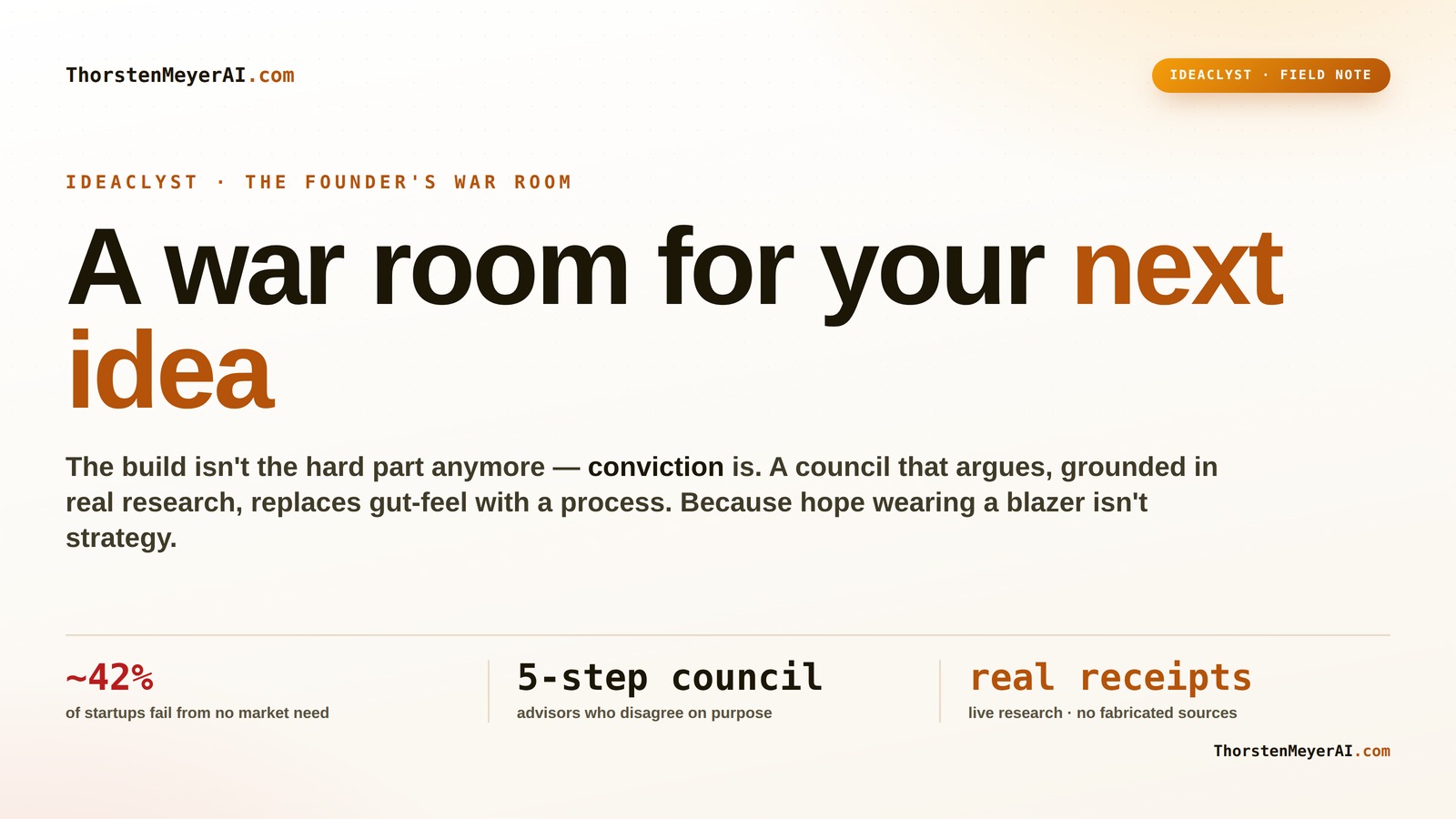
A war room for your next idea
The build isn’t the hard part anymore — conviction is. Knowing which idea deserves the next six months, and being able to defend it. Most founders answer with gut feel and optimistic math. That’s hope wearing a blazer. IdeaClyst replaces it with a process.
The most expensive decision is what to build
The single most valuable thing a tool can do is talk you out of the wrong six months. The numbers make the case better than any pitch.
Three tools in one — on your own machine
Strip away the framing and IdeaClyst is three things at once, all running locally with nothing leaving your laptop.
An AI council
Pressure-tests an idea you bring it — advisors who argue on purpose.
A discovery engine
Finds ideas you didn’t know to look for by hunting real demand signals.
A founder’s workspace
Carries winners from “interesting” all the way to “ready to build.”
Advisors who disagree on purpose
Not one confident, agreeable answer — a structured five-step deliberation where models play different roles and turn on their own work. The disagreement is the feature.
The five-step deliberation
A council that leads with the bad news surfaces the objections you’d otherwise find the expensive way, on month five.
Product strategy
Who’s it for, what’s the wedge, why now, what’s the business model.
Technical architecture
What would it actually take to build — and where’s the risk.
Critique pass
The council turns on its own work. Where’s the hand-waving? What kills this?
Second, independent critique
A different voice, a different angle — so blind spots don’t survive.
Final synthesis
Everything into one coherent founder packet: strategy, architecture, validation, plan.
When IdeaClyst cites a source, it actually fetched it
The hard departure from “ask an AI what it thinks of my startup.” It runs in a strict, real-data-only mode — if it can’t gather genuine evidence, it says so plainly rather than inventing a plausible paragraph.
Confidence with receipts
No fabricated statistics, no imaginary competitors, no made-up citations. The packet survives a skeptical co-founder or a sharp investor because the reasoning has receipts.
Market research first
Scouts the landscape before the council reasons about anything.
Competitor read
Real positioning, pricing signals, feature claims — differentiation vs. reality.
Validation with links
Not “talk to customers” — concrete signals & sources you can click.
From the blank page to build-ready
Evaluation is half the problem; the blank page is the other half. And a plan is worthless if it dies in a tab you never reopen.
Bring a space, not an idea
“AI for accountants,” “tools for indie game studios” — plus your goal and real capacity. It hunts demand signals across HN, Reddit, Product Hunt, GitHub, pricing pages.
- An honest market read — leads with the bad news when a space is hard
- An opportunity map — high pain, thin competition
- Ranked candidates — wedge, who pays, effort, risk, confidence
- each with KILL CRITERIA — when to walk away
A home and a forward path
Every promising idea gets carried forward, with every artifact in plain files on your disk.
- Validation tooling — sprint board, interview list, evidence browser
- Founder profile — a personal-fit lens; same discovery, different advice
- Build workspaces — funnel, personas, landing draft, version history
- “Build this idea” → a PRD + task queue, ready for a coding agent
Key Takeaways
- A war room is a dedicated, visual space for strategic idea development—whether physical or digital.
- IdeaClyst combines AI council debates with real-time web research grounded in your own machine, reducing costly validation errors.
- Running entirely on your local device, it keeps your ideas private and under your control, avoiding the risks of cloud-based tools.
- Structured critique and debate help you build conviction and avoid expensive mistakes based on wishful thinking.
- Even small teams or solo founders can create powerful, flexible war rooms using digital tools like IdeaClyst.
As an affiliate, we earn on qualifying purchases.
Why a War Room Isn’t Just a Fancy Meeting Space—It’s Your Idea’s Fortress
A war room is more than a conference table and whiteboards. It’s a dedicated space where your team’s focus sharpens. Think of it as a battle station for your ideas—where you keep all research, notes, sketches, and decisions visible and accessible.
For example, in a startup racing to develop a new app, a physical war room might have a wall covered in user journey maps, sticky notes with feature ideas, and printed research data. The goal? Keep everyone aligned and ensure the team doesn’t lose momentum or forget key insights.
In the digital age, IdeaClyst replicates this concept on your own device, creating a private, organized environment where ideas are not buried in emails or scattered across apps. This consolidation matters because it reduces cognitive overload—when everything is in one place, teams can make faster, more informed decisions. It also minimizes the risk of losing critical insights in the shuffle, which can lead to costly missteps or duplicated efforts. The war room becomes a strategic hub, enabling a holistic view of progress and obstacles, fostering better coordination and quicker pivots when needed.
As an affiliate, we earn on qualifying purchases.
Design Principles of a Modern Digital War Room — How IdeaClyst Fits In
Think of a well-designed war room as a blend of visual clarity and flexible workspace. Walls become digital canvases, whiteboards turn into interactive dashboards, and furniture is replaced with movable virtual modules. Learn more about digital workspace design principles.
For instance, using IdeaClyst, you can create sections for strategy, architecture, critique, and validation, each with its own focus. These are stored as Markdown files on your local machine, making version control and iteration seamless.
Teams benefit from a clutter-free, distraction-free environment that encourages deep concentration—just like a physical war room but with the added advantage of instant access to live research data and AI insights. The design principles here matter because they foster a mental state conducive to critical thinking and strategic planning. Clutter and distractions can impair judgment, so digital tools that emulate the clarity of a physical war room—organized, focused, and flexible—are vital for effective decision-making. By enabling quick reconfiguration of focus areas, IdeaClyst helps teams adapt rapidly to new insights or challenges, which is crucial in fast-paced startup environments.
As an affiliate, we earn on qualifying purchases.
How IdeaClyst’s AI Council Turns Ideas Into Defensible Strategies
IdeaClyst’s secret weapon is its AI council—an ensemble of models that debate your idea from different angles. Instead of one AI giving you a yes or no, you get a structured five-step critique: strategy, architecture, critique, second critique, and synthesis.
Imagine pitching a new feature for your SaaS app. One model questions its market fit, another examines technical risks, a third finds potential flaws—then all come together to produce a detailed, balanced plan. It’s like having a team of skeptics, each bringing their expertise to the table.
This structured disagreement surfaces issues early, saving your months of costly missteps. It also forces founders to consider multiple perspectives, which is critical because single-answer AI models often oversimplify complex decisions. The tradeoff is that this approach requires more initial setup and understanding of the critique process, but the payoff is a more robust, defendable strategy. The final output, a Markdown document, is yours to own, version, and present—making it an essential tool for strategic alignment and investor pitches.
collaboration software for founders
As an affiliate, we earn on qualifying purchases.
As an affiliate, we earn on qualifying purchases.
Grounding Your Ideas in Real Research — No More Wishful Thinking
Many AI tools spout confident-sounding claims without backing them up. IdeaClyst avoids that trap by integrating live web research into its council. It pulls in real data—market trends, competitor analysis, user feedback—directly from the internet. For more on quality assurance and research tools, check out this site.
For example, instead of assuming a market is growing, IdeaClyst can provide recent statistics and articles, making your strategy evidence-based. This reduces the risk of building something nobody needs, which industry data shows is a top reason startups fail. The implication is that founders can make more accurate predictions and allocate resources more effectively, rather than chasing false positives or overestimating opportunity sizes. This real-time grounding also helps identify emerging trends or shifting consumer behaviors early, so strategies remain relevant and competitive. The tradeoff is that relying on current data requires constant updating and verification, but the benefit is significantly improved confidence in decision-making, ultimately saving time and money by avoiding misguided investments.
Frequently Asked Questions
What exactly is a war room in a business or startup context?
A war room is a dedicated space—physical or digital—where teams focus intensely on planning, problem-solving, and decision-making. It keeps everything visible and organized, helping everyone stay aligned and move fast.
How is a digital war room different from a regular meeting space?
A digital war room like IdeaClyst is a private, organized environment that consolidates research, notes, and critiques, all stored locally. It’s designed for deep focus and structured decision-making, rather than just casual meetings or presentations.
Can I create a war room without a dedicated physical space?
Absolutely. Digital tools like IdeaClyst allow solo founders or small teams to set up a flexible, portable war room on their laptop or desktop. It’s all about having a focused environment for your ideas, anywhere you work.
What features should I look for in a digital war room?
Key features include structured debate tools (like AI council), real-time web research integration, local-first data storage, visual organization (boards, markdown notes), and flexibility for collaboration or solo work.
How does IdeaClyst help prevent startup failures?
By grounding ideas in real-world research and structured critique, IdeaClyst helps you avoid building products nobody wants or overestimating market potential—common pitfalls that lead to failure. It accelerates validation and builds conviction early, reducing the risk of costly missteps and ensuring your efforts are focused on viable opportunities.
Conclusion
A war room isn’t just a fancy term; it’s a strategic advantage. With IdeaClyst, you get a private, structured environment that turns ideas into battle-ready plans—faster, safer, smarter. Your next big leap starts here—are you ready to fight for it?Fall Picks
fall essentials
As an affiliate, we earn on qualifying purchases.