
White light in phosphor-converted LEDs starts with blue because blue photons have high energy, making them ideal for exciting phosphor materials that emit broader visible wavelengths. When blue light hits the phosphors, it excites them to produce a mix of colors, giving you natural, high-quality white light. This process guarantees energy-efficient lighting with excellent color rendering. Keep exploring to discover how material choices and layer design optimize this conversion for different lighting needs.
Key Takeaways
- Blue LEDs are efficient and readily available, making them ideal for exciting phosphor materials to produce white light.
- Blue light serves as a stable, high-energy source that, when converted, creates a broad spectrum of visible wavelengths.
- Phosphor materials absorb blue photons and emit other colors, enabling customizable white light with desired color qualities.
- Starting with blue light simplifies spectral conversion design, optimizing energy efficiency and color rendering.
- Using blue LEDs as a base allows precise control over the spectral output and overall quality of white light.
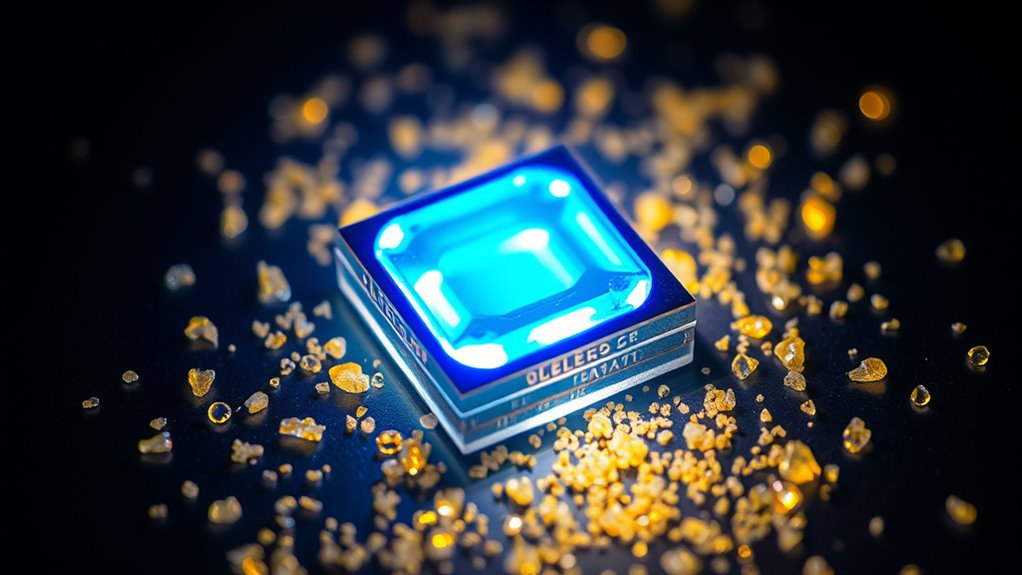
Phosphor-converted LEDs are a popular and efficient lighting technology that transforms blue or ultraviolet light into visible colors through phosphor materials. This process, known as spectral conversion, is fundamental to producing the broad spectrum of white light that we rely on for everyday illumination. By exciting phosphor particles with blue LED light, you can generate a mixture of wavelengths that combine to produce a pleasing, white light. Since spectral conversion directly influences the color quality and color rendering index, optimizing this process is key to achieving high-quality lighting.
Efficiency optimization in phosphor-converted LEDs revolves around how effectively your device converts electrical energy into visible light. When designing these LEDs, you want to maximize the amount of blue light absorbed by the phosphor while minimizing wasted energy as heat. The choice of phosphor materials plays an essential role here; the best phosphors have high quantum efficiency, meaning they emit more visible photons per absorbed photon. By selecting phosphors that match the emission spectrum of your blue LED, you can improve spectral conversion efficiency, guaranteeing more of the input energy translates into useful light.
Maximize spectral efficiency by choosing high-quantum-yield phosphors aligned with your blue LED’s emission spectrum.
You should also consider the thickness and distribution of the phosphor layer. Too thick, and you risk re-absorption of emitted light, reducing overall efficiency. Too thin, and spectral conversion may be incomplete, leading to inconsistent color output. Properly optimizing the phosphor layer’s thickness ensures a balance: it captures enough blue photons to produce the desired white light without causing significant energy losses. Uniform distribution prevents hot spots and color inconsistencies, helping you achieve a stable, high-quality white light.
The spectral conversion process also influences the color temperature and rendering, affecting how natural or vibrant the light appears. To produce warm or cool white light, you can adjust the phosphor composition, blending different phosphors to tailor the spectral output. This customization allows you to meet various application needs, from cozy indoor lighting to bright commercial illumination.
Furthermore, understanding the spectral conversion process helps in developing more energy-efficient and high-quality lighting solutions. In essence, understanding spectral conversion and focusing on efficiency optimization allows you to harness the full potential of phosphor-converted LEDs. By carefully selecting phosphor materials, managing layer design, and fine-tuning the spectral output, you guarantee your LED lighting is not only energy-efficient but also offers superior color quality. This combination of technological precision and material science is what makes white light start with blue—delivering bright, efficient, and high-quality illumination tailored to your needs.
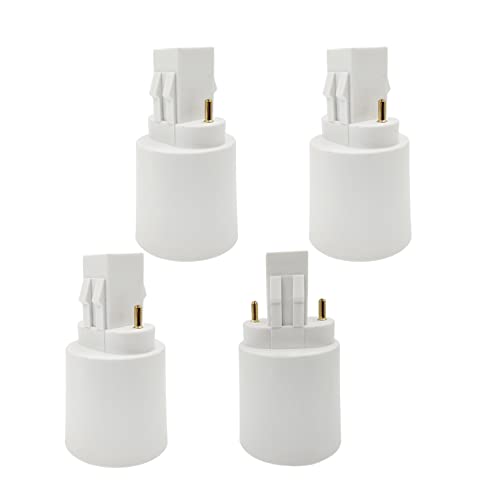
E-Simpo 4pcs Gx23 to E26/E27 Lamp Base Holder Socket Adapter, Refinded Gx23 to E26/e27 Bulb Base Converter CFL PL-S PL-C Bulb Holder Conversion Double Tab.2P in Parallel (4-Pack)
4pcs/lot, GX23 Lamp base to E27 light sockets/holder adapter Not for G23, G24d, GX24d which are also 2P….
As an affiliate, we earn on qualifying purchases.
As an affiliate, we earn on qualifying purchases.
Frequently Asked Questions
How Efficient Are Phosphor-Converted LEDS Compared to Other Lighting Technologies?
When comparing phosphor-converted LEDs to other lighting technologies, you’ll notice they offer high energy efficiency, often surpassing incandescent and halogen bulbs. They convert electricity into visible light with less energy loss. Plus, their long lifespan reduces replacement costs. While initial costs might be higher, the overall cost comparison favors LEDs over time, making them a smart, energy-efficient choice for your lighting needs.
What Are the Environmental Impacts of Phosphor Materials Used in LEDS?
You should consider the environmental impacts of phosphor materials in LEDs, especially regarding toxic element mitigation. Recycling phosphors can reduce waste and prevent harmful substances from entering ecosystems. However, some phosphors contain toxic elements like heavy metals, which pose risks if not properly managed. Implementing phosphor recycling programs helps minimize environmental harm and supports sustainable LED use, making these lighting solutions more eco-friendly overall.
Can Phosphor-Converted LEDS Be Used Outdoors in Extreme Weather?
You might worry about weather resilience, but phosphor-converted LEDs are designed for outdoor use, even in extreme conditions. Their material durability ensures they withstand moisture, temperature fluctuations, and dust. Manufacturers often enhance these LEDs with protective coatings, making them suitable for harsh environments. So, yes, you can confidently use phosphor-converted LEDs outdoors—they’re built to perform reliably regardless of weather challenges.
How Does Phosphor Aging Affect LED Light Quality Over Time?
You should know that aging effects impact LED light quality over time, mainly due to phosphor stability issues. As the phosphor degrades, it can cause color shifts and reduced brightness. This degradation means your LED’s light might become less vibrant or change hue, affecting overall performance. Regularly monitoring LED performance helps identify these aging effects early, ensuring you maintain consistent lighting quality and make timely replacements if needed.
Are There Health Concerns Related to Blue Light Emission in LEDS?
You might worry about blue light and eye health, and it’s true that prolonged exposure can cause eye strain or disrupt sleep patterns. While LEDs emit blue light, modern screens and lighting often include features to reduce exposure. To protect your eye health, take regular breaks, use blue light filters, and consider dimmer lighting at night. Staying aware helps you enjoy LED benefits without compromising your eye health.

KXZM 12V 5M/16.4ft LED Strip Light Blue 600LEDs Flexible SMD2835 High Brightness No-Waterproof IP20 LED Tape Lights for Bedroom Christmas Party etc(No Power Supply)
[High-density SMD2835 600LEDs]: SMD2835 600LEDs 16.4ft/5m Light Strip has higher brightness and better light efficiency than 300 LEDs….
As an affiliate, we earn on qualifying purchases.
As an affiliate, we earn on qualifying purchases.
Conclusion
Think of phosphor-converted LEDs as a painter mixing colors on a palette. You start with a single blue hue—bright and pure—and add a splash of phosphor, transforming it into a warm, white glow. Just as an artist creates a masterpiece from simple strokes, this process turns a basic blue light into a versatile, full-spectrum illumination. So, next time you flip on a light, remember you’re witnessing the magic of a single color’s transformation into endless possibilities.
dalattin Warm White LED Strip Lights, 3000K Tunable Soft White Light Strip 16.4ft, Bright 300 LEDs, White Led Lights for Bedroom, Mirror, Kitchen Decoration
High Brightness: Warm white led strip lights can easily light up those dark rooms, cabinets, mirrors and corners….
As an affiliate, we earn on qualifying purchases.
As an affiliate, we earn on qualifying purchases.
The Fundamentals and Applications of Light-Emitting Diodes: The Revolution in the Lighting Industry (Woodhead Publishing Series in Electronic and Optical Materials)
As an affiliate, we earn on qualifying purchases.
As an affiliate, we earn on qualifying purchases.